
Did you know that nearly one in four American homes will face structural distress during their lifetime? In the Natural State, our expansive clay soils make sunken slab foundation repair a common necessity rather than a rare occurrence. When you notice a growing gap in your sidewalk or a trip hazard on your pool deck, it’s natural to feel a sense of dread about the potential mess of a repair crew tearing up your yard and the impact on your property value.
We understand that your home is your most significant investment, and you want a solution that lasts without turning your daily life upside down. You deserve a repair that’s as stable as the ground should be. This 2026 guide explains how to identify early signs of settlement and why modern polyurethane technology is the smartest way to permanently level your concrete. You’ll learn how we stabilize the soil beneath your home with minimal disruption, giving you back a safe, beautiful property and the peace of mind you deserve.
A sunken slab is more than just an aesthetic annoyance; it is a physical manifestation of soil failure beneath your property. When we talk about a sunken slab, we’re describing a concrete surface that has dropped below its original level because the ground underneath has shifted, eroded, or compressed. This isn’t just a concrete problem. It’s a ground-level structural issue. For homeowners in Little Rock or Conway, seeing a driveway or patio dip by even an inch should be viewed as a clear warning sign. If the soil can’t hold up a sidewalk, it might soon struggle to support more critical parts of your home’s infrastructure.
Ignoring these changes leads to immediate safety risks. Uneven concrete creates dangerous trip hazards that can lead to injuries and potential liability. Beyond the physical danger, sunken slabs often cause water to pool in areas where it shouldn’t. Instead of draining away from your home, rainwater might sit against your foundation, which only accelerates the cycle of soil instability. Fortunately, modern technology has moved past the need for messy, total concrete replacement. We now use a process called Polyjacking, or polyurethane concrete leveling, which offers a surgical and permanent fix by addressing the root cause: the soil itself.
It’s important to distinguish between minor cosmetic settling and a more serious structural settlement. Minor cracks might appear over decades, but when a patio or porch begins to pull away from the main house, you’re looking at a structural shift. This gap allows moisture to reach the deeper layers of your foundation, potentially affecting your crawl space or basement. If you notice your interior floors feel unlevel or your doors are sticking in the same area where an exterior slab is sinking, these are signs that the movement is spreading. Identifying these issues early allows for a more targeted sunken slab foundation repair before the damage requires more invasive piering or interior work.
In the Arkansas real estate market, curb appeal is everything. A sunken driveway or a fractured front walkway immediately signals to buyers that a home hasn’t been properly maintained. This can significantly decrease your property value and make the selling process much harder. Beyond the financial impact of a lower sale price, there’s the ongoing risk of water infiltration. Cracks in a sunken slab act like funnels, directing water into the subgrade soil. This moisture causes the soil to expand and contract even more violently, which leads to further sinking. Taking a proactive approach with sunken slab foundation repair saves you from the much higher costs of replacing entire sections of concrete or fixing secondary foundation damage later on. Whether it’s a residential driveway in Malvern or a commercial entryway, keeping your concrete level is a vital part of property maintenance.
Arkansas homeowners face a unique geological challenge known as expansive red clay. This soil behaves like a dense sponge, swelling during our wet springs and shrinking drastically during the dry, humid summers. This constant movement creates a “pumping” effect that destabilizes anything sitting on top of it. If a builder in Little Rock or Conway didn’t properly compact the soil before pouring your concrete, the ground eventually gives way under the weight. This is the primary reason why many residents eventually require sunken slab foundation repair to restore their property’s safety and value.
In addition to the soil’s natural movement, our region’s heavy rain cycles often lead to “washouts.” This occurs when water finds a path beneath the slab and carries away the subgrade material. You might not see the damage from the surface, but the structural support is slowly being hollowed out. You should look for specific visible symptoms such as:
When clay dries out, it leaves behind empty spaces. Large tree roots can accelerate this by pulling moisture from directly beneath your home during a drought. Voids are the empty pockets of air that lead to the eventual collapse or dipping of a concrete surface. Once these pockets form, the slab has no choice but to sink into the empty space, creating the dangerous trip hazards and fractures you see on your driveway or patio.
We typically see the most significant settlement in high-pressure areas. Driveways and garage floors are prime candidates for sinking because they must support the weight of heavy vehicles. This constant force pushes the concrete into any existing voids. Pool decks and patios are also high-risk zones because the soil near the house is often more saturated by roof runoff. Even interior slabs can shift, causing expensive damage to your tile or hardwood flooring. A complimentary initial assessment from a local expert can help you identify these problems early. Catching the movement now ensures that your sunken slab foundation repair is a straightforward, permanent fix rather than a major reconstruction project.
When you’re faced with an uneven driveway or a dipping patio, you generally have three choices: traditional mudjacking, total concrete replacement, or modern polyurethane injection. While mudjacking has been a standard for decades, it has a significant flaw when dealing with Arkansas soil. The slurry used in mudjacking typically weighs over 100 pounds per cubic foot. In a region where the subgrade is already struggling to support the concrete, adding thousands of pounds of heavy grout often causes the slab to re-sink even faster. It’s essentially trying to fix a weight problem by adding more weight.
Polyurethane injection, often called polyjacking, offers a more scientific and durable approach. Instead of heavy mud, we use a lightweight, high-density foam that provides incredible lifting power without the crushing weight. The “mess factor” is also a major consideration for homeowners. Mudjacking requires large, unsightly holes drilled into your concrete, often the size of a soda can. In contrast, polyjacking uses tiny, penny-sized ports that are easily patched and nearly invisible once the job is done. This makes it the preferred choice for sunken slab foundation repair when you want to maintain the appearance of your property.
This method relies on a specialized two-part liquid that we inject directly beneath the settled slab. Once these components meet, they react and expand into a rigid, structural foam. This expansion doesn’t just lift the concrete back to its original position; it flows into every tiny void and compacts the loose soil simultaneously. Because the foam is entirely waterproof, it won’t wash away during the heavy spring rains we experience in Malvern and Little Rock. It creates a permanent, stable base that traditional grout and dirt simply can’t match. It’s a solution designed to handle the environmental stresses of our region for the long haul.
Tearing out and pouring new concrete is a massive, disruptive undertaking. It’s expensive, loud, and often leaves your driveway or pool deck unusable for days or even weeks while the new material cures. Most importantly, replacing the concrete fails to address the underlying soil failure that caused the problem in the first place. If you pour heavy new concrete onto the same unstable Arkansas clay, it’s only a matter of time before it starts to settle again. Choosing polyurethane concrete leveling allows you to fix the root cause of the problem while keeping your original concrete intact. It’s a faster, cleaner, and more durable way to handle sunken slab foundation repair without the headache of a construction zone in your front yard.
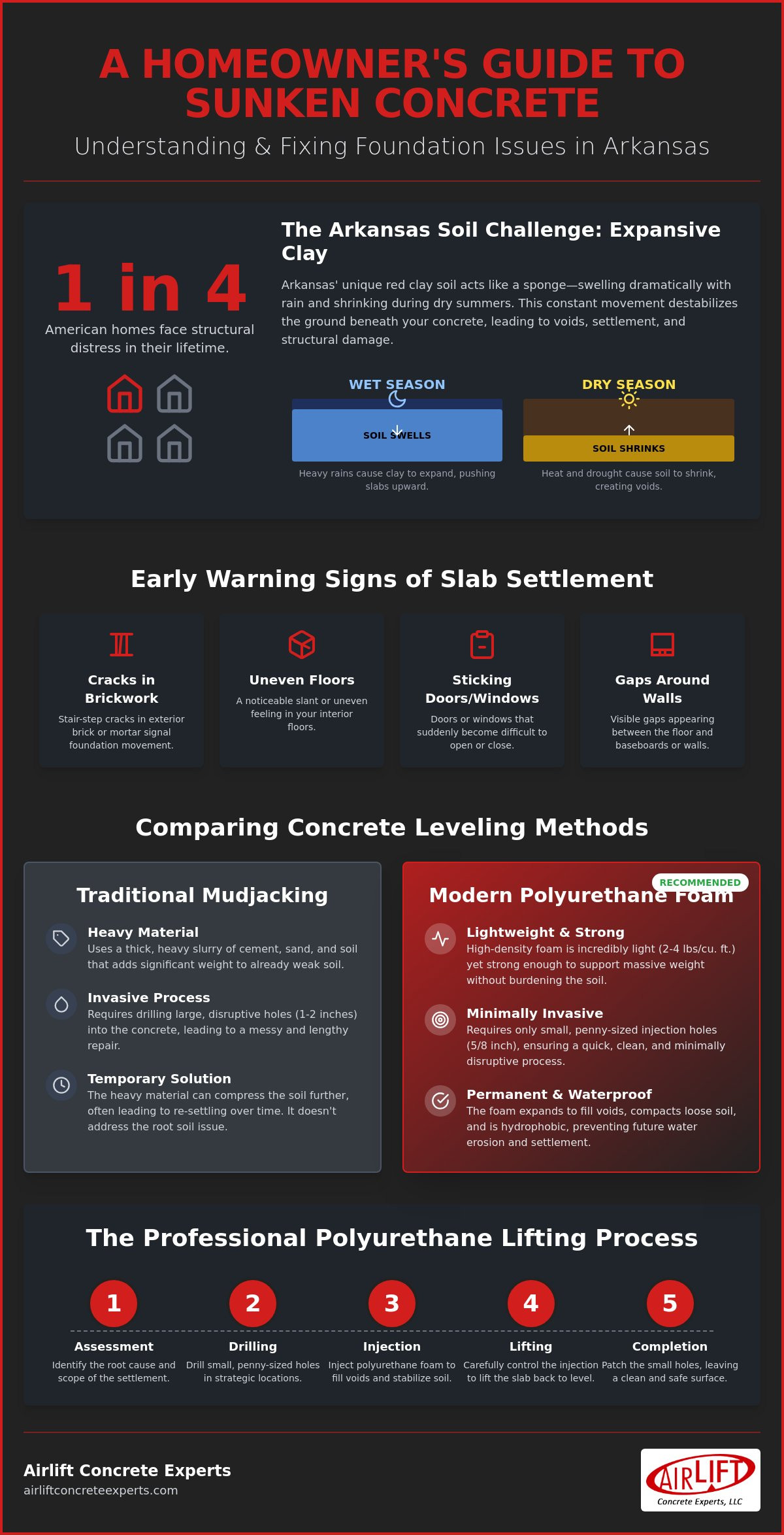
Understanding the steps involved in a professional repair can transform your anxiety into a sense of security. The process is remarkably efficient and designed to respect your time and property. It begins with a professional assessment where a local expert examines the specific drainage patterns and soil conditions around your home. Once we identify the voids, we prepare the site with surgical precision. Unlike traditional methods that require heavy machinery, our setup is compact and minimally invasive, ensuring your landscaping remains undisturbed throughout the sunken slab foundation repair.
The technical execution follows a methodical four-step sequence:
One of the most significant benefits of modern polyurethane technology is the rapid turnaround time. While new concrete takes days to cure and traditional mudjacking material remains soft for hours, polyurethane foam reaches 90% of its full strength within 15 to 30 minutes of injection. This means your daily routine isn’t put on hold. In most cases, you can park your car on a repaired driveway or host a gathering on your pool deck the very same day. This immediate return to service makes it the most convenient option for busy Arkansas families.
Local knowledge is the secret to a permanent repair. A specialist who understands the unique behavior of soil in Malvern or Little Rock knows exactly how to space the injection grid to account for local clay density. This expertise ensures the lift is even and the subgrade is fully stabilized. Using specialized equipment and following professional foundation repair standards guarantees that the job is done right the first time. If you’re ready to secure your home’s future, you can schedule your complimentary assessment today to see how our team can restore your concrete surfaces with precision and care.
Airlift Concrete Experts has built a reputation as the definitive local authority for homeowners facing the stress of structural instability. As a family-owned business founded in 2017, we treat every project like we’re working on a neighbor’s home. We don’t just see a cracked driveway or a dipping pool deck; we see a homeowner’s hard-earned investment that needs protection. By choosing specialized sunken slab foundation repair, you’re opting for a solution that prioritizes long-term durability over a quick cosmetic fix. A stabilized foundation is the only way to ensure that your property remains safe and retains its market value in our challenging regional climate.
Waiting to address settlement issues only leads to more complex problems. What starts as a minor trip hazard on a sidewalk can eventually evolve into significant structural failure that affects your home’s entire frame. We encourage you to take a proactive stance. Our team focuses on “repair, not replacement,” which often saves you significant time and money compared to traditional construction methods. We provide the technical expertise of a large-scale contractor with the personal touch of a local specialist.
We’re proud to serve our neighbors across Central Arkansas, including communities in Cabot, Conway, Benton, and Bryant. Our deep understanding of the local “Arkansas Factor” allows us to provide more accurate and effective results than national competitors who might not understand our specific clay densities. We believe in transparency and straightforward communication. This is why we offer a complimentary initial assessment for every local resident. This no-pressure evaluation helps you understand exactly what’s happening beneath your concrete so you can make an informed decision about your home’s maintenance.
Getting your property back to a level, safe condition is a straightforward process. It begins with a thorough site inspection where we map out the necessary lift points and provide a clear explanation of the work required. Once scheduled, most sunken slab foundation repair projects are completed in a single day, leaving you with a surface that’s ready for immediate use. Reminding yourself that a level slab is a safer, more valuable home can help turn the stress of repair into the satisfaction of a job well done. You don’t have to live with the anxiety of shifting concrete. Contact Airlift Concrete Experts for your free assessment today and let us provide the permanent stability your Arkansas home deserves.
Addressing a dipping driveway or a cracked patio doesn’t have to be a source of constant anxiety. You now know that the expansive clay soils in Central Arkansas are often the culprit, but modern technology provides a permanent way out. By choosing high-density polyurethane injection over messy, heavy alternatives, you’re investing in a lightweight solution that stabilizes the ground without the risk of re-settlement. This process ensures your property remains safe, level, and valuable for years to come.
Airlift Concrete Experts has been family-owned and operated since 2017, providing specialized sunken slab foundation repair to our neighbors in Little Rock, Malvern, and throughout Central Arkansas. We pride ourselves on being the local authority that understands our region’s unique structural challenges better than anyone else. Our team is dedicated to restoring your property with precision and care.
Don’t let a small settlement issue turn into a major structural failure. You can Schedule Your Free Foundation Assessment Today to get a clear, professional look at your concrete’s condition. We’re here to help you restore your peace of mind and the stability of your home.
The cost of repairing concrete surfaces depends on the size of the slab and the volume of material required to fill the underlying voids. While specific project totals vary, industry data for the South-Central region suggests that polyurethane injection typically costs significantly less than total concrete replacement. Most homeowners find that lifting their existing slab is a more cost-effective alternative to the disruptive process of demolition and pouring new material.
Yes, polyurethane concrete leveling is considered a permanent solution because the material is chemically inert and waterproof. Unlike traditional soil or grout, high-density foam doesn’t wash away during Arkansas’s heavy rain cycles. The foam remains stable beneath the slab for decades, providing a rigid support structure that isn’t affected by moisture or temperature changes. It effectively stops the cycle of settlement by filling the empty pockets that caused the initial drop.
A sinking exterior slab can definitely lead to interior wall cracks if it’s physically connected to your home’s main foundation. When a heavy patio or porch pulls away from the structure, it creates tension that can shift the wall studs and drywall inside. You might notice diagonal cracks near door frames or windows as the house settles into the new gap. Addressing sunken slab foundation repair early prevents these cosmetic issues from becoming major structural repairs.
The primary difference lies in the weight and precision of the materials used. Mudjacking uses a heavy slurry of sand, cement, and soil that can weigh over 100 pounds per cubic foot, often causing the ground to sink further. Polyjacking uses a lightweight, high-density foam that expands to fill voids without adding significant weight to the soil. Polyjacking also requires much smaller injection holes, leaving a cleaner finish on your property.
Professional foam injection is designed to be minimally invasive and is safe for surrounding landscaping and underground utilities. Because the equipment is compact, there’s no need for heavy trucks to drive across your lawn. The foam expands along the path of least resistance, filling empty voids without putting undue pressure on healthy pipes. Technicians use a strategic grid to ensure the lift is controlled and doesn’t interfere with your home’s infrastructure.
You can typically drive on your driveway within 15 to 30 minutes after the injection process is finished. High-density polyurethane cures almost instantly, reaching nearly its full strength before our technicians even leave your property. This is a massive advantage over new concrete, which requires several days of curing time before it can support the weight of a vehicle. Your daily routine remains largely uninterrupted during the repair.
Ignoring a sunken slab leads to worsening trip hazards, increased liability risks, and potential water damage. The voids beneath the concrete act as funnels for rainwater, directing moisture toward your home’s foundation and accelerating soil erosion. Over time, a simple sunken slab foundation repair can turn into a complex structural failure requiring expensive piering. Proactive maintenance protects your home’s value and prevents small cracks from turning into a total property emergency.

 Call Now