
Replacing your entire driveway might seem like the only way to fix those dangerous tripping hazards, but for most Arkansas homeowners, that massive expense is actually the less effective choice. It’s stressful to watch your property value dip as your concrete sinks, and even more confusing when you’re trying to decode different contractor quotes. You deserve a repair that stands up to our state’s expansive clay soil without the headache and mess of a full demolition.
This guide explores the real-world factors that influence polyurethane concrete leveling cost in 2026, helping you understand why this method remains the most cost-effective alternative to replacement. We’ll look at the technical reasons why high-density foam provides a permanent fix and provide the transparency you need to make an informed decision for your home. By the end of this article, you’ll know exactly what determines the price of a stable, level surface that’s designed to last for decades.
Polyurethane concrete leveling is a precision repair method that utilizes high-density, structural foam to lift and stabilize sunken slabs. When you’re evaluating the polyurethane concrete leveling cost, it’s helpful to view the project through the lens of long-term value. While traditional concrete leveling techniques like mudjacking might appear cheaper on an initial quote, they often fail to address the underlying soil issues prevalent in Arkansas. Mudjacking uses a heavy slurry that can actually cause further sinking over time. In contrast, polyjacking provides a lightweight repair that typically lasts over 20 years. This makes it a much smarter investment than a temporary patch that requires frequent re-intervention.
While our focus is on Arkansas homeowners, this advanced technology is utilized by top professionals nationwide. For instance, Foundation Werks provides these same high-performance concrete repair services to property owners throughout the Dallas metropolitan area.
Procrastination is often the most expensive mistake a homeowner can make. If you ignore sunken concrete, the problem won’t resolve itself. As water continues to wash out the soil beneath your slab, the void grows larger and more unstable. A larger void requires a greater volume of foam to fill and lift, which inevitably increases your final repair bill. Catching a settling driveway or sidewalk early keeps the scope of work manageable and protects your property value from the steep decline associated with structural neglect.
Most professional contractors in Central Arkansas require a minimum project fee to cover mobilization. This base price accounts for the specialized equipment, high-tech rigs, and the expert crew needed to perform the work safely. If you have just one small sidewalk slab that needs attention, the price might seem high relative to the size of the area because the crew still has to bring the entire setup to your driveway. You can maximize your value by bundling multiple repairs into a single visit. We recommend looking around your property for a sinking pool deck, a tilting patio, or a gap under your garage floor. Adding these smaller areas to a larger project often results in a significantly lower cost per square foot, giving you the most benefit from the mobilization fee.
Deciding between lifting and replacement depends entirely on the structural condition of your concrete. If the slab is mostly intact but has simply settled or tilted, it’s a prime candidate for polyurethane leveling. This method usually costs between 50% and 70% less than a full tear-out and pour. Beyond the financial savings, lifting is much faster. You can drive on a leveled surface within minutes, whereas new concrete requires days of curing time and creates a massive construction mess in your yard.
However, if your concrete looks like a spider-web of deep, interconnected cracks, it has likely lost its structural integrity. In those specific cases, foam cannot hold the crumbling pieces together, and replacement is the only safe route. For most Arkansas homeowners, catching the problem early ensures they stay on the lifting side of that 50% rule, saving thousands of dollars while restoring safety to their property.
While many homeowners assume that square footage is the only metric that matters, the truth is that the polyurethane concrete leveling cost depends on several hidden variables. The most significant factor is void volume. This is the actual amount of empty space that has developed beneath your concrete due to soil erosion or settlement. Because we can’t see through the slab, the volume of foam required to fill that gap and provide a stable base is the primary cost driver. A slab that has dropped four inches will naturally require more material than one that has only settled an inch.
Slab thickness and weight also play a major role in your final estimate. A standard residential sidewalk is much lighter than a heavy-duty driveway or a commercial warehouse floor. Heavier slabs require higher-density foam to generate the necessary lifting force and maintain long-term stability. Accessibility is another consideration; our crew can easily reach a front walkway, but a confined interior floor or a pool deck with limited equipment access may require more labor. Additionally, travel time to regional areas like Hot Springs or Cabot can influence mobilization fees, as we bring our specialized rigs directly to your site.
The underlying cause of these issues often relates back to Soil health and function. When Arkansas soil loses its ability to manage moisture correctly, it either shrinks away or washes out entirely, leaving your concrete unsupported and prone to cracking.
Residential projects like driveways and pool decks usually focus on restoring safety and curb appeal. Commercial lifting, however, involves much higher stakes. We often work on high-traffic warehouse floors that must support the weight of forklifts and heavy machinery. These commercial jobs typically use a ‘per-pound’ pricing model. This ensures total transparency, as the client pays specifically for the weight of the specialized load-bearing foam injected under the slab to meet specific structural requirements.
It’s vital to understand that not all polyurethane is created equal. Some contractors might use cheaper, low-density ‘insulation’ foam that lacks structural integrity. We use specific high-density polyurethane designed for the unique environmental challenges of Arkansas. This structural foam is hydrophobic, meaning it won’t wash away during our heavy spring rains. It creates a permanent, waterproof barrier that protects your investment for years to come. If you’re ready to see how these factors apply to your specific project, you can request a complimentary initial assessment to get a clear picture of your property’s needs.
Choosing the right repair method often feels like a balancing act between your immediate budget and the long-term stability of your home. When you evaluate the polyurethane concrete leveling cost, it’s helpful to compare it against the two extremes: traditional mudjacking and full replacement. Replacement is undoubtedly the most expensive route. It involves noisy demolition, the cost of hauling away heavy debris, and the high price of a new concrete pour. Mudjacking sits at the bottom of the price scale, but its lower upfront cost often masks a variety of technical shortcomings that can lead to higher expenses later.
Polyjacking acts as the “Goldilocks” solution for Arkansas property owners. It provides a mid-range price point while offering the highest level of durability and precision. Unlike other methods, high-density foam doesn’t just lift the concrete; it stabilizes the environment beneath it. This prevents the cycle of sinking and shifting that plagues so many driveways in our region. By investing in a modern solution, you’re choosing a repair that is designed to last for decades rather than a temporary patch that might fail after the next heavy storm season.
Traditional mudjacking has several drawbacks that aren’t immediately obvious on a contractor’s quote. The primary issue is weight. The sand and cement slurry used in mudjacking weighs approximately 100 pounds per cubic foot. In the soft clay soils common across Central Arkansas, adding this massive weight to an already failing subgrade can actually accelerate soil compaction. This often causes the slab to sink even further than it did originally. Furthermore, the injection holes required for mudjacking are large, usually around two inches in diameter. These leave unsightly, circular patches that are difficult to hide. Because the slurry is prone to erosion from groundwater, many homeowners end up paying for a second repair within a few years, making the total polyurethane concrete leveling cost much more attractive in hindsight.
Your time has a specific financial value, especially if a sinking slab is blocking access to your garage or a commercial storefront. Concrete replacement requires significant “down-time,” as new pours typically need 7 to 28 days to cure before they can handle the weight of a vehicle. This means weeks of parking on the street or losing business revenue. Polyjacking eliminates this frustration entirely. Our high-density foam reaches 90% of its full load-bearing capacity in as little as 15 to 30 minutes. You can have your driveway leveled in the morning and park your car on it before lunch. This immediate return to service ensures your daily routine remains uninterrupted, providing a level of convenience that replacement simply cannot match.
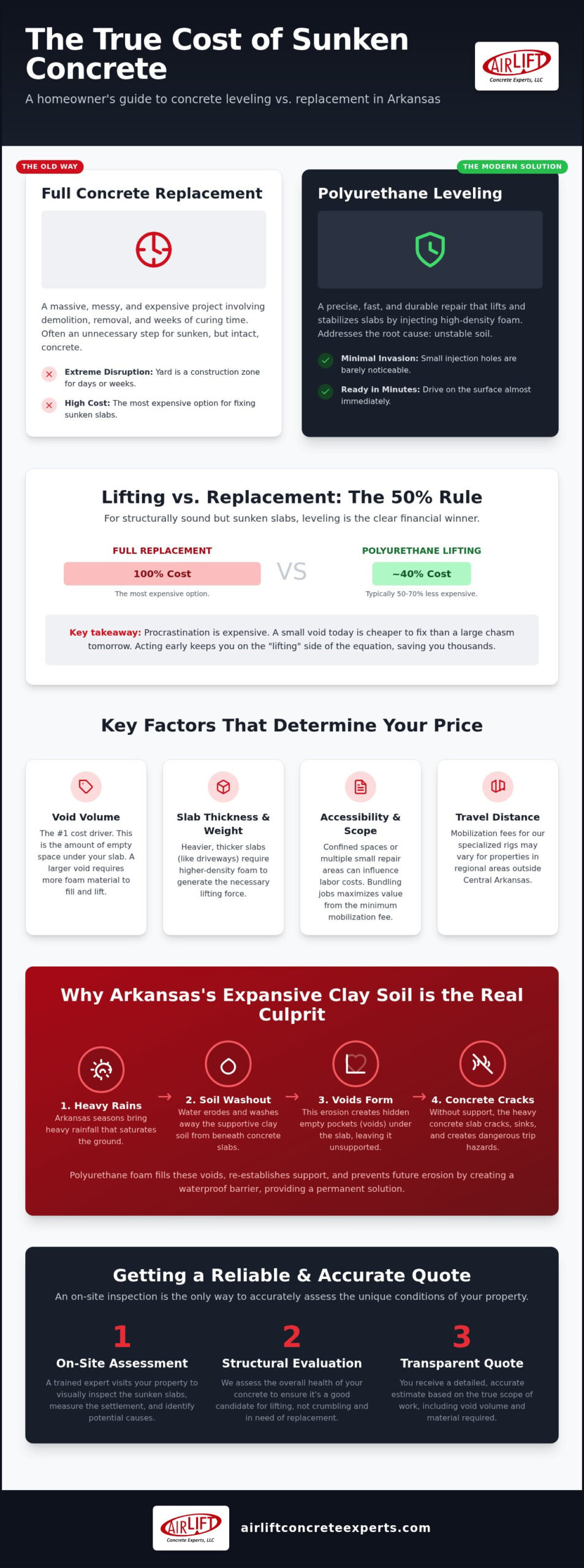
The ground beneath your feet in Central Arkansas isn’t as stable as it might appear. When calculating the polyurethane concrete leveling cost, we have to look closely at the geology of your specific property. Our region is famous for its expansive red clay. This soil behaves like a sponge; it swells significantly when it’s saturated by our heavy spring rains and shrinks drastically during summer heatwaves. This constant movement creates a “shrink-swell” cycle that leaves concrete slabs unsupported, leading to the sinking and cracking that many homeowners in Little Rock and Malvern face every year.
Traditional mudjacking often fails in these conditions because the slurry is made of heavy, porous materials. When the clay beneath a mudjacked slab shrinks, that heavy patch can actually pull the concrete down further. Polyurethane foam offers a technical advantage because it’s hydrophobic. It doesn’t just lift the slab; it creates a waterproof barrier that prevents future soil washout. By sealing the underside of the concrete, the foam keeps water from reaching the vulnerable soil, protecting your investment from the recurring damage caused by Arkansas weather.
During a typical Arkansas heatwave, the sun pulls every drop of moisture out of the clay. As the soil pulls back, it leaves gaps where there used to be solid support. High-density foam is the ideal solution for this because it’s incredibly lightweight. It provides the necessary structural lift without adding the massive weight that causes further compaction in softened clay. Professional polyurethane concrete leveling is the best defense against clay-based settling.
Environmental factors vary greatly depending on where you live. In older neighborhoods throughout Little Rock, mature tree roots often grow beneath driveways, drinking up the moisture and accelerating soil shrinkage. In areas with poor natural drainage, heavy runoff can quickly carve out large voids under sidewalks and patios. We focus on the specific geology of Central Arkansas properties to ensure our repairs account for these local variables. We often recommend simple drainage improvements alongside our leveling services to ensure the polyurethane concrete leveling cost remains a one-time investment. If you’ve noticed your concrete shifting after a storm, it’s time to schedule a visual soil assessment with our local team to identify the root cause before the damage spreads.
Getting a “ballpark” figure over the phone might feel convenient, but it often leads to frustrating budget surprises once a crew actually arrives on-site. Because every slab in Central Arkansas sits on a unique patch of clay or fill dirt, a visual, on-site inspection is the only way to determine a reliable polyurethane concrete leveling cost. We believe in transparency, which means we need to see the specific degree of the drop, the condition of the surrounding soil, and any potential drainage issues that could undermine the repair. A physical assessment allows us to calculate the exact volume of high-density foam required, ensuring your quote is accurate and final.
During an Airlift Concrete Experts assessment, our specialist will walk your property to identify the root cause of the settlement. We don’t just look at the sunken concrete; we look at the environment around it. You can prepare for this visit by clearing vehicles or patio furniture from the affected area and identifying where water typically pools during our heavy Arkansas rainstorms. This information helps us design a stabilization plan that addresses both the immediate trip hazard and the long-term health of your property’s foundation.
Investing in your home’s structural integrity should come with peace of mind. That’s why we stand behind our work with a comprehensive warranty that protects your cost-investment for years to come. Unlike DIY kits or temporary mudjacking patches, our professional-grade polyurethane is designed to remain stable regardless of seasonal moisture changes. We treat every project as if it were on our own property, focusing on a repair that restores both safety and long-term value.
When you meet with an estimator, don’t hesitate to ask about the technical details of the repair. You should inquire about the specific density of the foam being used and why it’s the right choice for your particular slab type. Ask about the “hole pattern” as well; one of the biggest benefits of polyjacking is that we use penny-sized injection holes that are barely visible once sealed. Finally, feel free to check for our references in local cities like Conway, Benton, or Bryant. We take pride in our regional reputation and want you to feel confident that you’re partnering with a neighbor who understands our local ground conditions.
Ready to restore your sunken driveway or pool deck? The process is straightforward and designed to be stress-free. After you schedule your complimentary initial assessment, we provide a detailed quote that outlines the scope of work and the total project price. Most repairs are completed in just a few hours, and you can return to full traffic almost immediately. If you are searching for polyjacking near me, our team is ready to provide the local expertise you need. Contact us today to secure your property and eliminate those tripping hazards for good.
Investing in your home’s safety shouldn’t be a guessing game. We’ve explored how the polyurethane concrete leveling cost is shaped by the unique geology of Central Arkansas and why high-density foam is the most durable answer to our state’s shifting red clay. By choosing a specialized repair over a full replacement, you’re saving time, money, and the structural integrity of your property. Since 2017, Airlift Concrete Experts has helped homeowners across the region transform sinking slabs into safe, level surfaces using specialized high-density polyurethane technology that stands the test of time.
Ready to eliminate those tripping hazards? Request Your Free Professional Concrete Leveling Estimate Today. Our team provides no-obligation structural assessments to give you the transparency you need before any work begins. We’re proud to serve our neighbors with honest advice and reliable results. Let’s work together to protect your home’s value for decades to come.
Polyjacking is a superior investment because it addresses the root cause of settlement in Arkansas’s challenging red clay. While mudjacking uses a heavy slurry that can cause more sinking, high-density foam provides a lightweight, waterproof base that won’t wash away. Choosing this modern method ensures you don’t have to pay for the same repair again in a few years. It’s the most reliable way to secure your property’s value and safety.
Every driveway is unique, so the final estimate depends on the depth of the settlement and the size of the voids underneath. While we don’t provide flat rates without an inspection, the polyurethane concrete leveling cost is consistently much lower than the price of tearing out and replacing the entire slab. A visual assessment is the only way to get a precise quote tailored to your specific driveway’s condition and soil health.
DIY foam kits are generally not recommended for the heavy structural lifting required on Arkansas properties. These retail products often use low-density foam that lacks the compressive strength to support a concrete slab or withstand local soil movement. Professional rigs use specialized equipment to heat and mix structural-grade polyurethane, ensuring a repair that actually lasts. Cutting corners with a kit often leads to more expensive professional repairs later.
Most reputable contractors have a minimum mobilization fee to cover the expense of bringing specialized equipment and a professional crew to your site. This base price ensures that even small jobs receive the same high-quality structural foam and technical precision as large commercial projects. You can often get better value by bundling several smaller repairs, such as a sidewalk and a patio, into one single visit to maximize the crew’s time.
Standard homeowners’ insurance policies typically don’t cover concrete leveling because they view settlement as a maintenance issue or “earth movement.” However, every policy is different. You should review your documents or speak with your agent to see if you have specific riders. In some cases, if the sinking was caused by a covered event like a sudden pipe burst, you might find some assistance with the polyurethane concrete leveling cost.
Polyurethane leveling is a permanent solution that is designed to last for the remaining lifespan of the concrete. The foam is hydrophobic, meaning it won’t break down or wash away when exposed to groundwater or heavy rain. Because it doesn’t add significant weight to the soil, it prevents the secondary settlement that often plagues older repair methods. It’s a one-time investment in the stability and safety of your home.
For larger residential or commercial projects, we recommend discussing payment options during your initial consultation. While we focus on providing the most cost-effective repair through modern technology, every property owner’s financial needs are different. A visual assessment is the best time to discuss the scope of work and how it fits into your budget. We prioritize transparency and straightforward communication to ensure there are no surprises during the repair process.
If our technicians discover a larger void than initially anticipated, it may require a greater volume of material to ensure a stable lift. The price of polyjacking is directly related to the amount of foam injected beneath the slab. We use high-tech sensors to monitor the lift in real-time, ensuring we use exactly what’s needed to support the concrete without wasting material. This precision helps keep your project as efficient and affordable as possible.

 Call Now