
On a humid Tuesday in Little Rock, a homeowner noticed a hairline crack in their drywall that had expanded by 4 millimeters since the previous summer. This subtle shift is often the first warning sign that the state’s notorious red clay soil is moving beneath your feet. You likely already know that Arkansas soil is unpredictable; it expands when saturated and shrinks during our 100 degree August days. It’s natural to feel a sense of anxiety when doors begin to stick or floors start to slope. Investing in professional foundation repair is the most effective way to transform that structural worry into long term security for your family.
This guide explains how specialized local techniques protect your property from the specific geological challenges found across the Natural State. You’ll learn why modern solutions like polyjacking offer more durability than outdated methods and how a clear, 20 point inspection process removes the confusion surrounding repair options. We will walk through the functional differences between piering and mudjacking to ensure you gain the peace of mind that comes with a stable, level home and a transferable warranty.
Professional foundation repair is far more than a cosmetic patch for a few unsightly cracks. It’s a permanent structural intervention designed to stabilize your home against the volatile earth beneath it. In Central Arkansas, the ground is rarely still. Homeowners in Little Rock and Malvern often contend with “Arkansas Red Clay,” a type of expansive soil that acts like a sponge. When the weather is wet, the clay expands with immense force; when it dries, it shrinks away, leaving voids that cause your home to sink. Generic repair kits or quick-fix mortar applications fail because they don’t address this underlying geological instability. To truly protect your investment, you need a solution that accounts for the unique behavior of local soil.
The high plasticity of Arkansas soils creates a constant challenge for slab-on-grade foundations. Plasticity refers to the soil’s ability to change volume based on moisture levels. By 2026, climate patterns in the region have shown an increase in rapid shifts between heavy precipitation and intense dry spells. This volatility accelerates the rate of foundation settlement. In Saline and Pulaski County, geological benchmarks indicate that soil can exert thousands of pounds of pressure against a basement or crawl space wall when saturated. Understanding these types of foundations and how they interact with local clay is the first step in a successful professional foundation repair strategy.
You don’t always need to go under the house to see that something is wrong. In Arkansas brick homes, the most common red flag is a “stair-step” crack pattern following the mortar lines between bricks. This suggests the ground is moving unevenly. If you live in Conway or Cabot, you might notice that your windows have started sticking or your doors won’t latch properly. These aren’t just signs of an aging house; they’re often the result of a shifting slab. Differential settlement is the uneven sinking of a structures footprint. When one corner of your home drops while the others remain stable, the frame twists, leading to the following symptoms:
At Airlift Concrete Experts, we’ve spent years studying these local soil patterns. We know that a lasting professional foundation repair requires more than just lifting a house; it requires stabilizing the soil-to-structure relationship. We treat every home like it belongs to a neighbor, providing clear explanations and reliable results that stand up to the Arkansas climate.
Choosing the right method for professional foundation repair depends on whether the issue lies in the deep soil or the surface slab. Arkansas homeowners often face shifting clay soils that cause significant structural settlement. To address these movements, experts utilize two primary categories of repair: mechanical underpinning for deep structural support and chemical injection for surface-level lifting. Each method serves a specific purpose in restoring the integrity of a home.
When a home experiences severe structural failure, helical or push piers are the industry standard. These steel supports are driven deep into the earth until they reach stable, load-bearing strata. In central Arkansas, this often means bypassing 15 to 25 feet of expansive clay to hit bedrock or dense sand. This method provides the highest load-bearing capacity, often supporting tens of thousands of pounds per pier. For homeowners dealing with sinking perimeter walls, consulting residential foundation contractors in Little Rock ensures the piers are installed to the exact torque requirements needed for permanent stability.
For concrete slabs, polyurethane foam injection represents the modern evolution of professional foundation repair. This process involves drilling small, 5/8-inch ports into the concrete and injecting a high-density resin. The foam expands rapidly, filling voids and lifting the slab with surgical precision. Because the material is hydrophobic, it won’t wash away during heavy Arkansas rainstorms. This makes it a superior choice for stabilizing pool decks and driveways in Hot Springs, where soil erosion is a frequent concern.
The choice between these methods usually comes down to the level of disruption and the specific structural goal. While both are effective, they solve different problems:
If you’re noticing new cracks in your brickwork or a garage floor that seems to be sinking, don’t wait for the problem to expand. Getting a free structural inspection from a local specialist can help you determine if your home needs the deep support of steel piers or the precision of foam injection.
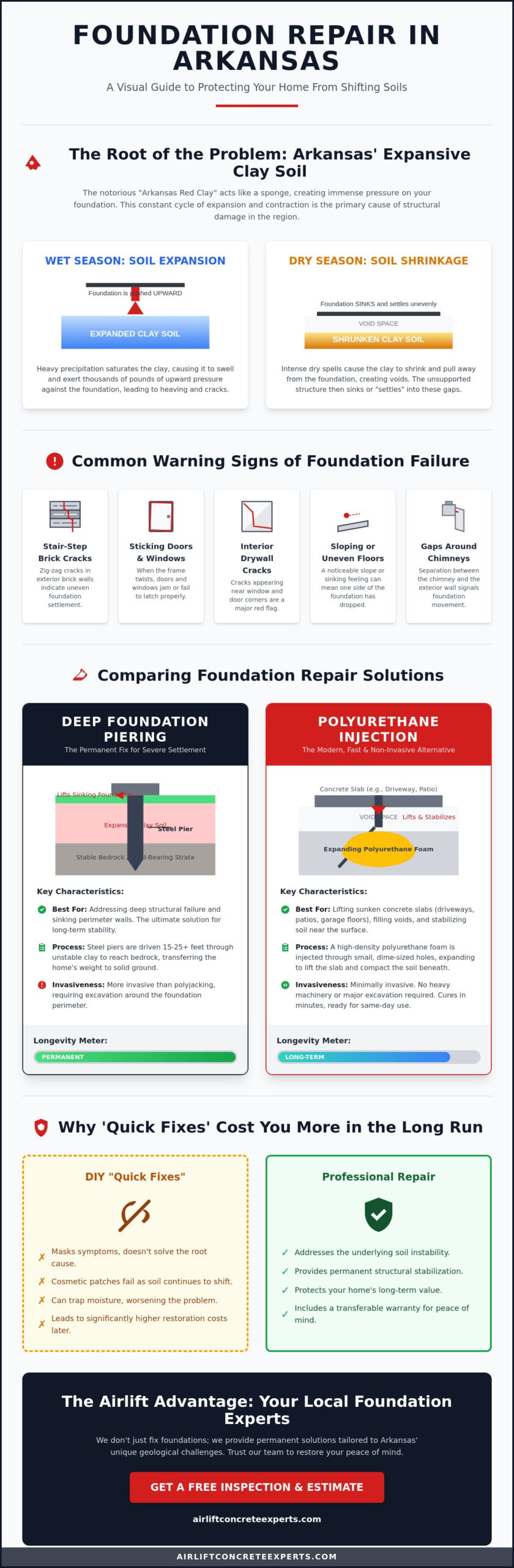
Homeowners often feel the urge to grab a tube of epoxy or a bag of concrete patch when they first spot a crack in the garage floor. It’s a natural reaction to try and save money. However, these retail products are cosmetic bandages, not structural solutions. Surface patching fails to address the underlying soil settlement that caused the damage in the first place. If the ground continues to shift, that rigid epoxy will simply snap or pull away from the slab. This creates a false sense of security while the real danger remains hidden. Ignoring the root cause often leads to secondary issues like ruptured sewer lines. A single broken plumbing stack can cost over $5,000 to excavate and replace, making the initial savings of a DIY kit a very expensive mistake.
The climate in Central Arkansas presents unique challenges for standard hardware store sealants. Relative humidity levels in the region frequently exceed 75 percent during the summer months. This heavy moisture prevents DIY bonding agents from curing correctly, which causes most surface patches to peel or flake away within 120 days. Beyond the weather, these patches don’t provide any lifting force. They fill the gap but leave the foundation in its sunken, unstable position. While a DIY kit might cost under $100, it lacks the long-term ROI of pro foundation repair. Choosing a permanent fix ensures your home stays level and protects your equity against future structural failure.
Achieving a level foundation requires precision that goes far beyond a standard bubble level. Experts use specialized tools to ensure the house is stabilized without causing further damage. This professional-grade approach includes:
Safety is the most critical factor when moving thousands of pounds of concrete. Attempting to lift a slab without professional engineering oversight can lead to catastrophic structural failure or personal injury. Professional foundation repair is a verified investment in the home’s resale value, often preventing a 15 percent reduction in market price during a home inspection. Our team uses modern polyjacking techniques to stabilize the soil and lift the structure, providing a permanent solution that local Arkansas homeowners can trust for years to come.
Arkansas homeowners face unique challenges with highly expansive clay soils that shift significantly between wet and dry seasons. Selecting a partner for professional foundation repair requires more than just checking a price tag. You need a contractor with a verified Arkansas contractor’s license, comprehensive liability insurance, and at least 10 years of experience working specifically with Central Arkansas soil profiles. Out-of-state franchises or “storm chasers” often lack this local context. They might apply generic solutions that fail when the next drought hits the region.
A professional inspection report should be transparent and detailed. It acts as a diagnostic tool rather than a sales pitch. It should identify the root cause of the movement, whether it is poor drainage, tree root intrusion, or natural soil consolidation. One of the most critical factors for long-term value is the transferable warranty. In the 2026 real estate market, a foundation warranty that transfers to the next owner is a major selling point. It provides the buyer with the security that the home is structurally sound.
Choosing from the numerous foundation repair companies near me involves asking direct questions. A professional contractor provides a no-pressure inspection. This means they explain the mechanics of the settlement without using scare tactics. Use this checklist during your interviews:
A professional quote is a roadmap for your home’s stability. It must include a detailed soil analysis and a map of specific pier or injection points. If a project involves significant structural shifts, look for an engineering stamp. This ensures the plan meets specific Arkansas building codes and safety standards.
Be cautious of the lowest bid. In foundation work, the cheapest quote often indicates a “patch” rather than a permanent solution. Effective professional foundation repair requires high-grade materials, such as specialized polyjacking resins or steel piers that reach load-bearing strata. A comprehensive proposal also includes a cleanup plan, ensuring your property is restored to its original state once the stabilization is complete.
Ready for a clear, honest assessment of your home? Schedule a free inspection with Airlift Concrete Experts today.
Airlift Concrete Experts operates with a simple, Arkansas-grown philosophy: treat every home as if it were our own. We aren’t a national franchise following a generic script. We are local specialists who understand the unique clay soils and shifting terrain of the Natural State. Our team has built a reputation in Malvern and across Central Arkansas for providing professional foundation repair that lasts. We focus on permanent solutions rather than temporary patches, ensuring your structural integrity is restored with precision and care.
Choosing a local partner means you’re working with people who value the community. We’ve seen how foundation failure causes stress for families. Our goal is to replace that anxiety with confidence. We use a methodical approach to evaluate every crack and slope. This ensures we address the root cause of the settlement rather than just the visible symptoms. When we step onto your property, you’re getting more than a contractor; you’re getting a neighbor dedicated to keeping Malvern’s homes safe and stable.
Traditional repair methods often involve heavy machinery and weeks of disruption. We’ve modernized the industry by utilizing advanced polyjacking technology. This process is incredibly clean and efficient. We inject high-density polyurethane foam through holes no larger than a penny. This foam expands to fill every void beneath your slab, providing a lift that is both lightweight and permanent. Most of our repairs are completed in a single day. You won’t have to worry about destroyed flower beds or torn-up lawns. If you’ve been looking for polyjacking near me, our specialized equipment provides a surgical level of accuracy that older methods simply can’t match.
A damaged foundation is more than a nuisance; it’s a financial risk. Real estate industry data indicates that foundation issues can reduce a property’s market value by 10% to 15%. We provide a free, honest inspection to help you stay ahead of these risks. Our technicians don’t use high-pressure sales tactics. We provide a clear, technical assessment of your home’s needs. Reaching a state of peace of mind starts with knowing your foundation is level and secure. Don’t let small cracks turn into structural failures. We’ve helped hundreds of families secure their homes, and we’re ready to do the same for yours. Schedule your free professional foundation inspection with Airlift today!
Your home relies on the stability of the soil beneath it. Choosing professional foundation repair means moving beyond temporary patches to address the unique clay and silt profiles found across Little Rock and Malvern. Whether your structure requires deep-driven piering or specialized polyurethane injection technology, the goal is always permanent stabilization. Relying on DIY fixes often leads to recurring settlement issues that can compromise your home’s structural integrity over time. It’s better to address these symptoms early before they lead to more complex damage that requires extensive intervention.
Airlift Concrete Experts brings over 7 years of local Arkansas experience to every project we handle. As a family-owned and operated team based right here in Malvern, AR, we understand how our regional weather patterns impact your slab or crawl space. We use specialized polyurethane injection technology to lift and level concrete with precision, ensuring a solution that lasts. You shouldn’t have to worry about the safety of your family or the value of your investment when the ground shifts. We’re here to provide the technical expertise and neighborly service you expect from a local specialist.
Get Your Free Foundation Inspection from Airlift Concrete Experts and take the first step toward a stable, worry-free home today.
You need professional foundation repair when cracks exceed 1/8 inch in width or appear in a stair-step pattern across exterior brickwork. While hairline cracks might be simple concrete shrinkage, gaps that allow a nickel to pass through indicate active structural movement. Our team identifies these issues during a free inspection to ensure your Arkansas home remains stable. We focus on long-term durability rather than temporary surface fixes that hide underlying soil problems.
Standard Arkansas homeowners insurance policies typically exclude structural stabilization unless the damage resulted from a covered peril like a burst pipe. Data from the National Association of Insurance Commissioners shows that 95 percent of policies don’t cover earth movement or gradual settlement. We recommend reviewing your specific policy riders or contacting your agent to see if you’ve added earthquake or sinkhole endorsements. These specific additions are often the only way to secure coverage for soil-related issues.
Most structural restoration projects in the Little Rock or Alexander areas take between 1 and 3 days to complete. Small residential jobs involving 5 to 8 piers are often finished in a single afternoon. Larger projects requiring extensive polyjacking or structural stabilization may extend to 72 hours. We prioritize minimizing disruption to your daily routine while ensuring the soil is properly stabilized. This efficient timeline prevents the project from dragging on for weeks like traditional methods.
It’s possible for new hairline cracks to appear or existing ones to shift as the home returns to its original position. This occurs because the drywall and framing adjusted to a settled state over several years. We monitor the lift carefully to minimize this stress. Our goal is to restore structural integrity, which provides a stable base for any subsequent cosmetic repairs. Restoration ensures your home’s frame is level before you invest in new interior finishes.
Professional polyjacking uses a lightweight, high-density expanding foam, while traditional mudjacking relies on a heavy slurry of sand and cement. Polyjacking requires 5/8-inch drill holes, which are 75 percent smaller than the 2-inch holes needed for mudjacking. This modern method cures in 15 minutes. It provides a permanent, waterproof solution that won’t wash away during the heavy rainfall common in Arkansas. This ensures your concrete stays level for decades without adding excessive weight to the soil.
You can sell an Arkansas home with a history of foundation issues, provided you disclose the repairs and provide transferrable warranties. According to Arkansas Real Estate Commission disclosure requirements, all structural repairs must be documented for the buyer. Homes with certified professional foundation repair often retain their full market value. Buyers feel more secure when they see a warranty from a local expert who understands our regional soil conditions and has permanently resolved the instability.
Ignoring foundation settlement leads to compounding structural damage that can increase repair costs by 50 percent within 24 months. Untreated gaps allow moisture to enter, which compromises your home’s energy efficiency and invites pest infestations. Small cracks eventually turn into shifted door frames and broken utility lines. Early intervention through a free inspection is the most cost-effective choice for protecting your property’s value. Taking action now prevents a localized issue from becoming a total structural failure.

 Call Now