
Did you know the warehousing sector faces an injury rate of 4.8 cases per 100 workers, which is nearly double the private industry average? In Jefferson County, the risk is often right under your feet. You likely already see the signs: forklift tires jarring over uneven joints or employees navigating subtle tripping hazards. When you need warehouse floor repair Pine Bluff facility managers can trust, you’re usually caught between the urgent need for safety and the fear of a week-long production shutdown.
We understand that every hour your floor is out of commission impacts your bottom line. This article explains how industrial-grade polyurethane leveling restores your slab’s structural integrity and meets 2026 OSHA standards without the lengthy cures required by new concrete. You’ll discover how we address the specific challenges of Pine Bluff’s silty loam soils to provide a high-load solution that keeps your machinery moving safely. We will walk through the technical benefits of soil densification and show you how a methodical, modern repair process secures your facility for the long term.
Warehouse floor failure isn’t always a dramatic collapse. It often begins as a subtle shift in how your equipment handles. In Pine Bluff, this might look like a forklift vibrating more than usual at a joint or a pallet jack catching on a slight lip. When we talk about floor failure, we’re describing sinking slabs, joint spalling, or the “rocking” effect where a slab physically moves under a heavy load. Ignoring these early warnings leads to a cycle of expensive equipment repairs and increased safety liabilities for your team.
The Jefferson Industrial Park and surrounding areas face unique challenges due to our regional geography. When your concrete loses its uniform support, the repetitive weight of 5,000-pound forklifts turns small gaps into major structural voids. This isn’t just an aesthetic issue. It’s a functional breakdown that compromises your facility’s efficiency. Identifying the specific symptoms of failure early is the first step toward a permanent solution for warehouse floor repair Pine Bluff managers can rely on.
Vertical displacement at your floor joints creates small “steps” that are brutal on forklift tires. If your operators report a jarring thud every time they cross a specific line, the slab has likely settled. You might also notice hollow sounds when heavy machinery passes over certain areas, indicating that sub-slab voids have formed. Cracks radiating from support columns or high-traffic loading dock areas are clear signals that the floor can no longer support the weight above it. These symptoms are common in facilities requiring concrete leveling techniques to restore a flush, safe surface.
Pine Bluff’s location near the Arkansas River means our local industrial sites sit on complex alluvial soils. These silty loams and clays are prone to moisture fluctuations. When the river levels rise or seasonal rains saturate the ground, the soil expands; when it dries, it shrinks. This constant movement creates pockets of air beneath your concrete. Because traditional patches only address the surface, they’ll inevitably fail if the underlying “active soils” remain unstable. Repetitive heavy loads accelerate this process by “pumping” the loose soil out through cracks or joints. Securing a professional warehouse floor repair Pine Bluff specialist is the only way to address these deep-seated soil issues before they lead to OSHA violations or fleet damage.
Standard concrete repairs often fail because they treat the symptom rather than the source. In a high-traffic environment, you need a material that does more than just sit on the surface. We utilize high-density polyurethane foam, a specialized material engineered specifically for industrial-grade performance. This isn’t the same product used in residential driveways; it’s a high-compressive-strength solution designed to withstand the relentless pressure of heavy manufacturing and logistics operations. When considering warehouse floor repair Pine Bluff businesses often find that traditional methods fall short under industrial stress.
The injection process is methodical and precise. We drill small, non-invasive holes into the affected slab and inject the liquid polymer directly into the voids identified during our assessment. As the material travels, it undergoes a chemical reaction that causes it to expand and harden. This expansion doesn’t just lift the concrete. It aggressively densifies the underlying soil, turning loose silt or clay into a stable, reinforced foundation. This process is particularly effective for the moist conditions found near the Arkansas River, as the foam is entirely waterproof. It won’t wash away or erode, providing a permanent barrier against future soil loss caused by warehouse cleaning or external runoff.
Surface-level patches or epoxy fillers are temporary Band-Aids. They don’t account for the empty space beneath the concrete that causes the slab to flex and crack in the first place. Our approach focuses on structural restoration. The high-density polyurethane expands to fill 100% of sub-slab voids, creating a fully supported surface that eliminates the risk of rocking or further settlement. By addressing the root cause, we ensure your floor remains compliant with OSHA safety standards and free from the tripping hazards that lead to workplace injuries.
The compressive strength of industrial polyurethane is its most significant advantage. While traditional mudjacking uses a heavy slurry of sand and cement that adds more weight to already failing soil, polyurethane is lightweight yet incredibly strong. It maintains its structural integrity even under constant vibration and the massive weight of loaded forklifts. Effective warehouse floor repair Pine Bluff facilities require must address the structural integrity of the soil itself. Our team at Airlift Concrete Experts can help you determine the best approach for your facility through a professional evaluation of your floor’s load-bearing needs. This modern method ensures that once your floor is level, it stays level for the long haul.
Every hour your production line stops or your loading dock closes, your bottom line takes a hit. In a 24/7 logistics environment, traditional floor repairs often feel like a trade-off between safety and productivity. Polyjacking changes that equation by focusing on “time-to-traffic.” Unlike traditional methods that require days of curing, our high-density foam reaches 90% of its full compressive strength within minutes of injection. This speed allows your team to resume operations almost immediately after we finish the work.
For warehouse floor repair Pine Bluff facility managers often fear the “rip and replace” cycle. Tearing out old concrete creates clouds of silica dust, requires heavy jackhammers, and leaves behind piles of debris that can contaminate your inventory. Our process is significantly cleaner. We use small, 5/8-inch injection holes that are roughly the size of a penny. This minimal footprint means we can work in specific zones or aisles while the rest of your facility stays active. You don’t have to shut down your entire operation to fix a single sinking slab.
Choosing the right restoration method depends on your operational needs. This comparison highlights why concrete lifting is the logical choice for modern industrial efficiency.
Maintaining these surfaces is a requirement under OSHA safety standards, which mandate that all walking-working surfaces be kept in good repair and able to support their intended load. Polyjacking meets these standards without the week-long closures that cripple regional supply chains.
Our methodical approach ensures precision and stability. We begin by drilling a series of small holes in a strategic grid pattern across the settled slab. We then inject the polyurethane foam, carefully monitoring the lift with laser levels. This allows us to achieve a level surface to within 1/10th of an inch, eliminating the tiny lips that cause forklift tires to wear prematurely. Once the slab is level and the sub-soil is densified, we seal the injection holes with a color-matched cementitious grout. Our equipment rigs are compact and self-contained, meaning we won’t block your loading docks or interfere with your fleet’s movement during the process. It’s a straightforward, professional solution for warehouse floor repair Pine Bluff businesses can utilize to stay on schedule.
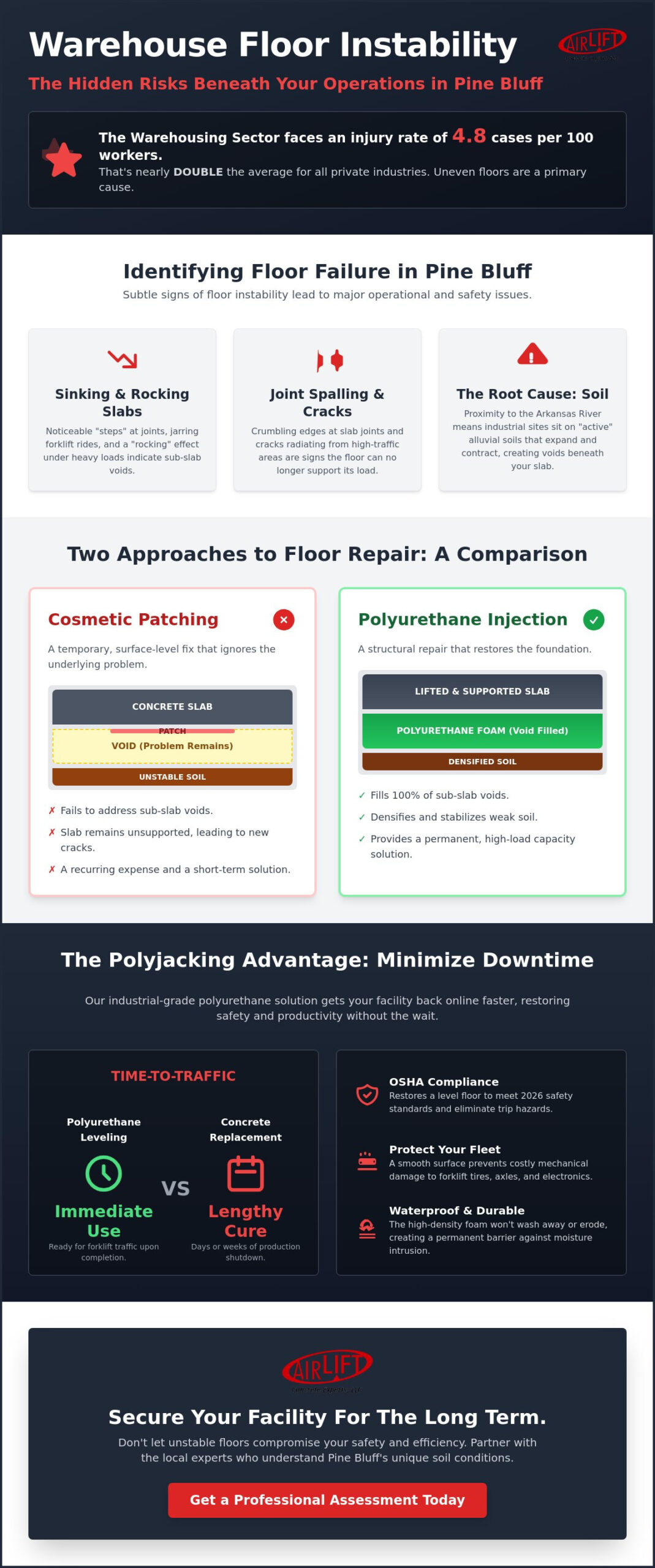
Investing in your facility’s floor isn’t just a maintenance task; it’s a strategic move for your bottom line. In Pine Bluff, where the warehousing and transportation sector faces an injury rate of 4.8 cases per 100 workers, safety is a primary operational concern. OSHA has increased its enforcement priorities for 2026, focusing heavily on walking-working surfaces and overall warehousing operations. A single willful violation can now result in fines exceeding $165,514. When you prioritize warehouse floor repair Pine Bluff facility managers can effectively eliminate the tripping hazards and uneven surfaces that lead to these costly penalties and worker compensation claims.
Beyond legal compliance, level floors provide a direct return on investment through fleet protection. Forklifts and pallet jacks are designed for flat surfaces. When these machines constantly travel over “steps” or rocking slabs, their suspensions, axles, and tires take a beating. The jarring impact of a 5,000-pound load hitting a quarter-inch lip causes premature mechanical wear that wouldn’t occur on a stabilized floor. By addressing these issues now, you shift your budget from expensive emergency repairs and fleet downtime to predictable, preventive maintenance.
Joint failure often begins with “curling” or rocking, where the slab moves vertically as weight passes over it. This movement is the primary cause of joint spalling, where the edges of the concrete break away and create debris. Our polyurethane injection process stops this movement by filling the voids underneath, providing a solid foundation that prevents the slab from flexing. Industry professionals often report that stabilizing these uneven joints can extend the life of industrial tires by up to 30%, as it eliminates the constant grinding and impact they endure on failed surfaces.
Uneven floors are frequently a symptom of larger environmental issues in the Arkansas River Valley. Because the soil beneath your slab is connected to the ground beneath your walls, slab settlement can signal broader stability concerns. In industrial steel buildings, a sinking floor can put undue stress on support columns, potentially leading to wall cracks or structural misalignment. Integrating your floor maintenance with professional foundation repair ensures that your entire facility remains structurally sound from the ground up. Addressing these issues early prevents a localized floor problem from evolving into a building-wide crisis.
Don’t let a settling slab compromise your facility’s safety or your equipment’s lifespan. Contact our team to schedule a complimentary initial assessment and ensure your warehouse meets the highest standards of structural integrity and operational efficiency.
At Airlift Concrete Experts, we don’t just provide a service; we act as a dedicated regional partner for the industries that drive Jefferson County’s economy. Our deep roots in Arkansas give us a specific perspective on the environmental pressures affecting local facilities. When you choose us for warehouse floor repair Pine Bluff, you’re working with a team that understands the specific challenges of the Arkansas River Valley’s alluvial soil. We’ve spent 12 years refining our methods to ensure our high-load solutions meet the rigorous demands of modern logistics and manufacturing. We take pride in being the local authority that businesses turn to when they need a reliable, long-term fix rather than a temporary patch.
We’ve invested in specialized, high-capacity equipment designed specifically for commercial-scale lifting. This isn’t a scaled-up residential approach; it’s a dedicated industrial system capable of raising massive slabs and stabilizing heavy machinery bases. Our history includes successful projects involving grain bins, expansive warehouses, and complex industrial slabs across the state. As a family-owned, Arkansas-based specialist, we treat our customers like neighbors. We understand that transparency is vital when addressing high-stress structural issues, which is why we provide clear, technical explanations for every step of the repair process. Our A+ rating with the Better Business Bureau as of June 2026 reflects this commitment to honest, professional service that Pine Bluff businesses can depend on.
Getting started is a methodical process designed to minimize your administrative burden. During our initial site visit, we conduct a thorough technical evaluation to identify the root cause of your slab settlement. We look beyond the surface cracks to map the sub-surface voids and soil instability mentioned earlier. Following this assessment, we develop a customized repair plan tailored to your facility’s specific shift schedules and traffic patterns. We can coordinate our work in phases to ensure your loading docks remain operational during your peak hours. This flexibility allows you to address safety hazards without sacrificing your production targets. Our goal is to transform your structural anxiety into a sense of security through a predictable and professional restoration process.
Contact Airlift Concrete Experts today for a free warehouse floor evaluation.
Your warehouse floor is the foundation of your entire operation. Moving away from temporary surface patches toward specialized high-density polyurethane technology ensures that your facility can handle the high-load demands of modern industry. By addressing the root cause of slab settlement and void formation, you protect your forklift fleet and maintain full compliance with 2026 OSHA safety standards. This proactive approach to warehouse floor repair Pine Bluff managers trust turns a potential liability into a long-term asset.
Airlift Concrete Experts has served the region since 2017. Our deep Arkansas roots mean we understand the environmental challenges unique to our local landscape. We’re here to help you transform structural anxiety into operational confidence with minimal disruption to your production schedule. Take the first step toward a safer, more efficient workplace today.
Request Your Free Warehouse Floor Assessment to receive a complimentary initial structural evaluation from our specialized team. We look forward to helping you stabilize your facility for the years ahead.
Most industrial repairs are completed within a single business day. The injection process is remarkably fast, and the foam reaches its full compressive strength in approximately 15 to 30 minutes. This efficiency allows our team to address large sections of your facility without the extended downtime or logistical headaches associated with traditional concrete work.
Yes, heavy machinery can typically resume normal traffic within 30 minutes of the final injection. Because the industrial-grade polyurethane cures almost instantly, your operators don’t have to wait days for the material to harden. This rapid “time-to-traffic” advantage is why many regional facilities choose this method to maintain their rigorous 24/7 shift schedules.
Absolutely, the high-density foam we utilize is engineered specifically to withstand the extreme compressive loads of manufacturing environments. It provides a stable, permanent base for heavy racking systems and high-capacity equipment. The material aggressively densifies the soil below, creating a reinforced foundation that maintains its structural integrity even under constant vibration and massive weight.
No, the polyjacking process is remarkably clean and generates negligible debris compared to demolition. We only need to drill small, 5/8-inch holes, which are roughly the size of a penny, to deliver the polymer. This non-invasive approach is ideal for food-grade storage or sensitive electronics warehouses where silica dust contamination would be a significant hazard.
The silty loam and clay soils common in the Arkansas River Valley are prone to erosion and moisture-driven movement. These conditions often lead to the sub-slab voids that cause concrete to sink or “rock” under pressure. Our warehouse floor repair Pine Bluff services include soil densification, which stabilizes these local soil types to prevent future settlement and erosion.
Concrete leveling is significantly more cost-effective than a total “rip and replace” project. You save by avoiding the high labor costs of demolition, the expense of new materials, and the massive financial hit of a week-long facility shutdown. It’s a high-value solution that restores your floor’s function and safety at a fraction of the cost of new construction.
Yes, we specialize in stabilizing rocking slabs by filling the air pockets that cause the concrete to shift. Loading docks are high-stress zones where repetitive heavy traffic often “pumps” out the underlying soil over time. Our injection process restores 100% contact between the slab and the ground, stopping the movement and preventing the joint failure that damages forklift tires.
Yes, we provide specialized leveling for grain bin foundations and other agricultural concrete structures throughout Jefferson County. Our high-load polyurethane is perfectly suited for the immense weight of filled bins. We understand the local agricultural landscape and offer the technical expertise needed to stabilize these critical storage facilities and ensure they remain level and secure.

 Call Now