

What if you could restore your home’s structural integrity without turning your living room into a dusty construction site for weeks? Most homeowners feel a sudden jolt of anxiety when they notice a new crack in the drywall or realize the kitchen floor isn’t quite level anymore. These aren’t just cosmetic issues; they are signs that your home is settling into the shifting Arkansas clay. You might worry that the only fix involves expensive demolition and massive disruption to your family’s daily life. Fortunately, modern foundation slab lifting has evolved into a clean, precise science that respects your time and your property.
We understand how stressful structural issues can be, especially when you’re trying to protect your biggest investment. This guide explains how high-density polyurethane foam injection provides a permanent, non-invasive solution to sunken concrete. You’ll learn why this advanced method is superior to traditional repairs, how the process works in as little as 15 to 30 minutes of cure time, and how a professional assessment can help you achieve long-term peace of mind for your home’s foundation.
Foundation slab lifting is a specialized engineering process used to raise and stabilize concrete floors that have drifted from their original, level position. Instead of the costly and messy alternative of tearing out old concrete, we use pressurized injection to fill the empty spaces beneath your home. This method restores the slab’s elevation and provides a solid base that prevents future movement. For many homeowners in the Little Rock metro area, this isn’t just a home improvement project; it’s a necessary step to protect the structural integrity of their largest investment.
While some people use the term “settling” to describe a sinking floor, the reality is often more active. In Arkansas, our foundations face unique environmental pressures. Most slab failures occur because the soil beneath the concrete can no longer support the weight of the structure. This happens for three primary reasons: soil shrinkage during droughts, erosion from heavy rainfall, or poor soil compaction during the original construction. Understanding these factors is the first step toward a permanent fix.
The “Red Clay” found throughout Central Arkansas is notoriously expansive. It acts like a sponge, swelling significantly when wet and shrinking during our hot, dry summers. This constant cycle creates voids, or hollow pockets, directly beneath your foundation. When the soil pulls away, the heavy concrete slab loses its support and begins to sag into the empty space. Because 72% of homes in the United States rely on concrete slab foundations, this is a widespread challenge that requires a professional approach to soil stabilization.
It’s important to distinguish between a simple cosmetic floor crack and a structural failure. While a hairline crack in a garage floor might be common, other signs indicate your home needs foundation slab lifting to remain safe. You should monitor your property for these specific indicators:
When you notice these symptoms in cities like Conway or Hot Springs, it’s a sign that the foundation slab lifting process is needed to stop the movement before it affects the rest of the house. Addressing these issues early prevents the damage from spreading to your drywall, roofing, and plumbing systems.
Modern structural repair shouldn’t feel like a demolition project. At Airlift Concrete Experts, we’ve refined the polyjacking method to be as non-invasive as possible. This approach to foundation slab lifting uses high-density polyurethane foam that expands with incredible force while remaining remarkably lightweight. Because our equipment is self-contained in our specialized trucks, we don’t need to drive heavy machinery across your lawn or move bulky gear through your home. It’s a “stealth” repair that delivers structural stability without the typical construction mess.
The speed of this process is one of its greatest benefits. Unlike traditional concrete repairs that can take days to dry, our polyurethane foam reaches nearly 90% of its full strength in just 15 to 30 minutes. This means you can walk on your floors or park your car on your driveway almost immediately after we finish the job. We focus on providing a solution that minimizes disruption so you can get back to your normal routine with a level, stabilized home.
The process begins with precision. Our team drills a series of small, penny-sized injection ports into the sunken concrete in a strategic grid pattern. These holes are significantly smaller than the large gaps required for older repair methods, which helps maintain the original strength of your slab. We then inject the two-part liquid polymer through these ports. As the liquids mix, they undergo a chemical reaction that turns them into a rigid, high-density structural foam.
During the injection phase, we monitor the slab’s movement with advanced laser levels. This allows us to see even the smallest fraction of an inch of lift in real-time. Once the slab reaches the desired elevation, we remove the injection equipment and seal the ports with a specialized concrete grout. The result is a nearly invisible finish that blends into your existing floor or driveway. If you’re concerned about specific cracks in your home, requesting a professional assessment is the best way to determine the exact injection points needed for your property.
Homeowners often ask why we prefer polyurethane over traditional mudjacking slurry. The primary reason is weight. Mudjacking uses a heavy mixture of sand, cement, and soil that can weigh upwards of 100 pounds per cubic foot. In the expansive clay soils of Little Rock and Conway, adding that much extra weight can actually cause the ground to sink further over time. In contrast, our high-density foam weighs only 2 to 5 pounds per cubic foot, providing the necessary lift without overburdening the soil.
Durability is another critical factor. Polyurethane is naturally hydrophobic, meaning it won’t absorb water or wash away during Arkansas’s heavy spring rains. Once it cures, it becomes a permanent part of your home’s infrastructure that isn’t susceptible to erosion. This precision expansion allows us to achieve millimeter-accurate leveling, ensuring your doors latch perfectly and your floors feel solid underfoot once again.
Choosing between traditional mudjacking and modern foundation slab lifting with polyurethane is a decision that affects your home’s stability for decades. While mudjacking has been used for years, it relies on a heavy mixture of water, dirt, and cement. This slurry often weighs over 100 pounds per cubic foot. In contrast, high-density foam weighs only 2 to 5 pounds per cubic foot. When you add thousands of pounds of heavy mud to already weak Arkansas soil, you often create a cycle of secondary settlement where the repair itself causes the ground to sink even further.
Speed is another major differentiator. Mudjacking requires large, heavy hoses and a significant amount of water, often leaving a messy residue on your property. The slurry can take 24 to 72 hours to fully cure, during which time the area is unusable. Polyjacking is a much cleaner, faster alternative. Because the foam expands and hardens almost instantly, the entire process usually takes just a few hours from start to finish. It’s the difference between a major construction project and a precise surgical intervention.
In communities like Malvern and Little Rock, we’ve seen many homeowners regret choosing mudjacking after just a few seasons. The primary issue is erosion. Since mudjacking slurry is essentially a soil-based product, it’s susceptible to the same forces that caused the original settlement. Heavy rains can wash the material out from under the slab, leaving you right back where you started. The large injection holes required for mudjacking also weaken the concrete slab more than the penny-sized ports used in modern foam injection. This makes mudjacking an increasingly obsolete technology for those looking for a permanent structural fix.
Polyurethane foam offers a level of durability that traditional materials simply can’t match. It’s an inert material that won’t leach chemicals into your yard or contaminate the local groundwater. Once injected, it creates a waterproof seal beneath your concrete, effectively protecting the underside of the slab from moisture and future erosion. While the initial investment for foam is typically higher than mudjacking, the long-term value is clear. You aren’t just filling a hole; you’re stabilizing the environment beneath your home. For more technical details on how this works in our region, you can explore our resources on polyjacking near me to see how we handle specific local soil conditions.
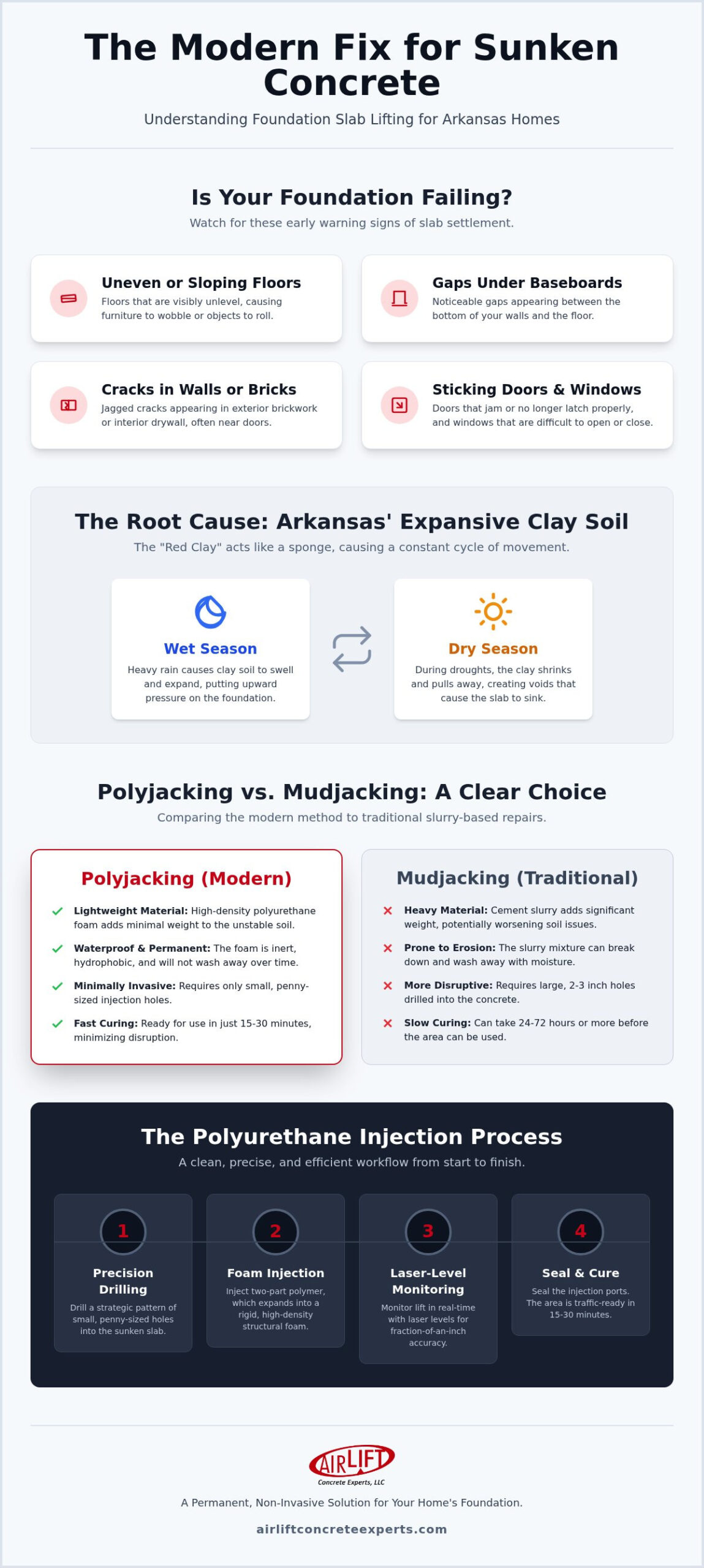
Arkansas soil isn’t just dirt; it’s a dynamic force that constantly challenges residential foundations. The “Red Clay” prevalent in Central Arkansas is technically known as expansive soil. This means it changes volume significantly based on its moisture content. When it rains heavily in Little Rock or Conway, the clay expands and pushes upward on your slab. When the summer heat hits Hot Springs, the soil dries out and shrinks, leaving your foundation unsupported. This relentless cycle is the primary reason homeowners eventually require foundation slab lifting to correct sunken interior floors or uneven garage slabs.
Local expertise is vital because the geological strata vary significantly across our service area. A home built near the Arkansas River Valley sits on different sediment than one perched in the Ouachita Foothills. We’ve spent years studying these regional shifts to provide repairs that actually last. Without this localized knowledge, a contractor might treat the symptom without understanding the underlying soil behavior. Understanding how the ground moves in your specific neighborhood is the only way to ensure a permanent fix.
During the wet seasons, the clay acts like a massive underground sponge. This creates a “heave” effect, where the pressure from the expanding soil can actually lift parts of a slab-on-grade foundation unevenly. When the dry season follows, the soil pulls away and leaves the voids that lead to settlement. Fluctuations in Arkansas soil moisture levels directly create the physical stress that manifests as structural cracks in your home’s foundation and walls.
In Bryant and Benton, we often see unique settlement patterns where one corner of a home sinks while the rest remains stable. This is frequently due to the transition between different soil types in the region. In North Little Rock, many residential slabs suffer from poor drainage that accelerates this process. When water pools near the foundation, it saturates the clay and weakens its load-bearing capacity. This makes the soil too soft to hold the weight of the concrete, leading to the need for foundation slab lifting to restore the home’s level.
Maintaining proper drainage is your first line of defense. Ensuring gutters are clear and downspouts direct water at least five to ten feet away from your home can slow down soil erosion. However, once the soil has shifted and the slab has dropped, professional intervention is the only reliable solution. If you’ve noticed your floors aren’t level or doors are sticking, you can schedule a free structural assessment with our team to identify the root cause of your settlement issues.
When you’re facing structural issues, you need more than just a contractor; you need a partner who understands the ground beneath your feet. Airlift Concrete Experts is a family-owned and operated specialist that has served Central Arkansas since 2017. We’ve built our reputation on being the premier professional foundation repair partner for homeowners from Little Rock to Benton. Because we live and work in the same communities as our customers, we treat every project with the same care and precision we’d use on our own homes. We focus exclusively on expert repair, which allows us to dedicate all our resources to mastering the science of polyurethane injection.
Our approach to foundation slab lifting is rooted in technical excellence and transparent communication. We don’t believe in high-pressure sales tactics or flashy marketing gimmicks. Instead, we offer a complimentary structural assessment to provide you with a clear, honest explanation of your home’s needs. During this visit, our technicians use precision diagnostic tools to identify the exact cause of your settlement and design a repair plan that offers long-term structural peace of mind. We stand behind our work with a commitment to permanent solutions, ensuring your property remains stable long after we’ve finished the injection process.
Whether it’s a sunken kitchen floor or a massive warehouse foundation, we have the specialized equipment to handle the job. Our team excels in commercial concrete lifting for businesses across Malvern and Little Rock, where minimizing downtime is a top priority. On the residential side, we focus on interior floor leveling and garage slabs to eliminate trip hazards and restore your property’s safety. We prioritize non-invasive methods that protect your landscaping and interior finishes while providing a permanent structural solution. This versatility ensures we can handle everything from a small patio to a large industrial floor with the same level of expertise.
Delaying structural repairs often leads to more expensive interventions as cracks spread and settlement worsens. We make it easy to protect your investment with a straightforward scheduling process for residents in Cabot, Jacksonville, or Sherwood. Our high-density polyurethane foam is designed for durability; it won’t wash away or degrade over time. By addressing your sunken slab now, you prevent secondary damage to your walls, roof, and plumbing systems. Contact Airlift Concrete Experts today for a free quote to take the first step toward stabilizing your home and reclaiming your peace of mind.
Taking action early is the most effective way to prevent minor settlement issues from becoming major structural headaches. Modern foundation slab lifting using high-density polyurethane foam offers a cleaner, faster, and more durable solution than traditional mudjacking. By choosing a method that addresses the unique challenges of Arkansas red clay without adding unnecessary weight to the soil, you’re ensuring that your home remains level and safe for years to come.
Airlift Concrete Experts has been a family-owned and operated partner for homeowners since 2017. We take pride in serving Little Rock, Malvern, and the surrounding Central Arkansas communities with advanced technology and neighborly care. You don’t have to live with sticking doors or uneven floors when a permanent, non-invasive fix is available. Our team is ready to help you restore your property’s value and your own peace of mind with a solution that’s built to last.
Schedule Your Free Foundation Assessment with Airlift Concrete Experts to get started. We look forward to helping you stabilize your home and protect your family’s future.
The total cost for structural leveling depends on the size of the sunken area and the amount of high-density foam required to stabilize the soil. While regional data from early 2026 indicates that foundation repairs in Arkansas can vary widely, the investment is almost always lower than the price of a full slab replacement. Because every home sits on a different layer of clay or sediment, we provide a detailed assessment to give you an accurate picture of the project’s scope.
High-density polyurethane is an industrial-strength material specifically engineered to support the weight of heavy concrete slabs and the structures above them. It expands with enough force to lift residential foundations while simultaneously compacting the loose soil beneath the slab. This technology is so reliable that it’s frequently used to level airport runways and interstate highways, so it’s more than capable of providing a stable base for your home.
Most residential projects are completed in just a few hours, allowing you to regain use of your space the same day. Unlike traditional methods that require days of drying time, our polyurethane foam reaches nearly 90% of its full strength in 15 to 30 minutes. You don’t have to move out or shut down your household; you can walk on the floors and move furniture back into place almost as soon as we finish the injection.
We can often perform foundation slab lifting on cracked concrete by using a strategic grid of injection ports to lift sections simultaneously. Our goal is to close the gaps and restore a level surface, though the cracks themselves will remain visible and may need a topical filler afterward. If the concrete is too fragmented to be safely lifted, we’ll provide an honest recommendation on whether the slab can be saved or if other structural interventions are necessary.
The injection ports are very small, roughly the size of a penny, and we take great care to make them as inconspicuous as possible. Once the lift is complete, we fill these holes with a specialized grout that matches the color and texture of your existing concrete. Most homeowners find that the ports are nearly impossible to spot once the grout has cured, especially in garages or under interior flooring like carpet or LVP.
Delaying a repair allows the slab to continue sinking, which puts increasing stress on your home’s entire structural frame. This movement often leads to secondary damage like broken plumbing lines, large cracks in exterior brickwork, and interior drywall failure. Addressing the issue now prevents these compounding problems and protects your home’s market value, which is much easier than trying to sell a house with known structural instability.
Most standard homeowners insurance policies don’t cover foundation repair resulting from natural soil settlement or expansive clay. However, if your slab began to sink due to a sudden peril like a major plumbing leak, you might have a valid claim. It’s a good idea to consult with your insurance agent to see if your specific policy includes any provisions for structural stabilization or soil subsidence.
Polyurethane is a permanent, waterproof solution that won’t wash away or degrade even in the wettest Arkansas seasons. Because the foam is an inert material, it doesn’t break down over time like the organic matter found in traditional mudjacking slurry. Once we’ve filled the voids and compacted the soil, the foam stays in place indefinitely, providing a durable foundation that resists the erosion and shrinking cycles of the surrounding clay.

 Call Now