
What if nearly 50% of the air you breathe in your living room actually comes from the dark, damp dirt beneath your feet? In Central Arkansas, where summer humidity often hits 90%, an open crawl space acts like a sponge for moisture. This leads to musty odors and cupping hardwood floors that can ruin your home’s interior. Investing in professional crawl space encapsulation services is the most effective way to seal out this dampness and protect your property. At Airlift Concrete Experts, we’ve seen how our unique local clay soils can trap water against your foundation, leading to wood rot and structural instability if left unaddressed.
You likely already know that a damp home feels harder to cool and costs more to maintain during a Little Rock heatwave. This 2026 guide explains how full encapsulation creates a dry, conditioned environment that lowers utility bills and preserves your home’s resale value. We’ll walk you through the technical process of installing vapor barriers and dehumidifiers specifically designed for the Arkansas climate. By the end, you’ll understand why a permanent solution is the only way to ensure lasting peace of mind for your family and your foundation.
A Crawl space encapsulation system is a comprehensive moisture management solution that transforms the area under your home from a damp, vented cavity into a clean, dry, and conditioned environment. While a basic vapor barrier involves laying thin plastic over the soil, professional crawl space encapsulation services involve sealing the entire space. This includes the floor, foundation walls, and support piers. By creating a physical barrier between your home and the earth, you prevent the soil’s natural moisture from evaporating into your floor joists.
The primary reason this matters for Little Rock residents is the “Stack Effect.” This building science principle describes how air moves upward through a house. Warm air rises and escapes through the attic, creating a vacuum that pulls cool, damp air from the crawl space into your living areas. Research from the Department of Energy indicates that as much as 50% of the air you breathe on the first floor originates in your crawl space. If that space is filled with mold spores or high humidity, your indoor air quality suffers. We believe a healthy home starts from the ground up.
Airlift Concrete Experts uses a multi-layered approach to ensure a permanent fix. The foundation of this system is a 20-mil reinforced polyethylene liner. This material is significantly thicker and more durable than the 6-mil plastic often found in older homes. It resists tears and prevents moisture vapor from penetrating the barrier. We secure the liner to the walls and piers to create a 100% airtight seal.
We also seal all foundation vents. In the humid climate of Central Arkansas, open vents allow moist air to enter, where it hits cool ductwork and condenses into liquid water. To manage internal humidity, we install a specialized crawl space dehumidifier. These units are designed to operate in low temperatures and can remove up to 100 pints of water per day; this is a capacity that standard residential units from big-box stores cannot match.
Arkansas humidity levels often exceed 70% during summer months, leading to visible symptoms in local homes. You might notice condensation dripping from your HVAC ductwork or white, powdery efflorescence on your foundation walls. In communities like Conway and Benton, many homeowners report “cupping” hardwood floors, where the edges of the boards sit higher than the center due to moisture absorption from below. A musty smell in your home is a byproduct of microbial volatile organic compounds, which are gases released by mold and bacteria thriving in damp wood. If you spot mold growth on your floor joists, it’s time to consider professional crawl space encapsulation services to protect your home’s structural integrity.
Central Arkansas presents a unique set of challenges for homeowners because of its climate and geology. In Little Rock, average morning relative humidity levels often reach 85%, creating a constant stream of water vapor that seeks out the coolest part of your home: the crawl space. This moisture doesn’t just sit there; it interacts with the region’s infamous red clay soil. This type of soil is highly expansive, meaning it swells significantly when wet and shrinks during the dry Arkansas summers.
The geography of towns like Malvern and Hot Springs adds another layer of complexity. The hilly terrain and specific soil compositions in these areas often lead to water pooling around foundations rather than draining away. When this water saturates the red clay, it creates hydrostatic pressure. This pressure exerts thousands of pounds of force against your foundation walls, leading to cracks and moisture intrusion that only professional crawl space encapsulation services can effectively stop.
Arkansas red clay loses its load-bearing capacity when it becomes oversaturated. For homes built on pier and beam foundations, this is a recipe for disaster. As the soil softens, the heavy concrete piers can begin to sink or tilt. This movement often leads homeowners to search for foundation repair near me to address sloping floors or sticking doors.
Many local homeowners believe that keeping foundation vents open will “air out” the space. In reality, this makes the problem worse. During a humid July day in Arkansas, opening vents pulls warm, wet air into a cool crawl space. This results in immediate condensation on your floor joists and plumbing. If you suspect your foundation is shifting due to these moisture cycles, a professional inspection can identify the root cause before it requires major structural intervention.
Wood is a hygroscopic material, meaning it acts like a sponge. In a damp crawl space, floor joists can quickly reach their “fiber saturation point,” which is typically around 30% moisture content. Once wood hits this threshold, it undergoes permanent structural degradation. This environment is the primary breeding ground for Arkansas mold and wood-boring insects.
Utilizing specialized crawl space encapsulation services
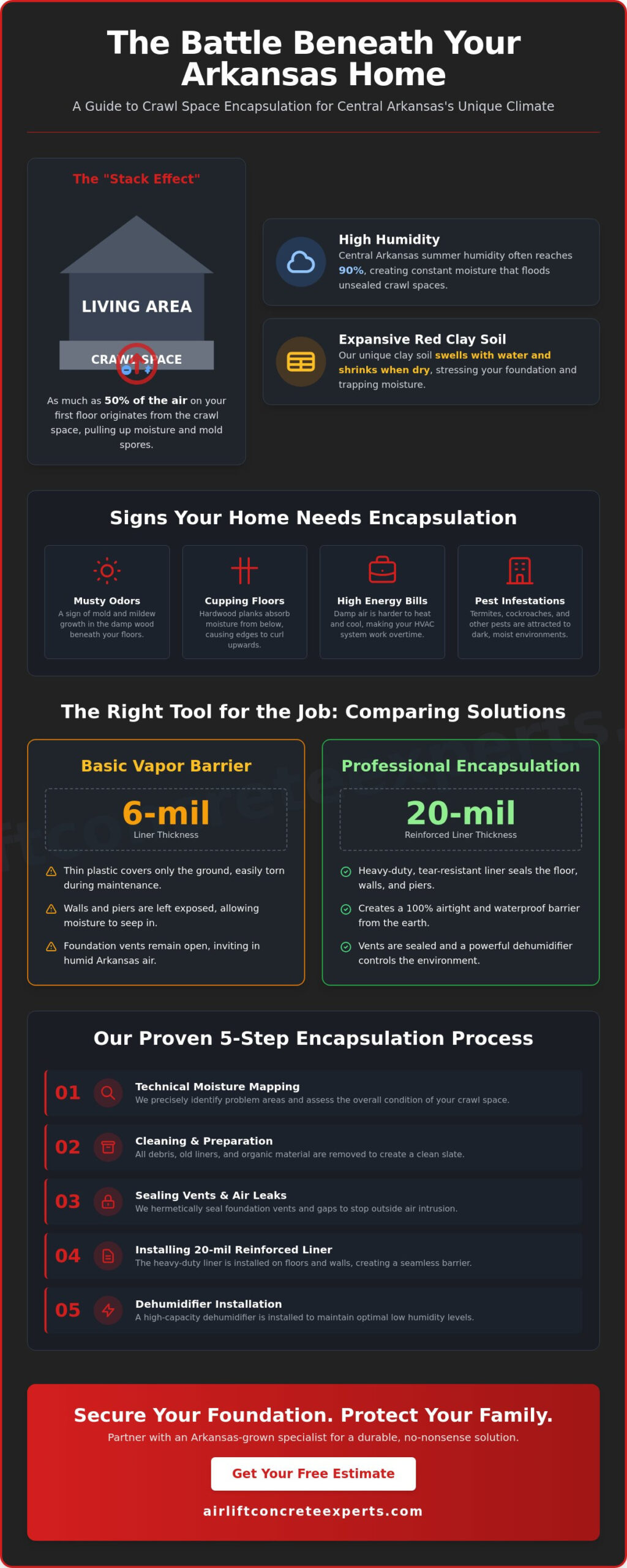
Choosing between a basic vapor barrier and full crawl space encapsulation services depends on your home’s specific needs and your long-term goals. A standard vapor barrier typically consists of a 6-mil plastic sheet laid over the ground. While this provides a temporary shield, it lacks the durability required for heavy Arkansas clay. These thin sheets often tear within 5 years and leave foundation walls exposed to rising moisture. In contrast, professional encapsulation uses a 20-mil reinforced liner that resists punctures and lasts over 25 years. This wall-to-wall approach seals every entry point for moisture, including the vents and foundation walls, creating a completely controlled environment.
In areas like Cabot and Jacksonville, high water tables make basic plastic sheets ineffective. If your home has multiple stories, a vapor barrier won’t stop the “Stack Effect.” This physical phenomenon occurs when warm air rises through your living spaces and pulls damp, unconditioned air from the crawl space into your bedrooms. DIY barriers also carry risks. If you don’t seal the edges correctly, you can trap moisture directly against your foundation. This leads to wood rot and structural decay that a simple sheet of plastic cannot prevent.
Arkansas homeowners face long, humid cooling seasons that put immense pressure on mechanical systems. Investing in crawl space encapsulation services can reduce HVAC wear by up to 25% because the unit doesn’t have to fight constant humidity. For residents in Little Rock and Conway, this translates to lower monthly utility bills and a higher resale value. If you’re flipping a house, a basic barrier might satisfy a quick inspection. However, for long-term residents, the permanent protection of encapsulation ensures the home remains structurally sound for decades. This specialized approach transforms a damp, neglected area into a clean, dry space that protects your family’s health and your largest financial investment.
Airlift Concrete Experts follows a methodical, five-step protocol to transform a damp, vented crawl space into a clean, conditioned environment. We don’t believe in shortcuts because the high humidity in Central Arkansas doesn’t allow for them. Our process ensures your home remains protected from the ground up for decades.
Before the liner goes down, we address the root causes of moisture. Proper grading and drainage are essential to keep water from pooling against the foundation. If we find that your interior support piers have shifted due to the expansive clay soils in Little Rock, we may recommend polyurethane concrete leveling to stabilize the structure before encapsulation begins. We ensure all standing water issues are resolved through sump pump installation or French drains to provide a dry canvas for the new system.
Our crawl space encapsulation services rely on precision. We don’t just lay the liner down; we use mechanical fasteners and specialized masonry anchors to secure the barrier to the foundation walls every 12 inches. Every seam is overlapped by at least 12 inches and sealed with heavy-duty waterproof tape to create an airtight bond. We carefully wrap support piers and seal around plumbing penetrations with specialized boots. To remain compliant with Arkansas building codes, we maintain a 3-inch “termite inspection strip” at the top of the foundation wall. This allows pest control professionals to verify the home’s safety without compromising the encapsulation system.
Airlift Concrete Experts doesn’t just treat symptoms; we solve the underlying structural issues that threaten your home’s value. We’ve built our reputation on understanding the specific interplay between Arkansas soil and residential foundations. Our team approaches every project with the mindset that your crawl space is the literal heartbeat of your home’s stability. By combining our deep concrete expertise with specialized crawl space encapsulation services, we provide a level of protection that general contractors simply can’t match.
We view your home as a single, integrated system. If the soil shifts, the concrete cracks, and if the crawl space retains moisture, the entire structure suffers. This comprehensive perspective is why we maintain a no-nonsense professional identity that prioritizes transparent pricing over sales gimmicks. Whether you’re in Little Rock, Hot Springs Village, or Malvern, we provide a clear roadmap for repair. Our service area covers the heart of the state, ensuring that neighbors in Benton and Bryant receive the same high-level expertise as those in the capital.
Choosing a local, Arkansas-grown specialist offers a distinct advantage over national franchises. We don’t follow a corporate manual written for a different climate. We understand the high humidity and expansive clay soils unique to our region. This local knowledge allows us to seamlessly integrate crawl space encapsulation services with advanced solutions like our polyjacking near me services. If your foundation is settling while your crawl space is rotting, we address both issues simultaneously to ensure total stability.
Don’t wait until the next humid Arkansas summer begins to address moisture issues. High humidity levels can lead to wood rot and mold growth within weeks once temperatures climb. We encourage you to schedule a free crawl space inspection today to identify vulnerabilities before they become expensive emergencies. Our goal is to protect your family’s biggest investment with permanent, specialized solutions. We treat every home like it belongs to a neighbor because, in Central Arkansas, it usually does. You deserve the peace of mind that comes from a stable foundation and a dry, healthy crawl space.
Managing the high humidity and expansive red clay of Central Arkansas requires a specialized approach to moisture control. Since 2017, Airlift Concrete Experts has provided homeowners with durable solutions that go far beyond basic plastic sheeting. Our team utilizes technical expertise in both foundation repair and concrete leveling to address the specific structural challenges caused by local soil conditions. Investing in professional crawl space encapsulation services is the most effective way to prevent wood rot and maintain your home’s value against the region’s 70% average summer humidity levels. We’re a local, Arkansas-owned company that treats every project with the care your neighbors deserve. You’ll gain peace of mind knowing your home stands on a dry, stable foundation. Don’t wait for moisture to cause permanent structural damage when a proven solution is available right here in Little Rock.
Schedule Your Free Crawl Space Inspection with Airlift Concrete Experts
We’re ready to help you protect your investment and ensure your home remains safe for your family for decades to come.
Professional crawl space encapsulation services in Arkansas typically range between $5,000 and $15,000 depending on the size and condition of the area. These figures align with 2024 national averages reported by Angi, though local soil conditions in Little Rock can impact the final investment. Our team provides a free inspection to give you a precise quote tailored to your home’s specific needs. This ensures you pay for exactly what your foundation requires.
Encapsulation alone doesn’t fix structural sagging, but it prevents the moisture that causes wood rot and floor instability. If your floors feel bouncy, it’s often because humidity levels above 60 percent have weakened your floor joists over time. We often combine encapsulation with supplemental support jacks to restore structural integrity. This two-step process addresses both the symptom of bouncy floors and the environmental cause of the wood decay.
You almost always need a dehumidifier to maintain a healthy environment after sealing the space. While a heavy duty vapor barrier stops moisture from the ground, it doesn’t account for humidity that enters through the house or small gaps. A dedicated crawl space dehumidifier keeps relative humidity below 50 percent. This prevents condensation from forming on your floor joists and protects your home from the humid Central Arkansas climate.
A standard crawl space project usually takes between two and four days to complete. The first day involves cleaning out debris and leveling the soil for proper coverage. We then install the drainage systems and the 20 mil vapor barrier on the subsequent days. Larger homes or those requiring extensive mold remediation might require a fifth day of labor. Our crew works efficiently to minimize disruption to your daily routine.
You can use your crawl space for storage once the encapsulation process is complete and the area is dry. The heavy duty white liner creates a clean, conditioned environment that’s much safer for seasonal items than a damp, dirt floor. We recommend keeping stored items away from the dehumidifier and ensuring they don’t puncture the vapor barrier. This transformation turns a wasted, dark space into a functional asset for your household.
Encapsulation can lower your monthly energy bills by 15 to 20 percent according to data from the Department of Energy. When your crawl space is sealed, your HVAC system doesn’t have to work as hard to combat the humid air rising into your living areas. This reduces wear on your equipment and keeps your home more comfortable. Many Little Rock homeowners notice these savings immediately during our hot, humid summer months.
Encapsulation is a permanent solution for mold because it removes the moisture that mold needs to grow. Mold spores thrive when the relative humidity stays above 60 percent for extended periods. By sealing out ground moisture and using a dehumidifier, we create an environment where mold cannot survive. This provides long term peace of mind for families concerned about air quality and structural health in their Arkansas homes.
Waterproofing focuses on redirecting liquid water away from the foundation, while encapsulation seals the area to control water vapor and humidity. Waterproofing involves tools like sump pumps and French drains to manage heavy rain. Encapsulation uses a thick polyethylene barrier to completely isolate the home from the earth. Most effective crawl space encapsulation services in Little Rock integrate both methods to provide total protection against both floods and humidity.

 Call Now