

A single uneven concrete slab can cost your business more in legal fees and liability claims than the entire parking lot is worth. As a business owner in central Arkansas, you’ve likely noticed how our local red clay soils cause sidewalks and warehouse floors to shift and sink over time. It’s a frustrating position to be in, especially when you’re forced to choose between a dangerous trip hazard and the week-long closure required for traditional concrete replacement. You shouldn’t have to shut your doors just to keep your property safe and accessible.
The good news is that you can eliminate these liability risks and restore structural stability in a single afternoon. This 2026 guide covers everything you need to know about commercial concrete lifting Little Rock specialists use to save companies up to 75% compared to the cost of pouring new slabs. By utilizing advanced high-density polyurethane foam, you’ll achieve perfectly leveled, ADA-compliant surfaces with almost zero downtime. We will explore the precision of “no-mess” injection technology and how it provides a permanent, waterproof solution for the unique environmental challenges of our region.
Commercial concrete lifting is a non-invasive structural repair method designed to restore the integrity of sunken or shifting slabs without the mess of demolition. Unlike traditional replacement, this process addresses the voids beneath the surface, providing a stable foundation for heavy-duty operations. For many local businesses, commercial concrete lifting Little Rock services have become the standard for maintaining safety and operational uptime. By utilizing modern concrete leveling techniques, we can raise slabs to their original position with surgical precision.
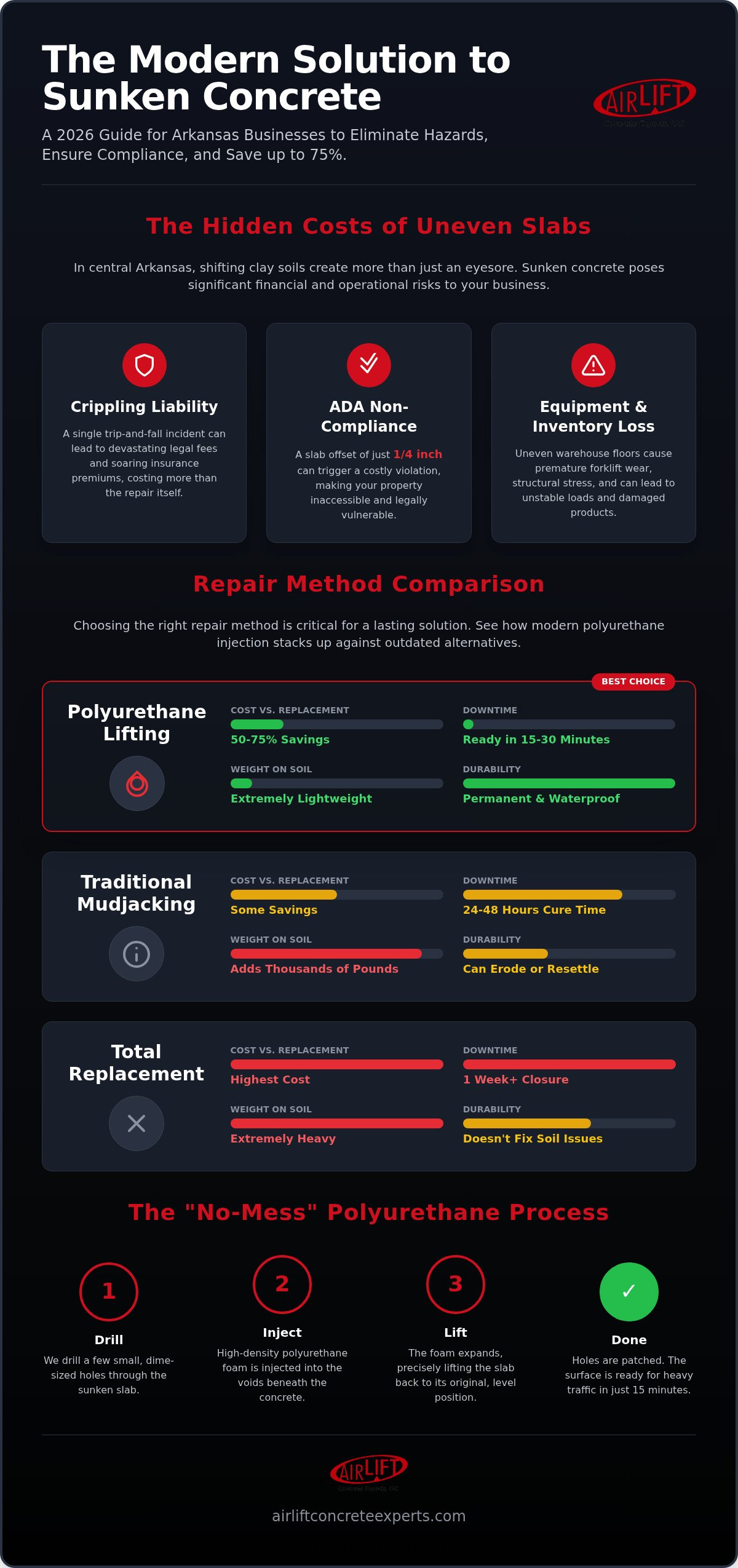
Ignoring a settling slab is a gamble that few businesses can afford. A single trip-and-fall incident on your property can lead to devastating legal fees and rising insurance premiums. The Americans with Disabilities Act (ADA) maintains strict guidelines for public walkways. Even a vertical offset as small as 1/4 inch can trigger a violation, as it creates an impassable barrier for wheelchairs and a significant hazard for pedestrians. In the eyes of the law, claiming ignorance of the problem isn’t a defense; it’s a liability.
Your storefront sidewalks, loading docks, and parking lots are the most common areas where concrete failure occurs. Little Rock’s unique climate plays a significant role in this degradation. Our region experiences intense seasonal temperature swings that cause the local red clay to expand and contract rapidly. This movement creates empty pockets under the concrete, leading to the cracks and “stair-stepping” often seen in retail parking areas. Taking a proactive approach to these repairs ensures a safe customer environment and protects your brand’s reputation as a reliable local establishment.
The damage caused by uneven concrete extends far beyond the surface. In warehouse settings, unlevel floors are a primary cause of forklift maintenance issues and safety hazards. Constant jarring from driving over uneven joints impacts your equipment in several ways:
Slab instability can also lead to long-term structural damage to the building’s walls and door frames. Maintaining level concrete preserves the value of Little Rock commercial real estate and eliminates the hidden costs of working around damaged surfaces. It’s about more than just aesthetics; it’s about the health of your bottom line and the longevity of your facility.
Choosing the right method for commercial concrete lifting Little Rock projects often comes down to a choice between traditional mudjacking and modern polyurethane injection. While mudjacking has been used for decades, it relies on a heavy slurry of sand and cement to force slabs upward. This added weight is a significant drawback in central Arkansas. High-density polyurethane foam offers a lightweight alternative that addresses the root cause of the problem without adding thousands of pounds of stress to the soil.
The science behind polyurethane is simple yet effective. Two liquid components meet at the injection tip, creating a chemical reaction that expands the material into a rigid, waterproof foam. This expansion allows for incredible precision, lifting slabs to within a fraction of an inch. Because the foam is significantly lighter than mudjacking grout, it won’t cause the secondary sinking that occurs when heavy materials compress the underlying earth even further. When you’re managing a high-traffic facility, you need a solution that stays level for the long haul.
Efficiency is another major differentiator. Mudjacking requires 24 to 48 hours to cure, which can paralyze a busy loading dock or storefront. Polyurethane foam reaches 90% of its full strength in just 15 to 30 minutes. Your concrete is ready for heavy foot traffic or vehicle weight almost immediately after the technician finishes the job. This speed is essential for businesses that operate around the clock.
Little Rock’s red clay is notorious for its high shrink-swell potential. During our humid summers and rainy winters, the clay expands and contracts, creating large underground voids. Polyurethane foam is uniquely suited for this environment because it flows into these gaps and compacts the loose sub-soil as it expands. Unlike mudjacking grout, which can erode or wash away during heavy Arkansas rainstorms, polyurethane is chemically inert and waterproof. This durability is a key factor in the Federal Highway Administration’s Life-Cycle Cost Analysis, which highlights how selecting long-lasting repair methods reduces the total cost of ownership for infrastructure.
Maintaining a professional appearance is vital for retail and office environments. Mudjacking requires drilling large, 2-inch holes that are difficult to hide once patched. Modern polyurethane concrete leveling uses penny-sized injection points that are virtually invisible after the repair. The process is dust-free and much quieter than traditional methods, allowing your staff to work without distraction. If you’re concerned about the stability of your warehouse or parking lot, a professional assessment can help you determine if foam injection is the right fit for your property.
Investing in commercial concrete lifting Little Rock businesses often find that the financial benefits extend far beyond the initial invoice. When comparing the cost of lifting to a full replacement, the savings are immediate. Lifting existing slabs typically costs between 50% and 70% less than pouring new concrete. This discrepancy exists because you’re eliminating the most expensive parts of a construction project: demolition, debris removal, and high labor costs. You aren’t paying for jackhammering, hauling old concrete to a landfill, or the high fees associated with heavy equipment operation.
Beyond the direct project costs, business owners must account for the “Downtime Tax.” A new concrete slab requires a minimum of seven days to cure before it can support heavy commercial traffic. For a retail center or a logistics hub, a week of restricted access translates directly into lost revenue and logistical headaches. Polyurethane lifting eliminates this concern. Since the foam reaches structural strength in under 30 minutes, your operations continue with minimal interruption. You’re paying for a solution that solves the problem without creating a secondary crisis of lost productivity.
Sustainability is also becoming a priority for Little Rock enterprises. Choosing to raise your concrete instead of replacing it keeps massive amounts of debris out of local landfills. It also reduces the demand for new cement, which is a carbon-intensive material. You’re essentially recycling your existing infrastructure while improving its performance and safety for years to come.
A high-quality polyurethane repair often outlasts traditional concrete patches because it addresses the underlying soil instability rather than just covering it up. New construction in Little Rock also involves the added expense of building permits and municipal inspections if the valuation exceeds $5,000, whereas non-invasive lifting often falls below these thresholds or avoids them entirely. For commercial property managers, the ROI of polyjacking is defined by the immediate elimination of liability risks combined with the preservation of the existing asset for another 10 to 15 years.
Lifting is the optimal choice when the slab is structurally sound but has simply settled due to soil voids. If the surface isn’t crumbling or severely pulverized, it is a prime candidate for expert concrete lifting. The speed of execution serves as a primary cost-saving factor, allowing you to fix a dangerous trip hazard before it results in an expensive insurance claim. Assessing the integrity of your concrete early can save you from the eventual necessity of a total, and far more expensive, replacement.
Successful commercial concrete lifting Little Rock projects rely on a methodical approach that prioritizes your business’s operational flow. We begin with a detailed initial assessment to determine if the settlement was caused by soil erosion, poor compaction, or drainage issues. Understanding the “why” behind the sinking ensures the repair remains a long-term fix rather than a temporary patch. Our team works with you to identify high-traffic zones and safety requirements before the first injection hole is even drilled. This stage is about more than just a quote; it’s about building a partnership to protect your property.
Scheduling is often the biggest hurdle for commercial managers. We offer nighttime and weekend service options specifically to avoid interfering with your peak hours. During the repair, we implement strict safety protocols, using clear signage and barriers to cordon off work zones. This keeps your customers and employees safe while our technicians focus on the precision work of raising your slabs. We treat your place of business with the same respect we’d want for our own, ensuring the site is clean and ready for use the moment we finish.
Clear communication with property management and tenants is vital for a smooth project. We coordinate the placement of our equipment to ensure it doesn’t block essential access points or delivery docks. Most repairs are completed within a 1 to 4 hour window. Because the injection equipment is compact, we don’t require massive staging areas. This means your storefront or warehouse remains largely accessible throughout the process, allowing your team to stay productive while we stabilize the ground beneath them.
Precision is the hallmark of modern polyurethane lifting. We can adjust slabs to meet specific slope and threshold requirements, ensuring your property adheres to strict ADA standards. Once the lift is complete, we conduct a post-repair inspection to verify proper drainage and surface alignment. We provide detailed documentation of these repairs, which serves as a vital record for your insurance provider and liability protection. Hiring a specialist who understands the nuances of local Little Rock building codes protects your investment and your peace of mind. If you’re ready to secure your property’s foundation, you can request a professional evaluation to get started on your customized repair plan.
Airlift Concrete Experts isn’t a distant national franchise; we’re a family-owned business deeply rooted in the Arkansas community. Since our founding, our team has focused on solving the specific structural challenges that local business owners face every day. When you choose us for commercial concrete lifting Little Rock projects, you’re working with neighbors who understand exactly how our regional climate and red clay soils behave. We don’t just apply a generic fix. We use advanced high-density polyurethane technology specifically engineered to support the heavy loads of warehouse floors, industrial parking lots, and high-traffic retail storefronts.
Our regional expertise spans over 10 years of navigating the unique geological conditions of central Arkansas. This experience allows us to anticipate problems that outsiders might miss, such as specific drainage patterns or soil compaction issues common in our area. From the heart of downtown Little Rock to the industrial zones of North Little Rock and the surrounding communities, we provide a steady, methodical approach to every repair. We believe that a stable foundation is the first step toward a successful business, and we’re proud to be the local authority that helps our neighbors maintain their properties.
We view every repair as an investment in our shared local economy. By providing reliable infrastructure repair, we help businesses stay open, keep employees safe, and avoid the high costs of total demolition. Our commitment to professionalism and transparency means you’ll always know exactly what the repair entails and why a specific method was chosen. While we specialize in slabs, we also offer professional foundation repair for more complex structural issues. Our goal is to transform your property’s instability into a sense of long-term security.
Every property has its own set of challenges, which is why we never offer a one-size-fits-all estimate. We provide customized repair plans tailored to the specific needs of retail centers, municipalities, and industrial facilities. Our process begins with a thorough evaluation where we identify the root cause of your concrete’s settlement and outline a clear, low-pressure path to restoration. You can Schedule your Little Rock commercial concrete assessment today. to receive a professional evaluation of your facility’s needs and ensure your business remains on solid ground for years to come.
Maintaining a safe and professional commercial property shouldn’t come at the cost of your operational sanity. We’ve explored how high-density polyurethane foam provides a permanent, waterproof solution for the shifting soils of central Arkansas. By choosing commercial concrete lifting Little Rock experts, you’re not just fixing a sidewalk; you’re proactively managing your liability and preserving the long-term value of your real estate. This modern approach offers a significant return on investment by avoiding the high costs and seven-day curing times of traditional replacement.
Airlift Concrete Experts remains dedicated to serving our community with family-owned values and specialized technical knowledge. We prioritize zero-downtime solutions because we know that every hour your business is restricted matters. Our team of Arkansas soil specialists is ready to help you navigate local building codes and restore your property’s stability with precision and transparency. Get a Free Commercial Concrete Assessment in Little Rock to take the first step toward a safer, more stable facility today. You can trust our local authority to handle your structural concerns with the care and expertise your business deserves.
Most commercial concrete lifting projects in Little Rock are completed within one to four hours. Unlike traditional replacement that takes days to cure, our specialized technicians work quickly to stabilize your property. The duration depends on the size of the area and the volume of the voids beneath the slab. Because the equipment is compact and the process is streamlined, we can often finish a storefront or warehouse section before your next shift begins.
High-density polyurethane foam is specifically engineered to support heavy industrial loads, including forklifts and manufacturing machinery. Once injected, the material expands into a rigid structure that can withstand thousands of pounds of pressure per square foot. This makes it an ideal solution for warehouse floors and loading docks in central Arkansas. It doesn’t just lift the concrete; it creates a stable, long-lasting foundation that resists compression under the weight of your heaviest equipment.
Polyurethane injection provides a long-term solution that typically lasts between 10 and 15 years, even in challenging Arkansas red clay. The foam is waterproof and chemically inert, so it won’t wash away or erode during our heavy seasonal rainstorms. By filling the voids and compacting the underlying soil, we address the root cause of the settlement. While the clay will always shift with moisture changes, the foam remains stable to prevent future sinking.
You can resume normal traffic on your concrete surfaces within 15 to 30 minutes of the injection process. The polyurethane material reaches 90% of its full structural strength almost immediately after it expands and cures. This rapid turnaround is essential for Little Rock businesses that cannot afford to block customer access or halt deliveries. Your parking lot or entrance will be ready for heavy vehicles and foot traffic before our crew even leaves the site.
The injection process is designed for minimal disruption to your retail environment. We use quiet, truck-mounted equipment and small, penny-sized injection points that produce very little noise or dust. Because the work is so fast, we can often schedule repairs during low-traffic hours or overnight. Your customers will notice the safer, level walking surfaces, but they won’t be bothered by the mess or loud machinery associated with traditional demolition and replacement.
Your slab is likely a candidate for commercial concrete lifting Little Rock if it is sinking or uneven but still structurally intact. If the concrete is severely crumbled, pulverized, or has multiple deep cracks, replacement might be necessary. However, most trip hazards and drainage issues can be solved through precision lifting. A professional assessment is the best way to determine if the existing concrete can be salvaged to save you time and significant costs.
We specialize in restoring concrete to meet specific ADA slope and threshold requirements. Our technicians use precision leveling techniques to ensure that sidewalks, ramps, and entryways are safe for all visitors and compliant with local building codes. By eliminating vertical offsets as small as a quarter-inch, we help you avoid legal liabilities and insurance risks. Every project includes a post-repair check to verify that the surfaces are level and provide proper drainage.
Polyurethane injection typically has a higher material cost per square foot than traditional mudjacking, but it offers a lower total cost of ownership. Mudjacking uses a heavy slurry that can cause secondary sinking in Arkansas soil, often requiring repeat repairs. Polyurethane is waterproof, lightweight, and cures in minutes rather than days. When you factor in the lack of business downtime and the 10 to 15-year lifespan of the repair, polyurethane is the more cost-effective choice.

 Call Now