

The heaviest repair method is often the one that fails first when you are dealing with the shifting red clay of the Natural State. If you have noticed even a 1/4 inch height difference in your warehouse floor, you are already facing a documented OSHA trip hazard that puts your employees at risk and your revenue on the line. For commercial concrete lifting Arkansas facility managers must choose between adding massive weight to unstable soil or using a modern, lightweight alternative that addresses the root cause of the sinkage.
We understand that you cannot afford to shut down operations for days while waiting for heavy concrete slurries to dry. You need a solution that is as hardworking as your team. This guide examines the technical differences between traditional mudjacking and high-density polyjacking, specifically focusing on how each material interacts with Arkansas’s unique environmental conditions. We will show you how a 15-minute cure time and a waterproof seal can provide the permanent stability your property requires. You will learn why the physics of the repair matters more than the initial quote when protecting your long-term ROI in 2026.
Commercial concrete lifting is the specialized process of restoring structural integrity and safety to business flatwork. For property managers, this means more than just fixing a crack; it involves stabilizing the very ground that supports your operations. In our region, the need for concrete leveling often stems from the volatile nature of the earth beneath us. Arkansas is known for its expansive red clay, which acts like a sponge. During the wet seasons in Little Rock, this clay swells with moisture, only to shrink and crack during the dry summer months. This constant movement destabilizes foundations and leaves voids under heavy slabs.
Ignoring a sunken slab in Conway or Benton creates a domino effect of property damage. Beyond the immediate trip hazard, uneven concrete often leads to secondary foundation drainage issues. When a slab tilts toward a building rather than away from it, rainwater is funneled directly into the foundation. This accelerates erosion and can lead to costly structural failures that are far more expensive to fix than a simple lift. Maintaining level surfaces is a critical part of commercial concrete lifting Arkansas facility managers use to avoid OSHA violations and protect their bottom line in 2026.
Central Arkansas receives significant annual rainfall, which frequently leads to sub-base washout. In areas like Malvern, the local red clay presents unique challenges because it lacks the stable load-bearing capacity required for industrial operations. When you place thousands of pounds of inventory or machinery on a slab supported by shifting clay, the soil eventually compacts. This compression creates gaps between the dirt and the concrete, leaving the slab unsupported and prone to cracking under pressure. Without a stable base, even the thickest commercial concrete won’t stay level for long.
Recognizing the early symptoms of settlement can save your business from a total slab failure. Early detection allows for a faster, less disruptive repair process. Watch for these common indicators:
These symptoms aren’t just aesthetic flaws; they’re signals that the soil has failed and requires professional intervention to prevent further damage.
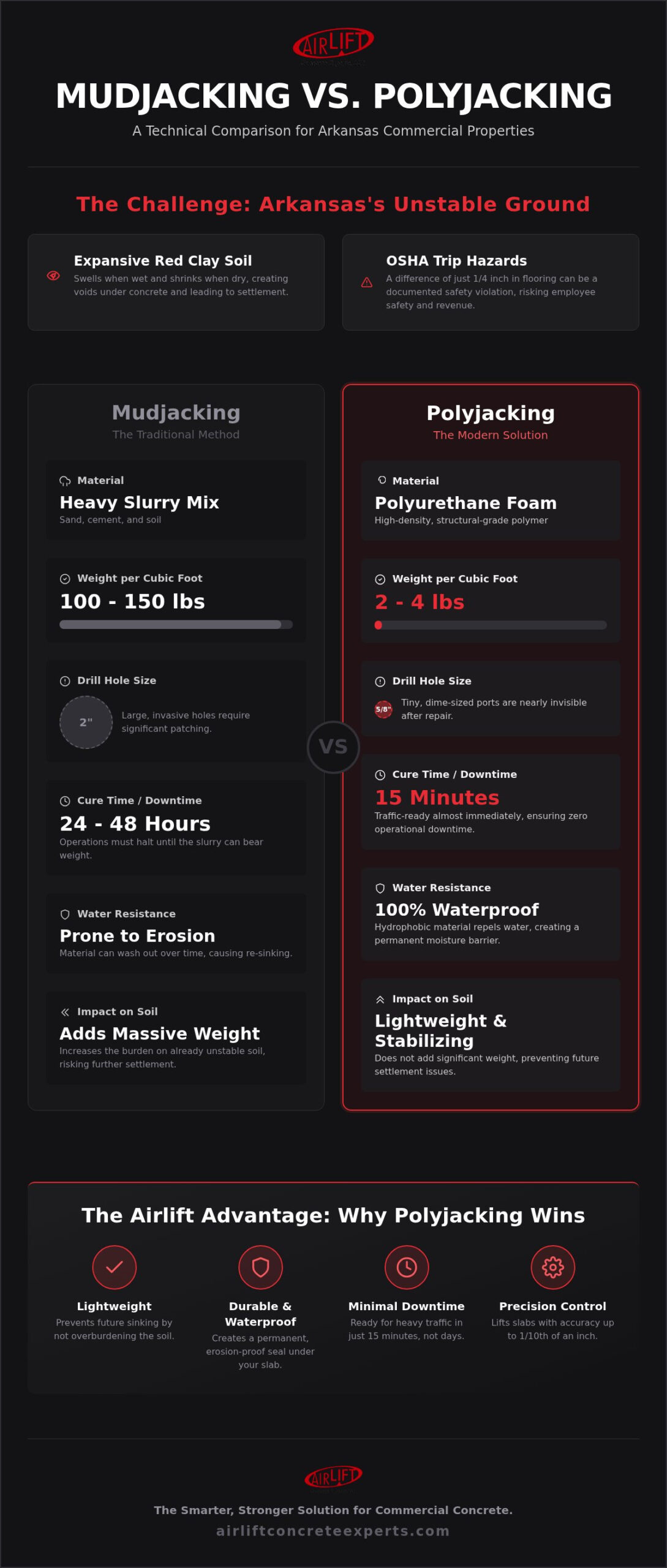
Choosing the right method for commercial concrete lifting Arkansas projects often comes down to a choice between traditional weight and modern efficiency. Mudjacking is the older approach. It uses a heavy slurry composed of sand, cement, and local soil pumped under the slab. This process requires drilling large, 2-inch holes through your concrete. While it can lift heavy sections, it adds significant “overburden” to the already struggling Arkansas clay, which often leads to further sinking down the road.
Polyjacking represents the 2026 standard for industrial repairs. Instead of a heavy mixture, it utilizes high-density polyurethane foam injected through tiny 5/8-inch ports. These ports are roughly the size of a penny, making them far less noticeable on finished surfaces. The foam expands chemically to fill every void beneath the concrete. Perhaps most importantly for your operations, polyjacking offers a 15-minute cure time. This allows for immediate traffic flow in Little Rock warehouses or retail storefronts, whereas mudjacking often requires 24 to 48 hours to set before it can support heavy loads.
Mudjacking relies on pure hydraulic force to move heavy slabs. This requires high-pressure pumping of a material that weighs up to 150 pounds per cubic foot. In contrast, polyurethane foam works through controlled chemical expansion. It exerts enough pressure to lift the slab but weighs only 2 to 4 pounds per cubic foot. Polyjacking is a waterproof, lightweight solution that won’t erode in Arkansas storms. Because the foam is hydrophobic, it won’t wash away or lose its shape during the heavy rainfall common in Central Arkansas.
For businesses, the cost of a repair isn’t just the invoice; it’s the lost revenue from closed lanes or inaccessible loading docks. Mudjacking is a messy process involving large hoses and wet slurry that can splatter nearby walls or equipment. Polyjacking is a self-contained, clean operation. The equipment footprint is also much smaller. Smaller poly-trucks minimize congestion in North Little Rock parking lots, allowing your customers to move freely while we work.
If you’re concerned about the visual impact on decorative commercial patios or high-traffic retail zones, the smaller injection holes are a significant advantage. They blend seamlessly into the existing concrete once patched. To see how these technical advantages apply to your specific facility, you can request a complimentary commercial assessment to evaluate your slab’s condition. This professional oversight ensures you’re solving the underlying soil issue rather than just patching a symptom.
In the context of commercial concrete lifting Arkansas soils often dictate the ultimate success or failure of a repair. The “overburden” effect is a primary reason why traditional mudjacking frequently falls short of expectations. When a contractor pumps a heavy slurry of sand and cement under a sinking slab, they are adding roughly 150 pounds per cubic foot to a sub-base that has already proven it cannot support the original weight of the concrete. This approach doesn’t solve the problem; it compounds it by placing more stress on the fragile earth.
The result is a predictable re-sink cycle that many local business owners know too well. In areas like Jacksonville, we often see mudjacking repairs that fail within 36 months because the underlying clay simply gives way under the added mass of the slurry. Polyurethane physics offers a more stable path. High-density foam weighs only 2 to 4 pounds per cubic foot. It effectively “floats” the slab, restoring the level without adding significant weight. This ensures a much higher long-term ROI, as a single poly-repair typically outlasts multiple mudjacking attempts that would eventually require a complete tear-out and repour.
Unlike slurry, which merely fills space, polyurethane foam expands to compact the surrounding soil. As it travels through the voids, it pushes against the loose earth, creating a denser and more stable base for your facility’s floor. Because we use closed-cell foam, the material is naturally waterproof. In the high-humidity climate of Central Arkansas, this is essential for durability. It seals the underside of the slab, preventing future erosion from groundwater and stopping the “washout” cycle that causes sinking in the first place.
Facility managers often wonder if a lightweight foam can really hold up under the weight of a forklift or heavy industrial machinery. Modern industrial poly foam is engineered for extreme compressive strength, with the capacity to support loads from 7,200 to over 14,000 pounds per square foot. This is more than enough to maintain level surfaces for sensitive industrial equipment and high-volume logistics. For the “weak” soil profiles found across our region, providing lightweight support is the most effective way to ensure the ground doesn’t continue to settle under the combined weight of the slab and the repair material. Choosing commercial concrete lifting Arkansas specialists who prioritize these physics ensures your warehouse or storefront remains safe for years to come.
The diverse commercial landscape of the Natural State requires a repair method that is as versatile as the businesses it serves. High-density polyurethane is not just a patch; it is a structural solution used across various industries to ensure safety and operational continuity. We provide commercial concrete lifting Arkansas facility managers trust to keep their operations moving without the long delays associated with traditional concrete replacement. From the heavy traffic of logistics hubs to the quiet walkways of retail centers, polyjacking offers the precision needed to restore surfaces to within 1/10th of an inch of their original position.
Warehouse and factory floors are perhaps the most critical areas for precision leveling. Even a minor height difference between slabs can cause a forklift to jar, which risks damaging sensitive inventory or causing operator injury. Similarly, loading docks and ramps face repetitive impact from heavy vehicles. Polyjacking stabilizes these high-impact zones by filling the voids created by soil compaction, ensuring the slabs don’t re-settle under pressure. In Little Rock shopping centers, maintaining level sidewalks and parking lots is essential for eliminating trip hazards and protecting your business from liability.
Hospitality environments in Hot Springs require a delicate touch. Pool decks are particularly prone to settlement due to constant water exposure and shifting sub-bases. Polyjacking is the ideal choice here because it uses low-pressure injection that won’t damage expensive underground plumbing or drainage systems. The process is remarkably clean and quiet. Guests aren’t disturbed by the mess of slurry pumps or the noise of heavy construction, and the area is safe for foot traffic just 15 minutes after the repair is complete.
For industrial operations in Conway and Cabot, every hour of downtime represents lost revenue. Stabilizing grain bin floors or heavy machinery pads requires a material that can withstand massive compressive loads. Many property owners assume that a “rip and replace” approach is the only way to fix a failing industrial floor, but that can shut down a 24/7 facility for weeks. Choosing modern concrete lifting instead of a new pour allows you to maintain your production schedule while securing your foundation.
If you’ve noticed sinking slabs or wall separation in your facility, you can request a professional assessment to see how our regional expertise can solve your specific structural challenges. We focus on providing a permanent fix that respects both your budget and your operational timeline.
Airlift Concrete Experts focuses exclusively on high-density polyurethane technology because it is the most reliable way to secure the structural future of your property. As a family-owned business based in Malvern, we understand that Arkansas enterprises are the backbone of our community. We treat every warehouse floor, retail storefront, and industrial loading dock as if it were our own. Our “No-Downtime” promise is a cornerstone of our service; we ensure your surfaces are ready for full operational use in under 30 minutes. This speed allows you to address a critical safety hazard during a lunch break or shift change without disrupting your entire production schedule.
When you request a professional commercial assessment, we do more than just look at surface-level cracks. Our specialists evaluate the specific soil conditions on your site and calculate the structural load requirements of your industry to develop a customized repair plan. Our team arrives with specialized, low-impact equipment designed for the precision required in 2026 industrial environments. By choosing Airlift for commercial concrete lifting Arkansas businesses gain a stable partner dedicated to long-term structural health rather than a temporary patch. We prioritize transparency and straightforward communication, ensuring you understand every step of the process before we begin.
Our technical approach begins with advanced void mapping under the concrete. We identify the exact location and size of the hollow spaces beneath your slab to ensure comprehensive stabilization and support. Once we begin the injection process, we monitor the lift with high-accuracy tools to achieve tolerances within 1/10th of an inch. This level of precision is essential for meeting strict industrial standards where even a slight deviation can affect the calibration of sensitive machinery or the safety of automated logistics systems. For facility managers interested in the specific material science behind our methods, we encourage you to read our polyurethane concrete leveling guide for more technical details.
Our deep roots in Malvern allow us to serve the entire Central Arkansas corridor, from Little Rock and Hot Springs to Conway and Cabot, with unmatched local expertise. We don’t just lift concrete; we apply professional foundation repair standards to every commercial project we undertake. This commitment to quality ensures that your repair stands up to the unique environmental pressures and red clay challenges of our region. If you are ready to secure your facility, protect your equipment, and eliminate dangerous trip hazards, request your free commercial concrete lifting quote today! We are ready to help you restore safety and long-term value to your business property.
Choosing the right method for commercial concrete lifting Arkansas determines whether your repair is a permanent solution or a temporary patch. Traditional mudjacking often fails in our region because the heavy slurry simply overburdens the existing red clay. High-density polyurethane foam provides a smarter alternative by stabilizing the soil without adding significant weight. Since 2017, we’ve helped local businesses restore their foundations using specialized materials engineered specifically for industrial load requirements. It’s a process that respects your bottom line and your operational schedule.
You don’t have to accept trip hazards or equipment damage as an inevitable part of doing business. With a 15-minute cure time, your warehouse or retail space can return to full capacity almost immediately after we finish. We invite you to Schedule Your Free Commercial Concrete Assessment with Airlift Concrete Experts to identify the best path forward for your property. Our team is ready to provide the precision and durability your facility deserves. Let’s work together to make your business surfaces safe and level for years to come.
High-density polyurethane foam is engineered specifically for heavy industrial loads. It can support between 7,200 and 14,000 pounds per square foot; this is more than enough to handle the weight of semi-trucks, fully loaded forklifts, and sensitive machinery. Unlike mudjacking slurry, which can crumble under vibration, our specialized foam creates a solid, stable base that maintains its structural integrity even in high-traffic warehouses. It’s a reliable choice for the most demanding commercial environments.
Most Arkansas businesses experience minimal disruption, as polyurethane foam cures in just 15 minutes. You don’t have to wait days for a new pour to dry or 24 hours for mudjacking slurry to set. We often complete repairs during shift changes or lunch breaks. Once the injection ports are patched, your team can drive forklifts or heavy vehicles over the area immediately. This speed makes it the preferred choice for 24/7 industrial facilities.
While polyjacking often has a higher initial material cost than mudjacking, it provides superior long-term value for large commercial areas. Mudjacking is heavy and frequently causes the soil to sink again within a few years, requiring repeat repairs. Polyjacking addresses the underlying soil issues without adding significant weight. When you factor in the lack of business downtime, it is the most cost-effective investment for commercial concrete lifting Arkansas facility managers can make.
No, the high-density foam used in our process is hydrophobic, meaning it is completely waterproof and won’t wash away. This is a critical advantage during heavy Central Arkansas storms or flooding events. Traditional mudjacking slurry is prone to erosion and can lose its shape when exposed to groundwater. Our closed-cell foam stays exactly where we inject it, creating a permanent seal that prevents future sub-base washout and protects your slab from moisture damage.
We can perform interior floor leveling inside active environments without requiring you to clear out your inventory or close your doors. The equipment footprint is small, and the process is remarkably clean compared to the wet slurry used in mudjacking. We drill tiny, 5/8-inch holes that are easily patched and blended into your existing floor. Since the foam cures in minutes, your customers or employees can use the area safely almost immediately after we finish.
A professional polyjacking repair is designed to last as long as the concrete itself. Because the foam is a stable, non-biodegradable polymer, it won’t break down or lose its lifting power over time. This is especially important in Arkansas’s challenging red clay, which expands and contracts with the seasons. By compacting the loose soil and filling the voids, the foam creates a stable foundation that resists the typical settlement cycles that plague our region.
Yes, we proudly serve the entire Central Arkansas corridor, including North Little Rock and Conway. Our team is based in Malvern, but our mobile units frequently travel to Hot Springs, Benton, Bryant, and Cabot to assist local facility managers. We understand the specific soil challenges in these communities and provide the same high level of professional service to every client. We are your local authority for commercial concrete lifting Arkansas businesses rely on for safety.
Lightweight foam is superior because it doesn’t overburden the already unstable Arkansas soil. Mudjacking slurry weighs roughly 150 pounds per cubic foot, which often causes the weak red clay to compress and sink even further. Our polyurethane foam weighs only 2 to 4 pounds per cubic foot. It provides the necessary lift and support without adding the massive weight that leads to secondary settlement. It’s a scientifically better approach for our region’s unique environmental conditions.

 Call Now