
That uneven warehouse floor or buckled loading dock isn’t just an eyesore; it’s a liability waiting to happen. For Arkansas business owners, commercial concrete leveling isn’t a maintenance footnote; it’s a strategic decision that protects your employees, your equipment, and your bottom line. The good news is that fixing it doesn’t have to mean shutting down your operations for days on end.
You already know the pressure. A raised slab edge near your entrance creates a trip hazard that no “watch your step” sign can fully cover. A settling warehouse floor throws forklifts off balance and strains equipment over time. And beneath it all, Arkansas’s notorious red clay soil keeps expanding and contracting with every rain cycle, making the problem worse with each passing season. These are real concerns, and they deserve a straightforward solution.
This guide explains how advanced polyurethane foam injection addresses the root causes of concrete settlement in Arkansas’s unique soil conditions, restoring level, stable surfaces with minimal disruption to your business. You’ll learn what makes this method more effective than traditional approaches, what to expect during the process, and how Airlift Concrete Experts serves commercial properties across Central Arkansas, from Little Rock to Hot Springs and beyond.
Most concrete problems don’t announce themselves with a dramatic crack or sudden collapse. They develop quietly, over months and seasons, until one day a forklift operator notices the floor feels wrong, or a customer catches their foot on a raised slab edge near your entrance. Knowing what to look for, and understanding why it’s happening beneath the surface, is the first step toward protecting your facility.
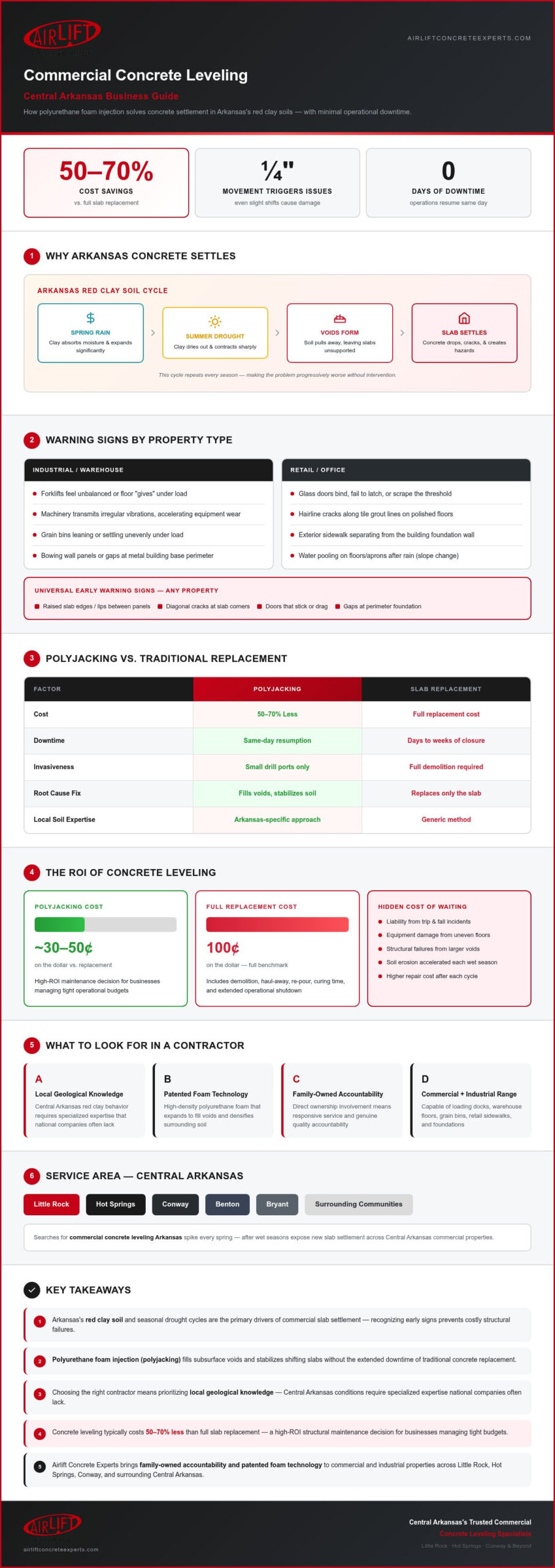
Arkansas’s red clay soil is the underlying culprit behind most commercial slab settlement in this region. Unlike sandy or loamy soils, red clay expands significantly when it absorbs moisture and contracts sharply during dry periods. This constant volumetric cycling, which intensifies during the spring rain-to-summer drought transition, creates voids beneath concrete slabs as the soil pulls away from the surface above it. Those voids leave slabs unsupported, and unsupported slabs settle. It’s a straightforward mechanical process, but one that national concrete companies without local geological knowledge consistently underestimate.
This is precisely why searches for commercial concrete leveling Arkansas spike every spring. Business owners who made it through another wet season step outside and find their loading dock has dropped, their sidewalk has separated from the building, or their warehouse floor has developed a noticeable slope. The rain didn’t cause the problem overnight; it accelerated a process that had been building for months.
Common early warning signs across commercial property types include:
Heavy storage structures like grain bins place enormous concentrated loads on their base slabs. When the soil beneath those slabs develops voids, the bin can begin to lean or settle unevenly, which strains the structure’s integrity over time. Inside warehouses and manufacturing facilities, machinery mounted on settling concrete transmits irregular vibrations that accelerate wear on bearings and mechanical components. Large metal buildings often show foundation settlement through bowing wall panels or gaps forming at the base perimeter where the slab meets the exterior skin.
Commercial glass doors are precision-hung, and even a quarter-inch of slab movement can cause them to bind, fail to latch, or scrape against the threshold. Inside, polished concrete floors or large-format tile installations develop hairline cracks along grout lines when the slab beneath flexes. Perhaps the most overlooked symptom is exterior sidewalk separation, where the concrete apron pulls away from the building’s foundation wall, creating a gap that collects water and accelerates the very soil erosion driving the settlement.
Catching these signs early matters. A settled slab that’s addressed promptly through commercial concrete leveling Arkansas professionals is a repair job. Left alone through another Arkansas wet season, it becomes a structural liability with a much larger price tag attached.
Commercial concrete leveling is a non-invasive repair process that restores sunken or tilted slabs to their original position without removing and replacing the concrete above. Rather than tearing out existing flatwork, trained technicians inject high-density polyurethane foam beneath the slab through small, precisely drilled ports. The foam expands to fill subsurface voids, compacts loose soil, and generates enough upward force to lift the slab back to grade. The result is a stabilized, level surface that’s ready for traffic in a fraction of the time a replacement would require.
For Arkansas properties sitting on expansive red clay, the void-filling aspect is particularly critical. Lifting the slab corrects the visible symptom; filling the voids addresses the mechanical cause. Once those air pockets are eliminated and the surrounding soil is consolidated, the slab has a continuous, load-bearing foundation beneath it rather than unsupported spans waiting to settle again.
Technicians drill small-diameter ports, typically around 5/8 of an inch, through the settled slab at strategic locations mapped to the void pattern below. A two-component polyurethane mixture is then injected through each port, where it reacts and expands to many times its original liquid volume within seconds. This rapid expansion fills voids, displaces moisture, and exerts controlled upward pressure on the slab. Skilled operators monitor the lift in real time, stopping injection at each port when the target elevation is reached. Polyjacking is, at its core, a lightweight, waterproof structural solution that delivers millimeter-level precision without the weight or water-absorption issues of older cement-based methods.
That precision matters enormously in commercial settings. A warehouse floor that’s off by even a quarter-inch across a long span creates cumulative stress on forklifts, pallet jacks, and mounted equipment. Polyurethane foam injection can restore flatness to within a tenth of an inch, which is a tolerance that traditional mudjacking simply cannot match reliably.
Mudjacking pumps a heavy cement-and-soil slurry beneath a slab to push it upward. The method has been around for decades, and it works, to a point. But in Central Arkansas’s clay-heavy soils, it introduces two problems. First, the slurry adds significant weight to an already stressed subgrade, which can accelerate future settlement. Second, cement slurry is porous and absorbs groundwater, which means it softens and erodes during the wet seasons that drive so much commercial concrete leveling Arkansas demand in the first place.
High-density polyurethane foam is chemically inert and fully waterproof once cured. It doesn’t absorb moisture, it doesn’t degrade in contact with the mineral compounds common in Arkansas red clay, and it weighs a fraction of what cement slurry does. For industrial applications like grain bin base slabs and heavy warehouse floors, that combination of light weight and high compressive strength is exactly what the subgrade needs.
Commercial-grade polyurethane foam used in structural applications is engineered to handle substantial compressive loads, making it appropriate for the kind of concentrated weight that grain storage structures, loaded dock aprons, and heavy manufacturing floors demand. Unlike lightweight spray foams used in insulation, structural injection foam maintains its shape and density under sustained pressure without creeping or compressing over time.
Its resistance to water erosion is equally important. Arkansas’s seasonal rainfall doesn’t just move soil; it carries dissolved minerals that break down less stable fill materials. Polyurethane remains chemically stable in that environment, which means the repair holds through wet seasons rather than softening beneath the slab again. For facilities dealing with both surface settlement and deeper structural concerns, combining concrete leveling with professional foundation repair creates a comprehensive approach that addresses movement at every depth. If you’re unsure which scope of work your facility actually needs, a structural assessment from a qualified local contractor is the right starting point before committing to any repair path.
Concrete repair rarely feels urgent until it becomes expensive. For Arkansas business owners, the financial case for addressing settled slabs sooner rather than later is straightforward: polyurethane foam injection typically costs 50 to 70 percent less than full slab replacement, and that gap widens considerably when you factor in the indirect costs that replacement projects carry with them.
Full demolition and replacement means renting equipment, hauling debris, waiting on concrete cure times measured in days, and absorbing the revenue loss that comes with a closed loading dock or inaccessible entrance. Polyjacking eliminates most of that calculus. The repair footprint is small, the process is quiet relative to demolition work, and there’s no concrete waste to dispose of. For a regional distribution center or a retail property with consistent daily traffic, that operational difference is significant.
Beyond direct repair costs, unaddressed settlement creates compounding liabilities that show up on your balance sheet in less obvious ways. OSHA standards for general industry workplaces require walking and working surfaces to be maintained in a safe condition, and a raised slab edge in a warehouse aisle is a documented hazard. A single worker’s compensation claim tied to a trip-and-fall on uneven concrete can easily exceed the cost of the repair that would have prevented it. The same logic applies to customer-facing areas, where premises liability exposure grows with every month a known hazard goes unaddressed.
For commercial real estate owners in Central Arkansas, there’s also an asset value dimension to consider. Appraisers and buyers scrutinize deferred structural maintenance, and settled flatwork around a building’s perimeter signals potential subgrade problems that can reduce appraised value or complicate financing. Documenting a professional commercial concrete leveling Arkansas repair, with a stabilized subgrade and restored grade elevation, becomes a positive line item in a property’s maintenance record rather than a red flag.
Polyurethane foam cures within minutes of injection, not hours or days. Foot traffic can typically resume almost immediately after port holes are patched, and vehicle traffic follows shortly after. There’s no wet concrete to barricade, no cure window to schedule around, and no heavy demolition equipment creating dust and noise throughout your facility. For operations that run on tight daily schedules, that difference in downtime is often the deciding factor. Our guide on concrete lifting covers the efficiency advantages in more detail for properties weighing their repair options.
Level entryways aren’t just a courtesy; they’re an ADA requirement for public-facing commercial properties. A settled sidewalk or entrance apron that creates an abrupt elevation change can put a business out of compliance with accessibility standards. Inside warehouses, stabilizing the soil beneath high-load slabs reduces the micro-movement that causes forklifts and pallet jacks to behave unpredictably over time, which is a safety concern that also extends equipment service life—a critical component of the machinery ROI discussed by United Lift LLC. Addressing these issues through commercial concrete leveling Arkansas professionals isn’t just reactive maintenance; it’s a documented step toward a safer, more compliant facility.
Not every concrete contractor who advertises in Central Arkansas has the experience to handle commercial-scale structural work. There’s a meaningful difference between a crew that patches residential driveways and a team that understands how to stabilize a grain bin base slab or restore a warehouse floor to within tight flatness tolerances. Choosing the wrong contractor doesn’t just mean a poor repair; it can mean a repair that fails within a season because the underlying soil conditions weren’t properly assessed.
Local knowledge is the variable that national franchise operations consistently underestimate. The clay composition around Little Rock behaves differently from the soil profiles in the Hot Springs foothills, and both differ from the alluvial conditions you’ll find in communities closer to the Arkansas River. A contractor who’s worked across Central Arkansas for years understands these distinctions before they ever drill the first injection port.
Before committing to any repair plan, ask direct questions that reveal whether a contractor has genuine commercial experience:
A credible proposal for commercial concrete leveling Arkansas work distinguishes clearly between cosmetic surface patching and genuine structural stabilization. Filling surface cracks with caulk addresses appearance; injecting foam beneath a settled slab addresses the void that caused the settlement. If a quote doesn’t specify injection depth, foam volume estimates, or port placement strategy, it’s not a structural repair plan.
Transparent, low-pressure communication is a reliable signal of contractor quality. A contractor who walks your facility, explains what they’re observing in plain language, and provides a detailed written quote before asking for a commitment is operating with the kind of accountability that commercial work demands. Vague estimates and high-pressure closing tactics are the opposite signal. For a broader framework on vetting structural repair contractors in Arkansas, our foundation repair near me guide covers the evaluation process in practical detail.
Airlift Concrete Experts has been serving commercial and industrial properties across Central Arkansas since 2017, bringing family-owned accountability and patented foam technology to every assessment. Contact Airlift Concrete Experts to schedule a structural assessment for your facility and get a clear picture of what your slab actually needs.
Since 2017, Airlift Concrete Experts has built its reputation one stabilized slab at a time across Central Arkansas. As a family-owned operation based in Malvern, the company brings something national concrete contractors can’t replicate: genuine accountability to the communities it serves. When a business owner in Little Rock or Hot Springs calls with a settling warehouse floor, they’re talking to a team that understands the local soil, knows the seasonal patterns, and has a direct stake in getting the repair right.
Polyurethane foam injection is the method Airlift prioritizes for commercial work because it’s the right tool for the conditions Arkansas properties actually face. The patented foam technology Airlift uses is waterproof, chemically stable in red clay environments, and capable of handling the compressive loads that industrial facilities demand. That’s not a marketing claim; it’s why the method consistently outperforms older slurry-based approaches in this region’s wet-dry soil cycles.
Grain bin slab stabilization is one of Airlift’s most specialized commercial applications. These structures concentrate enormous weight onto relatively small base slabs, and when the subgrade develops voids, the consequences move beyond cosmetic settlement. Airlift’s technicians assess load distribution before injection begins, mapping port placement to address the actual void pattern rather than applying a generic repair template. The same precision carries into warehouse floors, loading dock aprons, and other heavy-use industrial surfaces where tolerances matter.
Every commercial engagement begins with a technical consultation, not a sales pitch. Airlift’s team walks the facility, identifies the settlement pattern, and explains the underlying cause in plain language before recommending any scope of work. Injection work is scheduled to minimize disruption to daily operations; the process generates no heavy demolition noise, no concrete debris, and no extended cure window that forces you to barricade sections of your facility. Being family-owned means every project carries the weight of a local name and reputation, and that accountability shows up in how the work gets done.
If your facility is showing any of the settlement signs covered in this guide, the right next step is a structural assessment from a contractor who knows Central Arkansas soil conditions firsthand. Airlift Concrete Experts offers complimentary assessments for commercial properties across Little Rock, Hot Springs, Conway, and the surrounding region. The goal isn’t a quick sale; it’s a durable repair that holds through Arkansas seasons and protects your property’s long-term value.
Arkansas property managers looking for a dependable commercial concrete leveling Arkansas partner don’t have to settle for a national company that treats your facility like any other job. Contact Airlift Concrete Experts for a commercial estimate and find out exactly what your slab needs.
Settled concrete doesn’t fix itself, and Arkansas’s red clay soil won’t stop cycling through wet and dry seasons. What this guide makes clear is that you don’t have to choose between a costly replacement and doing nothing. Commercial concrete leveling Arkansas businesses trust comes down to the right method, applied by a contractor who understands the soil conditions your facility actually sits on.
The core takeaways are straightforward: polyurethane foam injection addresses the void problem beneath your slab, not just the visible symptom above it. Repairs cost a fraction of full replacement and don’t require extended operational downtime. And local expertise genuinely matters when the subgrade beneath your property has specific regional characteristics that national companies routinely overlook.
Airlift Concrete Experts has been a family-owned part of Central Arkansas since 2017, using specialized high-density polyurethane technology to stabilize commercial and industrial slabs with zero-downtime solutions built around your schedule.
Don’t wait for a settled slab to become a safety incident or a structural failure. Schedule your free commercial structural assessment with Airlift Concrete Experts and get a clear, honest picture of what your facility needs.
Concrete leveling consistently costs significantly less than full slab replacement, often 50 to 70 percent less depending on the scope of work. The exact figure for your facility depends on the square footage being addressed, the depth and number of voids beneath the slab, and the accessibility of injection points. Because every commercial property sits on different subgrade conditions, the most accurate way to understand your costs is through a site-specific structural assessment rather than a ballpark estimate.
Most commercial polyjacking projects are completed in a single day, though larger warehouse floors with extensive void patterns may require two visits. The actual injection phase moves quickly because polyurethane foam reacts and expands within seconds of application. Technicians spend much of the project time on precise port placement and elevation monitoring rather than waiting on materials to cure. There’s no concrete cure window afterward, which means your floor is back in service far sooner than a replacement would allow.
Yes. Structural-grade polyurethane foam used in commercial applications is engineered to handle substantial compressive loads, which is precisely why it’s appropriate for grain bin base slabs, loaded dock aprons, and warehouse floors supporting heavy equipment. This is a different product category from the lightweight spray foam used in building insulation. For grain bin applications specifically, Airlift Concrete Experts maps injection ports to the actual void pattern beneath the base slab rather than applying a generic repair approach, ensuring the foam addresses the concentrated load points where structural support matters most.
In most cases, yes. Polyjacking generates no heavy demolition noise, no concrete debris, and no extended barricaded zones. Foot traffic can typically resume almost immediately after port holes are patched, and vehicle traffic follows shortly after. Airlift schedules injection work around your operational needs, and the compact equipment footprint means technicians can work in sections of your facility while other areas remain active. This is one of the most practical advantages of commercial concrete leveling for Arkansas businesses that can’t afford extended shutdowns.
Arkansas’s red clay soil is the primary driver. Red clay expands when it absorbs moisture and contracts sharply during dry periods, a cycle that repeats every season. As the soil pulls away from the underside of a slab during dry spells, it creates voids that leave the concrete unsupported. Over time, the unsupported slab settles into those gaps. Poor original compaction during construction, underground water migration, and the weight of heavy equipment accelerating soil displacement are contributing factors that compound the clay’s natural behavior.
Mudjacking pumps a heavy cement-and-soil slurry beneath a slab to push it upward. It’s an older method that works in some residential situations, but it introduces real problems in Central Arkansas’s clay-heavy soils. The slurry adds significant weight to an already stressed subgrade, and because it’s porous, it absorbs groundwater and softens during wet seasons. Polyurethane foam is waterproof, chemically inert, and weighs a fraction of cement slurry. For commercial concrete leveling Arkansas facilities with industrial load requirements, that combination of light weight and high compressive strength is the more durable long-term solution.
Warranty specifics vary depending on the scope and conditions of each commercial project. Rather than making a blanket claim here, we’d encourage you to ask directly during your structural assessment. Airlift is a family-owned operation with a direct stake in the communities it serves across Little Rock, Hot Springs, Conway, and surrounding areas, and that local accountability shapes how the company stands behind its work. Confirming warranty terms in writing before any project begins is always the right approach for commercial structural repairs.
Leveling is appropriate when the concrete itself is structurally sound but has settled due to subsurface voids or soil movement. If the slab is cracked through its full depth, badly spalled, or has deteriorated beyond a stable surface, replacement may be the more practical path. A qualified contractor can distinguish between cosmetic surface damage and genuine structural compromise during an on-site assessment. If your slab is settling uniformly and the concrete above is intact, polyjacking is almost certainly the more cost-effective and less disruptive solution.

 Call Now