
Imagine a typical morning at your Little Rock warehouse when a forklift driver hits a sharp, uneven joint at the loading bay. That sudden jolt isn’t just an annoyance; it’s a clear sign that the ground beneath your facility is shifting. When you’re searching for loading dock leveling in Arkansas, you’re usually fighting the state’s notorious red clay, which shrinks and swells until your heavy industrial slabs begin to sink. This creates dangerous tripping hazards and risks expensive damage to your equipment.
We know how frustrating it is when a busy bay goes offline, especially when you’re worried about OSHA violations or water pooling in the pits. You might think that a full concrete replacement is the only way to fix a sunken slab, but that often leads to weeks of unnecessary downtime. In this article, you’ll learn how to identify structural concrete failure and why high-density polyurethane foam is the fastest, most durable solution for Arkansas warehouses. We’ll explore how this hydrophobic material stabilizes your dock and supports up to 14,000 pounds per square foot, letting your team get back to work safely in minutes.
Recognizing the early warning signs of a failing loading dock can save your facility thousands in repairs and lost productivity. Often, the first sign isn’t a visible crack in the concrete but a change in the sound and feel of daily operations. If your forklift drivers report a jarring “thump” every time they cross the threshold between the warehouse floor and the dock leveler, you’re likely dealing with a hollow sub-base. This indicates that the soil beneath the slab has washed away or settled, leaving the heavy concrete unsupported and prone to shifting.
Other visible indicators of structural failure include:
Facility managers often mistake a sinking floor for a mechanical issue with the dock leveler itself. However, a perfectly functioning metal leveler can’t compensate for a sinking concrete foundation. When the concrete pit settles, the leveler’s frame twists and its mounting points shift. This misalignment places immense stress on the hydraulic or mechanical components, leading to frequent breakdowns. Slab instability creates a cascading effect that forces mechanical hardware out of its engineered alignment, eventually causing total equipment failure.
Understanding the basics of Concrete leveling is vital for any property manager facing these issues. While traditional methods might involve heavy machinery and long periods of downtime, modern loading dock leveling Arkansas solutions focus on stabilizing the soil first. This provides a permanent, stable base for the heavy equipment above without the need for full reconstruction.
Ignoring a sunken dock creates significant safety and financial risks for your business. According to safety data from the Bureau of Labor Statistics, nearly 6,600 employees missed work in 2018 due to injuries on loading docks, dock plates, and ramps. Uneven walking surfaces are prime candidates for OSHA tripping hazard violations, which can lead to hefty fines and increased insurance premiums.
Beyond personnel safety, uneven joints act like speed bumps for material handling equipment. This constant impact destroys expensive forklift tires and shatters axles over time. By addressing loading dock leveling Arkansas needs early, you prevent these minor offsets from evolving into major structural damage that could compromise the entire warehouse foundation and your bottom line.
Arkansas red clay is notorious among builders for its unstable behavior. In industrial hubs like Little Rock and Hot Springs, this expansive soil acts like a massive sponge. It swells significantly when it absorbs moisture and shrinks as it dries out during our humid summers. For a loading dock supporting thousands of pounds of freight, this constant movement is disastrous. Heavy rainfall accelerates the process by washing away the fine particles in the sub-base, creating hidden pockets of empty space known as voids.
The vibration from constant truck traffic further compounds the issue. As semi-trailers back into bays and forklifts traverse the threshold, they send rhythmic energy into the slab. This vibration compacts any poorly prepared fill soil, turning small gaps into major structural failures. These Central Arkansas weather cycles mean your dock foundation is under constant assault, eventually leading to the sinking that requires professional loading dock leveling Arkansas services to restore safety.
When soil washes away, it leaves a void. These subterranean gaps are the root cause of sinking docks in high-growth logistics corridors like Conway and Cabot. Many facility managers try to fix the problem with a surface patch of new concrete or asphalt. This is just a temporary band-aid because it ignores the hollow space beneath. Without filling the void, the new material eventually cracks and sinks under the weight of industrial loads. Poor drainage often feeds these voids, as water finds the path of least resistance through the soil. Failing to address these hazards can put your facility at odds with OSHA’s standard for walking-working surfaces, which requires all working areas to be maintained in a safe, stable condition.
Historically, mudjacking was the primary fix for sunken concrete. This process pumps a heavy slurry of cement, sand, and soil under the slab. However, this material weighs over 100 pounds per cubic foot. In many cases, adding that much weight to already failing Arkansas soil actually speeds up the sinking process. Traditional grout also lacks the flexibility to withstand 24/7 truck traffic without crumbling or washing away again during the next spring flood.
Modern logistics facilities now turn to high-density polyurethane. It’s lightweight, waterproof, and far more durable than old-fashioned mud. This technology has become the gold standard for professional foundation repair because it addresses the soil’s root instability without adding massive weight. If you’ve noticed your bays becoming uneven, a quick assessment from Airlift Concrete Experts can determine if your soil is still shifting and provide a permanent stabilization plan.
High-density polyurethane isn’t the same material used for residential insulation. It’s a specialized industrial polymer specifically engineered to support the massive weight of semi-trucks and loaded forklifts. For businesses seeking loading dock leveling Arkansas, this solution provides a permanent fix that actually strengthens the soil beneath the slab. It doesn’t just push the concrete up; it expands to fill every hidden pocket of empty space, creating a solid foundation that can support up to 14,000 pounds per square foot.
Because the foam is hydrophobic, it won’t wash away or degrade during heavy Arkansas spring floods. It acts as a moisture barrier, sealing the underside of your concrete against future erosion. This is a critical advantage over traditional methods, as the foam remains stable regardless of how much groundwater moves through the red clay. You’re not just fixing the height of the slab; you’re protecting it from the environmental cycles that caused the sinking in the first place.
One of the biggest advantages is the minimal disruption to your facility. We only need to drill small, penny-sized holes to inject the material. This preserves the structural integrity of your existing slab while allowing the foam to expand and lift. Unlike traditional methods that add thousands of pounds of heavy slurry to already sinking soil, polyurethane is incredibly lightweight. It adds almost no additional stress to the sub-base while providing immense lifting power for even the heaviest commercial slabs.
Traditional concrete replacement is a logistical nightmare. It often requires a seven-day wait for the material to reach full strength, which means your most important loading bays stay offline for a week or more. Professional concrete lifting using polyurethane foam completely changes that timeline. The material reaches 90% of its full strength within 15 to 30 minutes of injection. This speed allows you to resume heavy operations mid-shift, keeping your logistics moving without the massive financial hit of a prolonged shutdown.
Achieving a perfectly flush surface is essential for forklift safety and equipment longevity. Our technicians use sensitive dial indicators to monitor the lift in real time, often achieving a level surface within 1/10th of an inch. This precision allows us to restore the original pitch of the dock, ensuring that water drains away from the building rather than pooling in the pits. While some might consider a retail foam kit for small repairs, those products lack the compressive strength and controlled expansion needed for industrial loads. Professional loading dock leveling Arkansas requires industrial-grade equipment to ensure the repair lasts for a decade or more.
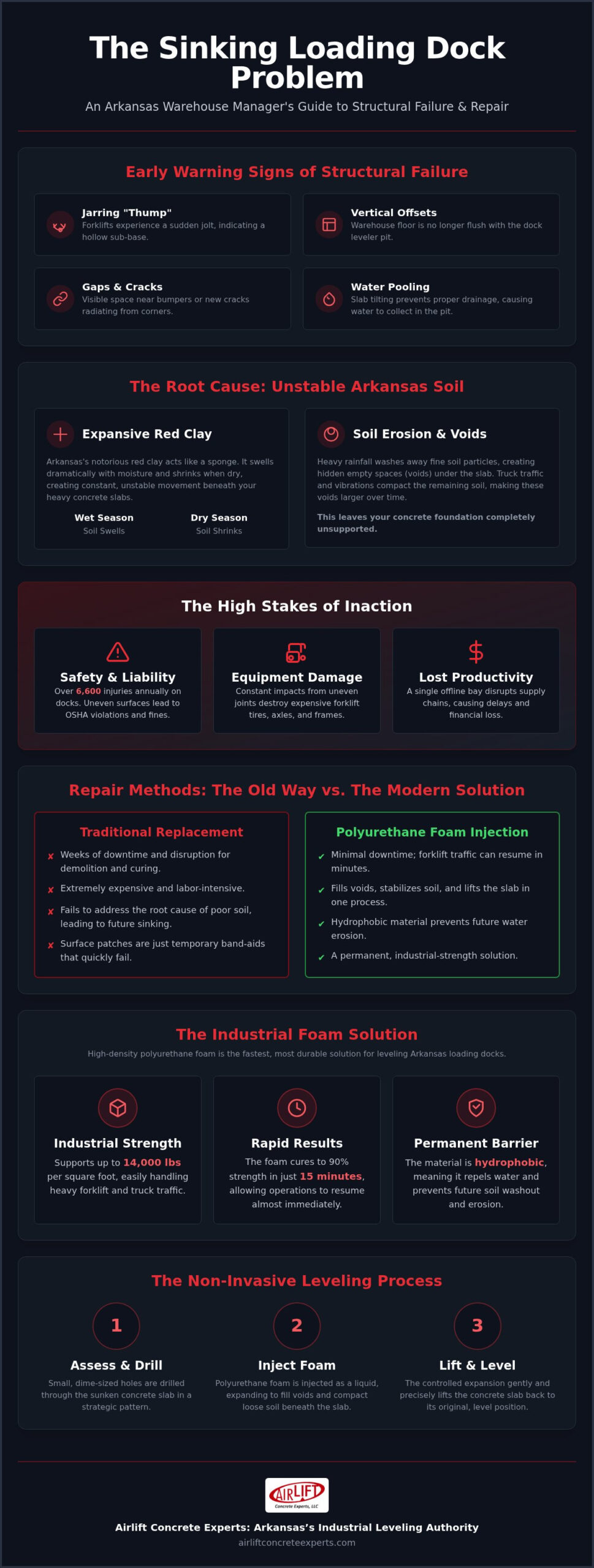
Every effective loading dock leveling Arkansas project begins with a methodical site assessment. We start by mapping the subterranean voids and calculating the specific load-bearing requirements of your daily traffic. This isn’t a one-size-fits-all application. We look at the weight of your heaviest forklifts and the frequency of semi-truck arrivals to determine the exact density of polyurethane needed to stabilize the slab permanently. Our team focuses on the root cause of the sinking to ensure the solution lasts for years, not just months.
Once the assessment is complete, we execute a strategic drill pattern. Our technicians drill penny-sized, 5/8-inch holes in precise locations to maximize lift while preserving the structural integrity of the concrete. As we inject the high-expansion foam, we monitor the slab rise in real-time. You can actually see the concrete move back into its original position as the foam fills every hidden pocket of empty space. Once the slab is flush, we seal the injection ports with an industrial-grade concrete patch that blends seamlessly with your existing floor.
We understand that a warehouse is a high-traffic environment where safety is the top priority. Before we begin, we take steps to protect your inventory and equipment from the work zone. A major part of our preparation involves identifying underground utilities and the hydraulic lines for your mechanical dock levelers. Our process is remarkably clean. Unlike traditional concrete work, there’s no dust, no messy slurry, and no need for heavy demolition equipment. This allows us to work in one bay while your facility remains active in others nearby.
The job isn’t finished until we verify the results under real-world conditions. We test the slab for stability by observing it under active forklift loads to ensure there’s no deflection or “bounce.” We also confirm that the mechanical dock leveler plate now aligns perfectly with the warehouse floor, eliminating the jarring impacts that damage equipment and cause operator fatigue.
To keep your polyjacking near me repair permanent, we recommend keeping dock seals in good repair to prevent surface water from reaching the sub-base. If you’re ready to secure your facility’s foundation and eliminate tripping hazards, contact Airlift Concrete Experts for a comprehensive site evaluation.
Airlift Concrete Experts was founded in 2017 with a simple mission: to provide the most reliable structural solutions for our neighbors across the state. As a family-owned and operated business based in Malvern, we understand the unique pressures that Arkansas facility managers face. When you choose us for loading dock leveling Arkansas, you aren’t just hiring a contractor; you’re partnering with a local specialist who knows exactly how our regional climate and heavy red clay affect industrial foundations.
Logistics managers in Little Rock and Benton trust our team for commercial concrete lifting because we prioritize their operational uptime. We’ve spent years refining our application of polyurethane concrete leveling technology to meet the high-load demands of 24/7 distribution centers. Our expertise in loading dock leveling Arkansas ensures that your facility meets safety standards without the cost of total slab replacement. The Airlift Concrete Experts Promise is our commitment to restoring the safety and efficiency of your facility using methods that are faster and more durable than traditional alternatives.
Our service area extends to the busiest industrial corridors in the state. We provide dedicated support for facilities in North Little Rock, Jacksonville, and Sherwood, where heavy truck traffic is constant. Our technicians have extensive experience with the specific soil conditions found in the industrial parks of Bryant and Conway. We’ve worked alongside manufacturing and distribution centers across the region, building a library of local references that speak to our transparency and technical precision. We treat every facility like it belongs to a neighbor, ensuring the job is done right the first time.
We believe that a clear understanding of the problem is the first step toward a permanent fix. That’s why we offer a no-obligation on-site industrial inspection for your facility. During this assessment, we’ll identify void locations, calculate load requirements, and explain the repair process in detail. You’ll receive a transparent quote that focuses on long-term structural stability rather than a quick patch. We don’t sell DIY kits or new concrete construction; we specialize in the advanced lifting techniques that keep your bays open. Contact Airlift Concrete Experts today to schedule your loading dock evaluation and let us help you maintain a safer, more productive workplace.
A sinking loading dock doesn’t have to mean a complete operational shutdown. By choosing high-density industrial polyurethane, you address the root cause of the problem, the shifting Arkansas red clay, without the weeks of downtime required for new concrete. This specialized material provides a permanent, waterproof seal that supports your heaviest forklift traffic almost immediately after injection.
As a family-owned Arkansas business, Airlift Concrete Experts is dedicated to keeping our local distribution hubs safe and productive. Our zero-downtime solutions for Central Arkansas logistics mean you can fix your bays mid-shift and avoid costly equipment repairs or OSHA safety fines. When you prioritize professional loading dock leveling Arkansas, you’re investing in the long-term structural integrity of your warehouse and the safety of your operators.
Ready to restore your facility’s efficiency? Schedule Your Free Commercial Loading Dock Assessment today and let us help you build a safer work environment for your team. We look forward to being your partner in property maintenance.
Yes, it is significantly more cost-effective than a total rebuild. Polyurethane injection avoids the labor-intensive costs of demolition, hauling away tons of old concrete, and pouring new material. It focuses on stabilizing the existing slab rather than starting over. Most facilities save between 50% and 70% compared to the cost of full replacement while achieving the same structural stability for their heavy industrial traffic.
Your loading dock can usually return to service in as little as 15 to 30 minutes after the injection is complete. Unlike new concrete that requires a seven-day cure time, high-density foam reaches 90% of its full strength almost immediately. This speed makes it the ideal choice for busy logistics centers in Arkansas that don’t want to have a critical bay offline for a week or more.
Yes, industrial-grade polyurethane is engineered to support up to 14,000 pounds per square foot. This compressive strength is more than enough to handle fully loaded semi-trailers and heavy forklifts. The foam expands to fill voids and creates a dense, stable foundation that distributes weight evenly across the sub-base. This prevents the point-load failures that are common when heavy equipment drives over hollow slabs.
No, the high-density polyurethane we use is hydrophobic, which means it repels water. It won’t wash away, erode, or degrade even if your dock pit experiences flooding during a heavy Arkansas spring storm. This property makes it superior to traditional mudjacking material, which is highly susceptible to washout. The foam acts as a permanent moisture barrier beneath your concrete to prevent future soil erosion.
No, we specialize in the concrete foundation and soil stabilization beneath the dock. We don’t repair the mechanical or hydraulic components of the metal leveler plates themselves. However, our loading dock leveling Arkansas services often resolve mechanical issues by realigning the concrete pit. When the floor is level, the metal hardware can finally operate within its original engineered specifications without being twisted by a sinking slab.
A professional polyurethane repair typically lasts 10 to 15 years or more. Because the material is waterproof and chemically inert, it won’t break down in the soil over time. It effectively stops the shrink-swell cycle of Arkansas red clay by filling the voids where water would otherwise collect. This creates a long-term solution that withstands our state’s extreme temperature shifts and high humidity levels.
Ignoring the problem leads to increased equipment damage and serious safety risks. Sunken slabs create jarring impacts that destroy forklift axles and tires, while uneven joints often result in OSHA tripping hazard violations. Over time, the hollow voids beneath the slab will grow. This eventually leads to a sudden, catastrophic collapse of the concrete under the weight of a heavy load or a parked vehicle.
Yes, we provide loading dock leveling Arkansas services throughout Central Arkansas, including Little Rock, Conway, Benton, and North Little Rock. Our team is based in Malvern, which allows us to respond quickly to industrial facilities across the region. We understand the specific soil conditions in these logistics hubs and offer on-site assessments to help local managers maintain safe, efficient operations without the need for total concrete replacement.

 Call Now