
What if the cracks and dips in your garage floor aren’t actually a concrete problem, but a soil problem? If you’ve struggled to close your garage door or found yourself stepping over new trip hazards, you aren’t alone. Many homeowners in Little Rock, Hot Springs, and Conway face these same structural frustrations. It’s natural to worry that the only fix is a costly, messy demolition and replacement. However, most sinking garage floor repair Arkansas projects can be completed more efficiently by focusing on what lies beneath the slab.
We understand the stress that comes with seeing your home’s foundation shift. This article will show you how polyurethane leveling provides a permanent, non-invasive solution that stabilizes the ground and lifts your floor back to its original position. You’ll learn about the unique challenges of Arkansas red clay and how our specialized foam injection process offers a quick turnaround with minimal mess. By the end, you’ll see why a level, safe garage is well within reach without the headache of a full concrete pour. We’ll even explain how a complimentary assessment can help you take the first step toward a stable home.
A sinking garage floor often starts with subtle clues that are easy to overlook until they become daily nuisances. For many homeowners in Central Arkansas, the first sign isn’t a massive crack, but a sliver of daylight. If you see light showing under the garage door when it’s closed, your floor has likely settled. This “smile” shaped gap at the corners happens because the concrete slab is pulling away from the door frame, creating an entry point for pests, moisture, and drafts. It’s one of the most common reasons homeowners seek sinking garage floor repair Arkansas services.
Beyond the door, you should inspect where the floor meets the walls. Gaps forming between the floor slab and the garage walls indicate that the soil underneath is no longer supporting the weight of the concrete. You might also notice your automatic garage door opener struggling. When the floor isn’t level, the tracks and sensors fall out of alignment. This puts unnecessary strain on the motor and can cause the door to reverse unexpectedly or fail to close securely.
Cracks in the concrete are another major indicator, but it’s vital to distinguish between hairline shrinkage and structural settlement. Hairline cracks are often superficial and occur as concrete cures. However, if one side of a crack is higher than the other, the slab is actively sinking. Addressing these symptoms early is the key to successful sinking garage floor repair Arkansas projects before the damage spreads to the rest of your home.
It’s important to understand whether you’re dealing with a sinking slab or a sagging floor, as the repairs are very different. A sinking slab is a concrete settlement issue on grade, meaning the heavy floor is moving because the earth beneath it has shifted or washed away. This is distinct from the “bouncy” sagging floors found in older homes with pier-and-beam foundations. Identifying your specific foundation type is the first step in professional foundation repair. Modern Concrete leveling techniques are specifically designed to stabilize these heavy on-grade slabs without the need for demolition.
You can use the “quarter test” to gauge the severity of a crack. If you can slide a quarter into the gap, the settlement is significant enough to require professional attention. Watch for signs of active movement, such as cracks that grow wider during the rainy season or those that begin to affect the exterior of your home. When a garage floor sinks significantly, it can pull on the adjacent walls, leading to stair-step cracks in your exterior brickwork. This suggests the settlement is no longer localized and may be threatening the overall structural integrity of your garage.
The ground beneath your home is far from static. In Central Arkansas, the primary culprit behind concrete instability is the regional red clay. This specific soil type is categorized among Expansive or swelling soils, which change volume significantly based on their moisture content. When the clay absorbs water, it expands with enough force to push against your concrete slab. As it dries out, the soil shrinks and pulls away, leaving the heavy concrete suspended over an empty pocket of air. This relentless cycle of movement is why sinking garage floor repair Arkansas homeowners require is so common.
Seasonal weather patterns in our region accelerate this process. Heavy spring rains often saturate the ground, but they also create underground “rivers” that can wash away the loose sub-slab support. This erosion creates immediate voids. When the intense summer heat arrives, the clay dries and cracks, further reducing the support structure. Additionally, if the soil wasn’t properly compacted during your home’s original construction, the weight of the garage and your vehicles will eventually compress the earth, leading to noticeable settlement. Understanding these underground shifts is the first step toward a permanent fix.
Your home’s water management system plays a massive role in soil stability. When gutters are clogged or undersized, they overflow and dump gallons of water directly next to your garage’s perimeter. This localized saturation causes the clay to swell unevenly, putting “heave” pressure on the edges of the slab. Downspout placement is just as critical; if they discharge water too close to the foundation, they contribute to the erosion of the supporting soil. Maintaining proper foundation and drainage is one of the most effective ways to prevent your garage floor from sinking further.
The high humidity and frequent temperature swings in Little Rock and the surrounding areas keep the soil in a constant state of flux. This environmental stress makes Central Arkansas homes particularly susceptible to shifting foundations and uneven garage slabs. Moisture levels directly dictate the physical volume of local clay soil. Because these conditions are unique to our region, generic repair methods often fail to address the root cause. If you’ve noticed your floor beginning to dip, a professional structural assessment can identify exactly how the local climate is affecting your property.
When homeowners realize their concrete is settling, they often assume the only options are a massive replacement project or a messy process called mudjacking. However, polyjacking has emerged as the definitive solution for sinking garage floor repair Arkansas families trust for speed and reliability. This process involves injecting high-density polyurethane foam through tiny ports in the concrete. Once underneath the slab, the foam undergoes a chemical reaction that causes it to expand with immense force, lifting the heavy concrete back to its original position while simultaneously compacting the loose soil beneath.
Unlike older methods, polyjacking addresses the root cause of the problem without adding excessive weight to the already unstable ground. It is a clean, surgical approach that restores structural integrity with minimal disruption to your daily routine. Because the material is injected as a liquid before expanding into a rigid foam, it reaches every corner of the void under your garage, ensuring that no pocket of air is left to cause future settlement.
The biggest drawback of traditional mudjacking is the weight of the material itself. Mudjacking uses a heavy slurry of cement, sand, and soil that can weigh up to 120 pounds per cubic foot. In the expansive clay soils of Central Arkansas, adding that much weight can actually cause the ground to sink even further over time. In contrast, high-density polyurethane foam weighs approximately 4 pounds per cubic foot. This lightweight nature allows us to lift the slab without overloading the soil.
The physical footprint of the repair is also much smaller. Mudjacking requires large, unsightly holes drilled into your garage floor, often the size of a soda can. Polyjacking only requires penny-sized injection ports that are easily patched and blended with your existing concrete. Perhaps the most significant benefit for busy households is the curing time. While traditional grout can take days to dry, polyurethane foam cures almost instantly. You can park your car back in the garage just 30 minutes after we finish the repair.
Beyond the lift, polyjacking offers long-term protection that traditional fillers can’t match. As the foam expands, it flows into the smallest cracks and crevices, creating a waterproof barrier that prevents future erosion. This is vital in our region, where heavy rains often wash away sub-slab support. The foam won’t shrink over time, and it won’t wash away even if the soil becomes saturated again. Choosing a specialist for polyjacking near me ensures that your garage floor remains level and stable for years to come. This modern approach transforms a stressful structural issue into a quick, permanent fix that preserves your home’s value and safety.
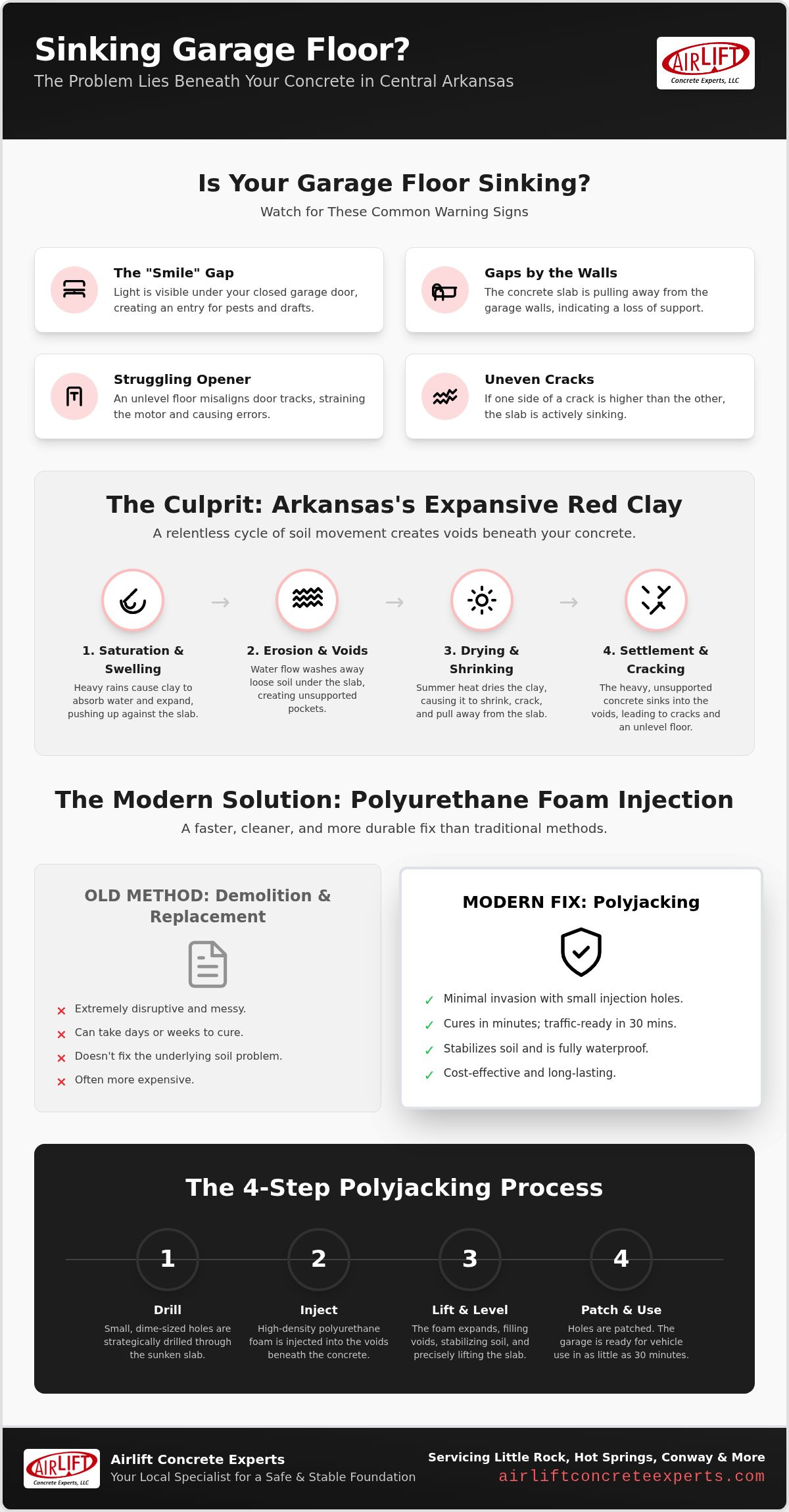
Homeowners often worry that structural work involves weeks of chaos, loud machinery, and a destroyed yard. When you schedule sinking garage floor repair Arkansas, the reality is much more organized and surgical. We’ve refined a four-step process designed to restore your home’s stability with the least amount of stress possible. Our methodical approach to sinking garage floor repair Arkansas ensures that every injection point is placed with purpose, targeting the exact areas where the soil has failed.
Before any work begins, our experts perform a thorough evaluation of your garage. We use precision levels to determine the exact degree of settlement and check for secondary issues, such as cracks in the foundation walls that might be linked to the sinking floor. This detailed look allows us to provide a transparent, no-obligation quote based on the actual size of the void beneath your concrete. We believe in straightforward communication, so you’ll know exactly what the job requires before we ever pull a truck into your driveway. This neighborly approach is why families in Malvern and Little Rock trust us with their homes.
One of the biggest advantages of our modern approach is that you typically don’t need to empty your entire garage. We can often work around larger items, saving you the labor of moving heavy shelving or equipment. The process is remarkably clean, producing no dust clouds or piles of excavated dirt. High-density polyurethane foam expands with incredible speed to fill underground voids and cures into a rigid, waterproof support structure in under thirty minutes. This means your garage is back in service the same day we arrive. If you’re ready to fix those trip hazards and restore your home’s value, schedule your free assessment today.
Airlift Concrete Experts is more than just a repair company; we’re your neighbors. Based in Malvern, our family-owned and operated business has spent years perfecting the art of polyurethane concrete leveling. We focus exclusively on non-invasive structural repairs, ensuring that your home remains a safe and stable environment. Our commitment to quality is rooted in our identity as a local specialist. We don’t just fix concrete; we restore the peace of mind that comes with a secure property.
Our team provides dedicated service to Little Rock, Conway, Hot Springs, and the surrounding areas. Because we live and work in the same communities as our customers, we treat every project with the care it deserves. We understand that a shifting foundation is a high-stress issue. That’s why we prioritize transparent communication and straightforward solutions that address the root cause of the problem. When you choose us for sinking garage floor repair Arkansas, you’re partnering with a team that values durability and long-term results over quick, temporary fixes.
Since our founding in 2017, we’ve developed a deep understanding of Central Arkansas geology. The red clay soil found from Benton to Jacksonville presents unique structural challenges that national competitors often overlook. This expansive soil requires a specialized approach that accounts for moisture cycles and local building codes. Our experience allows us to predict how the ground will react to our repairs, ensuring that our polyjacking solutions remain stable for years. We’ve seen how Arkansas weather affects foundations firsthand, and we use that knowledge to provide superior protection for your home. Our specialized approach to sinking garage floor repair Arkansas is designed to handle these specific environmental conditions.
Identifying a problem early is the best way to prevent a small crack from turning into a major structural failure. Our experts provide a professional eye that looks beyond the surface. We evaluate the soil conditions, check for secondary foundation issues, and create a custom repair plan tailored specifically to your home’s needs. This process removes the guesswork and provides you with a clear path forward. If you’re ready to secure your foundation, you can schedule your free sinking garage floor assessment today. We’re here to help you protect your investment with a solution that’s as reliable as the people who perform it. We’re ready to get to work.
A sinking garage floor doesn’t have to mean a massive demolition project or a permanent loss of property value. By understanding how our regional red clay reacts to moisture, you can address the root cause of settlement with precision and confidence. Advanced polyjacking technology has transformed the industry, offering a lightweight, waterproof, and durable alternative to traditional mudjacking. This modern approach ensures your garage remains functional and safe without the mess of heavy excavation or days of downtime.
As Central Arkansas foundation specialists, Airlift Concrete Experts has been family-owned and operated since 2017. We take pride in providing our neighbors in Malvern, Little Rock, and Hot Springs with straightforward solutions that last. If you’ve noticed trip hazards or gaps under your garage door, the best time to act is before the damage spreads to your home’s main structure. Our team is ready to help you navigate the process of sinking garage floor repair Arkansas homeowners need for long-term security.
Request Your Free Structural Assessment from Airlift Concrete Experts today and take the first step toward a level, reliable garage floor. We look forward to helping you protect your home.
Costs for sinking garage floor repair Arkansas depend on the specific dimensions of your garage and the volume of polyurethane required to fill the voids underneath. A small corner lift requires significantly less material than leveling an entire two-car slab. During our initial assessment, we measure the degree of settlement to provide a custom quote. This ensures you only pay for the stabilization your home actually needs without the expense of a full concrete replacement.
A sinking floor can be a warning sign of broader structural movement. While the garage floor is often a separate slab, its settlement usually points to unstable soil conditions that may eventually affect your home’s foundation walls. If you see cracks in the exterior brickwork or interior drywall near the garage, the issue might be more than just a localized dip. A professional evaluation helps determine if the settlement is isolated or part of a larger pattern.
You can typically park your vehicle in the garage just 15 to 30 minutes after the polyjacking process is complete. This is one of the biggest advantages of high-density polyurethane compared to traditional mudjacking, which often requires several days of curing time. Our specialized foam reaches 90% of its full strength almost instantly. This rapid turnaround means you won’t have to leave your cars in the driveway or reorganize your daily schedule for an extended period.
Polyjacking provides a long-term solution by addressing the underlying soil instability. The foam expands to fill every empty pocket and compacts loose earth, creating a rigid support structure that doesn’t wash away or shrink. While we can’t control future geological shifts, our process creates a waterproof barrier that protects against the erosion common in Central Arkansas. It’s a proactive way to stabilize your property and prevent the cycle of sinking garage floor repair Arkansas projects from starting again.
Most standard homeowners insurance policies don’t cover concrete leveling because settlement is typically classified as a maintenance issue or the result of natural soil movement. However, if the sinking was caused by a sudden event like a burst water pipe, you might have a valid claim. It’s best to review your specific policy details or speak with your agent. We provide detailed documentation of our findings that can help you with the claims process if coverage applies.
The primary difference lies in the materials and the invasiveness of the repair. Slab jacking, often called mudjacking, uses a heavy cement slurry that adds significant weight to the soil and requires large injection holes. Polyjacking uses a lightweight, high-density foam that lifts the slab without putting extra stress on the ground. The holes for polyurethane are only about the size of a penny, making the final repair much cleaner and less noticeable than traditional methods.
Most residential garage floor leveling projects are completed within two to four hours. Because our equipment is self-contained and our process is surgical, we don’t need to perform heavy excavation or bring in large crews. We arrive, map the slab, inject the foam, and patch the ports all in a single morning or afternoon. This efficiency allows you to return to your normal routine quickly while knowing your home’s structural integrity has been professionally restored.
We can certainly address floors with significant cracking during the leveling process. As the polyurethane foam expands, it creates upward pressure that often closes existing cracks as the slab returns to its original height. While we don’t heal the concrete itself, the lift minimizes the appearance of the damage and prevents the cracks from widening. After the slab is level and stabilized, the surface can be sealed to protect it from moisture and further wear.

 Call Now