

In Central Arkansas, the ground beneath your feet is more than just dirt; it’s a living force that can quietly pull your home’s value into the red clay. You’ve likely noticed the warning signs: a door that sticks in the summer, a hairline crack crawling up the drywall, or a slight slope in the hallway that wasn’t there last year. It’s natural to feel a sense of dread when you realize you need sinking foundation repair in Arkansas, especially when you imagine heavy machinery tearing up your landscaping. We understand that your home is your most significant investment, and seeing it shift can be deeply unsettling.
This guide will show you that modern structural stabilization doesn’t have to be a destructive or messy ordeal. You’ll discover how to identify the specific soil triggers in our region and why advanced polyurethane leveling provides a permanent, non-invasive fix. We’ll walk through the science of Arkansas’s expansive clay, compare traditional piering to specialized high-density foam injection, and explain how to secure your home’s future starting with a complimentary initial assessment. You can restore your peace of mind without the stress of a traditional construction site.
Foundation settlement occurs when the soil beneath a home can no longer support its weight. This isn’t a random occurrence; it’s a physical reaction governed by the principles of soil mechanics. When the ground shifts or compresses, the heavy concrete structure above must follow. In our region, this movement often leads homeowners to seek sinking foundation repair Arkansas services to prevent long-term damage. Recognizing these signs early is the best way to protect your investment.
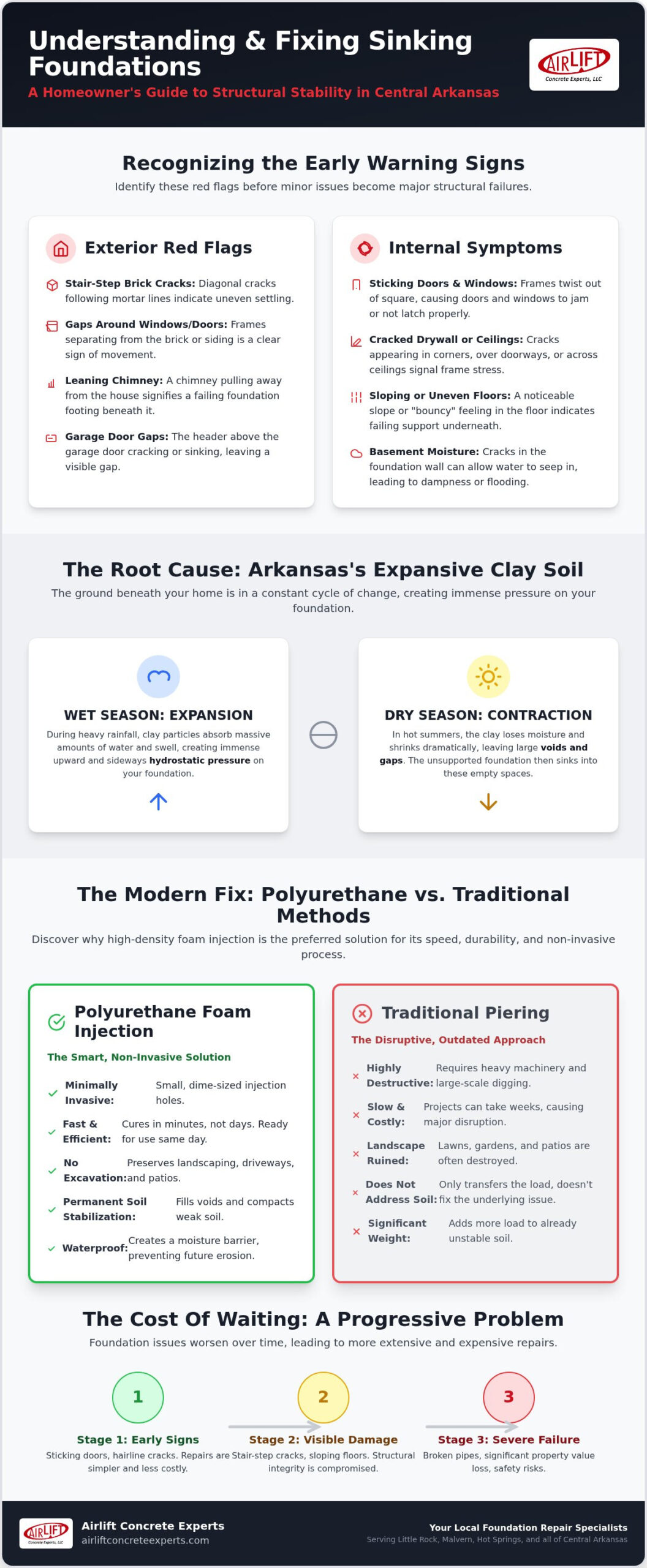
One of the most common indicators is the appearance of stair-step cracks in your exterior brickwork. These cracks follow the mortar lines and suggest that one section of your home is dropping faster than the rest. You might also notice gaps forming around window frames or a chimney that appears to be leaning away from the siding. These aren’t just aesthetic flaws. They’re clear signals that the structural integrity of your home is under stress.
Interior symptoms are often more subtle but equally concerning. You might find that doors which once swung freely now stick or refuse to latch. Sloping floors can make a room feel “off,” while cracks in the drywall or ceiling corners indicate that the frame is twisting. In many Little Rock homes, the “garage door gap” is a primary red flag. This happens when cracks form above the garage header as the slab-on-grade foundation begins to sink into the shifting soil below.
It’s important to distinguish between cosmetic settling and structural sinking. Small, vertical hairline cracks in a new build might just be the concrete curing. However, structural issues typically present as wider, diagonal cracks or “slumping” in concrete slabs like driveways and patios. Differential settlement is the primary cause of Arkansas structural cracks, occurring when the soil fails unevenly across the footprint of the house. Identifying these patterns early allows for a targeted repair rather than a total foundation overhaul.
Foundation problems are progressive. What starts as a sticking door can eventually lead to broken utility lines or complete structural instability. Beyond the physical risks, these issues have a severe impact on property value. Selling a home with foundation damage is notoriously difficult and often results in significant price drops. Seeking polyjacking near me provides a preventative fix that stabilizes the ground before the damage becomes catastrophic. Addressing sinking foundation repair Arkansas needs early ensures your home remains safe and its market value stays protected.
The beauty of the Natural State often masks a challenging reality for homeowners: the ground is rarely as stable as it looks. Central Arkansas is dominated by “Expansive Red Clay,” a soil type that acts more like a living organism than a static building surface. This clay is notorious for its high reactivity to moisture, which is the primary reason many residents eventually require sinking foundation repair Arkansas. Unlike sandy soils that allow water to pass through, our clay traps it, leading to significant volume changes throughout the year.
During our heavy rainfall seasons, these clay particles absorb water and expand significantly. This expansion creates immense hydrostatic pressure against your home’s footings and basement walls. Over time, this constant pushing can force walls to bow or foundations to shift. When the weather turns dry during our sweltering summers, the opposite happens. The clay loses its moisture and shrinks, leaving large voids beneath concrete slabs. Without the soil there to support the weight, the foundation inevitably drops into the empty space. This cycle of movement is why sinking foundation repair Arkansas is a specialized field that requires a deep understanding of local geology.
In areas like Malvern and Benton, the rolling hillsides present an additional challenge. Poor drainage on these slopes allows water to pool near the foundation or rush past it, causing the soil to erode. This combination of expansion, contraction, and erosion makes foundation maintenance a unique struggle for regional property owners. Without a proper management strategy, even a well-built home can begin to show signs of distress within just a few seasons.
Think of Arkansas clay as a giant, underground sponge. At a microscopic level, these clay particles are designed to hold onto water, swelling to several times their dry size. Our local weather provides the perfect storm for this process, as we often oscillate between extreme saturation and intense heat. This constant movement fatigues the concrete, leading to the cracks and shifts that threaten your home’s stability. Understanding the density of your soil is a critical step in any foundation repair near me, as it dictates how much support the structure actually has during these cycles.
Geography plays a major role in how these soil issues manifest. In Hot Springs Village, the hilly terrain often leads to uneven load distribution, where one side of a home sits on rock while the other rests on shifting soil. Meanwhile, homes in the Arkansas River Valley deal with higher baseline moisture levels that keep the soil in a near-constant state of expansion. We also see frequent “washout” areas after spring storms, where the soil literally disappears from beneath a patio or sidewalk. If you’ve noticed your walkway or porch pulling away from the house, scheduling a professional assessment can help identify if these geographic factors are at play before the damage spreads to your main structure.
High-density polyurethane injection has revolutionized how we approach structural stabilization in the Natural State. This material is a lightweight, waterproof, and eco-friendly structural resin specifically engineered to handle the demands of our local environment. Unlike traditional methods that rely on heavy cement-based mixtures, polyurethane provides a stable lift without adding unnecessary stress to the already fragile soil. For homeowners dealing with sinking foundation repair Arkansas, this modern approach offers a permanent fix that addresses the root cause of the shift without the need for massive excavation.
The process is remarkably non-invasive. Instead of bringing in heavy machinery that destroys your flower beds or lawn, we drill penny-sized holes directly through the concrete. We then inject the resin through these small ports. Most Arkansas homes can be stabilized in a single day. This allows you to return to your normal routine without the weeks of disruption common with older, more aggressive techniques. It’s a neighborly way to handle a high-stress problem.
One of the most critical advantages is the weight of the material itself. Traditional mudjacking uses a heavy slurry that can weigh upwards of 100 pounds per cubic foot. In the soft, expansive clay found in Malvern or Little Rock, adding that much weight can actually cause more sinking over time. High-density foam weighs only a few pounds per cubic foot. It provides the necessary lift and support without the risk of further settlement caused by excess weight.
In 2026, the choice between polyjacking and mudjacking comes down to long-term performance and efficiency. Polyurethane cures in minutes, whereas mudjacking requires days to fully dry. This rapid cure time means you can use your driveway or patio almost immediately after we finish the job. Additionally, polyurethane is waterproof. It won’t wash away during a heavy spring storm or shrink during a record-breaking Arkansas heatwave. While mudjacking might seem like a cheap fix initially, the durability of polyurethane provides much better long-term value for your property.
Our technicians maintain total control during the injection process. The chemical reaction allows the foam to expand and fill every hidden void beneath the slab before the lifting begins. We can control the lift to within 1/10th of an inch, ensuring your floors return to their original level with surgical precision. This level of accuracy makes the method ideal for concrete lifting in residential driveways where both appearance and drainage slope are vital for home maintenance.
The ground in Central Arkansas isn’t uniform. Neighborhoods just a few miles apart can face entirely different structural challenges. For instance, lakefront properties in Malvern and Hot Springs deal with constant moisture saturation and fluctuating water levels that can soften the soil beneath a dock or a home’s perimeter. These specific environmental factors require a contractor who understands the local water table and how it interacts with different types of fill. Choosing someone who knows the region ensures that your sinking foundation repair Arkansas project is tailored to your specific zip code rather than a generic template.
In more urban settings like Little Rock and North Little Rock, many homes utilize slab-on-grade construction. These slabs are particularly vulnerable to the “garage door gap” and interior floor sloping mentioned earlier. We also provide commercial concrete lifting for growing business districts in Conway and Cabot. Large warehouses and retail spaces in these areas often experience slab sinking due to heavy machinery and high foot traffic. Using high-density resins allows these businesses to stay operational while we stabilize their floors with minimal disruption.
If you’re unsure about the state of your property, you can request a complimentary assessment to get expert eyes on your foundation before small cracks become major structural liabilities.
We tailor our stabilization techniques to match the varied architecture found in Bryant, Benton, and Sherwood. While a ranch-style home in Sherwood might need simple interior floor leveling, a property in Hot Springs Village often requires specific slope-stabilization techniques. The hilly terrain in the Village creates uneven pressure on foundation walls, making expert precision vital. Our local roots also mean we understand the urgency of 24-hour response times during our intense spring flood seasons. When the water rises, you need a partner who can move quickly to protect your home’s structural integrity.
While professional intervention is necessary for active sinking, you can take several steps to maintain your home’s stability. Proper drainage is your first line of defense. We recommend these simple actions:
Staying proactive with these small tasks can significantly extend the life of your foundation and prevent the need for more invasive repairs down the road.
Choosing a partner for sinking foundation repair Arkansas is a decision that impacts the safety and longevity of your largest investment. At Airlift Concrete Experts, we’ve spent years refining our approach to structural stabilization. As a family-owned business founded in 2017, we’ve built our reputation on providing honest, neighborly service to homeowners in Malvern, Little Rock, and Hot Springs. We understand that foundation issues cause significant anxiety, which is why we focus on delivering a transparent, solution-oriented experience from the first phone call to the final walkthrough.
Our team specializes exclusively in repair and stabilization rather than new concrete construction. This narrow focus allows us to maintain a high level of technical expertise in the specialized field of polyurethane injection. By dedicating our resources to the science of lifting and leveling, we provide a cleaner, more efficient alternative to traditional mudjacking. Our commitment is to offer permanent fixes that respect your property, ensuring that your landscaping and daily routine remain as undisturbed as possible.
Every project begins with a complimentary initial assessment. During this visit, we don’t just look at cracks; we analyze the underlying causes of settlement. We take the time to explain how the local soil conditions are affecting your specific structure and provide a clear, no-pressure plan for restoration. This educational phase is vital for transforming your concern into a sense of security.
We follow a methodical, organized rhythm to ensure every repair meets our standards for durability and safety. Our process is designed to be steady and predictable:
A sinking foundation doesn’t have to be a source of constant worry. By addressing the issue with modern technology and local expertise, you can regain the peace of mind that comes with a stable, level home. Whether you’re in the heart of Little Rock or the hills of Malvern, we’re ready to help you secure your property’s future. Taking the first step now prevents the progressive damage that leads to much more expensive repairs later. Contact Airlift Concrete Experts for your complimentary assessment today!
Your home is your most significant investment, and it deserves a foundation that stands firm against the unpredictable Arkansas climate. By recognizing early warning signs like sticking doors or exterior cracks, you can address structural issues before they escalate into costly disasters. We’ve seen how the specialized use of high-density polyurethane foam provides a cleaner, faster, and more durable alternative to traditional repair methods. This advanced technology ensures your property remains stable without the need for invasive digging or heavy machinery.
As a family-owned and operated business based in Malvern, Airlift Concrete Experts is proud to serve Little Rock, Hot Springs, and all of Central Arkansas. We understand the unique challenges of our local soil and are committed to providing permanent, honest solutions for sinking foundation repair Arkansas homeowners can trust. You don’t have to face structural concerns alone. Get Your Free Foundation Inspection from Airlift Experts and take the first step toward a level, secure home today. Your peace of mind is just one assessment away.
The cost of foundation repair depends on several variables, including the size of the home, the depth of the settlement, and the specific soil conditions on your property. Factors like the number of injection ports needed or the severity of the structural damage will influence the final investment. Because every project is unique, we provide complimentary initial assessments to give you an accurate understanding of the work required for your home.
Most standard homeowner’s insurance policies in Little Rock don’t cover foundation repair caused by common issues like soil compaction or “shrink-swell” cycles. Coverage is typically only available if the damage resulted from a sudden, covered event like a major plumbing leak or a fire. It’s best to review your specific policy or speak with your agent to see if you have any specialized endorsements for structural movement or environmental risks.
Most residential polyurethane foam injection projects are completed in just one day. This is a significant advantage over traditional methods like mudjacking or piering, which can take several days or even weeks. Because the high-density resin cures in minutes, you can often resume normal use of your driveway, patio, or interior floors almost immediately after our team finishes the job. This efficiency minimizes the disruption to your family’s daily routine.
Yes, you can stay inside your home throughout the entire leveling process. Since polyurethane injection is a non-invasive method that uses small, penny-sized ports, there’s no need for massive excavation or heavy equipment that would make your home uninhabitable. The process is relatively quiet and clean, allowing you to go about your day with minimal interference while we stabilize the ground beneath your home’s structure.
The high-density polyurethane we use is environmentally inert and safe for use in your yard. Once the resin cures, it becomes a stable, waterproof material that doesn’t leach chemicals into the surrounding soil or groundwater. This makes it an ideal choice for Arkansas properties, especially those near sensitive areas like the lakes in Hot Springs, where protecting the local ecosystem is a priority for every homeowner.
House leveling is a specific type of repair that focuses on bringing a structure back to its original, level position. Foundation repair is a broader category that includes stabilization, crack sealing, and moisture management. When we perform sinking foundation repair Arkansas residents often need both stabilization to stop the movement and leveling to restore the home’s aesthetics. Both are essential for long-term structural health and maintaining your property’s value.
Your foundation often sinks more in the summer because the expansive red clay beneath your home shrinks as it loses moisture, which often triggers the need for sinking foundation repair Arkansas. This soil shrinkage creates large voids, causing the structure to drop into the empty space. While the ground may expand again during the wet winter months, the structural damage remains, making permanent stabilization necessary to prevent the cycle from repeating next year.
You can usually distinguish between the two by looking at the crack’s width, direction, and location. Minor hairline cracks that are vertical are often just “settling” cracks from the concrete curing. However, cracks that are wider than a quarter-inch, run diagonally, or form a “stair-step” pattern in exterior brick are major structural red flags. If you notice these patterns along with sticking doors, it’s time for a professional structural evaluation.

 Call Now