

Have you ever walked across your driveway or garage floor and heard a hollow “thud” that wasn’t there last year? It’s a sound that often triggers immediate anxiety for Arkansas homeowners, as it usually signals that you need professional void filling under concrete slab surfaces before a major collapse occurs. You’re likely worried about tripping hazards on your sidewalks or the staggering cost of tearing everything out to start over. we understand that your home is your most significant investment, and seeing your concrete crack or sink feels like a direct threat to your family’s safety and your long-term property value.
The good news is that a hollow space doesn’t have to mean a total loss. You can restore your property’s stability and protect against future erosion without the mess or expense of a full construction project. This guide will show you how to identify the warning signs caused by our unique regional soil conditions and why modern polyurethane injection is a superior, cost-effective alternative to traditional replacement. We’ll walk through the technical process of structural stabilization so you can move from feeling uncertain to feeling completely confident in the ground beneath your feet.
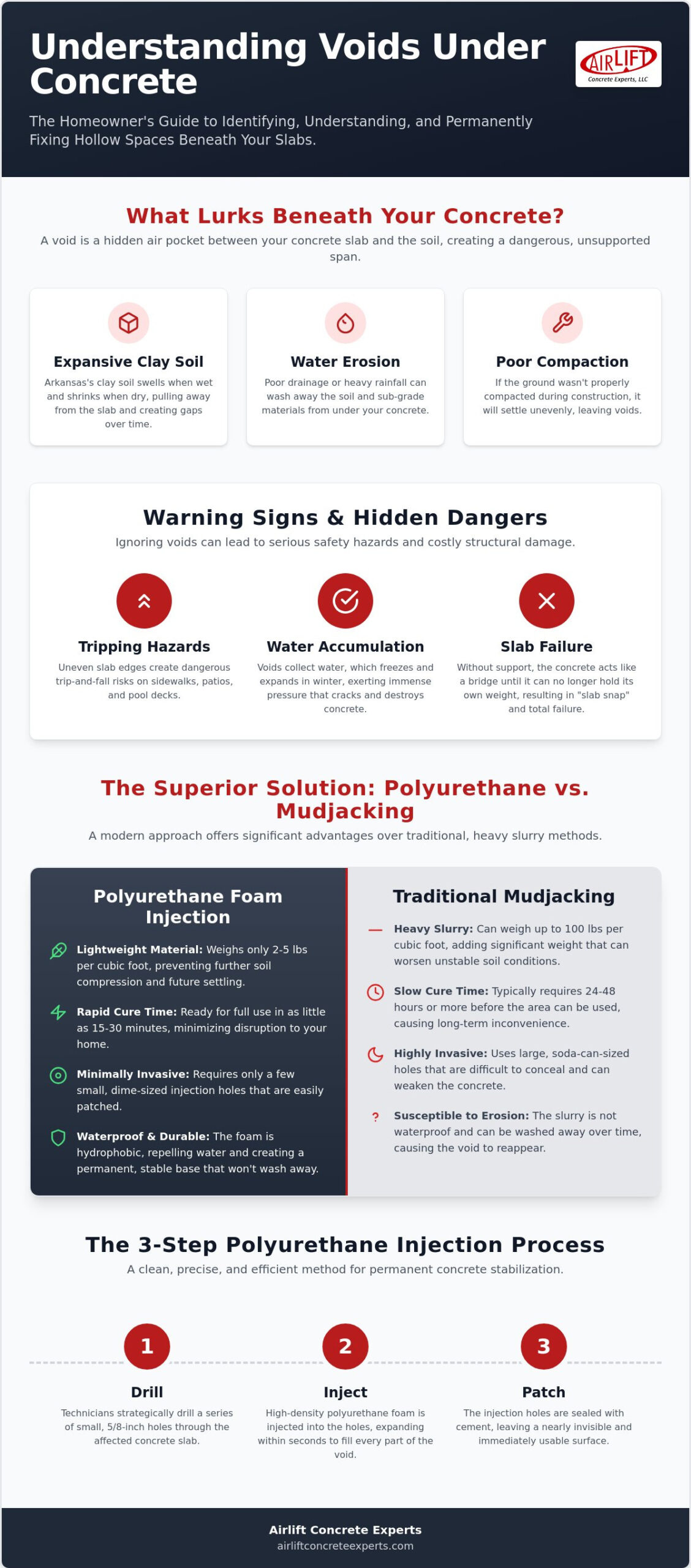
A void is essentially an empty pocket of air that develops between the bottom of your concrete and the soil meant to support it. While your driveway or patio might look solid from the surface, these hidden gaps are a silent threat to your property’s structural integrity. Unlike natural settling, where the entire slab and soil move together over time, a void creates a lack of support in specific areas. This transforms your concrete into a bridge that isn’t designed to hold its own weight, let alone the weight of a vehicle. When the tension becomes too great, you experience “slab snap,” which results in deep, jagged cracks that often require void filling under concrete slab surfaces to prevent total failure.
Arkansas homeowners face unique challenges due to our regional geology, specifically the prevalent red clay soil. This type of soil is highly expansive; it swells significantly when wet and shrinks during our hot, dry summers. This constant cycle of expansion and contraction creates natural gaps where soil pulls away from the concrete. Over time, these gaps become permanent voids that leave your foundation or driveway vulnerable.
Heavy rainfall and poor drainage also play a major role in erosion. When water isn’t properly diverted away from your home, it can tunnel beneath the concrete and wash away the sub-grade materials. Various Concrete leveling techniques have evolved to address this, but the root cause is often a combination of environmental factors and original construction flaws. If a builder didn’t properly compact the soil or if organic debris like tree roots was left in the ground to decompose, the resulting instability is almost guaranteed to create hollow spaces.
Ignoring a hollow slab doesn’t just lead to cracks; it creates genuine safety hazards for your family and guests. As the slab shifts, it creates uneven edges that become dangerous tripping hazards on sidewalks and porches. These edges can change by a fraction of an inch overnight, making them difficult to spot until someone catches their foot on them.
Water accumulation is another major concern for Central Arkansas residents. When a void exists, it acts as a reservoir for groundwater. During our winter months, this trapped water undergoes a freeze-thaw cycle, expanding as it turns to ice and exerting immense upward pressure on your concrete. This eventually destroys the slab’s load-bearing capacity. A driveway that once held a heavy truck may suddenly fail under the same weight because the underlying support is gone. Professional void filling under concrete slab structures restores that support, ensuring your concrete remains a stable, reliable part of your home for years to come.
While many people think of concrete repair only in terms of “lifting” a sunken section, the most critical step for long-term durability is void filling under concrete slab surfaces. Polyjacking has emerged as the modern gold standard for this task because it addresses the hidden air pockets that lead to structural failure. Unlike older methods that simply push a slab upward using heavy materials, this process focuses on replacing empty space with a high-density polymer that acts as a permanent support system. It’s a precise, non-invasive solution that restores the ground’s load-bearing capacity without the need for heavy machinery or total demolition.
The material used in this process is a specialized two-part liquid polymer that reacts and expands into a rigid, structural foam within seconds of injection. This expansion is powerful enough to lift thousands of pounds, yet the material itself is incredibly lightweight, weighing only about 2 to 5 pounds per cubic foot. This is a significant advantage over traditional slurry, which can weigh up to 100 pounds per cubic foot and often causes further soil sinking due to its own mass. Compressive strength in the context of slab support refers to the foam’s ability to resist being crushed or flattened under the heavy weight of the concrete and the vehicles or machinery resting on top of it.
Because the foam is hydrophobic, it doesn’t just tolerate water; it actively displaces it. This makes it ideal for Arkansas’s humid climate and high water tables, as the foam won’t wash away or degrade during heavy rain cycles. A Transportation Research Board study on stabilization techniques reinforces the effectiveness of pressure-injected materials in maintaining the integrity of concrete pavements. Additionally, once the foam cures, it becomes environmentally inert, ensuring it won’t leach harmful chemicals into our local Arkansas groundwater or soil. If you suspect your driveway or garage floor has lost its support, you can request a professional evaluation to determine the extent of the hollow space.
The actual repair is remarkably efficient and causes minimal disruption to your daily routine. Our technicians follow a methodical approach to ensure the void filling under concrete slab is complete and lasting:
Choosing the right method for void filling under concrete slab surfaces often comes down to understanding the physics of your soil. For decades, mudjacking was the standard approach; however, it relies on a heavy slurry of sand, cement, and soil. In the expansive clay environments of Malvern and Little Rock, adding weight to unstable ground is often counterproductive. Modern polyurethane technology provides a lightweight, durable alternative that solves the problem without the drawbacks of older techniques. By prioritizing stability over bulk, you can ensure a repair that lasts as long as the concrete itself.
Traditional mudjacking slurry weighs approximately 100 pounds per cubic foot. When this massive weight is pumped into a void, it often causes the underlying Arkansas clay to compress even further, leading to secondary settling and new cracks. High-density polyurethane foam weighs only 2 to 5 pounds per cubic foot. This allows it to fill the empty space and stabilize the slab without adding a new burden to the soil. It’s a surgical approach to structural repair that treats the cause of the problem rather than just the symptoms.
The aesthetic and functional differences are equally stark. Mudjacking requires drilling large, 2-inch holes that are difficult to hide once the job is finished. Polyjacking uses tiny, 5/8-inch holes about the size of a penny. Because the foam cures in as little as 15 to 30 minutes, you can park your car on the driveway almost immediately. Traditional slurry mixes can take days to fully harden, leaving your property out of commission. Additionally, polyurethane is hydrophobic; it won’t wash away during heavy rain or shrink over time like a soil-based mixture, making it a much more reliable choice for our regional climate.
Many homeowners assume that a cracked or hollow slab requires a full replacement, but this is rarely the most efficient path. Choosing polyjacking near me can save you between 50% and 70% compared to the cost of pouring new concrete. Beyond the financial savings, repair is far less disruptive to your landscape. You won’t have to deal with heavy demolition equipment or the mess of a new construction site that can take weeks to resolve.
Perhaps most importantly, pouring new concrete doesn’t address the underlying soil issues. If you replace the slab without performing void filling under concrete slab areas, the new concrete will eventually sink into the same hollow spaces that destroyed the old one. By stabilizing the base with polyurethane, you’re investing in a long-term solution that protects your property for years to come. It’s a smarter, more sustainable way to maintain your home’s value and safety.
Detecting a problem before your driveway or garage floor actually fails is the key to preventing a costly replacement. While some hollow spaces are obvious, many remain hidden until the weight of a vehicle or a heavy rainstorm causes a sudden drop. One of the most effective ways to check for these gaps is the “thump test.” By tapping the surface of your concrete with a heavy tool or even your heel, you can listen for a distinct, echoing “thud” that sounds like a drum. A solid slab will produce a dull, sharp sound because it has full contact with the sub-grade. If you hear that hollow echo, it’s a strong indication that you need void filling under concrete slab surfaces to restore structural support.
Visual cues provide another layer of diagnostic evidence. Walk around the perimeter of your patio or pool deck and look for gaps between the concrete edge and the adjacent soil. If you can see daylight beneath the slab, the erosion has already begun. You should also watch for pooling water during our frequent Arkansas storms. If water consistently gathers in one spot and then disappears quickly, it might be draining into an underground cavern that is washing away your foundation’s base. These stress patterns often lead to hairline cracks, which signal that the concrete is flexing because it no longer has a firm foundation to rest on.
The symptoms of a hollow slab aren’t always found directly on the concrete itself. In many Central Arkansas homes, an interior slab that has lost its support will cause the entire structure to shift slightly. You might notice your front door sticking in the frame or windows that suddenly become difficult to open. Inside, look for cracks in the drywall or the exterior brickwork above the foundation line. These are often the first signs that a slab is tilting, even if the movement is only a fraction of an inch. Catching these early allows for a simple void filling under concrete slab project rather than an extensive foundation overhaul.
It’s tempting to try a DIY approach with store-bought foam kits, but these rarely provide a permanent fix. Professional-grade polyurethane requires precise pressure monitoring and specialized injection equipment to ensure the material reaches every corner of the void. Without the right tools, you risk over-lifting the slab or leaving massive air pockets that will only cause more trouble later. Professional equipment allows for the surgical precision needed to stabilize your home without the guesswork of retail products.
If you’ve noticed any of these warning signs, schedule a comprehensive site evaluation with our team to get an accurate picture of your property’s health. For more complex issues involving the home’s structure, requesting a professional foundation repair consultation is the best way to ensure your home stays level and secure for the long term.
Airlift Concrete Experts stands as the definitive regional authority for void filling under concrete slab projects throughout Central Arkansas. Since 2017, our family-owned and operated company has prioritized the structural safety of our neighbors’ homes in Malvern, Little Rock, and Hot Springs. We understand that your home is often your most valuable asset, and we treat every repair with the care and precision it deserves. We don’t just patch surface cracks; we provide permanent stabilization using the most advanced high-density polyurethane foam technology available in 2026. This commitment to modern, specialized methods ensures that your repair isn’t just a temporary fix but a long-term investment in your property’s durability and your family’s peace of mind.
Our team possesses a deep, localized understanding of the geological challenges that define our region. We’ve spent years observing how the expansive red clay in Central Arkansas reacts to our intense seasonal moisture cycles. This expertise allows us to tailor our injection patterns for maximum effectiveness, ensuring the foam reaches the deepest pockets of erosion. We have established a proven track record of polyurethane concrete leveling for residential driveways, pool decks, and patios across the state. Because we’re rooted right here in Malvern, we offer exceptionally quick response times for residents in Benton, Bryant, and Conway. We pride ourselves on being a reliable partner that understands the specific environmental conditions of your neighborhood better than any national franchise.
While we take great pride in securing family homes, we also provide robust, specialized solutions for the Arkansas business community. Commercial slabs, such as warehouse floors, retail spaces, and high-traffic loading docks, face much higher stress loads than a standard residential driveway. Our high-density foam is specifically engineered for these heavy-duty applications, restoring the load-bearing capacity of the floor without the need for messy, disruptive demolition. We focus on the structural integrity of the entire facility, ensuring that your interior floor leveling meets the rigorous demands of your industry.
One of the greatest advantages for our commercial clients is our ability to minimize operational downtime. Because our rapid-cure polyurethane reaches full strength in less than 30 minutes, businesses can resume operations almost immediately after we finish the void filling under concrete slab. This efficiency prevents the loss of revenue that typically accompanies traditional concrete replacement. Whether you’re managing a local shop in Hot Springs or a large industrial facility in Little Rock, we provide the technical expertise and specialized equipment to keep your operations running smoothly. We invite you to contact us today to discuss your specific needs and schedule a complimentary initial assessment of your property’s concrete.
Protecting your home starts with understanding the ground beneath it. We’ve explored how the unique Arkansas climate interacts with our regional soils to create hidden hazards. By choosing professional void filling under concrete slab surfaces, you’re opting for a modern, non-invasive method that stabilizes your property without the weight and mess of outdated slurry. You now have the tools to spot warning signs early and the knowledge that high-density foam provides a permanent, waterproof barrier against future erosion.
Airlift Concrete Experts has been a trusted partner for Central Arkansas homeowners since 2017. As a locally owned and operated specialist in Malvern, we take pride in delivering results that stand the test of time. It’s time to transform your structural concerns into long-term security. Get Your Free Void Filling Assessment in Arkansas Today to restore the safety and value of your concrete surfaces. We look forward to treating your home with the same care we’d give our own neighbors.
Professional technicians fill these gaps by injecting high-density polyurethane foam through small, 5/8-inch holes drilled into the concrete. The liquid polymer expands within seconds to fill every corner of the empty space while simultaneously compacting the loose soil beneath. This process provides a stable, rigid base that restores the structural integrity of the surface without the need for heavy machinery.
High-density structural polyurethane is the superior choice for void filling under concrete slab surfaces in Arkansas. It is far lighter than traditional mudjacking slurry, which prevents it from further compressing our regional clay soils. The material is also hydrophobic, meaning it won’t wash away or degrade when exposed to groundwater or heavy rain cycles.
The cost of the repair depends on the total volume of the hollow space and the depth of the soil erosion. Factors like accessibility and the amount of material required to achieve stabilization will influence the final price. While we don’t provide flat rates, void filling is consistently a more cost-effective alternative than tearing out and replacing an entire driveway.
You shouldn’t attempt to use standard insulation spray foam for this type of repair. Canned foams designed for home insulation lack the compressive strength required to support the weight of a concrete slab or foot traffic. Structural-grade polyurethane is a specialized industrial product engineered specifically to hold thousands of pounds without collapsing.
The most common sign is a hollow “thud” sound when you walk across the floor or tap it with a heavy object. You might also notice that the slab is starting to tilt away from the foundation or that your interior doors have begun to stick in their frames. If you see gaps where the soil has pulled away from the concrete edge, a void is likely present.
Polyurethane void filling under concrete slab structures is a permanent solution because the foam is environmentally inert and waterproof. Once it cures, it doesn’t shrink or lose its shape over time. However, it’s vital to address any underlying drainage issues on your property to ensure that new erosion doesn’t occur in the soil surrounding the repaired area.
The injection process is capable of both filling voids and lifting sunken slabs. While the initial goal is to fill the air pocket and stabilize the ground, the expansive force of the foam can be controlled to raise the concrete back to its original, level position. This dual-action process is often referred to as polyjacking.
Leaving a void unaddressed almost always leads to “slab snap,” where the concrete eventually cracks and collapses into the hollow space. This creates dangerous tripping hazards and can lead to expensive foundation damage as water begins to collect in the gap. Addressing the problem early prevents the need for a total and costly concrete replacement.

 Call Now