
You are walking across your living room when you feel it: that unsettling, “spongy” bounce under your feet that simply didn’t exist last year. Perhaps you have started noticing thin cracks in the drywall above your door frames, or maybe you find yourself worrying about structural failure every time the Arkansas storm season brings heavy rains. These symptoms are more than just cosmetic nuisances; they are signs that the soil beneath your home is shifting. We understand that seeing your largest investment show signs of instability is stressful, and you deserve a solution that provides lasting security rather than a temporary patch.
In this guide, you will discover the professional methods used to permanently fix bouncy, uneven floors and structural sagging in Arkansas crawl spaces. Many homeowners begin their journey by researching sunken concrete floor repair Arkansas to address visible dips, but restoring a sagging floor requires a deep understanding of our region’s unique clay soils and humidity levels. We will walk you through the root causes of floor failure and the specialized support systems that return your home to a level, stable state. By the end of this article, you will have a clear path toward a home that feels solid underfoot once again.
Many homeowners in Central Arkansas first notice a problem when they step into a hallway and feel a distinct “give” under their feet. This “spongy” or bouncy sensation is more than just a quirk of an older house. It is often the first physical indicator that the support system beneath your feet is no longer making firm contact with the floor joists. You might also notice gaps appearing where your floorboards used to meet the baseboards or crown molding. These spaces aren’t just an eyesore; they show that the subfloor is physically pulling away from the home’s rigid frame.
Watch your interior doors closely. If they suddenly start to stick, swing open on their own, or refuse to latch properly, the frame has likely shifted out of square. This is frequently accompanied by diagonal “stair-step” cracks in the drywall near the corners of door frames. While homeowners often search for sunken concrete floor repair Arkansas to address driveway or garage issues, the same soil instability frequently manifests as these sagging interior floors over a crawl space. These symptoms are your home’s way of signaling that the structural equilibrium has been disrupted.
A sloping floor is rarely a standalone issue. It is typically the final symptom of long-term settlement or moisture damage. Understanding What is a Crawl Space? helps clarify why these structural failures happen, as these areas are highly susceptible to the moisture and soil shifts that compromise wooden supports. You can perform a simple “level test” by placing a ball or a carpenter’s level in different zones of a room to identify exactly where the dip is deepest. It is vital to distinguish between superficial floor finish issues, like warped hardwood, and deep subfloor sagging. Superficial issues stay on the surface, but structural sagging affects the entire plane of the room, often dragging furniture and partition walls down with it.
Ignoring these early warning signs in Central Arkansas can lead to significant complications. Our regional soil is known for its dramatic expansion and contraction, which can turn a minor bounce into a major structural failure over just a few seasons. Beyond the physical danger, structural instability can significantly impact your home’s resale value, as savvy buyers and inspectors will immediately flag uneven floors. Cosmetic fixes like wood filler or new carpeting won’t solve the problem because they don’t address the failing piers or rotted joists below. Reaching out for a professional assessment ensures you are treating the root cause rather than just masking a symptom. We believe in providing a clear, honest look at what is happening under your home so you can make an informed decision for your family’s safety.
Arkansas homeowners face a unique set of environmental challenges that aren’t present in many other states. The red clay soil found throughout our region is notorious for its expansive nature. When it rains heavily, the clay absorbs water and swells, exerting massive upward pressure on your home’s foundation. During our hot, dry summers, that same soil shrinks and pulls away from your footings. This constant cycle of heaving and shrinking is why you might find yourself looking into sunken concrete floor repair Arkansas for your exterior slabs while simultaneously noticing sagging floors inside your living room.
In cities like Malvern and Hot Springs, the rocky yet clay-heavy terrain makes pier stability a constant battle. If your yard has poor drainage, water pools around the foundation and saturates the soil beneath your crawl space piers. These piers can only remain stable if the soil beneath them stays consistent. When the ground shifts, those supports sink or tilt, leaving your floor joists without the solid base they need to stay level. While these systems are designed to meet International Residential Code foundation standards, even the best-built footings can struggle when the very earth beneath them is in motion.
Humidity is the second major culprit for floor failure in Little Rock and Conway. Because of the “stack effect,” warm air rises through your home and pulls damp, heavy air from the crawl space up into your living areas. This process traps moisture against your load-bearing floor joists. In the context of an Arkansas crawl space, relative humidity refers to the amount of water vapor present in the air compared to the maximum amount the air could hold at that same temperature. When this level stays consistently high, it creates a perfect breeding ground for wood rot.
Over time, chronic moisture leads to the “softening” of structural beams. Traditional supports like wood blocks or stacked bricks often fail because they lack the material integrity to withstand this damp environment. Wood shims rot, and bricks can shift as the saturated soil beneath them loses its load-bearing capacity. If you suspect your home’s supports are struggling, a professional assessment from a local specialist can help identify which joists have been compromised before the damage spreads. Identifying these issues early is the best way to prevent a minor bounce from turning into a major structural repair project.
Homeowners often try to address sagging floors with traditional “contractor fixes” that might have worked in drier climates but frequently fail in the humid conditions of Central Arkansas. You might have seen shimming, where cedar scraps, wood wedges, or even stacked bricks are forced between a pier and a beam to close a gap. While this might stop a floor from bouncing for a few months, it does nothing to address underlying soil settlement. Because wood is an organic material, it continues to compress and rot in damp crawl spaces. This leads to a cycle of repetitive repairs that never truly stabilize your home’s structure.
Sistering joists is another common approach where a new piece of lumber is nailed alongside a damaged or sagging one. However, if the root cause is moisture or microbial growth, the rot can easily transfer from the old wood to the new “sister” joist. These wood-on-wood repairs continue to settle as moisture levels fluctuate throughout the year. Many DIY crawl space repairs eventually lead to more expensive professional interventions because the initial “band-aid” fix allowed the structural damage to worsen. Relying on wood in a damp environment is simply a temporary measure that ignores the reality of Arkansas’s environment.
Modern structural repair has moved toward heavy-duty steel crawl space support jacks for a permanent solution. Unlike wood or concrete blocks, these systems offer infinite adjustability. This allows for precise, incremental floor leveling over time, which is essential to avoid cracking your drywall by lifting the structure too quickly. The galvanized steel construction is specifically designed to resist the high humidity levels we see in Benton and Cabot. It won’t rust, rot, or compress, ensuring that once your floor is level, it stays that way.
These steel posts do more than just hold up a beam. They distribute the floor’s weight to deeper, more stable soil strata by utilizing an engineered base. This bypasses the unstable surface clay that causes so much trouble for Arkansas foundations. When you calculate the long-term ROI, permanent structural steel is significantly more cost-effective than repetitive wood repairs. While you might initially search for sunken concrete floor repair Arkansas to fix a driveway, investing in high-quality steel interior supports protects your home’s internal foundation from the inside out. This approach transforms an anxious situation into a sense of security for your family’s future.
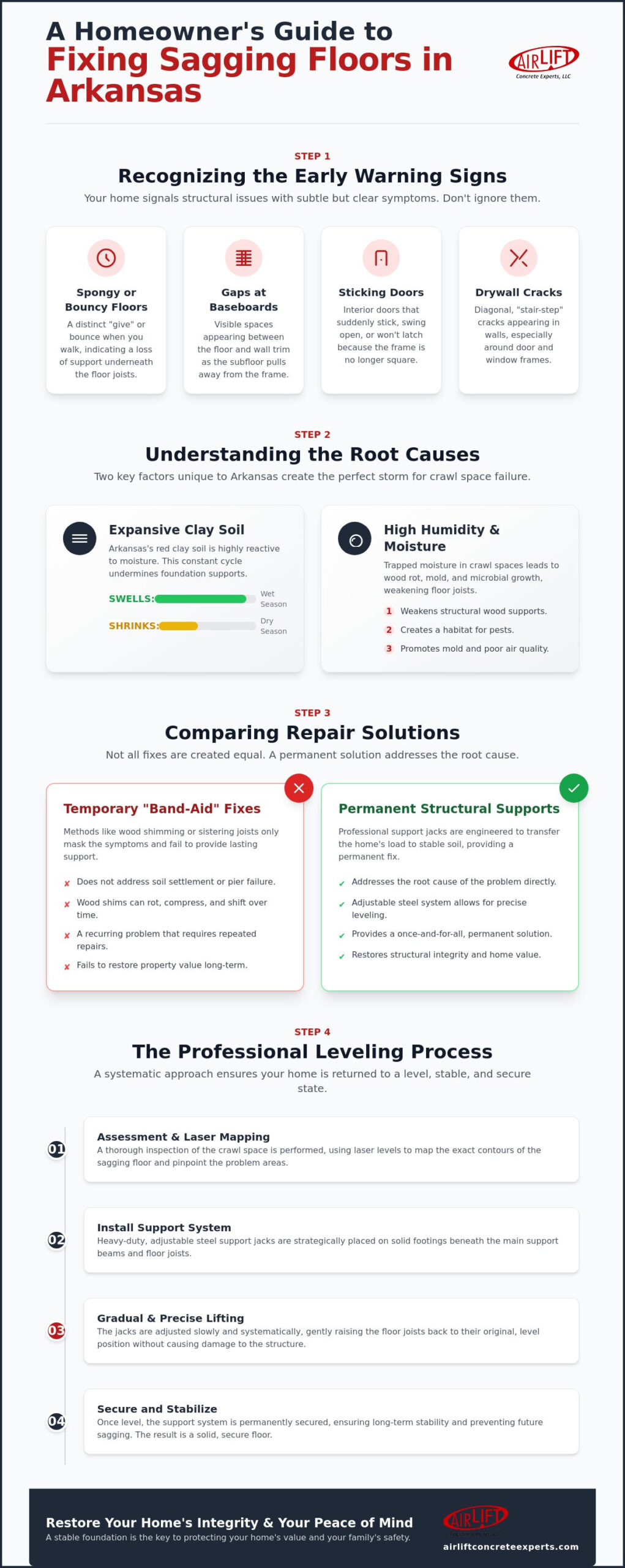
Every successful structural repair begins with accurate data. Our technicians start by conducting a comprehensive structural assessment and laser-level mapping of your entire floor. This isn’t a “best guess” operation. We use advanced diagnostic tools to identify every low spot and structural dip with millimeter precision. While many residents initially look for sunken concrete floor repair Arkansas to fix outdoor surfaces, the same technical rigor applies to interior leveling over a crawl space. Once we have a clear map of the sag, we prepare the crawl space environment. This involves clearing out old debris and ensuring our technicians have safe, unobstructed access to the failing beams and joists.
Next, we address the foundation of the repair itself. We don’t simply place jacks on the bare dirt. We install high-strength concrete footings for each new steel support post. These footings provide a stable, broad base that prevents the new supports from sinking into the soft Arkansas clay. By creating a solid platform, we ensure that the upward pressure we apply actually lifts the house rather than just pushing a support deeper into the ground.
The lifting phase is where technical expertise meets careful patience. Technicians use laser levels to monitor the floor’s progress in real time. We follow a “slow and steady” hydraulic approach. This incremental method is designed to prevent sudden drywall cracking or structural shocks to the rest of the home. As we slowly adjust the jacks, we constantly monitor the home’s interior doors and trim. This ensures the house adjusts naturally to its original position. You’ll often see sticking doors begin to swing freely again before the job is even finished. This methodical pace is what distinguishes a professional repair from a rushed DIY attempt.
Once the desired level is achieved, we lock the steel supports permanently into place. We don’t leave the floor resting on temporary hydraulic tools. The weight is transferred entirely to the galvanized steel posts and their reinforced concrete footings. We perform a final inspection of all door operations, floor stability, and weight distribution to ensure everything is perfect. If you’ve been searching for foundation repair near me, you know that Central Arkansas soil requires a solution that won’t shift next season. Our process is designed to provide that exact stability. To see how these steps can be applied to your specific home, you can schedule your complimentary assessment with our local team today.
At Airlift Concrete Experts, we have spent years serving our neighbors across Central Arkansas, from the historic neighborhoods of Little Rock to the growing communities in Cabot. We understand that your home is your most significant investment, and seeing it show signs of structural distress can be deeply unsettling. Our team brings a level of regional authority that national contractors simply can’t match. We don’t just see a sagging floor; we see the specific ways our local red clay has reacted to recent seasonal shifts. This deep-rooted local experience is exactly what prevents repair failure and ensures your home remains stable for decades to come.
Our approach goes beyond simply jacking up a beam. We look at the entire environment under your home to ensure a permanent fix. While many homeowners initially contact us for polyurethane concrete leveling to address sunken driveways or garage slabs, they soon realize that interior floor health is part of the same structural ecosystem. We integrate our leveling services with a broad understanding of foundation health, ensuring that every adjustment we make contributes to the long-term safety of your property.
Stabilizing a sagging floor is often the first step in a more comprehensive plan for home maintenance. In many cases, floor leveling works best when paired with crawl space encapsulation services. This combination doesn’t just level the floor; it addresses the high humidity that causes joists to soften and rot in the first place. Protecting your home investment with professional foundation repair means looking at the big picture. By addressing soil movement, moisture levels, and structural supports simultaneously, we provide a solution that stands up to the unique environmental pressures of the Natural State.
We believe that every homeowner deserves a clear, honest understanding of their home’s condition without any high-pressure sales tactics. When you reach out for a complimentary on-site structural assessment, you can expect a methodical evaluation of your floor’s current state. We’ll walk you through our findings, explain the root cause of the sag, and provide a custom repair plan designed for your specific home. Whether you’ve been researching sunken concrete floor repair Arkansas for your porch or you’re worried about a new bounce in your kitchen floor, we’re here to help.
Our Malvern-based team is proud to provide expert service to families in Conway, Benton, and Bryant. We treat every project with the care and precision we would use on our own homes. You don’t have to live with the anxiety of uneven floors or sticking doors. Contact us today to schedule your assessment and take the first step toward restoring the solid, stable foundation your family depends on.
A sagging floor is a clear signal that your home’s foundation requires professional attention. By moving beyond temporary wood shims and choosing permanent structural steel supports, you address the root cause of instability caused by Arkansas’s expansive clay and high humidity. We have spent nearly a decade serving our neighbors in Little Rock, Conway, and Malvern with advanced structural steel and polyurethane solutions. As a family-owned and operated Arkansas business, we take pride in providing the specialized care your property needs to remain level and safe for years to come.
Whether you first noticed a bouncy hallway or were researching sunken concrete floor repair Arkansas to address exterior settlement, the solution starts with a precise, expert evaluation. You don’t have to navigate these structural concerns alone. Our team is ready to provide a clear, low-pressure path toward a stable home. Schedule Your Free Sagging Floor Assessment with Airlift Concrete Experts Today and take the first step toward permanent peace of mind. You deserve a home that feels solid under every step, and we are here to help you restore that lasting security.
The cost of leveling a sagging floor depends on several variables, including the number of support jacks required, the current condition of your floor joists, and the accessibility of your crawl space. Every home in Central Arkansas presents a unique structural profile based on its age and soil conditions. Because of these factors, we provide a detailed on-site assessment to give you an accurate scope of work rather than a generic estimate. Investing in a permanent solution now prevents the much higher costs associated with total floor joist replacement or significant foundation failure later.
Minor cosmetic cracking in the drywall can occur during the lifting process, but our technicians use a highly controlled, incremental approach to minimize this risk. We monitor your home’s interior doors, windows, and trim throughout the lifting phase to ensure the structure adjusts naturally to its original position. While a few small cracks might appear as the house returns to a level state, this is a normal part of restoring structural integrity. Most homeowners find that these minor cosmetic touch-ups are a small trade-off for a home that is once again stable and safe.
DIY fixes using bottle jacks and lumber are temporary measures that often lead to more significant structural damage. Wood-on-wood repairs continue to settle as moisture levels fluctuate, and standard lumber is highly susceptible to the same rot that caused the initial sag. Furthermore, improper lifting can put uneven pressure on your home’s frame, causing plumbing leaks or severe drywall damage. Professional sunken concrete floor repair Arkansas specialists use engineered steel jacks and reinforced footings to provide a permanent solution that DIY materials simply cannot match.
Most residential floor leveling projects are completed within one to two days. Our team works efficiently to prepare the site, install reinforced concrete footings, and secure the steel support posts. While the actual lifting happens in controlled increments, the installation of the hardware is relatively quick. We strive to minimize disruption to your daily routine, and because all the work happens beneath your home, you won’t have to deal with the mess and noise of a major interior renovation.
A sagging floor indicates a failure in your home’s support system, but it doesn’t always mean your entire foundation is failing. It often points to localized issues like rotted joists, undersized beams, or sinking interior piers. However, if left unaddressed, these problems can eventually put undue stress on your perimeter foundation walls. Catching a “spongy” floor early allows us to stabilize the area with steel jacks before the instability spreads to the rest of the home’s structure.
Yes, encapsulation is an excellent preventative measure because it controls the moisture that leads to wood rot. By sealing out the humid Arkansas air and installing a vapor barrier, you keep your floor joists dry and strong. This protects both your original lumber and your new steel supports from the “softening” effect of chronic dampness. Combining encapsulation with structural supports is often the best way to ensure your floors remain level and your crawl space stays healthy for the long term; for homeowners also looking to boost energy efficiency, Insulation Magic! provides expert solutions that lower utility costs and enhance home comfort.
The most effective method for older pier and beam homes involves replacing failing wood or brick supports with adjustable galvanized steel jacks. Many older homes in Little Rock and Malvern were built with supports that have shifted or rotted over the decades. Steel jacks provide a stable, permanent alternative that can be adjusted with precision. This method allows us to restore the floor’s original height without the need for invasive and expensive demolition of the existing floor system.
The high-strength steel jacks we install are designed to be permanent structural fixtures in your home. Unlike wood posts or concrete blocks, these galvanized steel supports resist rust, rot, and compression even in damp environments. They are engineered to distribute the weight of your home to stable soil strata, ensuring that your floors stay level regardless of seasonal weather changes. This durability provides a sense of security that traditional materials simply can’t offer, making it a one-time fix for a long-term problem.

 Call Now