
The most expensive mistake you can make with a sinking commercial slab is assuming the concrete itself is the problem. In reality, the shifting Arkansas red clay beneath your foundation is almost always the culprit, which means traditional replacement is often just a temporary fix. If you’re managing a local facility, you’ve likely seen how quickly a small settlement can turn into a major liability. Professional commercial concrete lifting in Little Rock has evolved to address these specific environmental challenges without the need for heavy demolition or weeks of restricted access.
We understand that your primary goal is keeping your business running safely and smoothly. It’s frustrating to deal with recurring trip hazards that threaten ADA compliance and create unnecessary stress for your team. This guide explains how modern polyurethane technology provides a faster, more cost-effective, and significantly more durable way to stabilize heavy-duty slabs. You’ll discover how we can restore your property’s safety and structural integrity with minimal operational disruption, ensuring your concrete stays level regardless of what the soil does next.
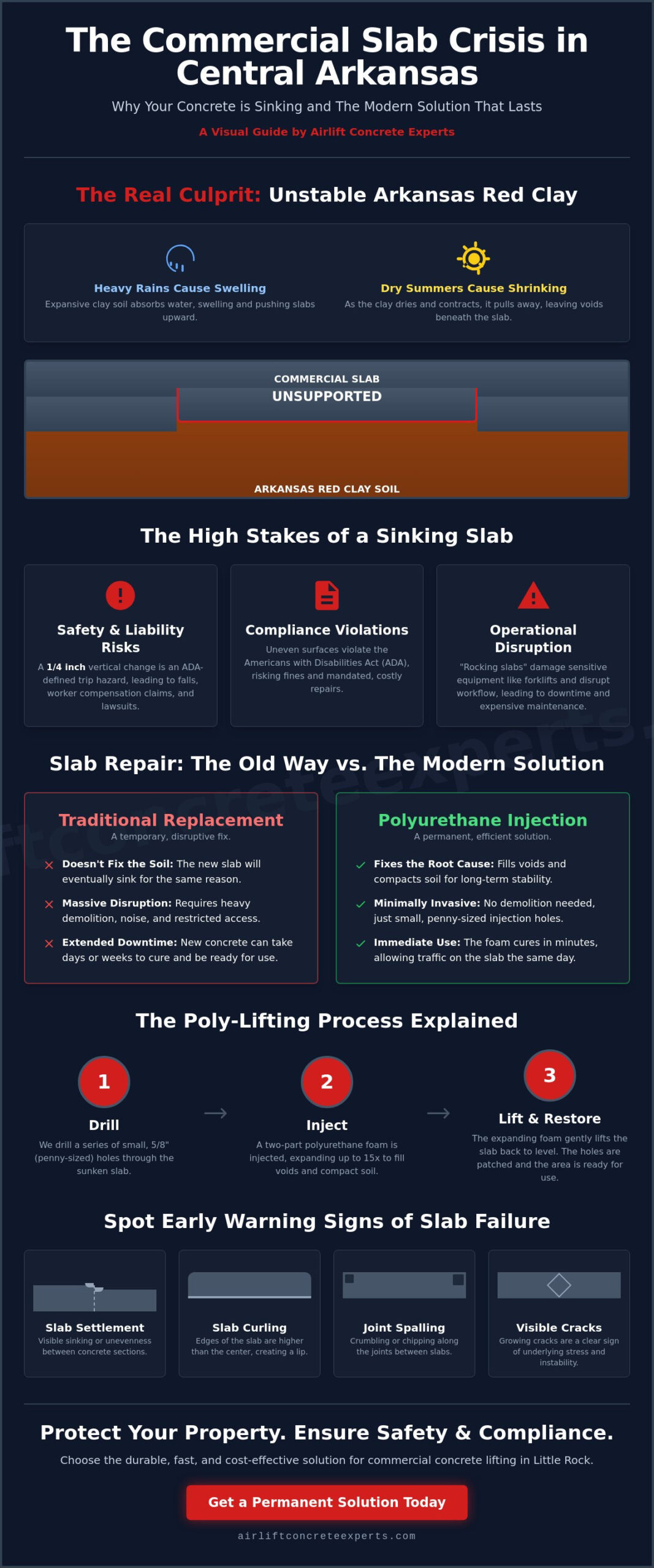
Managing a commercial facility in Central Arkansas involves more than just overseeing daily operations; it requires a constant awareness of the ground beneath your feet. Little Rock’s geography presents a unique challenge for structural stability, specifically due to the region’s highly expansive red clay soil. This soil doesn’t stay still. It acts like a giant sponge, swelling significantly during our heavy spring rains and shrinking during the dry, humid summers. This repetitive cycle creates massive sub-surface voids that leave heavy concrete slabs unsupported.
When you combine these soil shifts with the dramatic temperature fluctuations common in Central Arkansas, the stress on your pavement becomes immense. Concrete expands in the heat and contracts in the cold, leading to cracks that allow even more water to reach the sensitive clay below. If left unaddressed, these minor fissures quickly evolve into major settlement issues. Many property managers find that traditional patches don’t work because they don’t solve the underlying soil problem. Instead, modern polyurethane foam injection has become the regional standard for long-term stabilization.
The moisture retention of our local clay is particularly volatile in neighborhoods like Sherwood and Jacksonville, where the soil composition can change rapidly within a single property. Heavy rainfall often overwhelms commercial drainage systems, leading to water pooling near foundation edges. This saturation weakens the sub-base, causing slabs to tilt or sink. Because the clay is so heavy, it can actually pull away from the concrete as it dries, leaving the slab “bridged” over an empty pocket of air. Without the support of the earth, the weight of your building or heavy inventory will eventually cause the slab to snap.
Beyond structural concerns, uneven concrete is a massive financial liability. The Americans with Disabilities Act (ADA) defines a trip hazard as any vertical change in level of 1/4 inch or greater. In a high-traffic retail environment or a busy warehouse, a 1/4 inch lip is enough to cause a fall or damage sensitive equipment. Ignoring “rocking slabs” that shift under the weight of foot traffic or forklifts is a risk no business should take. Professional commercial concrete lifting in Little Rock doesn’t just fix the appearance of your property; it protects you from costly worker compensation claims and potential lawsuits. By addressing these failure points early, you ensure your facility remains safe, compliant, and fully operational.
Traditional methods of repairing sunken concrete often involve heavy machinery and messy cement slurries. In a commercial environment, this approach is frequently more disruptive than the problem itself. Modern polyurethane injection, often referred to as polyjacking, offers a surgical alternative. Instead of broad demolition, we use small, specialized equipment to address the root cause of slab failure. This process targets the sub-surface voids mentioned earlier, filling the empty spaces created by our shifting Arkansas soil with a high-density polymer that expands and hardens in seconds.
The science behind this method is what sets it apart from older techniques like mudjacking. When the two-part liquid polymer is injected, a chemical reaction occurs that causes the material to expand up to 15 times its initial volume. This expansion doesn’t just fill the hole; it exerts enough controlled pressure to lift massive slabs back to their original position. Because the material is waterproof and eco-friendly, it won’t wash away during a Little Rock flash flood or leach harmful chemicals into the local groundwater. It’s a permanent solution that adheres to American Concrete Institute standards for structural repair and soil stabilization.
Our team begins by drilling a series of penny-sized holes, approximately 5/8 of an inch, in a strategic grid across the affected slab. We then inject the high-density foam through these ports. As the foam expands, it travels into every crevice, compacting the loose red clay and creating a stable, lightweight base. One of the most significant advantages for a busy facility is the cure time. While a new concrete pour requires days of restricted access, polyurethane cures almost instantly. Most commercial surfaces are ready for heavy foot traffic or vehicle use within 15 to 30 minutes of the application. If you’re concerned about your facility’s specific layout, our team provides a complimentary initial assessment to map out the most efficient injection points.
A common misconception among property managers is that “foam” is too soft to handle the rigors of an industrial environment. In reality, the polymers used in commercial concrete lifting Little Rock projects are specifically engineered for extreme compressive strength. These materials are designed to withstand the constant vibration of heavy machinery and the weight of loaded forklifts without compressing or losing their shape over time. High-density polyurethane can support loads exceeding 10,000 lbs per square foot. This incredible strength-to-weight ratio ensures that your warehouse floor or loading dock remains level even under the most demanding daily operations.
When a commercial slab begins to settle, the immediate reaction for many property owners is to price out a full replacement. While a fresh pour looks appealing on paper, it often represents the most expensive and least durable path forward. For a business, the true cost of concrete work isn’t just the invoice for materials and labor; it’s the total operational impact. Professional commercial concrete lifting Little Rock projects often yield a higher return on investment because they treat the underlying soil instability rather than just replacing the surface material.
Choosing repair over replacement also carries a significant environmental benefit. Tearing out old concrete generates tons of landfill waste and requires a massive amount of energy to produce and transport new cement. By preserving your existing slabs, you’re making a sustainable choice that reduces your facility’s carbon footprint. Organizations like the International Concrete Repair Institute emphasize that extending the life of current structures through specialized stabilization is often the most responsible engineering decision.
The “hidden cost” of concrete replacement is the mandatory downtime. A new commercial-grade pour typically requires a 28-day cure period to reach its full compressive strength. During that time, your loading dock, warehouse floor, or parking lot is effectively out of commission. In contrast, polyurethane injection allows for a “business as usual” environment. There’s no dust from jackhammers and no massive debris piles. Because the foam cures in about 15 minutes, you can resume heavy operations almost immediately after the crew finishes. This speed turns a potential month-long logistical nightmare into a single-day maintenance task.
New concrete poured on the same unstable Arkansas red clay is destined to fail in the exact same way as the old slab. Without addressing the sub-surface voids, the weight of the new pour only accelerates soil compression. Polyurethane prevents future sinking by waterproofing the sub-base and filling those voids with a permanent, non-biodegradable material. This proactive approach avoids the “shrinkage cracks” that often plague new pours in our humid climate. This focus on soil-first solutions is a common theme in our guide to expert concrete lifting in Malvern & Little Rock, where we detail how targeted stabilization outperforms surface-level fixes every time. By choosing injection, you aren’t just fixing a symptom; you’re reinforcing the foundation of your business.
Spotting early warning signs is the best way to keep repair costs manageable and your facility safe. You don’t need to be a structural engineer to identify the symptoms of a failing slab. Often, the first clue is auditory. If you walk across a floor or drive a forklift over a joint and hear a hollow “thud” rather than a solid sound, you’re likely dealing with a sub-surface void. These pockets of air indicate that the soil has shifted or washed away, leaving the concrete to support its own weight without a foundation.
Pooling water is another clear indicator. If puddles remain on your concrete long after a rainstorm ends, the slab has likely tilted, disrupting the planned drainage. This is a common precursor to the need for commercial concrete lifting Little Rock businesses often face during the rainy season. Look for “slab curling,” where the edges of a slab lift higher than the center, or “joint spalling,” where the edges of the concrete joints begin to chip and crumble under pressure. Stair-step cracks in nearby masonry walls are also a major red flag, indicating that the settlement might be affecting the building’s structural frame.
We recommend conducting a monthly safety audit of your parking lot and warehouse floors. Check for any vertical lip greater than 1/4 inch, as these are immediate ADA violations and significant trip hazards. Pay close attention to transition points between different concrete pours or where the floor meets the wall. If you notice any of these signs, it’s time to consult a specialist who understands how to stabilize these specific failure points before they lead to a total slab collapse.
When you’re ready for a solution, having a bit of history ready for your contractor helps speed up the process. We’ll want to know the approximate age of the concrete, the original slab thickness, and if you’ve had any previous soil stabilization work performed. We always start with a complimentary initial assessment to accurately budget for the project and ensure our polyurethane method is the right fit for your needs. For issues that extend beyond the pavement and into the building’s main structure, you may want to review our guide on professional foundation repair in Arkansas. Don’t wait for a trip-and-fall accident to occur; schedule your commercial site evaluation today to secure your property’s future.
We aren’t a general construction company that treats concrete repair as a side project. Our team focuses exclusively on stabilization and leveling using advanced polyurethane technology. This specialization allows us to provide a level of precision that general contractors often miss when they’re juggling new builds and demolition. Property managers trust us for commercial concrete lifting Little Rock because we’ve seen every type of slab failure our regional soil can cause. We don’t just lift the surface; we restore the stability of your entire facility’s footprint with a focus on long-term durability.
Our commitment to professionalism and speed is designed to transform your structural anxiety into a sense of security. We use specialized equipment specifically engineered for high-density polymer injection, which allows us to achieve results that traditional mudjacking or new pours simply can’t match. By choosing a partner that prioritizes modern methods, you ensure that your facility remains safe, compliant, and ready for heavy-duty use for years to come.
National franchises often rely on one-size-fits-all approaches that don’t account for the unique behavior of Arkansas red clay. We live and work in this community, serving businesses from Malvern to Jacksonville. This local history gives us a deep understanding of how our regional climate and geology interact with commercial structures. We know how the soil expands in the spring and shrinks in the summer, and we calibrate our injection process to account for these shifts. As a regional specialist, we prioritize neighborly, low-pressure service. You’ll receive technical expertise without the flashy marketing gimmicks, ensuring you feel confident in the honest, straightforward assessment of your property’s needs.
Starting your repair shouldn’t be a stressful or complicated process. We provide a detailed, transparent repair quote that explains the cause of your settlement and our specific plan for stabilization. We also understand that your operations can’t stop just because the concrete did. Our team works closely with your facility manager to coordinate repairs during low-traffic windows or off-peak hours. This methodical approach ensures that commercial concrete lifting Little Rock services are completed with the least amount of disruption possible. Most projects are finished in a single day, allowing you to return to full capacity almost immediately. Contact Airlift Concrete Experts for your free commercial assessment to get started on stabilizing your facility today.
Little Rock’s unique soil demands a specialized approach that traditional concrete replacement simply can’t provide. By choosing high-density polyurethane injection, you address the root cause of slab failure without the weeks of downtime associated with new pours. This modern method ensures your property remains ADA compliant and safe for heavy equipment, protecting your business from liability and operational delays. Our team provides the professional commercial concrete lifting Little Rock businesses need to stay operational and safe.
Since 2017, Airlift Concrete Experts has focused on delivering specialized structural repairs across Central Arkansas. Our expertise in high-density polyurethane foam injection allows us to provide a stable solution for businesses in Little Rock, Malvern, and surrounding areas. We take pride in being a local partner that understands our community’s specific geological challenges better than any national franchise. Get Your Free Commercial Concrete Assessment Today to receive a clear, professional evaluation of your facility. We look forward to helping you keep your business on solid ground.
Polyurethane repair is almost always more cost-effective than a full replacement because it eliminates the expense of demolition, debris removal, and new material costs. While we don’t provide specific quotes without an assessment, the total project cost is significantly lower when you factor in the reduction in labor hours. You also save money by avoiding the extended business downtime that a new concrete pour requires.
Polyurethane lifting is considered a permanent solution because the high-density foam is waterproof and does not biodegrade over time. Unlike traditional mudjacking slurry, which can wash away during heavy Central Arkansas rainstorms, our specialized polymers remain stable. The material effectively binds with the local red clay and fills sub-surface voids, preventing future settlement even in our region’s volatile soil conditions.
Most commercial concrete lifting Little Rock projects don’t require you to shut down your operations. Because the polyurethane foam reaches its full compressive strength in about 15 minutes, we can often work while your facility remains active. We coordinate with your team to handle repairs in sections, ensuring that foot traffic and machinery can continue moving safely around the work zone without interruption.
High-density polyurethane is specifically engineered for industrial loads and can easily support heavy warehouse machinery, forklifts, and semi-trucks. The polymers we use have a high compressive strength designed to distribute weight evenly across the soil. This creates a solid base that prevents the concentrated pressure that leads to cracking and slab failure in high-impact areas like loading docks and warehouse floors.
A simple slab repair addresses concrete that has settled on the grade, while a foundation fix involves the structural supports of the building itself. If your interior floors are sinking but your walls remain straight, you likely only need slab stabilization. If you notice stair-step cracks in your masonry or doors that won’t close properly, the issue might be structural. We provide a complimentary initial assessment to determine the exact scope of your project.
The primary cause of sinking concrete in our area is the expansive nature of Arkansas red clay. This soil swells when it’s wet and shrinks significantly during dry periods, which creates empty pockets or voids beneath your slabs. Over time, the weight of the concrete and the traffic it carries causes the slab to settle into these voids. Poor drainage and seasonal temperature swings further accelerate this movement.
Polyurethane injection is an environmentally friendly choice because the material is inert and won’t leach chemicals into the surrounding soil or groundwater. By choosing repair over replacement, you’re also keeping old concrete out of local landfills and reducing the carbon footprint associated with new cement production. Our polymers are non-toxic once cured, making them safe for use in various commercial and industrial environments.
We provide comprehensive parking lot and sidewalk leveling services for businesses throughout the Little Rock area. Whether you’re dealing with trip hazards at your entrance or sunken slabs in your loading zones, we can restore the surface to a safe, level condition. Our process is ideal for parking lots because it allows vehicles to drive on the repaired sections almost immediately after the application is finished.

 Call Now