

Imagine walking through your Little Rock home on a Tuesday morning in early 2026 and noticing a new, jagged crack snaking up the drywall above your front door. It’s a sinking feeling that every homeowner in Central Arkansas dreads, leading to an immediate search for a reliable foundation specialist near me. You aren’t just looking for a quick fix; you need a local expert who understands how our specific regional soil conditions impact structural integrity from Malvern to Pulaski County.
We know that your home is your most significant investment, and seeing signs of movement can feel incredibly stressful. It’s natural to worry if a sticking window is just a seasonal quirk or a warning sign of a serious structural failure. This guide clarifies that confusion by teaching you how to identify specific symptoms of soil settlement and what a professional repair process actually looks like. We’ll show you how to secure a permanent solution for your foundation, ensuring your family stays safe while avoiding the high overhead costs often found with national franchises.
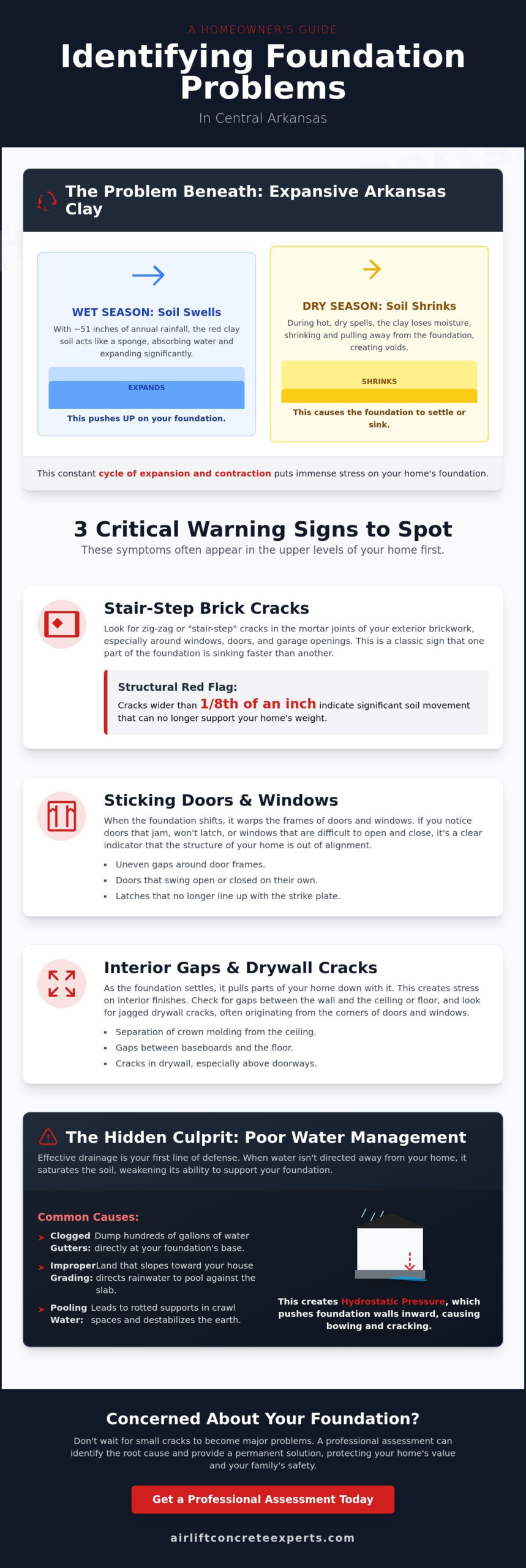
Arkansas red clay presents a unique challenge for homeowners because of its expansive nature. This soil type acts like a sponge; it swells significantly when wet and shrinks during the dry summer months. In Little Rock, where annual rainfall often averages around 51 inches, the ground undergoes constant volume changes. This movement puts immense stress on your home’s footprint. A Foundation (engineering) must remain stable to support the weight of the house, yet the shifting clay often causes the concrete to settle or crack. If you’re searching for a foundation specialist near me, you likely understand that our local geology requires a specialized approach that national firms might overlook.
Seasonal temperature swings in Hot Springs exacerbate these soil issues. During a hot, dry spell, the clay pulls away from the foundation, creating voids. When the heavy rains return, water fills these gaps and exerts pressure against the slab. You might notice small hairline cracks, which are often aesthetic. However, cracks wider than one-eighth of an inch are structural red flags. These larger gaps indicate that the soil can no longer support the weight of the structure. Our team focuses on identifying these shifts before they lead to catastrophic failure, providing peace of mind through expert analysis.
Homeowners in Malvern and Conway often report specific signs of settlement that shouldn’t be ignored. These symptoms usually manifest in the upper levels of the home first. Keep a close eye on these common indicators:
Effective water management is your first line of defense against structural damage. Clogged gutters are a primary culprit, as they dump hundreds of gallons of water directly at the base of your home. This leads to soil saturation near the slab, which weakens the ground’s load-bearing capacity. In Benton and Bryant, we frequently see “pooling” water in crawl spaces; this environment rots wooden supports and destabilizes the earth. Hydrostatic pressure is the primary driver of wall bowing, occurring when the weight of the water-saturated soil pushes inward against your foundation walls. Working with a foundation specialist near me ensures your drainage systems are evaluated alongside your structural repairs to prevent future movement.
While a general contractor handles broad home renovations like kitchen remodels or roofing, a structural foundation specialist focuses exclusively on the physics of your home’s support system. Most general contractors see a crack in a basement wall and suggest a cosmetic patch. A specialist sees that same crack and investigates why the soil beneath the footing shifted in the first place. In regions like Little Rock and Malvern, the local soil composition often dictates how a home settles over 15 or 20 years. We look past the concrete to analyze the load-bearing capacity of the earth itself.
Choosing a foundation specialist near me means hiring someone who understands that concrete is only as stable as the ground supporting it. Our work involves stabilizing the environment around your home to prevent future movement. This often requires specialized equipment and methods like polyjacking or pier installation that standard construction crews simply don’t possess. We focus on the “why” behind the damage to ensure a permanent solution rather than a temporary fix.
A professional inspection is a methodical, two-part assessment that begins on the exterior. We perform a 360-degree walk-around to identify stair-step cracks in brickwork or gaps around window frames. These are classic indicators that a specific corner of the house is sinking. In Malvern homes, we frequently find that poor drainage causes soil saturation, leading to these visible structural shifts.
The internal assessment is even more rigorous. We check for interior floor leveling issues that many homeowners might overlook. If a Little Rock home shows a slope of more than 1.25 inches across a 10-foot span, it’s a clear sign of structural distress. We document every measurement and crack pattern to create a comprehensive repair plan that addresses the specific movement of your property. If you suspect your home is shifting, scheduling a free inspection with a local expert is the most reliable way to protect your investment.
Modern diagnostics remove the guesswork from structural repair. We use digital floor mapping and high-precision laser levels to detect elevation changes as small as 0.1 inches across an entire floor plan. This technology allows us to see exactly where the house is dipping before the cracks even become visible to the naked eye. It provides a data-driven baseline for any necessary lifting or leveling work.
A specialist identifies the root cause of the movement, such as expansive clay or poor compaction, before proposing a fix. This ensures the repair addresses the source of the problem rather than just the symptoms. By using these advanced tools, a foundation specialist near me can provide a level of accuracy that guarantees long-term stability for your Arkansas home.
When you search for a foundation specialist near me, you’ll likely encounter two primary repair methods: polyjacking and piering. These aren’t interchangeable. Each solves a specific type of soil failure common in Central Arkansas. While older mudjacking methods used heavy grout that often added more weight to sinking soil, modern polyjacking uses lightweight high-density polymers to provide a permanent fix for sinking slabs without the mess or the risk of further settlement.
Polyjacking is a surgical approach to concrete repair. We inject high-density foam through holes smaller than a dime to fill voids and lift the concrete. This method is the top choice for sidewalk and driveway leveling because it doesn’t disrupt your landscaping. In Malvern, we frequently use this for pool decks and patios where heavy machinery can’t reach. The foam expands and hardens in seconds, creating a waterproof barrier that won’t wash away during heavy Arkansas rains.
This high-density material stabilizes the underlying soil by filling every pocket of air. It’s a non-invasive process that prioritizes speed and efficiency. You can drive your car over a repaired driveway just 15 minutes after we finish the job. For busy families in Little Rock, this minimal downtime is often the deciding factor between a quick repair and a total concrete replacement.
Sometimes the issue isn’t just a surface slab. If your home’s perimeter walls are cracking or your chimney is pulling away, you need structural steel piers. This is common in historic Little Rock homes built on expansive clay. We drive these piers deep into the earth until they hit stable, load-bearing strata. It’s a mechanical lift that bypasses the shifting topsoil entirely. While more intensive than polyjacking, piering provides the ultimate structural integrity for catastrophic settlement.
We use specialized equipment to ensure each pier is locked into place. As a local foundation specialist near me, we evaluate the soil density to determine if piers are the necessary safeguard for your home’s long-term value. Choosing between these methods depends on the depth of the problem:
Our team focuses on the most cost-effective path that guarantees safety. We don’t recommend piers if a simple foam injection will solve the problem, but we won’t compromise your home’s safety with a temporary fix if the foundation requires deep support.
Finding a reliable foundation specialist near me involves more than a quick search; it requires vetting for local expertise. While national franchises have big marketing budgets, they often lack the deep understanding of Central Arkansas soil profiles. The high clay content in Malvern and the shifting hills of Little Rock demand a customized approach that a generic manual can’t provide. A local team lives where you live, meaning they’ve seen how 100-degree summers and heavy spring rains impact local slabs and crawl spaces over decades.
Before signing a contract, verify that the company holds a valid Arkansas contractor’s license and carries comprehensive liability insurance. Ask for at least three local references from the past 12 months to confirm their reputation. Honest specialists prioritize education over sales. If a representative uses scare tactics or pressures you to sign immediately, they likely don’t have your home’s best interest at heart. A trustworthy partner provides a clear, written assessment and explains the long-term benefits of their proposed solution.
Your contractor should be an expert in structural restoration. Ask these specific questions to gauge their proficiency:
A foundation specialist near me should always visit your property before discussing costs. Avoid any contractor who offers a quote over the phone without a physical inspection. These sight-unseen estimates often lead to price hikes once the work begins. Be wary of extremely low bids. These often indicate patch-and-run tactics where a contractor addresses the symptom but ignores the underlying structural cause. Finally, stay away from companies pushing DIY repair kits for structural cracks. Real foundation issues require industrial-grade equipment and specialized resins to ensure a permanent fix.
Warranties are a vital part of your investment. Look for a warranty that covers both materials and labor, and ensure the company has been in business long enough to honor it. At Airlift, we stand by our work because we know our methods are built to last for the life of your home.
Finding a reliable foundation specialist near me shouldn’t feel like a gamble. At Airlift Concrete Experts, we’ve built our reputation on the bedrock of family-owned values. We treat every Hot Springs home with the same meticulous care we’d give our own. Our team understands that foundation issues cause genuine stress for Arkansas families, so we’re here to replace that anxiety with a sense of security. We don’t just fix concrete; we restore the safety and value of your most important investment.
Our reach extends across the entire Central Arkansas region. From the historic neighborhoods of Malvern to the growing communities in Cabot, we serve as the definitive local authority on soil settlement and structural stability. The Airlift promise is simple: we provide permanent solutions that offer long-term peace of mind. We avoid the temporary “band-aid” fixes that national franchises often push, focusing instead on methods that address the root cause of your home’s instability.
Our specialized focus centers on polyurethane concrete leveling, a process known as polyjacking. This modern method is far superior to traditional mudjacking. We restore foundation repair near me with precision foam injection that fills subterranean voids and lifts concrete with surgical accuracy. In cities like Benton and Bryant, we’ve successfully leveled sunken slabs and driveways that had settled significantly due to shifting subsoils. The high-density polyurethane material we use is waterproof, eco-friendly, and won’t wash away over time, providing a stable base that lasts for the life of the structure.
If you’ve noticed cracks in your drywall or a sticking front door, it’s time to take action before the damage worsens. You can schedule your no-obligation structural assessment by calling our office or using our online booking tool. During this visit, a foundation specialist near me will perform a comprehensive walk-through of your property. You’ll receive a customized repair estimate that details the necessary steps to stabilize your home. We provide the facts you need to make an informed decision without any high-pressure sales tactics. Schedule your free foundation inspection with Airlift today!
Structural issues in the shifting clay soils of Little Rock and Malvern don’t improve with time; they only grow more complex. Since 2017, our family-owned team has helped homeowners navigate these regional challenges using specialized polyjacking technology. This modern method provides a permanent solution for soil settlement that’s faster and less invasive than traditional piering. When you search for a foundation specialist near me, you need a partner who understands the specific geological demands of Central Arkansas.
We’ve spent years serving neighbors in Hot Springs and the surrounding areas, focusing on restoring structural integrity with precision. Our goal is to transform your anxiety into a sense of security by providing clear, technical explanations without high-pressure sales tactics. We believe in doing the job right the first time so you can enjoy lasting peace of mind. Your home is your most significant investment, and it deserves the care of a local authority that treats every project with neighborly respect.
Get Your Free Foundation Inspection in Central Arkansas
Foundation repair costs in Arkansas typically range from $2,163 to $7,811 according to 2024 industry data from HomeAdvisor. Your final investment depends on the severity of the soil settlement and the number of piers required for stabilization. For example, a single pier installation might cost $1,000 while a full perimeter lift requires a larger budget. We provide a free inspection to give you an exact quote for your property.
Most modern foundation repair methods, such as polyjacking, require minimal disruption to your landscaping or driveway. We use small, 5/8 inch holes to inject structural foam, which prevents the need for heavy excavation or tearing up concrete slabs. If we must install steel piers, we carefully remove and replace shrubs within a 3 foot radius of the work area. Our team works hard to leave your property clean.
A standard foundation repair project usually takes between 1 and 3 days to complete. Simple polyjacking for a sinking porch might finish in 4 hours, while a complex residential stabilization in Malvern involving 10 piers takes about 72 hours. Factors like soil density and weather conditions influence the final timeline. As a foundation specialist near me, we prioritize efficiency so you can return to your normal routine without unnecessary delays.
You can remain in your home during the entire foundation repair process without any issues. Our team works primarily on the exterior of the structure, so your daily life inside remains undisturbed. You might hear some noise from hydraulic equipment between 8:00 AM and 5:00 PM, but there’s no need to book a hotel. We ensure your utilities remain functional and your living space stays safe throughout the duration of the project.
Most standard Arkansas homeowners insurance policies don’t cover foundation repair caused by soil compaction or natural settling. According to the Insurance Information Institute, coverage is typically limited to sudden and accidental events like a major pipe burst. It’s best to review your specific policy for endorsements related to earthquake or flood damage. Because these repairs are rarely covered, we offer flexible financing options to help manage the cost of structural stabilization.
The main difference is that mudjacking uses a heavy slurry of sand and cement, while polyjacking utilizes a lightweight, high-density polyurethane foam. Mudjacking holes are 2 inches wide and the material adds thousands of pounds of weight to the soil. Polyjacking requires holes smaller than a penny and the material is completely waterproof. This modern approach provides a permanent solution that won’t wash away during heavy Little Rock rainstorms.
Structural cracks are typically wider than 1/8 inch and often run horizontally or in a stair-step pattern through your brickwork. Small vertical cracks are usually the result of natural concrete curing or minor settling during the first 2 years after construction. If you notice a crack that allows a nickel to fit inside, it indicates a serious shift. Finding a foundation specialist near me for a free inspection is the best way to confirm your home’s safety.

 Call Now