

Last Tuesday, a homeowner in Little Rock discovered a thin, zigzagging line running down their basement wall after a heavy afternoon downpour. While the fracture looked small, the anxiety it caused was significant. They immediately worried about structural failure and the potential costs of a major renovation. It’s a common scene across the region, where our soil can expand by up to 10 percent when saturated, making foundation wall crack repair a top priority for maintaining long-term home value.
You likely share that same feeling of dread when you spot a new gap in your masonry. It’s frustrating to deal with recurring water leaks, especially when you’re unsure if the damage is a simple cosmetic fix or a sign of serious settlement. We understand that your home is your most important investment, and seeing it compromised feels like losing your sense of security. This guide explains exactly how to address these issues by analyzing the specific environmental conditions found across Central Arkansas. You’ll learn how to distinguish between minor settling and structural threats, when to attempt a DIY fix, and how specialized professional methods provide a permanent seal against water and soil intrusion.
Foundation wall cracks are fractures that develop in a home’s concrete or masonry structure when the material can no longer withstand the stress applied to it. In the technical context of a Foundation (engineering), these stresses often stem from soil movement, moisture imbalances, or poor initial construction. For homeowners in Little Rock and Malvern, ignoring a new fracture is a risk that can lead to expensive structural failure. While some cracks are benign, others indicate that the home’s primary support system is failing under the weight of the structure or the pressure of the surrounding earth.
Distinguishing between different types of fractures is the first step in successful foundation wall crack repair. Shrinkage cracks often appear within the first 12 months of a home’s construction as the concrete cures and loses moisture. These are usually thin and superficial. Settlement cracks, however, occur when the ground beneath the home shifts or washes away. You might notice visual cues like water stains on the basement floor or efflorescence, which is a white, crusty mineral deposit left behind by evaporating water. If a gap widens over a period of 30 days, it’s a sign of active movement that won’t stop on its own.
A simple way to assess a crack is the “pencil test.” If a fracture is wider than 0.25 inches, or the width of a standard pencil, it requires a professional review. You should also check for secondary signs of movement throughout the house. Are your kitchen doors sticking in their frames? Do you notice floors sloping more than 1 inch across a 10-foot span? In Pulaski and Hot Spring Counties, where annual rainfall averages 50 inches, the expansive clay soil can exert thousands of pounds of pressure against a wall. If these symptoms accompany a wall crack, it’s time to search for foundation repair near me to find a permanent solution. Addressing these issues early prevents a localized crack from becoming a total wall collapse, ensuring the long-term safety of your family and your investment. Effective foundation wall crack repair starts with an accurate diagnosis of these structural warning signs.
Arkansas red clay is the primary driver behind most residential structural issues in our region. This soil type is classified as highly expansive, meaning its volume changes significantly based on moisture content. Central Arkansas receives an average of 50 inches of rainfall annually. This volume of water transforms the ground into a heavy, swelling mass that exerts immense force against your home. We know the red clay in Malvern isn’t just a nuisance for gardeners; it’s a direct threat to your home’s skeleton.
When heavy rain hits Malvern or Conway, the soil surrounding your basement or crawl space becomes saturated. This creates hydrostatic pressure. Think of it as a constant, heavy weight leaning against your foundation walls 24 hours a day. If this pressure exceeds the load-bearing capacity of the concrete, the wall will begin to bow inward. This physical stress often results in horizontal or diagonal fissures. Dealing with these issues requires a professional approach to foundation and drainage to redirect water away from the structure. Without proper water management, the cycle of pressure and relief continues to weaken the masonry every season. This pressure is relentless. It doesn’t take long for a small hairline fracture to become a major structural concern.
The problem doesn’t end when the rain stops. Arkansas summers often bring extended droughts where the red clay loses moisture and shrinks. This soil contraction creates a gap between the earth and your foundation. When the ground pulls away, it leaves your foundation walls unsupported. This lack of lateral support is why foundation wall crack repair becomes a recurring necessity for many local homeowners. Generic national advice often ignores the sheer density of our local soil. While some suggest simple DIY patches, industry standards from the American Concrete Institute suggest more robust methods like Structural Crack Repair by Epoxy Injection for long-term stability.
The “wet-dry” cycle in Central Arkansas is aggressive. It requires a solution tailored to our specific geological conditions rather than a one-size-fits-all fix. If you’ve noticed new gaps in your basement walls after a dry spell, a quick assessment from Airlift Concrete Experts can help determine if the movement is active. We focus on the root cause of the shift, ensuring your home remains stable regardless of the weather. Our team understands how Malvern soil behaves differently than soil in other parts of the country. We use that local knowledge to protect your investment.
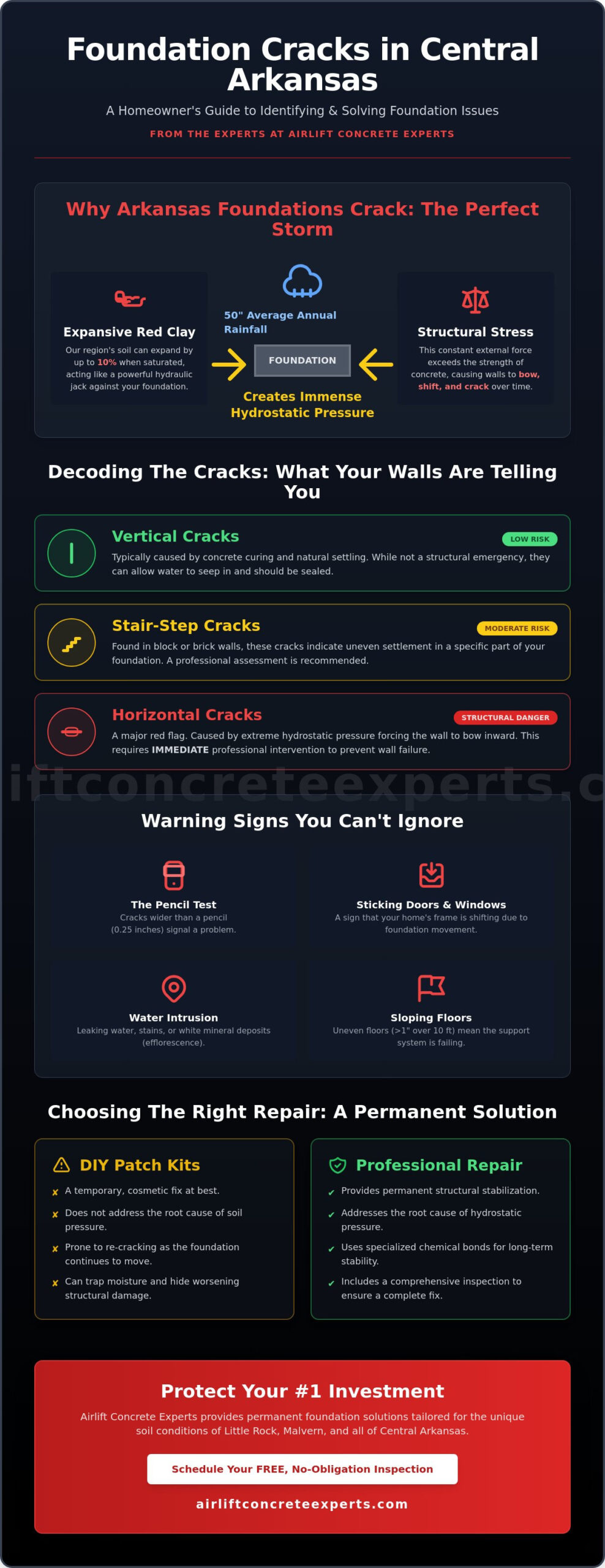
Many Arkansas homeowners find themselves staring at a new crack in their basement or crawl space wall, wondering if a $100 kit from a home improvement store will solve the problem. These kits are popular because they offer a quick, low-cost fix that looks clean on the surface. However, a surface-level patch rarely addresses the underlying pressure from expansive clay soils common in our region. Understanding Why Soils Cause Foundation Cracks is essential because standard insurance policies frequently exclude damage caused by soil movement. When you choose a DIY “band-aid,” you often ignore a structural warning sign that could lead to much larger expenses later. Before committing to any repair approach, reviewing a foundation repair specialist checklist for Malvern and Central Arkansas can help you ask the right questions and avoid hiring an unqualified contractor.
Standard caulk and hydraulic cement are the most common DIY materials, but they share a fatal flaw: they are rigid. Foundation walls are dynamic. They move based on moisture levels and temperature changes. If a crack is active, a rigid patch will simply pop off or crack again within one or two seasons. Most DIY injection kits also lack the pressure needed to reach the exterior of the wall. This leaves the middle and back of the crack open to moisture, which eventually rots the patch from the inside out. Relying on these kits can hide worsening structural issues until the wall begins to bow or lean significantly. In 85% of cases, DIY repairs require professional intervention within 24 months.
Professional foundation wall crack repair utilizes specialized equipment to ensure the sealant reaches every cubic inch of the void. We use professional-grade polyurethane resins that expand to fill the entire gap. This expansion creates a water-tight seal against the exterior soil, not just the interior surface. These modern resins remain flexible after they cure. This flexibility allows your foundation to handle minor thermal expansion without breaking the seal. You can learn more about how this technology works by exploring polyjacking near me, which uses similar high-density foam to stabilize and lift concrete surfaces across Central Arkansas.
While a professional foundation wall crack repair carries a higher initial price than a store-bought tube, the long-term cost analysis favors the expert approach. A DIY fix that fails three times in five years isn’t just a waste of money; it’s a risk to your home’s equity. Choosing a permanent, professional solution provides the security and peace of mind that your foundation is truly protected. We focus on getting the job done right the first time so you don’t have to worry about the next heavy rainstorm.
Fixing a foundation requires more than just filling a gap with hardware store caulk. It’s a technical process that addresses the root cause of the movement to prevent future failures. At Airlift Concrete Experts, we follow a methodical 5-step protocol to ensure your home remains stable. This process transforms a vulnerable wall back into a solid structural component.
Success begins with identifying the source of the stress. In Central Arkansas, 85% of foundation issues are linked to the region’s expansive clay soils that swell and shrink with the weather. We don’t just look at the crack; we look at your drainage and soil health. If we find old, failing DIY patches, we grind them away to reach the raw, porous concrete. A clean, dry surface is the only way professional-grade adhesives can achieve a permanent hold. Without this preparation, even the best resins will eventually peel away from the wall.
During the injection phase, our technicians carefully monitor the flow of the material. We ensure the crack fills from the very back of the foundation wall to the front surface. The choice of material depends on your home’s specific needs. We use epoxy when we need to restore structural strength, as it often becomes stronger than the original concrete. For foundation wall crack repair where water intrusion is the primary concern, we use expanding polyurethane. This material moves with the concrete and creates a flexible, waterproof seal. Once the resin cures, we remove the ports and smooth the surface. This final finishing makes the repair nearly invisible to the naked eye, restoring your basement or crawl space to its original condition.
If you’ve noticed new gaps in your basement walls, don’t wait for the next heavy rain to take action. You can schedule a free inspection with our local team today to protect your home’s long-term value.
Finding a crack in your basement or crawl space is stressful. It feels like the ground is shifting beneath your feet, and in Central Arkansas, it often is. At Airlift Concrete Experts, we don’t just see a job site; we see a neighbor’s home that needs protection. Whether you’re in Malvern, Little Rock, or the surrounding communities, our team provides the local authority required to solve these structural puzzles for good. We specialize in comprehensive foundation wall crack repair that stops the problem at the source, ensuring your home remains the safe haven it was meant to be.
We are a family-owned business, which means our reputation is built on the word-of-mouth of the people we see at the grocery store and local high school games. Our no-nonsense professionalism is a direct result of these values. We won’t sell you a complex piering system if a simpler solution will work. We only recommend the repairs you actually need to keep your family safe.
Arkansas soil is unique. Our region is famous for “Arkansas Red Clay,” a highly expansive soil that reacts violently to our state’s unpredictable weather patterns. This clay can exert thousands of pounds of pressure against your basement walls during a wet spring, then shrink away during a hot July drought. We’ve spent decades studying these specific soil behaviors. This local expertise allows us to apply the right pressure and the right materials to counter the specific environmental stressors found in Saline and Pulaski counties. When selecting a qualified foundation repair specialist in Malvern and Central Arkansas, it’s important to verify that they have direct experience with our region’s clay soil conditions and seasonal wet-dry cycles.
Effective foundation wall crack repair is rarely about the surface level fix. If the soil has shifted enough to break concrete, the structure itself might be out of alignment. We look beyond the visible damage to see if your home requires foundation leveling to restore its original position. By addressing the root cause of the movement, we ensure that the repairs we perform today won’t have to be redone five years from now.
Our repairs come with the security of a solid warranty. We use specialized equipment and modern polyjacking techniques that provide a cleaner, faster, and more durable result than traditional mudjacking. This methodical approach transforms your anxiety into peace of mind. You don’t have to wonder if the next big storm will cause more damage. Instead, you can trust in a solution designed to last as long as the home itself. Your home is likely your largest investment; let us help you defend it.
Don’t wait for a small crack to become a major structural failure. Take the first step toward a stable home by speaking with a local specialist who understands your neighborhood. Contact Airlift Concrete Experts for your free inspection and get the honest, expert answers you deserve today.
Identifying a crack in your basement or crawl space is the first step toward protecting your largest investment. In Central Arkansas, our expansive clay soil causes constant shifting that requires specialized attention rather than temporary DIY kits. Airlift Concrete Experts has spent over 7 years perfecting the use of high-density polyurethane foam technology to provide permanent stability for local families. As a locally owned and operated business based in Malvern, AR, we understand exactly how regional weather patterns and soil composition impact your concrete. Choosing professional foundation wall crack repair ensures that your home remains safe, dry, and level for the long term. Our team focuses on delivering technical excellence and neighborly service to every Little Rock area resident. You don’t have to navigate these structural concerns alone when a reliable partner is ready to help. We look forward to helping you restore your peace of mind and the safety of your home.
Schedule Your Free Foundation Inspection with Airlift Concrete Experts
Repair costs vary based on the damage, but the 2024 HomeAdvisor report lists the national average for professional crack repair between $250 and $800 per crack. Factors like the width of the gap and the depth of the concrete influence the final investment. We provide a free inspection for homeowners in Little Rock and Malvern to ensure you receive an accurate quote before any work begins.
Yes, a horizontal crack is a sign of serious structural distress caused by hydrostatic pressure from the surrounding Arkansas soil. While vertical cracks often result from minor settling, horizontal lines suggest your wall is bowing or failing under the weight of the earth. You should address these issues immediately to prevent a total wall collapse or significant structural failure in your home.
You can use a retail kit for minor hairline cracks, but these DIY solutions rarely address the root cause of the movement. Most store bought kits use rigid epoxy that doesn’t expand, which means the crack often reopens when the soil shifts during our wet seasons. Professional foundation wall crack repair ensures the entire void is sealed with specialized materials that bond permanently with the concrete.
A professional polyurethane injection is a permanent solution designed to last for the remaining lifespan of your home. Polyurethane remains flexible after it cures, so it moves with the natural expansion and contraction of the concrete during temperature changes. This flexibility prevents the seal from becoming brittle or failing like traditional mortar repairs, which often crumble within 2 to 3 years of application.
Not every crack indicates a sinking house, but vertical or diagonal cracks often point to differential settlement. Data from the ASCE shows that 25 percent of all homes in the United States will experience some structural distress. If you notice cracks wider than 1/8 inch or interior doors that won’t close, your foundation likely needs professional stabilization to stop the house from settling further into the soil.
Yes, professional foundation wall crack repair using polyurethane injection stops water infiltration by filling the entire thickness of the wall. The specialized resin expands to 20 times its liquid volume, creating a watertight gasket that seals out moisture. This process effectively closes the pathway that groundwater uses to enter your basement during heavy Arkansas rainstorms, keeping your lower level dry and safe.
Most individual crack repairs are completed in 2 to 4 hours by our specialized team. Our technicians arrive with the necessary equipment to clean the area, install injection ports, and apply the expanding polymer. You don’t need to leave your home during the process, and the work area is typically ready for use immediately after we finish our cleanup. It’s a quick, non-invasive way to restore your peace of mind.
You should repair any visible foundation cracks before listing your home to protect its market value and ensure a smooth closing. Real estate data indicates that foundation issues can reduce a home’s sale price by 10 to 15 percent if left unaddressed. Providing a transferable warranty from a local specialist gives potential buyers the confidence they need to move forward with the purchase without hesitation. If you’ve also noticed uneven surfaces inside the home, reviewing our guide on sagging floors repair near me can help you identify and address related structural concerns before they affect your sale.

 Call Now