
Last Tuesday, a Malvern homeowner noticed the gap between their driveway and garage floor had expanded to a staggering two inches. This created a dangerous trip hazard just days before a neighborhood gathering. You’ve likely felt that same knot in your stomach when you spot a new crack on your pool deck or see water pooling near your foundation after a heavy Little Rock rain. While these issues are stressful, professional concrete lifting provides a way to level your surfaces without the high cost or mess of a total tear-out.
Most homeowners believe that sinking slabs require a full replacement that ruins their landscaping for weeks. We understand that your home is your most important investment, and you want a solution that actually lasts. This guide will show you how professional polyurethane lifting restores safety and value to your property while remaining ready for foot traffic in under 15 minutes. We will break down the polyjacking process and explain why it is the most reliable, long-term fix for the unique soil challenges found in Central Arkansas in 2026.
Concrete lifting is a specialized process designed to restore the level surface of sunken slabs through the surgical injection of high-density materials. Unlike surface patching, which only covers up the visible damage, this method addresses the root cause of the problem beneath the concrete. For homeowners in Central Arkansas, maintaining flat driveways and walkways is a constant battle against the local environment. Our region is defined by a unique geological profile often called the Arkansas Factor, where heavy red clay and intense humidity cycles dictate the stability of our structures. While a surface patch might last a single season, professional concrete lifting provides a long-term solution that restores structural integrity and curb appeal in a single afternoon.
This method is part of a broader field of structural repair. You can gain a deeper perspective by Understanding Concrete Lifting and the history of slab stabilization. By injecting modern polymers under the slab, we fill the voids created by shifting soil, providing a stable base that prevents future movement. This approach is cleaner, faster, and more reliable than traditional demolition and replacement. It’s a permanent fix that addresses the underlying soil instability rather than just the cosmetic symptoms.
The primary culprit for sinking concrete in Central Arkansas is the dramatic swing in soil moisture. Little Rock receives an average of 50 inches of rainfall annually, which leads to significant soil washout. When heavy rain saturates the ground, it can carry away the fine particles of soil that support your driveway. Conversely, Hot Springs often experiences summer droughts that cause our local clay to shrink and pull away from the concrete. In Malvern, we frequently see driveway failures caused by poor initial compaction. If the soil wasn’t properly prepared during the original construction, the weight of the concrete eventually forces it downward as the earth settles naturally over time.
Ignoring a settling slab creates more than just an eyesore. In active neighborhoods like Bryant and Benton, uneven sidewalks represent significant trip hazard liabilities for homeowners. A vertical offset of just 0.25 inches is enough to cause a fall. Beyond safety, sunken slabs often tilt toward the home, directing rainwater directly into your foundation or crawlspace. This can lead to basement leaks and mold growth. Left unaddressed, a single sunken slab triggers a domino effect. The uneven weight distribution puts excessive stress on adjacent concrete sections, causing them to crack or sink as well. Taking action early with concrete lifting prevents a minor nuisance from becoming an expensive structural overhaul.
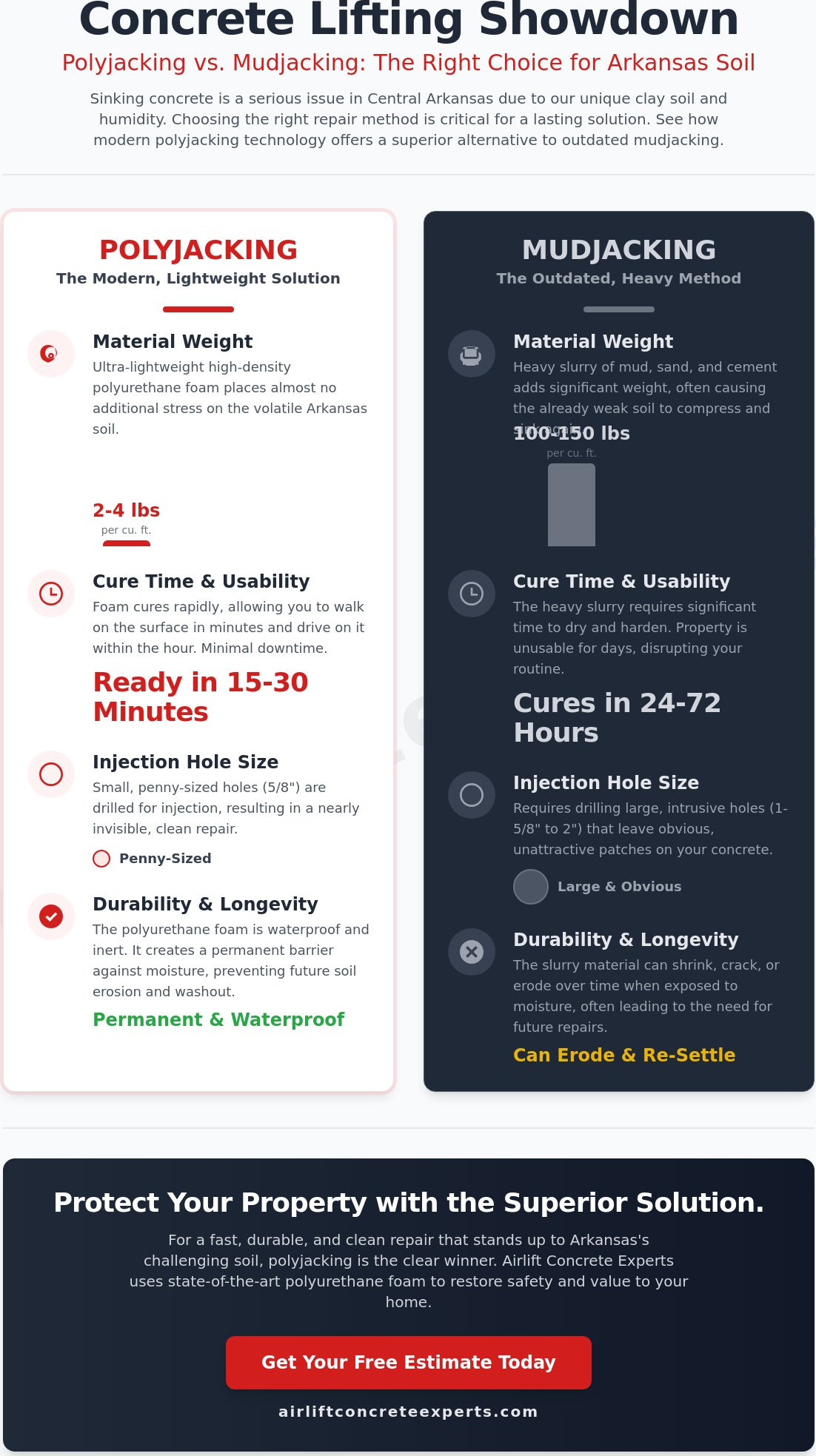
Arkansas homeowners often face a difficult choice when a driveway or patio begins to sink. Understanding the technical differences between traditional mudjacking and modern polyjacking is vital for long-term property stability. Mudjacking involves pumping a heavy slurry of sand, soil, and cement under the slab. This material weighs roughly 100 to 150 pounds per cubic foot. In the expansive clay soils common across Malvern and Little Rock, adding this much weight often causes the underlying soil to compress even further. This leads to secondary settlement where the concrete sinks again under the weight of the repair material itself.
Polyjacking uses a specialized high-density foam that weighs only 2 to 4 pounds per cubic foot. It provides the necessary lift without the added burden on the subgrade. When residents ask, Is Concrete Lifting Worth It? they must consider the speed of the results. Polyjacking foam cures in about 15 to 30 minutes, while mudjacking requires 24 to 72 hours of downtime before you can park a car on the surface. Our polyurethane material is also environmentally inert. It won’t leach chemicals into your lawn or react with the groundwater.
Precision is the hallmark of this modern method. We use specialized equipment to drill penny-sized injection holes, which are nearly invisible once the repair is complete. The foam expands rapidly to fill 100 percent of the voids beneath your concrete, creating a stable and uniform foundation. Because the foam is waterproof, it acts as a barrier that prevents future soil washout during heavy Arkansas rainstorms. This makes it a permanent solution for concrete lifting that protects your home’s curb appeal.
Mudjacking is a messy, invasive process that requires drilling holes up to 2 inches in diameter. These large holes leave unsightly scars on your concrete. The equipment involved is often heavy and can damage your landscaping or turf. Over time, the organic materials in a mudjacking slurry can erode or shrink during our hot, dry summers. In a state that averages nearly 50 inches of annual rainfall, using a material that can wash away or degrade is a temporary fix at best. You can learn more about durable alternatives by scheduling a free inspection with our local team.
Homeowners often dread the price tag of fixing a sunken driveway. However, choosing concrete lifting is a financially savvy move. On average, lifting costs 50% to 70% less than a full tear-out and pour. Replacement involves more than just new material; you’re paying for heavy equipment, demolition labor, and the disposal fees associated with hauling tons of old debris to a landfill. These hidden costs often double the initial estimate provided by standard paving companies.
Beyond the invoice, replacement disrupts your life and your yard. Heavy machinery can rut your lawn and destroy expensive landscaping. With our specialized methods, you get zero downtime. You can drive your car onto a lifted slab almost immediately after we finish the job. Additionally, repair preserves the visual consistency of your property. New concrete rarely matches the weathered color and texture of your existing surfaces, creating a “patchwork” look that can detract from your home’s curb appeal. We focus on maintaining the character of your home while restoring its safety.
Maintaining level surfaces is about more than aesthetics; it’s a critical investment in your Malvern property value. Tripping hazards on sidewalks or uneven driveways are major red flags for inspectors and buyers alike. By choosing polyurethane concrete leveling, you’re opting for a permanent fix that addresses the root cause of settlement. Central Arkansas soil is notorious for shifting, but our high-density foam stabilizes the ground beneath the slab. Proper leveling also redirects water away from your home. This prevents costly foundation erosion, potentially saving you thousands in structural repairs down the road.
While concrete lifting is highly effective, it isn’t a universal cure. If a slab is “shattered” into dozens of small, disconnected pieces, it lacks the structural unity required for the foam to lift it evenly. We also look for severe surface scaling or spalling where the top layer of the concrete has finished its lifespan and is flaking away. In these cases, the material itself has failed, not just the soil beneath it. We follow industry best practices to determine if a slab is a candidate for repair or if it’s time for a fresh pour. If you’re unsure which path to take, scheduling a free inspection allows us to evaluate the integrity of your concrete and provide an honest, no-pressure recommendation. We’ll tell you straight if your concrete is worth saving or if a replacement is your only safe option.
Arkansas soil doesn’t stay put. In Malvern and Cabot, the high clay content causes slabs to shift as the seasons change. This movement creates uneven surfaces that are more than just an eyesore. They’re genuine safety risks. When a slab sinks, it creates a vertical “lip” that’s a primary cause for trips and falls. Professional concrete lifting restores these surfaces to their original height, removing the hazard before an injury occurs on your property. We see these issues daily across Central Arkansas, where 85% of settlement cases are linked to poor soil compaction or drainage issues.
Pool decks are especially vulnerable in Central Arkansas. Water saturation often washes away the sub-base, leaving heavy slabs unsupported. Our specialized pool deck repair process uses high-density foam to fill these voids. This stops the sinking and levels the edges that cause stumbles during summer entertaining. For those planning a gathering, knowing how to raise a concrete patio can save thousands compared to pouring new concrete. We also provide sidewalk and driveway leveling to boost curb appeal and safety. In Hot Springs, slab-on-grade homes often face interior floor settlement. This causes cracked tiles and sticking doors, which we fix with targeted interior leveling.
Business owners in Little Rock and Jacksonville face specific liabilities. An uneven storefront sidewalk isn’t just a nuisance; it’s a legal risk. Our commercial concrete lifting services address these issues with minimal downtime. Most projects finish in under four hours, allowing your business to stay open. In Cabot’s industrial zones, level floors are mandatory for forklift safety and heavy machinery. A deviation as small as 0.25 inches can cause equipment damage or worker injury. We use polyjacking to achieve precision for:
Whether you’re managing a warehouse in Jacksonville or a home in Malvern, unlevel concrete is a problem that won’t fix itself. The longer you wait, the more the void underneath expands, leading to more expensive structural repairs. Using concrete lifting early is the most cost-effective way to preserve your property’s value and safety.
Don’t wait for a trip to happen on your property. Request your free inspection from our local team today.
Your home’s safety depends on the stability of the ground beneath it. As a family-owned, Arkansas-based specialist, Airlift Concrete Experts understands that a cracked driveway or a sinking patio is more than a cosmetic flaw. It’s a structural concern that requires a localized solution. We’ve spent years refining a process that prioritizes precision and long-term stability. Our approach to concrete lifting isn’t just about a quick fix. It’s about providing a permanent restoration that respects your property’s value.
The Airlift process begins with a comprehensive, free inspection. We don’t guess; we measure. Our technicians identify the root cause of the settlement, whether it’s poor compaction or moisture-related soil erosion. Once we’ve mapped the voids, we utilize high-density, geotechnical-grade polyurethane foam. This specialized material expands to fill every gap, lifting the slab back to its original position with surgical accuracy. Unlike traditional mudjacking, this foam is waterproof and won’t wash away, ensuring your repair lasts for the life of the structure.
Central Arkansas soil is notoriously difficult. The heavy clay profiles in Little Rock, Conway, and Benton expand and contract with the seasons, which often leads to significant slab movement. We’ve mastered these specific conditions through thousands of successful projects across the region. Our no-nonsense professional approach means we provide honest assessments without high-pressure sales tactics. You’ll receive a stable, warrantied repair that brings immediate peace of mind. We’re your neighbors, and we treat your home with the same care we’d give our own.
Reclaiming your property is a straightforward process. It starts when you schedule a professional evaluation through our office. On the day of your project, our crew arrives on time with specialized equipment. We drill small, penny-sized holes in the concrete, inject the polyurethane, and seal the sites. Most concrete lifting jobs are completed in just a few hours, and you can walk or drive on the surface immediately. There’s no heavy machinery tearing up your lawn and no weeks of waiting for concrete to cure.
Stop worrying about trip hazards and structural decline. Take the first step toward a level, safe home today. Contact Airlift Concrete Experts for your free inspection today.
Uneven slabs and sinking walkways aren’t just eyesores; they’re significant safety risks that compromise your property’s long-term value. Since 2017, Airlift Concrete Experts has served homeowners across Little Rock, Malvern, and Cabot by utilizing specialized high-density polyurethane technology. This advanced polyjacking method provides a permanent solution for soil settlement issues common in Central Arkansas, outperforming traditional mudjacking in both weight and durability. Choosing professional concrete lifting saves you from the massive disruption and unnecessary expense of a full concrete tear-out and replacement. As a family-owned and operated local specialist, we understand the specific geological challenges of our region better than any national franchise. You don’t have to settle for cracked driveways or hazardous pool decks. Our team provides the technical precision needed to restore your surfaces to their original level with minimal downtime. Take the first step toward a stable home by partnering with a neighbor who values your peace of mind and structural integrity. We look forward to helping you protect your investment.
Get Your Free Concrete Lifting Inspection in Central Arkansas
Concrete lifting typically lasts for the remaining lifespan of your concrete slab, which often exceeds 25 years in Arkansas. Our polyurethane foam is waterproof and chemically inert, so it won’t wash out during the 50 inches of average annual rainfall we see in Little Rock. While traditional mudjacking slurry can erode over time, this closed-cell foam maintains its structural integrity even when the surrounding soil fluctuates due to seasonal humidity.
The polyurethane foam used for concrete lifting is completely safe for your lawn and surrounding landscape because it’s an environmentally inert material. Once the foam cures within 15 minutes of injection, it doesn’t leach harmful chemicals into the Arkansas groundwater or soil. We use specialized equipment that requires only small, 5/8-inch holes, which means your grass and flower beds remain undisturbed throughout the entire repair process.
You can absolutely perform concrete lifting during the wet Arkansas winter months because polyurethane foam reacts and expands even in damp conditions. Unlike traditional methods that require dry soil to set properly, our polyjacking process works effectively in temperatures ranging from -20 to 120 degrees Fahrenheit. This allows homeowners in Malvern to address trip hazards in January rather than waiting for the spring dry spell to arrive.
You can drive your vehicle on the driveway just 15 to 30 minutes after the concrete lifting process is complete. The polyurethane foam reaches 90 percent of its full compressive strength within this short window, which is a major improvement over the 24 to 48 hours required for new concrete pours. This rapid curing time ensures that your daily routine remains uninterrupted while we restore the safety of your home’s entrance.
Concrete lifting will realign the separate sections of your sidewalk to eliminate vertical offsets, but it won’t physically disappear the existing cracks. After we level the slabs to within 1/10th of an inch, we recommend sealing the remaining surface cracks with a high-grade silicone sealant. This prevents water from infiltrating the subgrade and protects the soil from the 120 days of freeze-thaw cycles we experience annually in Central Arkansas.
Polyjacking is a modern form of slab jacking that uses lightweight polyurethane foam instead of the heavy sand and cement slurry used in traditional mudjacking. While mudjacking adds roughly 100 pounds of weight per cubic foot to already unstable soil, our polyjacking foam weighs only 2 to 4 pounds per cubic foot. This lightweight approach provides a permanent solution that won’t cause the underlying soil to sink further under its own weight.
Concrete lifting typically costs between 50 and 70 percent less than the total expense of tearing out and replacing an existing slab. According to industry data from HomeAdvisor, the cost of a full concrete replacement includes significant labor for demolition, debris removal, and the price of new materials. Choosing a repair over a replacement saves you thousands of dollars while providing a much faster turnaround time for your Malvern or Little Rock property.

 Call Now