

What if the solution to your leaning inventory racks and jarring forklift rides didn’t involve a week of facility downtime or a jackhammer? For many facility managers across Little Rock and Hot Springs, a sinking slab feels like a forced choice between expensive floor replacement or constant safety hazards. You’ve likely noticed that even a small dip in the concrete leads to damaged equipment, lost inventory, and increased employee fatigue. We understand the stress of managing a commercial space when the ground literally shifts beneath your feet, especially with the unique challenges of Arkansas red clay and our state’s high annual rainfall.
This 2026 guide to warehouse floor leveling Arkansas explains how you can restore structural integrity to your facility without the mess of traditional construction. You’ll discover how high-density polyurethane foam provides a lightweight, waterproof solution that cures in minutes, allowing your team to get back to work almost immediately. We will walk through the technical advantages of polyjacking over heavy mudjacking slurry and show you how to stabilize your foundation for the long haul. This article provides a clear roadmap to a level, safe, and efficient warehouse floor that stands up to the heaviest industrial loads while saving you from the high costs of replacement.
Arkansas business owners often face a common enemy: the ground itself. In regions like Little Rock and Conway, the soil isn’t just dirt; it’s a living, moving foundation of expansive red clay. This material is notorious for its “shrink-swell” cycles. When it rains heavily, the clay absorbs water and expands with incredible force. During a typical Arkansas drought, it shrinks and pulls away from the concrete. This constant movement creates empty spaces, or voids, beneath your warehouse floor. Without the support of the soil, the heavy concrete slab begins to sink under its own weight, making concrete leveling a necessity for operational safety.
The red clay found across Central Arkansas has high plasticity. This means it changes volume significantly based on moisture levels. Hot Springs and Malvern see an average of 57 inches of rain annually, which is much higher than the national average. This excess water creates hydrostatic pressure that pushes against foundations and washes out fine soil particles. Conversely, when the soil dries out during the summer, it leaves behind cavernous gaps. Traditional fill dirt often fails in these regions because it lacks the structural integrity to bridge these voids, leading to recurring settlement issues. Most warehouse floor leveling Arkansas projects reveal that the soil has washed out entirely, leaving large sections of the slab “bridging” over nothing but air.
While the soil provides the foundation, industrial activity accelerates its failure. Heavy inventory racks and the constant vibration from machinery put immense pressure on already weakened soil. This pressure leads to soil subsidence, which is the gradual settling or sudden sinking of the Earth’s surface due to the displacement of subsurface materials in industrial zones. In a warehouse setting, this often manifests at the joints. As forklifts travel across uneven slabs, they create a “teeter-totter” effect. The weight of the vehicle pushes one side of a joint down while the other side kicks up. This doesn’t just damage the forklift tires; it further compacts the unstable soil underneath, making the dip worse every day.
Industrial polyjacking is a specialized form of Commercial Concrete Lifting that uses the chemical expansion of high-density polyurethane to raise and stabilize heavy slabs. Unlike older methods, this process allows for surgical precision when correcting dips in a warehouse environment. It’s particularly effective at addressing the structural voids created by the problematic red clay soils that plague industrial sites from Conway to Little Rock. By filling these gaps with a stable, inert material, we stop the cycle of sinking before it compromises your entire facility.
The foam we use for warehouse floor leveling Arkansas isn’t the same material found in residential repair kits. We utilize high-density industrial formulations specifically engineered to withstand the immense compressive loads of heavy-duty racking and constant forklift traffic. Once injected, the foam expands with enough force to lift thousands of pounds of concrete. It also acts as a permanent, hydrophobic moisture barrier. This means the material won’t wash away or degrade during a heavy Arkansas spring rain, providing a long-term seal that protects the slab from future soil erosion and washout.
Weight is a critical factor when dealing with unstable Arkansas soil. Traditional mudjacking slurry weighs roughly 100 pounds per cubic foot. Adding that much dead weight on top of already failing clay often causes the slab to sink again within a few years. In contrast, our high-density polyurethane adds only 3 to 5 pounds per cubic foot. This lightweight profile provides the necessary lift without overtaxing the subgrade. The chemical expansion fills microscopic voids that liquid mud simply cannot reach, creating a uniform support structure that bonds directly to both the concrete and the soil.
Achieving modern “floor flatness” (FF) standards requires more than just guesswork. We use advanced laser leveling systems to monitor the slab’s movement in real-time during the injection process. This allows our technicians to lift the floor to within a fraction of an inch of its original position. Efficiency is a hallmark of this technology, which is why it has become the gold standard for regional logistics hubs. One of the greatest benefits for a busy facility is that high-density polyurethane foam reaches 90% of its full compressive strength within 15 to 30 minutes. Your team can drive a loaded forklift over the repaired area almost as soon as we finish the work.
Choosing the right method for warehouse floor leveling Arkansas depends on balancing speed, durability, and weight. Traditional mudjacking has been around for decades, but it’s often the wrong tool for Central Arkansas soil. Mudjacking relies on a heavy slurry of sand, cement, and soil. This mixture weighs approximately 100 pounds per cubic foot. When you pump that much weight onto unstable Arkansas clay, you risk causing a secondary sink. Polyjacking uses high-density foam that weighs only 2 to 5 pounds per cubic foot. It provides the same lifting power without the crushing dead weight.
Operational efficiency is another major differentiator. Mudjacking requires 24 to 72 hours to cure before it can handle vehicle traffic. Polyjacking cures to 90% strength in about 15 to 30 minutes. Your team can resume forklift traffic almost immediately. Additionally, polyjacking requires only penny-sized injection holes. Mudjacking leaves soda-can sized scars across your floor. For “clean” warehouses or food-grade facilities, polyjacking is the only viable choice. It’s a dry, self-contained process that doesn’t involve tracking wet slurry through your facility.
Mudjacking slurry is erodible. Our region sees nearly 60 inches of rain a year, which can seep under slabs and wash away the mud slurry. This leaves you right back where you started with a sinking floor. High-density foam is waterproof and won’t wash out. It also won’t damage your warehouse joint seals like the high-pressure pumping of thick mud often does. Because mudjacking adds so much mass to the subgrade, it often accelerates the compaction of the very soil it was meant to stabilize.
Replacing a slab is a logistical nightmare. It involves jackhammering, dust, and weeks of curing. Searching for polyjacking near me often reveals that repair is 50% to 70% cheaper than full replacement. A foam-stabilized floor often lasts longer than new concrete poured on raw soil. This is because the foam addresses the underlying voids that caused the original failure. It’s a cost-effective alternative that restores structural stability without the high price tag and operational headaches of a new build.
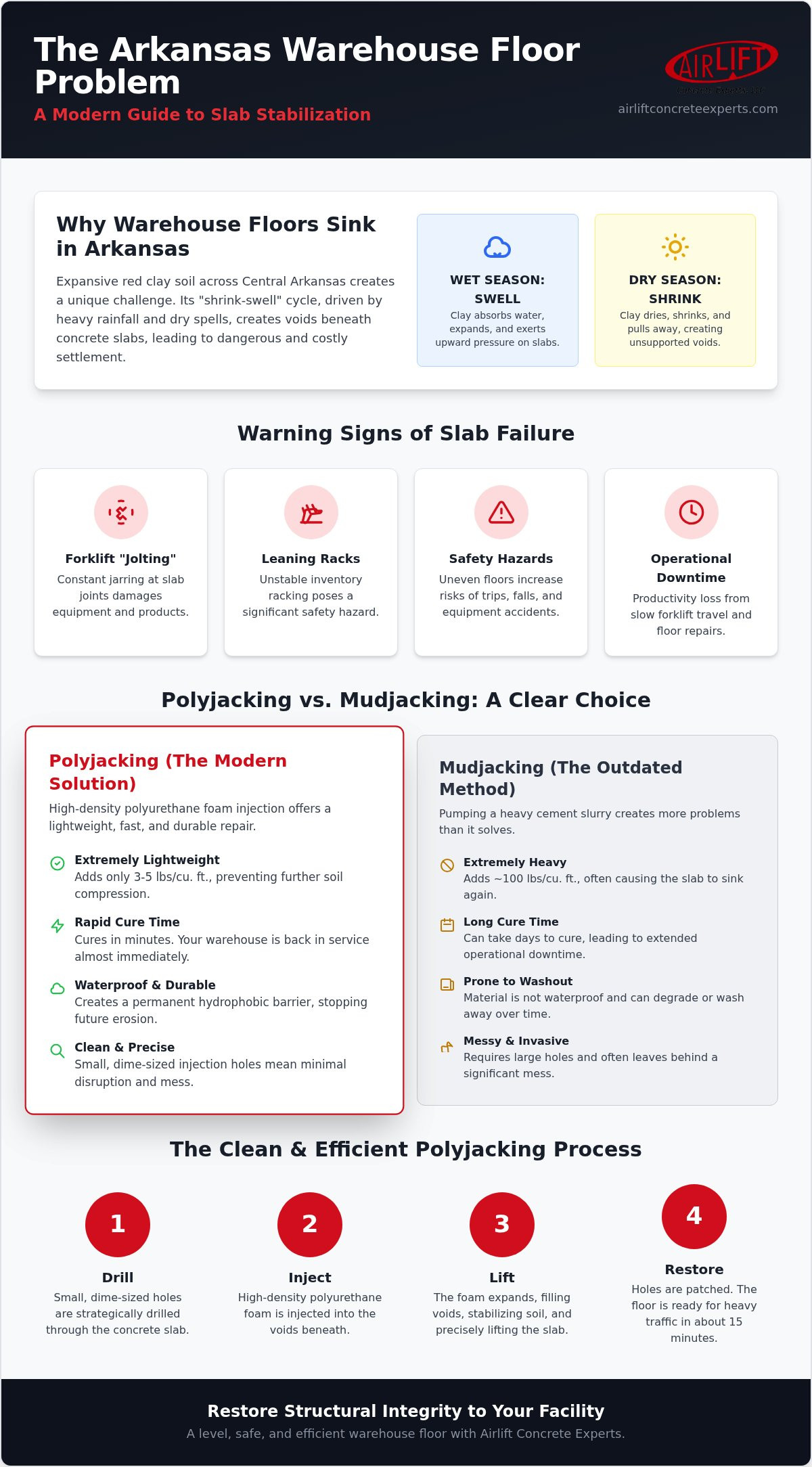
Recognizing the early warning signs of a sinking slab can be the difference between a quick repair and a total operational shutdown. One of the most obvious indicators is a noticeable “jolt” or “clunk” when forklifts cross expansion joints. This isn’t just a nuisance; it’s a sign that one slab has settled lower than its neighbor, creating a trip hazard and mechanical strain on your equipment. You might also see inventory racks that appear slightly misaligned or visibly leaning. In a high-density storage environment, even a one-degree tilt at the base translates to a dangerous lean at the top of the rack.
Other common physical symptoms include gaps appearing beneath your baseboards or partition walls. If you can see daylight under a wall that used to be flush with the floor, your foundation is likely migrating. Our polyjacking process is specifically designed for “clean-work” environments, meaning we can address these gaps without the dust and debris of traditional construction. You should also watch for cracking along the edges of your slabs or a “hollowing” sound when heavy equipment passes over certain areas. These are clear signals that you should prioritize warehouse floor leveling Arkansas to protect your facility’s long-term value.
Ignoring these signs creates significant liability for any business owner. Uneven floors are a primary cause of premature wear on forklift tires and axles, leading to frequent and expensive maintenance cycles. From a safety perspective, OSHA maintains strict standards for walking and working surfaces. A sudden bump or a rocking slab can cause a forklift to tip or a worker to trip, resulting in serious injury. Additionally, sensitive warehouse machinery, such as automated sorting systems or precision scales, requires a perfectly level base to function without constant calibration errors.
You don’t always have to wait for a crack to appear to know there’s a problem. We use hollow-sound testing and specialized assessments to find hidden soil gaps before the concrete fails. In Central Arkansas, soil washouts often leave “bridge” slabs that are essentially suspended over empty space. These slabs are under immense tension and can fail suddenly under a heavy load. Early void filling prevents 90% of future slab cracking by restoring the support structure before the concrete reaches its breaking point. If you’ve noticed any of these warning signs, contact us for a free commercial assessment to secure your facility.
Based in Malvern, Airlift Concrete Experts has spent years perfecting the art of Commercial Concrete Lifting for businesses across Central Arkansas. We aren’t a national franchise with a one-size-fits-all approach. Instead, we’re your neighbors who understand exactly how the local climate impacts industrial foundations in Little Rock, Hot Springs, and Conway. Because we live and work here, we’ve developed a specialized understanding of how to stabilize slabs against the region’s unique soil challenges. Our team knows that a repair in the Arkansas River Valley requires different considerations than one in the Ouachita foothills.
We know that every hour your warehouse floor is out of commission is an hour of lost revenue. Our team prioritizes a rapid response for regional facilities to minimize operational halts. Our “clean-work” promise is a cornerstone of our service model. Because we use a self-contained injection system, there’s no wet slurry or heavy dust to contaminate your inventory. This makes our method the preferred choice for warehouse floor leveling Arkansas in environments where cleanliness and speed are non-negotiable priorities.
Taking the first step toward a safer facility is simple and straightforward. We offer free on-site structural evaluations to help you understand the root cause of your slab settlement. During this assessment, our technicians identify hidden voids and provide a clear, technical plan for stabilization. Our process is entirely non-invasive, so there’s usually no need to empty your entire warehouse or move heavy racking before we arrive. Our assessment provides the data you need to make an informed decision about warehouse floor leveling Arkansas without any high-pressure sales tactics. We work around your operational schedule to ensure your facility stays productive while we restore its foundation.
Request your free warehouse floor assessment today!
Maintaining a safe and efficient industrial space in Central Arkansas starts with understanding the unique ground beneath your feet. The expansive red clay found from Little Rock to Hot Springs requires a lightweight, waterproof solution that won’t add unnecessary weight to an already stressed subgrade. High-density polyurethane foam offers the compressive strength needed for heavy forklift traffic while curing in minutes, ensuring your operations don’t grind to a halt. By addressing warning signs like uneven joints and leaning racks early, you protect both your equipment and your employees from preventable hazards.
Airlift Concrete Experts is a family-owned and operated business based in Malvern, dedicated to serving our fellow Arkansas business owners with specialized high-density polyurethane technology. We focus exclusively on repair and stabilization, providing a cost-effective alternative to the mess and expense of new concrete construction. Our team is ready to help you restore the structural integrity of your facility with precision and care. Get a Free Commercial Concrete Leveling Quote and take advantage of our free structural assessments for businesses. Let’s work together to ensure your warehouse floor leveling Arkansas project provides the long-term stability your business deserves.
Industrial high-density polyurethane is specifically formulated to handle extreme compressive loads. It’s frequently used for bridge approaches and airport taxiways, so it easily supports heavy forklifts and machinery. The foam doesn’t just lift the slab; it also compacts the underlying soil to create a more stable base. For warehouse floor leveling Arkansas, this material provides a durable support system that withstands the daily rigors of a busy industrial facility.
You won’t have to worry about long operational halts because polyurethane foam cures to 90% strength in roughly 15 to 30 minutes. Most warehouse projects are completed in a single day, and the floor is ready for forklift traffic almost immediately. This is a significant advantage over pouring new concrete, which requires days or weeks of curing time before it can handle the weight of heavy industrial equipment.
Polyjacking is an excellent choice for clean warehouses because it’s a dry, non-invasive process. The foam itself is an inert material that won’t leach into the environment or react with moisture. Unlike mudjacking, which uses a wet slurry, or concrete replacement, which creates massive amounts of dust, our process is self-contained. It allows food-grade or pharmaceutical facilities to maintain their required cleanliness standards while the structural repairs are being performed.
The foam we use is hydrophobic, meaning it won’t wash out or degrade when exposed to water. This is vital in Arkansas, where we see an average of 57 inches of rain annually. Traditional mudjacking slurry is prone to erosion, but polyurethane creates a permanent, waterproof seal beneath your slab. It effectively fills the voids created by soil washouts and prevents future moisture from undermining your warehouse’s structural foundation.
Most of the time, you don’t need to move your racking systems or empty the warehouse. Our high-pressure injection systems are capable of lifting slabs even under the weight of loaded racks. We carefully monitor the lift using laser levels to ensure everything stays aligned during the process. This non-invasive approach saves you the time and labor costs of relocating inventory, allowing your business to stay productive while we work.
Slab jacking is a targeted repair that lifts and stabilizes interior concrete floors by filling voids in the upper soil layers. Foundation repair usually involves the perimeter of the building and may require deep-driven piers to reach stable strata. While both address sinking issues, slab jacking is the preferred method for fixing the “jolting” joints and uneven floors that specifically interfere with warehouse operations and forklift safety across Central Arkansas industrial zones.
The total investment for warehouse floor leveling Arkansas varies based on the volume of polyurethane foam needed to fill the underlying voids. Since every facility in Little Rock or Hot Springs sits on different soil compositions, we provide custom assessments to determine the exact requirements. Generally, leveling a slab costs significantly less than a full replacement. You avoid the hidden costs of demolition, disposal, and the lost revenue associated with extended downtime.
As a Malvern-based, family-owned business, we take pride in the durability of our work. We offer professional assessments to determine the best stabilization plan for your specific site. Our high-density foam technology is designed for long-term structural stability, and we discuss all service details and performance expectations before the project begins. We treat every customer like a neighbor, ensuring you feel confident in the safety and reliability of your warehouse floor repair.

 Call Now