

A half-inch height difference between sidewalk slabs can create a tripping hazard. Sunken concrete trip hazard liability depends partly on who controls the walkway and on local rules. For a hazardous public sidewalk, responsibility may rest with the property owner, the municipality, or both. Prompt attention matters: a documented uneven slab can be assessed and addressed before it causes a fall.
If you manage a property, it is reasonable to focus on the visible edge, but the cause beneath the slab matters too. Runoff, soil erosion, and poor drainage can leave concrete unsupported and allow it to settle further.
This article explains how to assess sidewalk risk, what to document, and why repair timing matters. It also covers how drainage problems contribute to settlement and how polyurethane foam injection can fill voids and lift sunken concrete, helping you decide whether this approach may suit a walkway or another slab.
Uneven walkways often develop when soil shifts beneath concrete or water washes away support. For property owners, the cause, height difference, and repair history can guide a practical response.
Slabs sink when the soil beneath them shifts, erodes, or lacks firm compaction. Drainage problems can wash away supporting material, while repeated loading can expose weak spots in the base. Soil conditions and seasonal moisture changes also affect stability. The result may be a tilted sidewalk panel or a widening gap between slabs. Identifying the cause helps property owners choose a repair that addresses the movement, not just the visible edge.
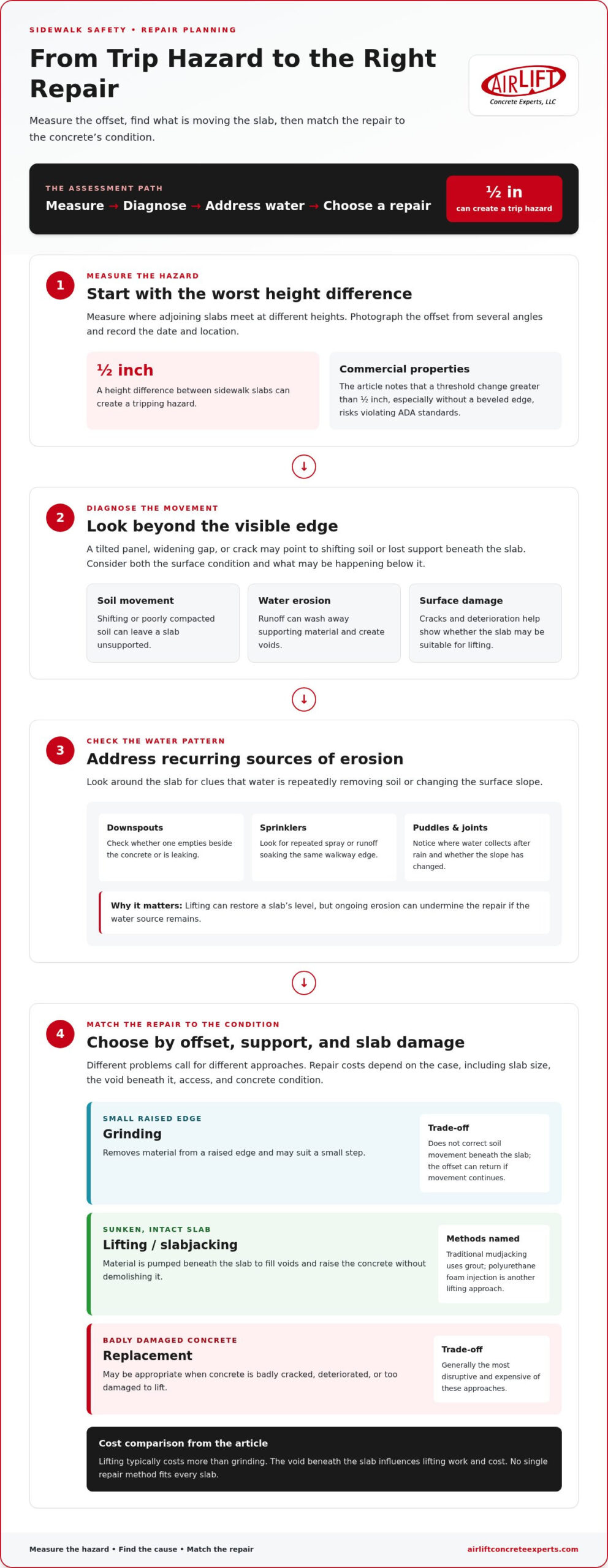
A trip hazard forms when adjoining concrete surfaces meet at different heights or a crack creates an uneven edge. A height difference of ½ inch between sidewalk slabs can create a tripping hazard. Cracks can also signal movement or deterioration, so assess both the surface and the slab’s support. On commercial properties, the U.S. Department of Justice says a threshold height change greater than ½ inch, especially without a beveled edge, risks violating ADA standards. Measure the worst offset and photograph it for repair planning.
Known hazards matter when someone is injured. A property owner found negligent for failing to keep the property reasonably safe could be liable for an injured person’s medical expenses. Responsibility for a hazardous public sidewalk may belong to the owner, municipality, or both, depending on local rules.
There is no single U.S.-wide statute of limitations for trip-and-fall injury claims. The deadline varies by state. When a city or another government entity may be responsible, special notice rules and shorter claim deadlines may apply, depending on the jurisdiction.
After a fall, photograph the slab from several angles, measure the height difference, and record the date and location. Preserve witness details, incident reports, and relevant medical records. Comparative negligence means an injured person’s own contribution to a fall may affect liability or recovery under the applicable rules.
Choose a repair by considering the offset, cracks, and cause of movement. A small raised edge and a sunken slab with lost soil support need different approaches. Matching the method to the condition can help restore safer walkways without overlooking the underlying problem.
Concrete movement can continue as soil settles and moisture erodes the base. A 1/4-inch lift can grow into a one-inch gap as the soil shifts. Prompt assessment helps owners understand whether uneven concrete needs grinding, lifting, or replacement. The right method depends on the slab’s condition, the height difference, and what caused movement beneath it.
Grinding removes material from a raised concrete edge and may suit a small step. It does not correct soil movement beneath the slab, so continued movement can bring the offset back. Lifting addresses a different problem: slabjacking fills voids beneath sunken concrete and raises the slab without demolishing it. This can be an alternative to replacing an intact panel that has settled.
Slabjacking pumps material beneath a slab to fill empty spaces and support the concrete. Traditional mudjacking uses a grout mixture; polyurethane foam injection is another lifting approach. The size of the void affects the work required. If poor drainage continues to wash away soil, the slab may move again unless the water problem is addressed too.
Replacement may be appropriate when concrete is badly cracked, deteriorated, or too damaged to lift. It may also make sense when a height difference appears alongside broader structural damage. Replacement is generally the most disruptive and expensive of these approaches. Lifting typically costs more than grinding, and the void beneath the slab influences the cost. For residential or commercial concrete, matching the method to the damage can help owners avoid replacing a slab that remains suitable for lifting.
Repair cost depends on the case and is given after a quote request; slab size, the void beneath it, access, and the concrete’s condition shape the estimate. For sunken but intact walkways, polyurethane concrete leveling can raise and level the slab without removing it. The repair method should address both the uneven surface and the cause of movement.
Water can change the ground beneath a driveway, patio, or sidewalk. Poor drainage, leaking downspouts, and sprinkler runoff may wash soil away, leaving concrete without even support. The slab can then settle or tilt as its base weakens. A new puddle on a driveway or patio can signal that the surface slope has changed and is directing water to a place it did not reach before.
Look for patterns around the slab, not just the visible low spot. Check whether a downspout empties beside the concrete, irrigation sprays across a walkway, or water collects near a joint after rain. These patterns can point to a recurring source. Water may also seep toward a foundation or basement if a changed slope directs runoff toward the building. That makes drainage assessment relevant beyond the tripping hazard itself.
Correcting drainage means reducing the flow that erodes soil and changing where water travels. Clear blocked drainage paths, repair leaking downspouts, and adjust sprinkler heads that repeatedly soak the same edge. Where runoff crosses a driveway or walkway, consider how the surrounding surface directs it. The aim is to prevent water from collecting beside or beneath concrete, rather than simply drying each puddle after a storm.
Soil support and drainage work together. A slab needs a stable base, but repeated water flow can carry away supporting material and leave voids. Lifting concrete may restore its level, yet continued erosion can undermine the repair if the water source remains. Addressing drainage alongside slab movement helps tackle the conditions that caused the uneven surface.
Replacing a slab alone does not resolve the underlying soil problem. If the same leaking downspout or runoff continues, it can affect the replacement concrete too. For example, a new driveway panel may settle again if water keeps washing soil from beneath its edge. Pair drainage correction with an assessment of slab support to limit continued movement and the risk of another tripping edge.
Polyurethane foam injection, also called polyjacking, lifts a sunken slab by filling voids beneath it. A technician drills small holes through the concrete, then injects high-density polyurethane foam underneath. The foam fills empty spaces and raises the slab toward an even position. Unlike slab replacement, this method works with the existing concrete instead of demolishing it.
The process can suit a sidewalk panel, driveway section, or patio slab that has settled but remains suitable for lifting. The concrete’s condition matters: severely cracked or deteriorated sections may not be good candidates. The size and location of the void also affect how the lift proceeds. The aim is to restore a safer, more level surface while supporting the slab beneath it.
Polyjacking can often be completed in hours rather than days, and the treated surface can be used immediately after the work. That can limit disruption around a walkway or entrance. Speed does not replace hazard control: keep people away from the uneven area during work, and address any continuing drainage problem that may be washing soil away.
Foam injection addresses the void and slab position; it does not redirect runoff or repair every type of concrete damage. Consider the cause, slab condition, and height difference together. If water continues eroding the base, correcting its path matters alongside lifting. If the slab is badly damaged, replacement may be more appropriate. Match the method to the concrete and its support, not just the visible trip edge.
For sunken concrete, polyurethane injection can fill underlying voids and raise an existing slab without replacing it. Restoring a more even surface can reduce a known tripping danger, but property owners should also document the condition and keep the area visible until repairs are complete. A sound repair decision considers both the slab’s height and the ground conditions beneath it.
Airlift Concrete Experts provides polyurethane concrete leveling for sunken slabs that remain suitable for lifting. The process can address uneven sidewalks, driveways, and commercial concrete by raising existing slabs rather than replacing them. It may also suit interior floors where settlement has created an uneven surface.
Consider concrete raising when a slab has dropped but remains suitable for lifting. For businesses, Commercial Concrete Lifting can help address settled concrete along walkways and entrances. The repair approach depends on the slab and the movement beneath it, so ongoing drainage problems should also be addressed.
If a sunken slab is affecting safe access at your property, contact Airlift Concrete Experts to discuss concrete leveling, or visit airliftconcreteexperts.com.
Treat sunken concrete trip hazard liability as part of an ongoing property-maintenance process, not a one-time repair decision. Assign responsibility for recording hazards, tracking drainage changes, and following repairs through to completion. Clear records help staff communicate what they observed and what action followed, especially when walkways serve residents, visitors, or customers.
Airlift Concrete Experts provides Polyurethane Concrete Leveling, Concrete raising, and Commercial Concrete Lifting for settled slabs. Use the documented condition to develop a repair plan suited to the concrete and its use. After drainage work or lifting, review the area again and update site records. This helps teams notice changes and respond consistently over time.
Contact Airlift Concrete Experts to discuss a concrete concern and consider the next step for your property. Steady attention can support safer, better-maintained walkways.
Property managers should assess pedestrian routes regularly and record hazards where they find them. Note the slab’s location, height difference, nearby cracks, lighting, and whether people can avoid the area. A dated photo from the same angle makes later comparisons useful. Include observations and interim precautions in maintenance records so staff can follow up rather than rely on verbal reports.
Concrete sinks when the soil supporting it loses strength or shifts. For example, a downspout that discharges beside a walkway can repeatedly direct water toward its base. Sprinkler overspray, poorly compacted fill, or a nearby tree root can also contribute to movement. Look for patterns connecting the low area to a water source, nearby landscaping, or changes in how the surface is used.
A concrete trip hazard is an abrupt change in walking level or a damaged edge that can catch someone’s foot. It may appear where sidewalk panels meet, around a broken corner, or beside a utility cover. Assess the route as pedestrians use it, including approaches and turns. A defect can matter even when it occupies only part of the walkway.
Acting promptly gives property teams more options for controlling access and planning repairs before the affected route becomes harder to use. Record the location, notify the person responsible for maintenance, and direct foot traffic away from the worst area where practical. Visible marking can alert pedestrians while repairs are arranged, but it does not remove the uneven surface or replace repairs.
Sunken concrete trip hazard liability can depend on whether an owner knew about the hazard and failed to take reasonable steps to address it. Responsibility also depends on who controlled the area and what precautions were taken. Maintenance logs, photographs, repair requests, and incident details can help show how the hazard was handled and clarify responsibility after an injury.
Responsibility can belong to the property owner, the municipality, or both, depending on local rules and who maintains that sidewalk segment. Liability for sunken concrete trip hazards on public sidewalks therefore depends on the location and applicable requirements. In Malvern, Hot Springs, Little Rock, Cabot, Conway, Benton, Bryant, North Little Rock, Sherwood, Jacksonville, and Hot Springs Village, determine whether the concrete lies on private property or within a public right-of-way.

 Call Now