

What if the steps at your entrance can be lifted instead of torn out? If they’re sinking, feel uneven underfoot, or have a widening gap beside the house, it’s understandable to wonder whether sunken concrete steps repair can make them safer or whether the damage goes deeper. The right approach depends on the concrete’s condition and what’s causing it to move.
In Arkansas, changing moisture can cause expansive clay soil to swell and shrink, contributing to movement beneath concrete. A surface patch may hide a crack, but it won’t correct settlement. When steps remain structurally sound and their layout is suitable, professional polyurethane lifting can raise and support them with less disruption than replacement.
This guide covers common causes of sinking, signs to look for, and how lifting compares with patching or replacement. You’ll also learn how to prepare for an assessment. Airlift Concrete Experts provides concrete raising across Arkansas, including Malvern, Hot Springs, Little Rock, Cabot, Conway, Benton, Bryant, North Little Rock, Sherwood, Jacksonville, and Hot Springs Village.
Uneven steps at a frequently used entrance can feel unsettling, especially when a gap appears beside the porch or the steps seem to tilt. These changes are useful clues, but they don’t identify the cause on their own. Settlement in concrete steps is downward or uneven movement that changes how the steps sit in relation to the ground or adjoining surfaces. An assessment can help distinguish movement from surface wear and evaluate the support beneath the concrete.
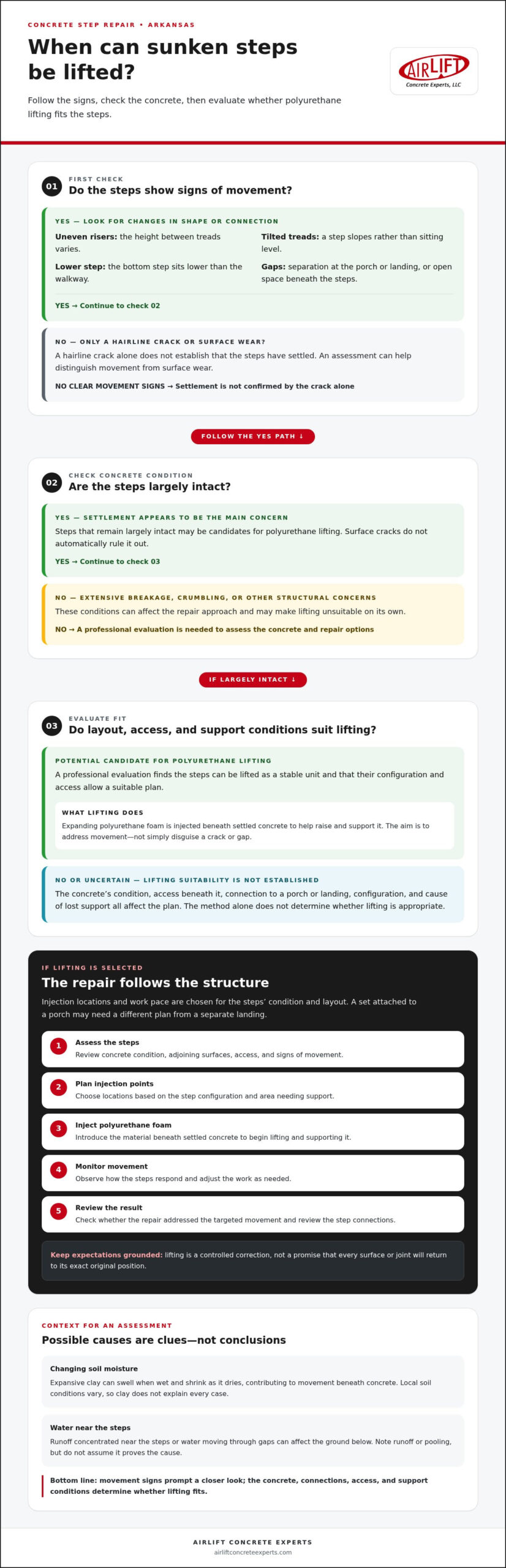
Look for changes in the step geometry and where the steps meet other structures. Risers may no longer appear evenly spaced, a tread may slope to one side, or the bottom step may sit lower than the adjacent walkway. New or widening gaps between the steps and a porch or landing can also show where movement has occurred.
A hairline surface crack alone doesn’t establish that steps have settled. A crack may be cosmetic, while a height difference, tilt, or separation suggests the concrete has shifted. Photos can document changes, but they can’t show the support beneath the steps or confirm a diagnosis.
Concrete steps rely on consistent support from the ground below. If soil shifts, compresses, or washes away, part of the structure may lose support and move. Water flow is one possible contributor: runoff concentrated near the steps or water moving through gaps can affect the ground beneath them. These are possibilities, not conclusions. Note nearby runoff or pooling, but don’t assume it proves the cause.
Arkansas soils can include expansive clay, which may swell when wet and shrink as it dries. That changing volume can contribute to movement beneath concrete, but local soil conditions vary, and clay shouldn’t be assumed to explain every settled set of steps. Similar symptoms can have different causes from one property to another. An on-site assessment evaluates the steps, their connections, and the support conditions below.
The term Slabjacking describes methods used to lift settled concrete by introducing material beneath it. For steps, the configuration and nature of the movement matter, so the method alone doesn’t determine whether lifting is appropriate. In sunken concrete steps repair, first establish whether the concrete has moved, cracked, or both.
Polyurethane concrete lifting raises settled concrete by injecting expanding foam beneath it to help lift and support the structure. With steps, the repair plan must account for each tread’s position, the connection to a porch or landing, and the concrete’s condition. The aim is to address movement, not simply disguise a gap or crack.
Polyurethane lifting introduces foam below settled concrete so the steps can be raised and supported when conditions allow. A professional evaluates whether the concrete can be lifted as a stable unit and how its shape and access affect the work. Severely broken steps or support conditions that call for another approach may make lifting unsuitable on its own.
The process starts with an inspection of the steps and nearby concrete. The technician considers visible cracking, how the steps meet the porch or landing, and the direction and extent of settlement. This helps determine whether lifting is appropriate and where injection points should go. The plan is based on the structure, rather than a one-size-fits-all pattern.
Lifting is a controlled correction, not a promise that every surface or joint will return to its exact original position. The goal is to improve the steps’ position and support in a way that suits their condition and layout. Injection locations and work pace are selected for the structure, so steps attached to a porch may need a different plan from a separate landing.
Steps that remain largely intact, with settlement as the main concern, may be candidates for polyurethane lifting. Suitability depends on an in-person evaluation of the concrete, access beneath it, the overall configuration, and the cause of lost support. Surface cracks don’t automatically rule out lifting, but extensive breakage, crumbling, or other structural concerns can affect the repair approach.
For sunken concrete steps repair, an assessment helps distinguish a liftable structure from one that needs a different plan. Airlift Concrete Experts provides polyurethane concrete leveling and raising across Arkansas, including Malvern, Hot Springs, Little Rock, Cabot, Conway, Benton, Bryant, North Little Rock, Sherwood, Jacksonville, and Hot Springs Village. Homeowners can request a complimentary initial assessment to discuss their steps and whether lifting suits the project.
The right repair depends on what has changed: the concrete’s surface, its position, or its structural condition. Patching can improve localized surface damage. Lifting may correct settlement when the steps can be raised and support conditions allow it. Replacement may be considered when the concrete is too damaged to repair effectively, in which case partnering with an experienced general contractor like Strother Built Construction can ensure a proper rebuild. No method fits every set of steps.
| Approach | Purpose | Limitation |
|---|---|---|
| Polyurethane lifting | Raise and support settled concrete when its condition and layout suit the repair. | May not address severe breakage or conditions that prevent effective lifting. |
| Surface patching | Fill or improve localized cracks and surface defects. | Does not, by itself, correct a sunken step or restore its level and alignment. |
| Replacement | Address steps whose damage or condition makes repair unsuitable. | Involves removing and rebuilding the affected concrete rather than correcting its position in place. |
Patching and lifting solve different problems. A surface crack in otherwise well-positioned concrete may call for a surface-focused repair. But if one tread sits lower than the next, or the steps have shifted away from a landing, filling a crack or gap won’t restore the original geometry. The opening may be covered while the uneven walking surface remains.
That distinction matters for sunken concrete steps repair. An assessment should establish whether the main issue is surface damage, movement, or both. If movement is present, the repair plan needs to address the steps’ position, not just the crack’s appearance. A patch may still have a role, but it shouldn’t be mistaken for a correction to settlement.
Polyurethane lifting may be appropriate when the concrete can be raised and its underlying support conditions allow it. Extensive breakage, crumbling, unstable support, or a configuration that can’t be corrected through lifting may change the repair plan. An on-site assessment evaluates the steps’ condition and the cause of movement before a method is selected. Photos show visible damage, but they can’t establish support conditions below the concrete.
For more detail about the leveling method, explore this guide to polyurethane concrete leveling. It explains the difference between raising settled concrete and treating surface damage. The key question is which method addresses the actual condition of the steps.
A little preparation can make an assessment more useful without requiring you to inspect beneath the concrete. Note what has changed, take photos from a safe position, and keep the approach clear. These details help a professional understand how the steps relate to the porch, landing, and nearby slabs.
Take clear photos showing the full set of steps and adjoining surfaces. If it’s safe, add closer views of visible cracks, gaps, and places where the concrete appears to slope or separate. Use the same viewpoints if you take more photos later, so changes are easier to compare.
There’s no need to measure or probe beneath the steps. A concise description of what you’ve observed and when it began is more useful than trying to determine the cause yourself. If the steps are visibly unstable, keep people away until they can be evaluated.
An on-site assessment looks at the steps as part of the entrance, not as an isolated slab. The professional considers the concrete’s condition, changes in level, and how the steps meet the porch or landing. Nearby concrete may also matter: an adjoining walkway or slab can help show whether movement affects more than one surface. Access around the steps is considered because it can affect the work.
Drainage and other visible site conditions provide context, not a diagnosis. Water flowing toward a stair base is worth pointing out, but that observation alone doesn’t confirm that it washed away support. The assessment combines visible conditions with the structure’s layout and condition to guide the repair approach.
For broader context on concrete lifting for slabs around a property, see this Central Arkansas concrete lifting guide. The same preparation can help you describe a settled landing or nearby concrete along with the steps.
If you’re concerned about sunken concrete steps repair, Airlift Concrete Experts offers a complimentary initial assessment to discuss visible conditions and possible next steps. Request an initial assessment for your Central Arkansas property.
Choosing a repair starts with understanding whether the steps have shifted, the concrete’s condition, and whether the support beneath it can be addressed. Airlift Concrete Experts provides polyurethane concrete leveling and raising for Arkansas properties. For homeowners considering sunken concrete steps repair, a complimentary initial assessment is a practical way to discuss what’s visible and whether lifting may suit the site.
Airlift Concrete Experts assesses settled concrete steps and surrounding site conditions before recommending a repair. The team considers the concrete’s condition, how the steps meet a porch or landing, the direction of movement, and access around the structure. When the concrete and layout are suitable, polyurethane foam can be injected beneath the steps to help raise and support them.
Each entrance is different. Steps connected to a landing may present different repair considerations than steps beside a separate walkway, and visible cracks or gaps don’t tell the whole story. The recommendation is based on conditions at the specific site, not an assumption that every set of steps needs the same solution.
During the initial assessment, share the property’s location, what changes you’ve noticed, and any access concerns. Mention whether the steps are uneven, a gap has appeared at the porch, or the approach is difficult to keep clear. Photos and notes about when symptoms appeared can also help. You don’t need to determine the cause yourself.
For a broader explanation of polyurethane concrete leveling in the region, Airlift’s polyjacking service guide for Malvern and Central Arkansas offers additional context. The assessment focuses on your steps and site conditions, so you can discuss a suitable path forward based on the actual entrance.
Request a complimentary concrete assessment to discuss your sunken steps with Airlift Concrete Experts.
A steady, usable entrance starts with understanding what the steps need, not rushing into a repair. If you’ve noticed changes, keep a record of what you see and consider how the uneven surface affects everyday access. A professional evaluation can turn those observations into a clearer understanding of the steps’ condition and possible next steps.
Airlift Concrete Experts is a family-owned Arkansas concrete-leveling specialist, founded in 2017. The team provides polyurethane concrete leveling and raising for residential and commercial properties, with recommendations shaped by the concrete and site conditions. You don’t need to arrive with a diagnosis. Sharing what you’ve observed is a useful place to begin.
For a practical starting point, begin a conversation about your concrete steps. A clearer understanding of the entrance can help you decide how to move forward.
Yes, sometimes. The condition of the steps determines whether lifting is appropriate. For sunken concrete steps repair, a professional considers whether the concrete can move as a stable unit, along with its cracks, alignment, connection to nearby surfaces, and access for the work. Steps that have shifted but remain intact differ from steps with extensive breakage. An on-site assessment helps identify suitable repair options.
Yes. Polyurethane foam can be injected beneath settled concrete to help raise and support it. The approach must suit the structure: a broad landing attached to stairs may need a different plan from a separate concrete step section. A professional evaluates the steps’ shape, condition, and access before choosing injection locations. An assessment determines whether foam lifting suits a particular entrance.
Concrete steps can sink when soil or other support beneath them shifts, compresses, or is lost. Water movement may contribute in some situations, but water near a stair base doesn’t establish that it caused settlement. For example, a homeowner may notice a low spot in the walkway as well as a gap by the steps. Looking at both surfaces can help a professional assess the site.
They can be, especially if uneven step heights or sloped treads make footing unpredictable. Until the steps are assessed, avoid an entrance that feels unstable or difficult to navigate, and keep children and visitors away from it. If another entrance is available, use it instead. Point out the affected steps to anyone who needs to enter the home.
Work time depends on the number of steps, their condition, access, and what the repair requires. A straightforward configuration and a more complex set of steps shouldn’t be assumed to take the same amount of time. Describe the layout and visible issues during an assessment so the project discussion reflects the specific entrance and work involved.
Not necessarily. Lifting addresses the concrete’s position, but it doesn’t automatically remove every condition that may have contributed to movement. Soil support, water flow, and nearby concrete can all be relevant to understanding a site. The assessment considers these factors before a repair is recommended. Lifting is a potential way to correct settled concrete, not a promise that movement can never happen again.
Airlift Concrete Experts provides polyurethane concrete leveling and raising for residential and commercial properties throughout Arkansas, including Malvern, Hot Springs, Little Rock, Cabot, Conway, Benton, Bryant, North Little Rock, Sherwood, Jacksonville, and Hot Springs Village. For settled steps, the team assesses the concrete and site conditions to determine an appropriate approach. Sharing the location and what you’ve observed helps start a useful project discussion.

 Call Now