
Could a sloping A/C pad be lifted safely, or does it need to be replaced? If your outdoor unit looks uneven, it’s reasonable to be concerned about the connected refrigerant lines and electrical connections. Sunken A/C pad repair starts with assessing the concrete: the right approach depends on the slab’s condition and the support beneath it.
In Central Arkansas, soil movement, erosion, or drainage problems can leave a concrete pad without even support. An assessment can help determine whether polyurethane concrete lifting may raise the slab or whether its condition calls for a different approach. The goal is to address the concrete while accounting for the HVAC equipment, not to assume every settled pad needs the same repair.
This article covers common causes of a sinking pad, signs to watch for, and how polyurethane concrete lifting works. You’ll also learn what an assessment considers and how to prepare for professional repair, so you can make an informed decision about restoring a stable, level surface.
An outdoor condenser sitting at an angle or a visibly settled pad is worth paying attention to. A tilt alone doesn’t establish that the unit is in danger, but check whether the concrete is uneven, cracked, or separating. Sunken A/C pad repair addresses the supporting slab, not the diagnosis or repair of the air-conditioning equipment.
Observe the concrete from a safe distance. Don’t move the unit or pull on its connected lines to investigate. Photos of the pad, its edges, and any visible changes can help document what you’ve noticed for an assessment.
Look for a slab that slopes, an edge that sits lower than the opposite side, or a noticeable change in the condenser’s position. Cracks, separation in the concrete, gaps beneath the pad’s edges, or exposed spaces can indicate that the slab may not have continuous support. Note any water pooling nearby, especially if it appears after rain or watering.
These signs don’t reveal the full cause or extent of the problem. A small gap may have a different explanation than a broad uneven area, and pooling water alone doesn’t prove erosion. If the pad has visibly moved or its condition is changing, a concrete assessment can help evaluate the slab and its support. Cooling problems or unusual equipment noises call for a separate HVAC evaluation.
A pad may settle if the ground beneath it shifts or no longer supports the concrete evenly. Possible contributors include soil movement, water washing material out from beneath the slab, or inadequate support below the pad. These factors can occur together, and the cause depends on the site. The surface appearance alone can’t confirm what is happening under the concrete.
Water is one part of the picture to note. Runoff and drainage patterns may contribute to erosion, while changes in ground moisture can affect soil stability. For broader background on the causes of concrete settlement, see the overview of concrete leveling. It provides context, not a diagnosis of a particular pad.
For homeowners in Little Rock and elsewhere in Central Arkansas, a practical first step is to assess the slab and its support. Understanding the site conditions helps determine whether lifting may be appropriate and keeps concrete repair separate from HVAC troubleshooting.
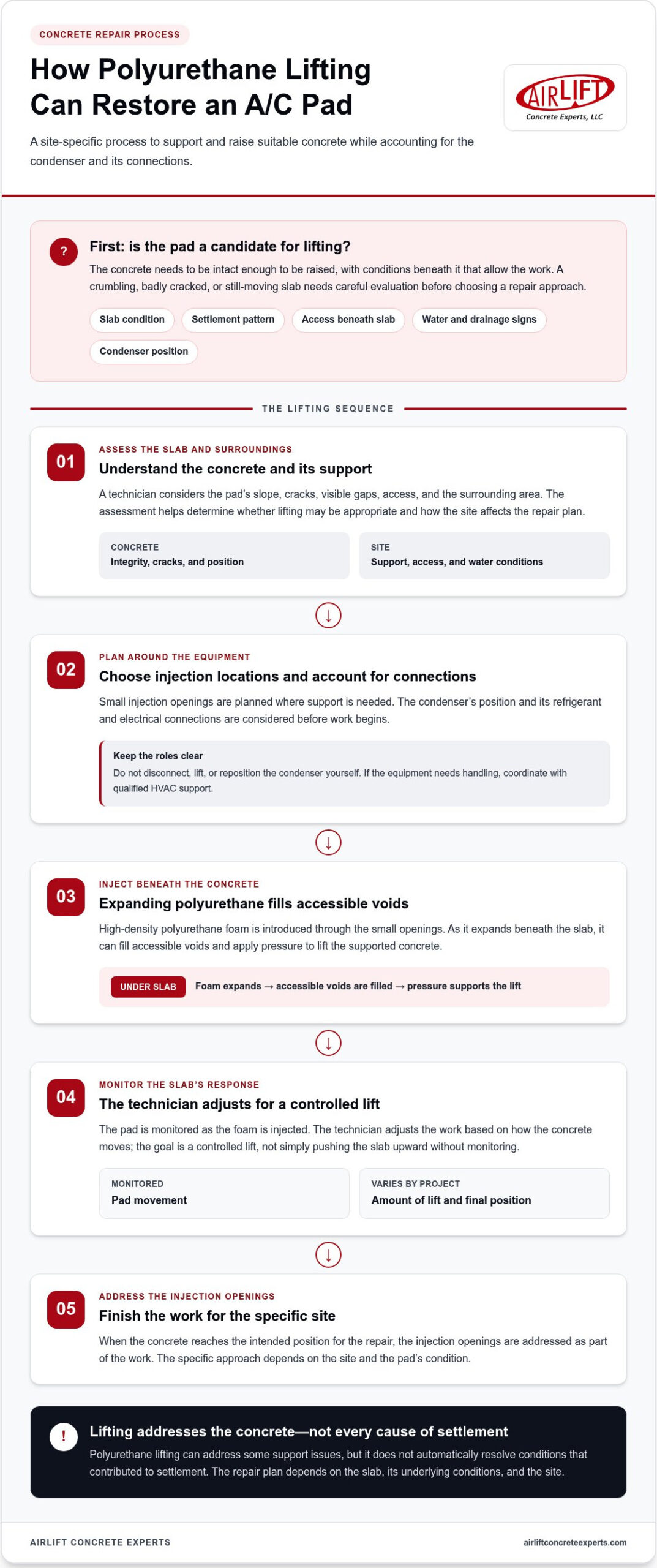
Polyurethane concrete lifting involves injecting expanding foam beneath a concrete slab to fill suitable voids and raise the supported concrete. For sunken A/C pad repair, the aim is to restore support and improve the slab’s position while accounting for the condenser and its connections. Whether lifting is suitable depends on the pad, the support beneath it, and site conditions.
The process begins with an assessment of the slab and surrounding area. A technician considers the pad’s slope, cracks, access, and visible gaps, then plans where to make small injection openings. These openings allow the high-density polyurethane foam to be placed beneath the concrete where support is needed. The goal is a controlled lift, not simply pushing the slab upward without monitoring its response.
After the injection points are planned, polyurethane is introduced through small openings in the slab. As the material expands beneath the concrete, it can fill accessible voids and apply pressure to lift the slab. The technician monitors the pad’s movement during injection and adjusts the work based on its response. The amount of lift and final position depend on the slab and underlying conditions, so results vary by project.
When the concrete reaches the intended position for the repair, the injection openings are addressed as part of the work. The specific approach depends on the site and the condition of the pad.
The condenser’s position and its refrigerant and electrical connections need to be considered before lifting begins. The work should be planned around the equipment rather than treating the pad as an isolated slab. An assessment can identify whether the unit’s placement or nearby connections affect access or the lifting plan.
Don’t disconnect, lift, or reposition the condenser yourself. If the equipment needs to be handled, coordinate with qualified HVAC support. Keeping those responsibilities clear allows the concrete work to focus on the pad and helps avoid unnecessary handling of the connected system.
For a pad in Little Rock or elsewhere in Central Arkansas, a site-specific evaluation helps establish whether lifting is appropriate and how to plan the work. Explore polyurethane concrete leveling to learn more about Airlift Concrete Experts’ concrete-lifting services.
The key question isn’t only how far the pad has sunk. It’s whether the concrete is intact enough to be supported and moved as a slab. Polyurethane lifting may be worth assessing when the pad is in suitable condition and there are accessible voids beneath it. A slab that is crumbling, badly cracked, or still moving needs careful evaluation before a repair approach is selected.
For sunken A/C pad repair, an assessment considers the concrete’s integrity, the pattern of settlement, access beneath the slab, and signs of ongoing water problems. Lifting can address some support issues, but it doesn’t automatically resolve the conditions that contributed to settlement. Airlift Concrete Experts focuses on concrete repair and lifting. Replacing a pad is a separate construction scope.
A pad that remains largely intact may be suitable for assessment even if it has settled or has a gap beneath part of an edge. Where voids and site conditions allow, injected polyurethane may support and raise the existing slab. The pad’s condition and its response during repair guide the work. An evaluation cannot promise a particular final elevation or permanent stability in every case.
Extensive cracking, crumbling edges, continued movement, or recurring water flow call for careful review. If water is washing material from beneath the slab, the drainage pattern may need attention as part of understanding the site. A concrete assessment also has limits: refrigerant leaks, electrical concerns, and cooling problems are HVAC issues, not concrete-lifting repairs.
| Factor | Lifting may be considered when… | Closer evaluation matters when… |
|---|---|---|
| Slab condition | The concrete appears intact enough to be supported and raised. | Cracks are extensive or edges are breaking apart. |
| Support below | Accessible voids or settlement may be addressed through lifting. | The condition beneath the slab is unclear or unsuitable for the approach. |
| Movement and water | The pad’s movement and surrounding conditions can be assessed for a repair plan. | Movement continues or water-related erosion may be ongoing. |
| Equipment concerns | The work can be planned around the condenser and its connections. | Mechanical or line issues need separate HVAC evaluation. |
This comparison is a starting point, not a diagnosis. An assessment in Little Rock or another Central Arkansas community can weigh these factors and determine whether lifting fits the pad’s condition. If the slab isn’t suitable for lifting, replacement may need to be considered as a separate scope of work.
A useful repair plan starts with the site, since not every settled pad needs the same treatment. During sunken A/C pad repair, the assessment considers the concrete’s condition, how it has settled, access around the slab, drainage, and the condenser’s position. These details help determine whether polyurethane concrete lifting is suitable and how to plan the work around the equipment.
The assessment looks at the slab and surrounding area, including visible cracks, gaps, slope, access, and signs of water collecting or flowing nearby. The condenser and its connected lines are also considered so that equipment handling isn’t improvised during concrete work. The repair plan is then shaped around the pad and site conditions.
To learn more about the method before an assessment, explore Airlift’s polyurethane concrete leveling information for background on concrete lifting.
Keep the route to the pad accessible and take photos of the slab and any changes you’ve noticed. Point out where water collects or where a gap has appeared. Don’t move or disconnect the condenser yourself. If equipment handling is needed, coordinate it with qualified HVAC support.
After the assessment, the next steps are to discuss the site-specific approach, prepare the work area, and carry out lifting if the slab and conditions are suitable. The crew monitors the concrete during the repair and considers the result in relation to the repair plan. The schedule and work details depend on the project, so an assessment is the clearest way to understand what your pad requires.
Airlift Concrete Experts serves communities across Arkansas, including Malvern, Hot Springs, Little Rock, Cabot, Conway, Benton, Bryant, North Little Rock, Sherwood, Jacksonville, and Hot Springs Village. If you’re concerned about a settled pad, request an assessment to discuss an approach suited to your site.
An uneven condenser pad can leave you wondering whether the concrete can be lifted or needs a different solution. Start by assessing the slab and the conditions around it. Airlift Concrete Experts provides polyurethane concrete leveling and raising, with an approach shaped by the pad’s condition, support, access, drainage, and equipment position.
Airlift is family-owned and operated and has served Arkansas properties since 2017. Its work focuses on concrete raising and polyurethane leveling, including projects in Little Rock and communities throughout the state. Lifting addresses the concrete slab and its support. It isn’t HVAC troubleshooting or repair, and any required handling of the condenser or its connections should be coordinated appropriately.
A concrete-lifting specialist can focus on how a slab has settled and what the site may require, rather than treating the pad as an air-conditioning fault. Airlift serves Arkansas homeowners and businesses with concrete-raising services. For more background on related work, explore the concrete lifting services available in Arkansas.
Describe what you’ve observed, such as a sloping slab, a gap beneath an edge, cracking, or water collecting nearby. Clear photos of the pad and surrounding area can help show those visible conditions. Airlift can assess whether the concrete is suitable for lifting and discuss an approach based on the site, rather than assuming every pad needs the same repair.
A project-specific assessment can clarify the concrete issue and the next step before work begins. If you’re concerned about a settled pad in Little Rock or elsewhere in Arkansas, request an assessment to discuss your A/C pad and whether concrete lifting may be suitable.
A tilted condenser or settled slab doesn’t automatically mean the pad must be replaced. The concrete’s condition, support beneath it, drainage, and equipment position all help determine whether polyurethane lifting may be appropriate. A site-specific assessment can clarify the options and keep the repair focused on the concrete, separate from HVAC troubleshooting.
For sunken A/C pad repair in Arkansas, Airlift Concrete Experts provides polyurethane concrete leveling and raising for residential and commercial properties. As a family-owned and operated business serving communities throughout the state, Airlift evaluates the site before shaping a repair plan around its needs.
If you’ve noticed a change in your A/C pad, share what you’re seeing and request an assessment. It’s a practical first step toward understanding the concrete and deciding how to move forward. Contact Airlift Concrete Experts to discuss your pad and arrange an assessment.
Yes, an existing pad may be lifted if the slab is intact enough and site conditions support the repair. Polyurethane concrete lifting can fill suitable voids beneath the concrete and raise the supported slab. An assessment considers cracking, crumbling, movement, access, and the support below. Lifting isn’t right for every pad, so the assessment helps determine whether repairing the existing concrete is a practical approach.
Polyurethane foam is used in professional concrete lifting, but whether it’s suitable beneath a particular A/C pad depends on the slab and site conditions. The work should be planned around the condenser and its connections, with equipment handling coordinated carefully. An assessment can help establish whether lifting is appropriate. This addresses concrete support only; it doesn’t evaluate or repair the air-conditioning system itself.
A pad may sink when the soil or other support beneath it shifts or erodes. Water movement, inadequate support, or changes in ground conditions may contribute, but the cause varies by site. A visible slope or gap at the slab’s edge can’t confirm what is happening below. A concrete assessment considers the pad and surrounding conditions to help identify a suitable repair approach.
It depends on the pad’s condition, access, and the condenser’s position. The lifting plan needs to account for connected refrigerant lines and electrical connections rather than treating the slab as an isolated surface. Don’t try to move or disconnect the unit yourself. If equipment handling is needed, coordinate with qualified HVAC support before concrete work proceeds.
Repair time depends on the pad’s condition and size, access, and the approach suited to the site. A reliable estimate requires an assessment, so there isn’t one duration that applies to every project. During polyurethane lifting, the technician monitors the slab’s movement as the work progresses. The repair plan can explain the expected steps for your specific pad without assuming every project follows the same schedule.
A concrete-lifting plan should account for the refrigerant lines and other connections, but equipment handling cannot be assumed to be risk-free. Don’t pull, disconnect, or reposition lines or the condenser yourself. Plan the concrete work around the equipment, and involve qualified HVAC support if handling the unit or connections is necessary. Concrete lifting addresses the slab, not refrigerant-system repairs.
Airlift Concrete Experts provides polyurethane concrete leveling and raising for Arkansas properties, including residential and commercial projects. Its service area includes Little Rock, North Little Rock, Malvern, Hot Springs, Hot Springs Village, Cabot, Conway, Benton, Bryant, Sherwood, and Jacksonville. For a sunken A/C pad, an assessment considers whether the concrete is suitable for lifting and how the work can be planned around the equipment.
Document the cracks, uneven areas, gaps, or pooling water with clear photos, and note any changes you’ve observed. Avoid trying to lift the slab or move the condenser yourself. A professional concrete assessment can evaluate the slab’s condition and whether polyurethane lifting may be suitable. If you’re also noticing cooling problems, unusual sounds, or concerns with refrigerant lines, those are separate HVAC issues.

 Call Now