
What if you could stop worrying about those growing cracks in your drywall and finally feel secure in your home’s stability again? For many homeowners across Central Arkansas, the shifting expansive clay soil makes foundation movement feel like an inevitable, expensive nightmare. You might notice sticking windows or a slight slant in the hallway and feel unsure who to trust for a permanent fix. Finding the right expertise for concrete foundation leveling Arkansas is about more than just filling a gap; it’s about restoring the structural integrity of your biggest investment.
We know how overwhelming it is to face potential structural issues, especially when you’re caught between confusing technical jargon and high-pressure sales tactics. This guide provides the clarity you need to identify real red flags and understand why specialized concrete foundation leveling Arkansas is the most effective way to address these concerns. We’ll explain the transition from older mudjacking techniques to modern polyjacking and show you exactly what to expect from a professional assessment. You’ll gain a clear path toward a stable, level home through concrete foundation leveling Arkansas that meets the latest 2026 safety standards and protects your family for years to come.
Many Arkansas homeowners describe a “sinking feeling” when they walk through their front door, a subtle intuition that something isn’t quite right with the home’s alignment. It isn’t just your imagination. Our state’s unique climate, characterized by heavy spring rains followed by intense summer heat, creates a cycle of soil expansion and contraction that puts immense pressure on your home. When you notice these shifts, it’s time to consider professional concrete foundation leveling Arkansas residents can rely on to prevent permanent structural damage.
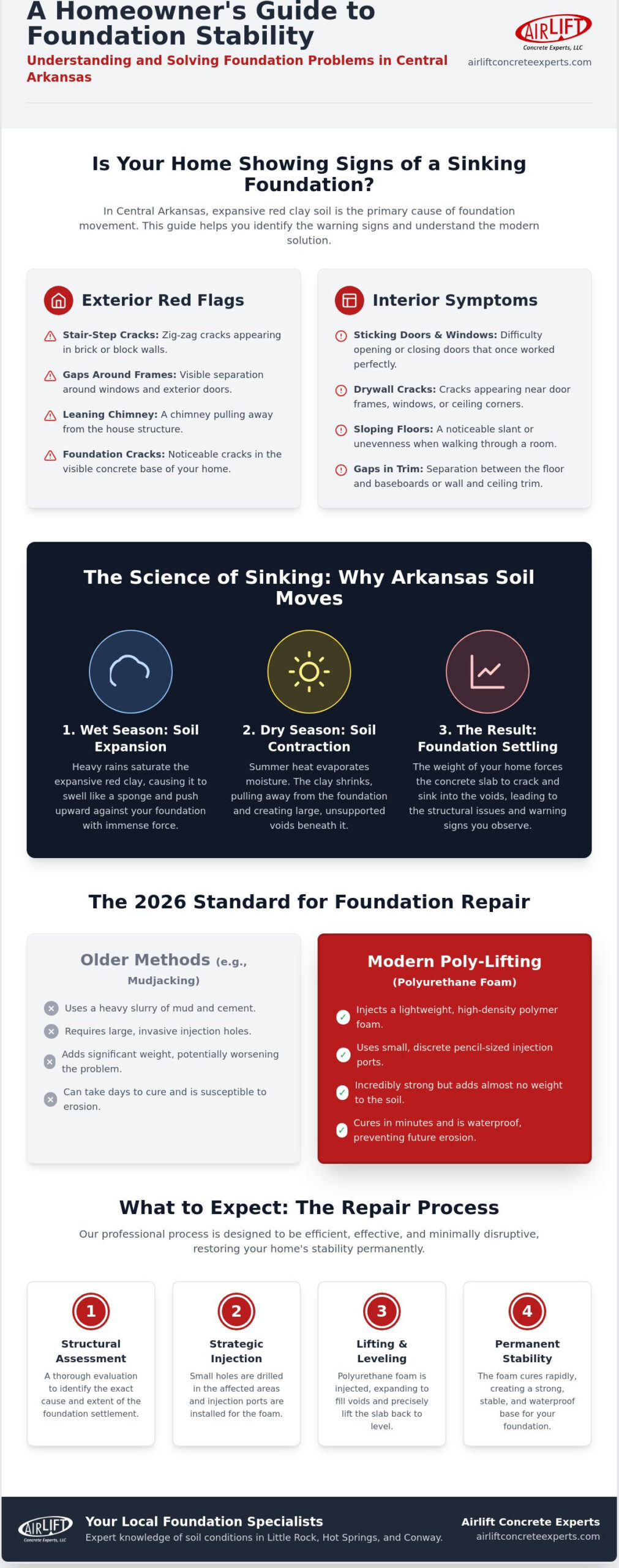
Ignoring a hairline crack might seem like a way to save money, but The Science of Sinking shows that minor settlement rarely stops on its own. In Central Arkansas, our active red clay soils act like a sponge. They swell when wet and shrink during droughts, leaving voids beneath your slab. These voids eventually cause the concrete to crack under the weight of the building. Catching these issues early is the difference between a simple polyurethane injection and a massive, disruptive excavation project. We’ve seen how Arkansas weather patterns move fast, and your foundation reacts just as quickly. A wet spring in Little Rock can saturate the ground, while a dry July in Hot Springs causes that same soil to pull away from your footings. This constant movement accelerates settling, making it vital to perform regular walkthroughs of your property.
The exterior of your home often tells the story of what’s happening underground before you see issues inside. You should look for stair-step cracks in the exterior brickwork, which usually follow the mortar joints and indicate that one side of the wall is moving faster than the other. Other common red flags include:
Inside the home, structural movement often manifests as functional problems. You might notice doors that stick or fail to latch properly during humid summers, or perhaps you’ve seen wall cracks appearing suddenly above interior door frames. These aren’t just cosmetic nuisances; they are signs that the frame of your house is twisting. Sloping floors or noticeable gaps between your baseboards and the flooring are also clear indicators that your slab is no longer level. If you can roll a marble across a hardwood floor and it consistently picks up speed in one direction, your foundation is likely calling for an expert assessment.
Arkansas isn’t just known for its natural beauty; it’s also home to some of the most challenging soil conditions in the country. The culprit behind most structural issues in our region is the high concentration of red clay. This soil isn’t a stable base for a heavy home. Instead, Arkansas red clay is notorious among builders and engineers for its expansive and reduction-resistant characteristics. It behaves much like a sponge, reacting violently to changes in moisture levels. When you understand how this soil moves, you can see why professional concrete foundation leveling Arkansas services are so essential for long-term home health.
The cycle of drought and heavy rain, particularly in the Little Rock area, keeps this soil in a state of constant flux. During a typical Arkansas spring, heavy rains saturate the ground. This moisture causes the clay to swell with incredible force, pushing upward against your foundation. When the summer heat arrives, the moisture evaporates, and the soil shrinks back down. This creates massive underground voids. Your home’s heavy concrete slab cannot support itself over these empty pockets, leading to the settling and cracking we discussed in the previous section. Traditional slab construction often fails here because it assumes the ground will stay put. In Central Arkansas, the ground is almost always on the move.
Clay swells when wet, but it doesn’t always lift your home evenly. If one side of your property stays wetter than the other, you’ll experience differential settlement. This uneven lifting puts immense shear stress on your concrete. During hot Arkansas summers, the “shrinkage” effect is even more dangerous. As the clay dries out, it pulls away from the footings. This localized soil compaction is the root cause of sinking foundations. It leaves your home’s weight resting on nothing but air, forcing the concrete to snap under its own weight. If you’re noticing these shifts, it’s a good idea to have a professional from Airlift Concrete Experts evaluate your soil’s stability.
Water is the primary driver of soil movement. Poor gutter runoff that pools near your foundation is a major risk factor. It over-saturates the clay in one specific spot, leading to rapid expansion. Along with that, large tree roots in areas like Malvern or Benton often suck moisture from the soil during dry spells, accelerating the shrinkage process. This moisture imbalance creates hydrostatic pressure. Hydrostatic pressure is the force of water against your foundation walls. When this pressure builds up, it doesn’t just move the soil; it can actually push against the foundation itself, causing walls to bow or floors to heave. Managing this pressure is the first step in ensuring your home stays level for decades.
For homeowners in other regions like Northeastern Ohio, Foundation Care Pros offers specialized foundation repair and basement waterproofing services that address these exact types of moisture-related structural issues.
Arkansas homeowners often face a difficult choice when their floors begin to slant or cracks appear in the slab. You might’ve heard of mudjacking, a traditional method that involves pumping a heavy cement slurry under the concrete. While this was the standard for decades, it often fails in our local red clay because the slurry itself is incredibly heavy. Adding more weight to already failing soil usually leads to more sinking over time. By 2026, the industry standard has shifted toward high-density polyurethane foam injection. This modern approach to concrete foundation leveling Arkansas residents prefer offers a permanent fix without the mess or the added weight of traditional concrete raising.
Repairing your existing concrete is almost always more cost-effective than a total replacement. When you tear out a driveway or a floor and pour new concrete, you aren’t fixing the underlying soil problem. The new slab will eventually sink into the same voids left by the old one. Polyjacking fills those voids and stabilizes the ground, ensuring your home remains level for the long haul. It’s a surgical approach that addresses the root cause of the movement rather than just masking the symptoms with a new layer of cement.
Polyurethane is a lightweight material that won’t add unnecessary stress to the fragile soil beneath your home. Because it expands to fill every nook and cranny, it creates a solid, supportive base that prevents future movement. Its waterproof properties are a significant benefit in our humid climate. Unlike mudjacking slurry, which can wash away during heavy Arkansas rains, polyurethane resists erosion and keeps your slab secure. Best of all, the downtime is minimal. You can walk or drive on the treated area in just minutes, not days, making it the most convenient option for busy families.
In cases where the soil is exceptionally unstable or the structure is heavy, polyjacking might be paired with structural piering. Steel piers are driven deep into the earth until they reach stable, load-bearing strata far below the shifting clay. For many projects involving foundation repair near me, we evaluate whether push piers or helical piers are the better fit. Push piers use the weight of the house to drive the steel into the ground, while helical piers are screwed in, making them ideal for lighter structures like porches or where the foundation is already severely compromised. This combination of deep support and surface leveling provides the ultimate peace of mind for your family’s safety.
The thought of having structural work done on your home can be stressful. We understand that your property is likely your most significant investment, and having a crew on-site can feel disruptive. Our approach to concrete foundation leveling Arkansas homeowners trust is designed to be as non-invasive and transparent as possible. Unlike traditional methods that might involve weeks of excavation and heavy machinery, our polyurethane injection process is surgical and efficient. We treat your home with the same respect we’d show our own neighbors in Malvern or Little Rock, ensuring you feel secure throughout the entire project.
We believe in a steady, methodical rhythm that begins with education. You won’t be left wondering what comes next. The team at Airlift Concrete Experts follows a logical problem-solution progression, where each step is explained clearly. This structural clarity is part of our commitment to being a reliable partner in your home’s maintenance. We focus on durability and long-term value, using advanced equipment that offers a permanent fix rather than a temporary patch. By the time we’re finished, you’ll have a level home and the peace of mind that comes with knowing the job was done right by local specialists.
Precision is the foundation of a successful lift. We start by using high-accuracy laser levels to determine the exact degree of foundation sink. This isn’t about guesswork; it’s about restoring the original engineering specifications of your structure. Our specialized technical equipment also helps us identify underlying soil voids that aren’t visible from the surface. Whether you’re in Cabot or Jacksonville, we develop a custom repair plan that accounts for your specific lot and the unique environmental conditions of your neighborhood.
The lifting phase is where the science of high-density polyurethane really shines. Our team drills tiny, penny-sized holes into the affected concrete slabs. These small access points are all we need to deliver the foam exactly where it’s needed. As the foam expands, it fills the voids and exerts upward pressure, lifting the slab back into place in real-time. You can often see drywall cracks begin to close as the house returns to its level state. Once the lift is complete, we seal the injection points with a professional finish that blends seamlessly with your existing concrete. To start your journey toward a stable home, request your professional foundation evaluation from our local team today.
Choosing a partner for your home’s structural health is a personal decision. As a family-owned and operated business, we don’t treat our customers like a number on a spreadsheet. We live and work in the same communities we serve, from Malvern to Little Rock and Hot Springs Village. This local connection means we have a personal stake in the safety and longevity of every home we touch. When you choose Airlift Concrete Experts, you’re getting a combination of advanced high-density polyurethane technology and the honest, neighborly service you expect from an Arkansas specialist.
Our focus is on transforming your anxiety into a sense of security. We know that structural issues are high-stress, so we prioritize transparent communication and straightforward solutions. We aren’t here to push flashy marketing gimmicks or unnecessary upgrades. Instead, we provide the technical expertise required for effective concrete foundation leveling Arkansas homeowners can trust for decades. Our team understands that a stable home is the foundation of a stable life, and we take that responsibility seriously. We pride ourselves on being the definitive local authority who understands our regional environmental challenges better than any broad national chain.
This dedication to transparency is a quality you should seek in all home service providers; for those also needing to vet roofing professionals, Rescue Roofing Tulsa offers an excellent guide on identifying a contractor who prioritizes integrity and quality workmanship.
Since we opened our doors in 2017, we’ve focused on mastering the specific challenges of our region’s soil. Our deep familiarity with the way Arkansas red clay shifts and settles allows us to provide more accurate assessments than competitors who don’t know our terrain. If you’ve been searching for polyjacking near me, our specialized crews are ready to serve families in Conway, Bryant, and Sherwood. We bring the right equipment and local knowledge to every job site, ensuring your repairs are tailored to your specific neighborhood’s environmental conditions.
Many companies offer quick cosmetic patches that hide cracks without addressing the underlying voids. At Airlift, we focus on long-term structural integrity. We use high-density foam because it provides a durable, waterproof base that won’t wash away or degrade over time. Investing in professional foundation repair is about protecting your home’s value and your family’s safety. We invite you to experience the peace of mind that comes with a level, secure property. To get started, Request your free foundation assessment and let our family help yours restore the stability of your home.
Your home deserves a foundation as stable as the community we share. We’ve explored how Arkansas red clay creates unique structural challenges and why modern polyjacking offers a cleaner, faster alternative to outdated repair methods. By choosing high-density polyurethane, you’re opting for a solution that resists erosion and provides long-term integrity without the disruption of heavy excavation. It’s about more than just a level floor; it’s about the safety and peace of mind your family deserves.
As a family-owned business serving Central Arkansas since 2017, Airlift Concrete Experts uses advanced technology to provide the concrete foundation leveling Arkansas homeowners need for lasting results. We take pride in helping our neighbors in Little Rock, Hot Springs, and Conway protect their most valuable investments with straightforward, professional service. Don’t let a small crack turn into a major structural failure when a permanent solution is just a phone call away.
Taking action today is the best way to ensure your property value remains intact. Request Your Free Foundation Inspection Today and let our specialists provide the technical clarity and structural stability your home requires. We look forward to partnering with you to keep your foundation firm for decades to come.
The cost of foundation repair depends on the severity of the settlement and the specific methods required to stabilize the structure. Minor repairs for small cracks or slight settling are naturally more affordable than major projects that require extensive piering or large volumes of polyurethane foam. Because every home sits on a different pocket of Arkansas clay, we provide a detailed assessment to determine the exact scope of work needed to secure your property.
You cannot safely fix a sinking foundation using a DIY kit. Structural repairs require industrial-grade high-density polyurethane and precision injection equipment that isn’t available for residential use. Attempting a temporary fix with retail products often masks the symptoms without filling the underlying soil voids. This can lead to continued movement and more expensive professional repairs in the future, as the root cause of the settling remains unaddressed.
Homeowners insurance in Arkansas typically doesn’t cover foundation repairs if the damage results from natural settling, poor maintenance, or construction defects. Most policies exclude damage caused by the expansion and contraction of clay soils. Coverage is generally only available if the structural issue is the direct result of a covered event, such as a sudden plumbing failure. It’s best to review your specific policy details with your insurance agent.
The primary difference lies in the weight and durability of the materials used. Mudjacking pumps a heavy cement slurry under the slab, which can add thousands of pounds of stress to already failing soil. Polyjacking uses a lightweight, high-density foam that expands to fill voids without adding significant weight. This makes polyurethane the preferred method for concrete foundation leveling Arkansas homeowners choose for long term stability in our region’s active red clay.
The polyurethane foundation repair process is remarkably efficient, often taking only a few hours to complete. Unlike traditional concrete replacement that requires days of curing time, our high-density foam reaches nearly its full strength within minutes of injection. This speed is a hallmark of concrete foundation leveling Arkansas families appreciate, as it allows you to return to normal use of your garage, driveway, or interior rooms almost immediately after we finish the job.
Polyurethane injection is a non-invasive process that protects your yard and landscaping from damage. We only need to drill penny-sized holes in the concrete to deliver the foam, so there is no need for heavy excavators or deep trenches. Our equipment remains in a single truck, which allows us to maintain a clean job site. You won’t have to worry about replacing sod or repairing flower beds once the structural work is complete.
Normal settling is typically uniform and minor, while sinking is uneven and leads to functional problems. You should look for specific red flags like doors that fail to latch, windows that stick in their frames, or stair-step cracks in your exterior brickwork. If you notice these symptoms, it indicates your home is experiencing more than just natural movement. A professional evaluation can confirm if your slab requires intervention to prevent further structural failure.
High-density polyurethane foam is environmentally safe and becomes completely inert once it has cured. It doesn’t leach harmful chemicals into the surrounding Arkansas soil or react with groundwater, making it safe for use around your home and garden. Because the material is waterproof and won’t degrade, it also helps prevent future soil erosion. This provides a sustainable, permanent solution for stabilizing your foundation without negatively impacting the local ecosystem.

 Call Now