
What if the uneven sidewalk or driveway outside your home could be lifted instead of torn out and replaced? If you’re searching for residential concrete leveling near me, you likely want a safer, more usable surface, but may not know why it sank or which local contractor can assess it. Soil movement and moisture can affect slab support, so the first step is to describe what you see and have the concrete evaluated.
A suitable contractor should serve your community, work on your type of concrete, and explain whether lifting is appropriate. This guide covers signs of a leveling problem, how to compare contractors and repair methods, and what to ask during an assessment. Airlift Concrete Experts specializes in polyurethane concrete leveling and raising for residential surfaces such as sidewalks, driveways, pool decks, and interior floors. With a professional assessment, you can understand whether lifting may be an option before deciding on replacement or another next step.
An uneven slab can raise immediate questions: Is it safe to walk across? What caused it to sink? Can it be repaired without replacement? If you’re searching for residential concrete leveling near me, start by noting what has changed and how the uneven area affects everyday use.
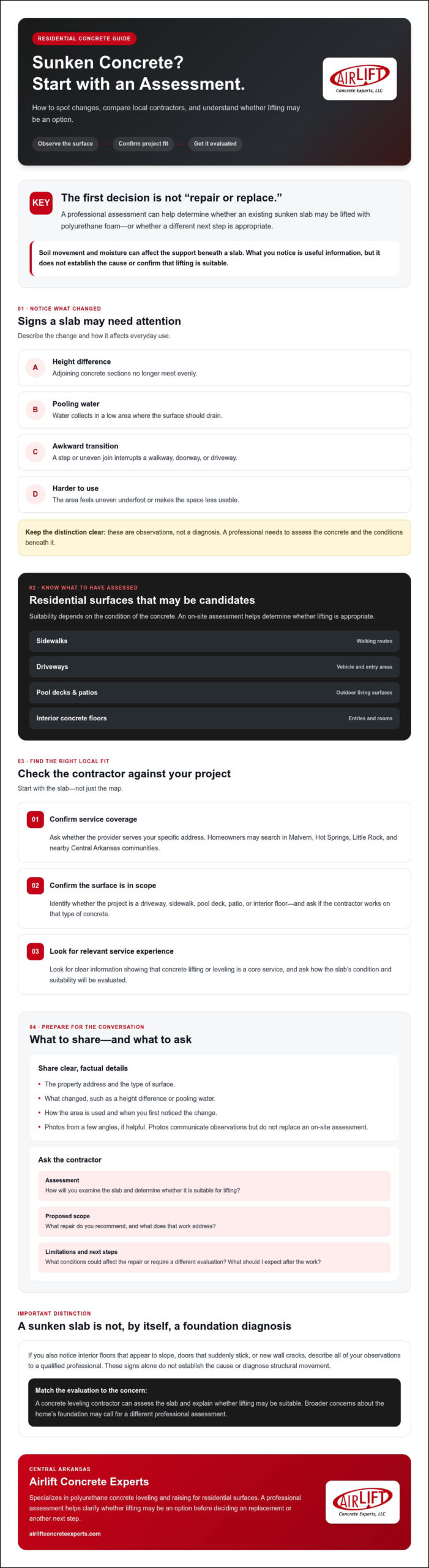
Look for signs such as:
These signs show that the slab has changed, but they don’t establish the cause or confirm that lifting is appropriate. Concrete leveling is the process of raising and stabilizing an existing sunken slab. For a neutral overview of what concrete leveling is, see Wikipedia’s summary of the process and common methods. A professional assessment is still needed to evaluate the concrete and conditions beneath it.
Depending on their condition, sunken sidewalks, driveways, pool decks, patios, and interior concrete floors may be candidates for leveling. A raised edge can disrupt a walking route, a low spot can collect water, and an uneven floor can make an entry or room harder to use. These are practical reasons to have a slab assessed, not proof that a particular repair will work. An on-site assessment helps determine whether the concrete is suitable for lifting.
An uneven sidewalk or driveway is not the same as a confirmed foundation problem. If you also notice changes such as interior floors that appear to slope, doors that suddenly stick, or new cracks in walls, describe all of your observations to a qualified professional. These signs alone don’t establish the cause or diagnose structural movement, and a photograph or single symptom can’t make that determination.
Ask what kind of evaluation fits your concern. A concrete leveling contractor can assess the slab and explain whether it may be suitable for lifting. Broader concerns about the home’s foundation may call for a different professional assessment. Clarifying the scope helps you understand the issue before deciding on repairs.
Start your search with the slab, not just the map. Identify the surface, describe what has changed, confirm that the provider serves your address, and request an assessment. This makes it easier to find a contractor whose work fits the problem.
Homeowners in Malvern, Hot Springs, Little Rock, and nearby Central Arkansas communities may search for a local provider. Confirm coverage for your specific property before making plans. Airlift Concrete Experts serves communities across Central Arkansas; for regional information, see this Central Arkansas concrete leveling homeowner guide.
Give the provider clear, factual details. Share the property address and identify the surface as a driveway, sidewalk, pool deck, patio, or interior floor. Describe any height changes or pooling water, explain how the area is used, and say when you first noticed the change. Photos from a few angles can help communicate what you see, but they don’t replace an on-site assessment.
Before arranging a visit, ask whether the contractor serves your address and handles that type of surface. These questions establish project fit early, especially when you’re comparing providers in different Central Arkansas communities.
Look for clear information showing that concrete lifting or leveling is a core service. Then ask how the provider evaluates the slab before recommending work. A useful explanation should cover what the assessment can establish, what repair is proposed, and what limitations could affect the work.
Use this checklist when comparing providers:
Clear answers help you compare relevant experience and communication, not just proximity. For more information about Airlift’s concrete leveling work, visit Airlift Concrete Experts’ website.
A nearby provider may serve your area, but you still need to know whether its experience and proposed approach fit your slab. When comparing options for residential concrete leveling near me, ask how the contractor evaluates the concrete, defines the work, and explains what to expect afterward.
Use this table to guide the conversation. Specific answers are more useful than broad assurances.
| Question to ask | Useful information to seek | Why it matters |
|---|---|---|
| Have you worked on this type of slab, such as a driveway, sidewalk, pool deck, or interior floor? | Relevant experience with the surface and its use. | Different locations have different access and use considerations. |
| How will you assess the slab and the support beneath it? | An explanation of what the contractor checks and how findings guide the recommendation. | Symptoms alone can’t establish the cause or confirm that lifting is suitable. |
| What repair do you recommend, and what area does it cover? | A defined work area, proposed approach, and description of what is included or excluded. | A clear scope helps you compare proposals and understand the planned work. |
| What should I expect after the work is complete? | Practical post-work instructions, expectations, and any stated limitations. | You’ll know how to plan for use of the area and what the contractor is or isn’t promising. |
Ask how the provider will examine the slab, its support, and relevant surrounding site conditions. Mention water pooling or other moisture concerns and ask how they affect the assessment. The contractor should explain the findings, including whether the slab appears suitable for lifting or whether another evaluation may be appropriate. Make sure you understand the reasoning before agreeing to work.
Request a written description of the affected area and recommended repair approach. Confirm what the work includes and excludes, and ask what might change if the on-site assessment reveals additional conditions. The proposal should also explain post-work expectations without relying on vague assurances. Don’t assume a particular result or lifespan unless the provider states it in writing.
For a separate overview of the method, read this polyurethane concrete lifting guide. Use it to prepare follow-up questions, then compare contractors based on how clearly they explain the work your slab may need.
The next steps should help you understand the slab before you decide whether to proceed. Describe the issue, arrange an assessment, review the findings, and consider the recommendation.
An on-site assessment, not a search result, determines whether a particular slab is suitable for concrete leveling. The slab’s condition and site conditions shape the recommendation, so ask the contractor to explain how those factors apply to your property.
The contractor reviews the affected surface, uneven areas, access to the work area, and visible site conditions. Explain what you’ve noticed and how the slab is used, then ask what the assessment found and what the proposed work would address. If lifting may not suit the slab, ask the provider to explain why and what next step it recommends. The assessment should give you information to consider before agreeing to work.
For a suitable sunken slab, polyurethane foam is injected beneath the concrete. The foam fills space below the slab and is used to lift it toward a more usable position. The recommendation depends on the slab and site, so ask the contractor to connect the proposed work to the assessment findings.
Before work begins, review the proposal and make sure you understand the affected area, repair approach, limitations, and post-work expectations. Concrete lifting addresses an existing slab. It does not mean every uneven surface can be raised or that site conditions won’t matter.
For a deeper explanation, read about the polyurethane foam concrete lifting process. If you’re considering residential concrete leveling near me in Central Arkansas, you can contact Airlift Concrete Experts to discuss your concrete leveling needs and ask whether your property address is within its current service area.
After comparing contractors and learning what an assessment involves, focus on finding a provider whose work matches your slab. Airlift Concrete Experts is a family-owned Arkansas business founded in 2017 that specializes in polyurethane concrete leveling and raising. The company serves communities across Central Arkansas. Confirm that your property address is within its current service area.
Airlift works on suitable existing concrete slabs, including residential driveways, sidewalks, pool decks, and interior floors. Polyurethane concrete leveling raises an existing sunken slab toward a more usable position, but whether a particular surface is suitable depends on its condition and the assessment. Airlift focuses on concrete repair and lifting, not new concrete construction.
Share your city, the type of surface, and a brief description of what you’ve noticed. Explain where the slab appears uneven, how the area is used, and when you first noticed the change. These details can help start the conversation, while an assessment provides a closer look at the concrete.
If you’re searching for residential concrete leveling near me, ask Airlift whether it serves your address, handles your surface type, and what to expect from an assessment. Start with your observations and questions, then use the provider’s explanation to decide on a reasonable next step.
A sunken sidewalk, driveway, pool deck, or interior floor deserves a clear assessment, not an automatic assumption that the concrete must be replaced. When searching for residential concrete leveling near me, look for a provider that serves your area, works on your type of slab, and explains its findings and recommended scope. An on-site assessment can help determine whether lifting is suitable for the concrete and conditions at your property.
Airlift Concrete Experts specializes in polyurethane concrete leveling and raising for existing concrete. The company serves Malvern and communities across Central Arkansas. Confirm current coverage for your address and ask what the assessment involves.
To discuss the uneven concrete at your property, contact Airlift Concrete Experts. Share your city, the affected surface, and what you’ve noticed to start the conversation.
Residential concrete leveling raises an existing sunken slab toward a more usable position. A contractor assesses the concrete and surrounding conditions to determine whether lifting is suitable and what repair approach may fit. Homeowners commonly ask about uneven sidewalks, driveways, pool decks, and interior floors. Leveling addresses the existing slab, not new concrete construction, and an assessment is needed to understand what the surface may require.
To find residential concrete leveling near me, identify the affected surface and describe what you’ve noticed, such as a height change or pooling water. Check whether contractors serve your address and have experience with that type of slab. Ask how they assess its condition, what repair they recommend, and what the work includes. Clear answers help you compare providers on project fit, not just distance.
No. A contractor needs to assess the slab’s condition and the site before deciding whether lifting is appropriate. A visible dip alone can’t confirm the cause or show whether the concrete is suitable for repair. Ask the provider to explain its findings, proposed scope, and any limitations. If the issue appears broader than a sunken slab, ask whether a different professional assessment may be needed before deciding what to do next.
Polyurethane concrete leveling involves injecting foam beneath a suitable sunken slab to lift it toward a more usable position. The contractor assesses the concrete and site conditions before recommending this approach, since not every slab is a candidate. Ask what area the proposed work covers and what to expect afterward. The process raises existing concrete rather than replacing it with a newly constructed surface.
The cost depends on the specific project, so a contractor’s assessment and written proposal are the best way to understand the work involved. Ask which area is included, what method is proposed, and whether site conditions could affect the scope. A general online figure is not a quote for your property. Comparing clear proposals can help you understand each provider’s recommendation without assuming every slab needs the same work.
Airlift Concrete Experts serves communities across Arkansas, including Malvern, Hot Springs, Little Rock, Cabot, Conway, Benton, Bryant, North Little Rock, Sherwood, Jacksonville, and Hot Springs Village. Coverage can depend on your specific address, so confirm directly with the company before arranging an assessment. When you contact them, share your city and the type of concrete surface you’d like them to discuss.
No. Concrete leveling addresses an existing sunken slab, such as a driveway or sidewalk, when an assessment finds it suitable for lifting. Foundation repair concerns a home’s foundation and is a separate issue. An uneven slab by itself doesn’t diagnose foundation movement, and a photo can’t establish the cause. Describe all the changes you’ve noticed and ask a qualified professional which type of assessment fits your concern.

 Call Now