
Can a sunken pool deck be leveled without removing the concrete? Often, polyurethane foam injection can lift a settled slab, but the right repair starts with understanding why it moved. If you’re considering pool deck leveling Arkansas homeowners can use to address uneven concrete, it helps to know what the process involves, how to assess the visible problem, and what to expect from a repair.
Arkansas soil and weather conditions can affect the ground beneath a pool deck. Changes in moisture, poor drainage, erosion, or loose soil may contribute to settlement. A professional assessment considers the slab’s movement and the site conditions before recommending a repair. Airlift Concrete Experts uses polyurethane foam injection through small 5/8-inch holes drilled in the concrete. The foam expands beneath the slab, lifts it, and compacts the supporting soil, with no trenches or heavy equipment.
This guide explains common causes of pool deck settlement, how to judge whether leveling may help, and what to expect during a professional repair. Airlift monitors the lift with precision laser levels to within 1/10 of an inch. The foam cures in about 15 minutes, and projects are typically completed in a single day. You’ll also learn about the structural warranty, which transfers to the next homeowner, and how to arrange a free inspection and estimate.
Uneven concrete around a pool can make walking, moving patio furniture, and enjoying the space less comfortable. A raised edge or sloping section may also create a trip hazard. These changes don’t automatically mean the entire deck needs to come out. They are a reason to check how the slabs sit and whether the concrete is suitable for lifting.
Pool deck leveling raises settled concrete slabs toward a more even position; it corrects slab elevation rather than replacing the entire deck. This distinction matters when the concrete remains suitable to lift. A pool deck is made of concrete slabs, much like other slab-on-grade foundations, but the right repair depends on the condition of the slab and what’s happening beneath it. Pool deck leveling Arkansas homeowners consider should start with those conditions, not an assumption based on one visible symptom.
Settlement can have different causes in different places. An inspection helps determine whether the slab has dropped and whether leveling is an appropriate response, rather than treating every crack or low spot as the same problem.
Look for a noticeable height difference where two concrete sections meet, a walking area that slopes or feels uneven, or a gap that wasn’t apparent before. A crack or puddle alone doesn’t establish why the deck changed, but it can provide useful context during an assessment.
Note where the uneven areas appear and when you first noticed them. Photos taken from the same spots over time can help you describe any visible change. You don’t need to measure or diagnose the slab yourself; clear observations give the team a practical starting point.
Concrete relies on the ground beneath it for support. If the underlying soil shifts, compresses, or erodes, a section of deck may lose support and settle. Water management and other site conditions can influence how soil behaves, so drainage patterns around an outdoor pool are worth noting.
Soil and weather conditions vary across Arkansas, so a cause shouldn’t be assigned from appearance alone. A crack doesn’t prove erosion, and standing water by itself doesn’t confirm settlement. An on-site assessment considers the slab’s position, drainage, surrounding ground, and other visible conditions.
Before the assessment, note which edges look uneven, where the surface slopes, and whether the pattern seems to have changed. These observations help focus the discussion on what you’ve seen while the team evaluates the cause at the site.
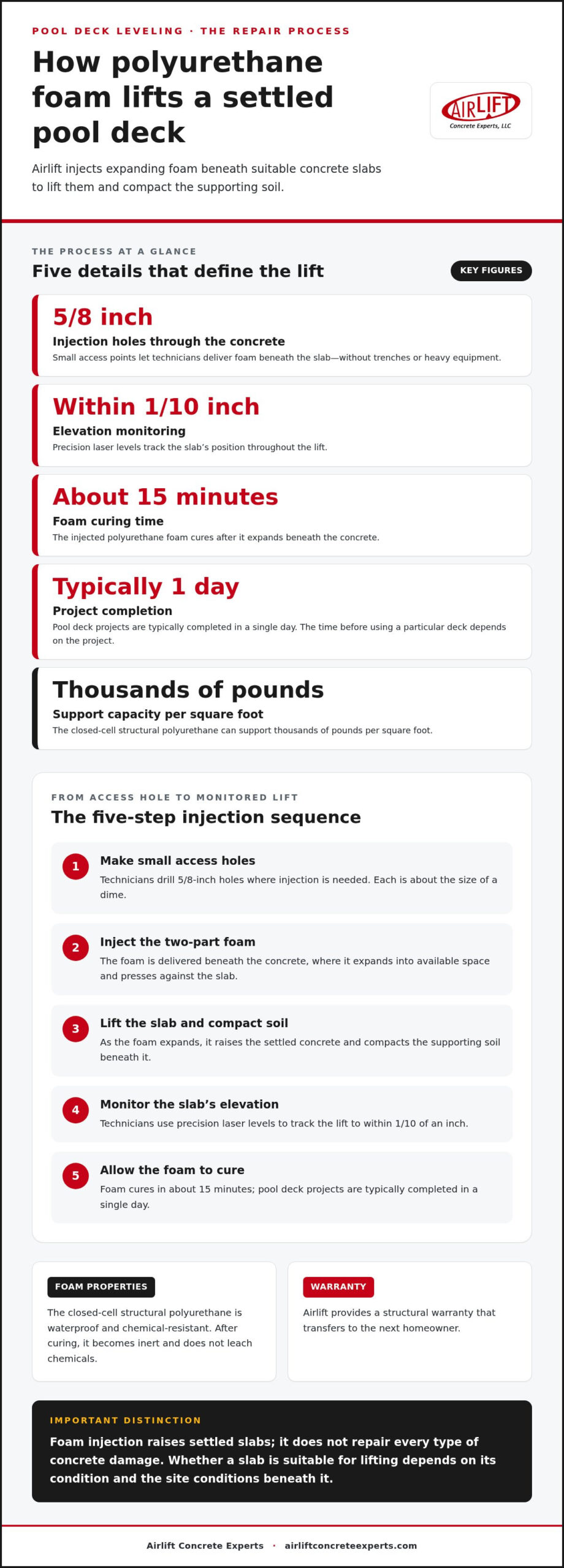
Polyurethane foam injection raises settled concrete by filling space beneath the slab, rather than removing the deck and starting over. It is the least invasive repair method, using only 5/8-inch injection holes, with no trenches or heavy equipment. Airlift uses a patented two-part polyurethane foam process: technicians inject the foam beneath the concrete, then monitor the slab as it rises.
The two-part foam expands underground to lift the slab and compact the supporting soil. Technicians use precision laser levels to monitor the lift to within 1/10 of an inch. The closed-cell structural polyurethane is waterproof and chemical-resistant. It can support thousands of pounds per square foot and is the same material used by the Department of Transportation for interstate highway leveling. The International Concrete Repair Institute (ICRI) offers broader information about concrete repair and deterioration; the steps below describe Airlift’s pool deck lifting process.
The foam is waterproof, chemical-resistant, and eco-friendly. After curing, it becomes inert and does not leach chemicals. It is safe for families, yards, and agricultural sites. Airlift’s polyurethane foam lifting provides a permanent, durable solution, and the company provides a structural warranty that transfers to the next homeowner.
The foam cures in about 15 minutes, and projects are typically completed in a single day. The time needed before using a particular pool deck depends on the project, so follow the guidance for your site before resuming use.
In brief: Airlift injects two-part polyurethane foam through 5/8-inch holes and monitors the lift to within 1/10 of an inch. The foam cures in about 15 minutes, and projects are typically completed in a single day, without trenches or heavy equipment.
If you’re considering pool deck leveling Arkansas homeowners can arrange a free pool deck inspection and estimate to discuss the site and repair process.
A visible crack or uneven joint can make it hard to tell whether a pool deck needs lifting, replacement, or another kind of repair. These options address different conditions. Polyurethane foam injection raises settled slabs; it isn’t a cure-all for every crack, surface defect, or pool-area concern. An assessment connects the visible condition to an appropriate repair scope.
| Consideration | Leveling | Replacement |
|---|---|---|
| Main purpose | Raise settled concrete that has dropped, correcting the slab’s position. | Remove and replace concrete when the repair plan calls for new concrete rather than lifting the existing slab. |
| Best suited to | A slab that needs elevation correction and is appropriate for lifting. | A concrete condition that cannot be addressed by correcting elevation alone. |
| What it addresses | Unevenness related to settlement. Lifting may improve the walking surface but does not promise to erase every crack. | The existing concrete itself, rather than simply adjusting the slab’s height. |
| What still needs review | Cracks, slab movement, drainage, and any concerns beyond the deck’s elevation. | The condition and scope of the work needed for the particular pool area. |
Slab lifting focuses on settled concrete. If an assessment finds that a section has dropped and is suitable to raise, restoring its position can help create a more even walking surface and reduce the height difference between adjacent slabs. The aim is elevation repair, not cosmetic restoration: lifting should not be presented as a way to remove every crack or resolve unrelated pool-area issues.
Leveling changes slab elevation; it doesn’t replace concrete or repair every surface defect. It also isn’t a substitute for work on unrelated pool systems. Cracking and movement need to be considered together, since the visible condition helps define what the repair should address. An inspection lets the team assess the slab and explain whether leveling fits the concern.
For homeowners weighing pool deck leveling Arkansas options, durability matters as much as the initial decision. Airlift’s polyurethane foam lifting is a permanent, durable solution, and its structural warranty transfers to the next homeowner. The assessment clarifies what the repair is intended to address, helping you make a decision based on the slab’s condition rather than assuming every crack needs the same response.
A little preparation can make an assessment more focused. You don’t need to measure the slab or determine why it moved. Note what you’ve observed and share practical details about reaching the pool deck. That gives the team useful context for discussing the visible conditions and whether polyurethane foam leveling is appropriate.
Before the inspection, record where the deck looks uneven and when you first noticed a change. Photos can help you point out affected areas, especially if the movement is easier to see from a particular angle. Mention any access constraints or site concerns so they can be considered during the visit.
Airlift Concrete Experts provides a free inspection and estimate. A $1,000 deposit is required to guarantee an appointment, and the full deposit is applied 100% toward the total service cost.
If you want background on concrete lifting before the visit, Airlift’s concrete lifting guide provides additional context on the repair approach.
Questions about materials and the surrounding property are reasonable, particularly in a family pool area. Airlift’s closed-cell polyurethane foam is waterproof, chemical-resistant, and eco-friendly. It becomes inert after curing and does not leach chemicals. The foam is safe for families, yards, and agricultural sites. These are the material’s stated properties, not a claim about pool water or pool equipment.
During the visit, point out areas where access is limited and share relevant site concerns. The inspection and estimate help explain the visible slab condition and proposed repair scope, so you can understand what the work is intended to address.
To discuss your pool deck, arrange an inspection and free estimate with Airlift. Whether your property is in Malvern, Hot Springs, Little Rock, Cabot, Conway, Benton, Bryant, North Little Rock, Sherwood, Jacksonville, or Hot Springs Village, clear observations help keep the conversation practical and specific to your site.
Airlift Concrete Experts is a family-owned structural repair company based in Malvern, Arkansas, providing polyurethane pool deck leveling and concrete repair. For homeowners considering pool deck leveling Arkansas, the assessment focuses on the specific slab, site conditions, and repair scope. Airlift’s structural warranty transfers to the next homeowner, an important detail when weighing a durable repair.
Airlift provides concrete leveling in these Arkansas cities: Alexander, Arkadelphia, Batesville, Beebe, Bella Vista, Benton, Bentonville, Blytheville, Bryant, Cabot, Camden, Centerton, Conway, El Dorado, Fayetteville, Forrest City, Fort Smith, Helena-West Helena, Hot Springs, Hot Springs Village, Jacksonville, Jonesboro, Little Rock, Magnolia, Malvern, Maumelle, Mayflower, Morrilton, North Little Rock, Paragould, Pine Bluff, Rogers, Russellville, Searcy, Shannon Hills, Sherwood, Siloam Springs, Springdale, Texarkana, Van Buren, Warren, and West Memphis.
Grain-bin floor lifting is also available beyond these Arkansas cities, including across the Mid-South and Midwest. Contact Airlift for details about grain-bin floor service outside Arkansas. This extended coverage applies to grain-bin floor lifting, not pool deck service.
For more background on polyurethane lifting and how it supports settled concrete, explore Airlift’s polyurethane concrete leveling guide. It can help you prepare questions about the process and connect the method to the concerns you’ve observed around your pool.
You can request a free estimate and a free inspection to discuss the pool deck and visible areas of concern. A $1,000 deposit is required to guarantee an appointment, and it is applied 100% toward the total service cost.
Before reaching out, it may help to have notes ready: which sections look uneven, when you noticed a change, and any access details that could help the team understand the site. You don’t need to diagnose the cause or decide on a repair in advance. The inspection provides an opportunity to review the concrete condition and discuss whether leveling is suitable.
Share what you’ve noticed and ask the questions that matter to you. Request a free pool deck inspection and estimate from Airlift Concrete Experts.
An uneven deck doesn’t have to leave you guessing about what to do next. Start with the areas that affect how you walk and use the space, then arrange an assessment to determine whether lifting is suitable. A sound decision is based on the slab’s condition, not the assumption that every crack calls for the same repair.
For pool deck leveling Arkansas homeowners can consider, an assessment can turn visible concerns into a clear repair plan. Bring your observations and ask about the proposed scope so you understand what the work is intended to address.
Request a free pool deck estimate and inspection from Airlift Concrete Experts to discuss your property and next steps.
Look for changes in how adjoining concrete sections meet, such as a newly visible height difference, a sloping path, or a gap that seems to be widening. A chair or table that no longer sits level can also draw attention to a surface change, though it doesn’t identify the cause. Note where you see the change and when you first noticed it. Photos from the same viewpoint can help document what you observe.
Yes. Polyurethane foam injection can raise a settled pool deck slab while leaving the existing concrete in place, if the slab is suitable for lifting. This can help when the main concern is a dropped section rather than a need for an entirely new deck. The assessment considers the concrete’s condition and movement together. If a slab has damage beyond an elevation issue, lifting alone may not address every concern.
Airlift’s closed-cell polyurethane foam is waterproof, chemical-resistant, and eco-friendly. After curing, it becomes inert and does not leach chemicals. It is safe for families, yards, and agricultural sites. These material properties do not make a claim about pool water or pool equipment, so keep questions about those systems separate from the foam’s stated characteristics.
Pool deck leveling focuses on raising settled concrete, so it shouldn’t be expected to erase every crack. A crack may remain visible after the slab’s position is addressed. Its location and appearance are useful details to share during an assessment because they help explain the concrete condition and repair scope. The inspection can distinguish an elevation concern from a surface defect that leveling alone may not resolve.
Polyurethane foam cures in about 15 minutes, and projects are typically completed in a single day. Curing time alone doesn’t establish when every pool area can reopen. Follow the guidance for your specific deck before resuming use.
Yes. Airlift serves these Arkansas cities: Alexander, Arkadelphia, Batesville, Beebe, Bella Vista, Benton, Bentonville, Blytheville, Bryant, Cabot, Camden, Centerton, Conway, El Dorado, Fayetteville, Forrest City, Fort Smith, Helena-West Helena, Hot Springs, Hot Springs Village, Jacksonville, Jonesboro, Little Rock, Magnolia, Malvern, Maumelle, Mayflower, Morrilton, North Little Rock, Paragould, Pine Bluff, Rogers, Russellville, Searcy, Shannon Hills, Sherwood, Siloam Springs, Springdale, Texarkana, Van Buren, Warren, and West Memphis. Contact Airlift to discuss a pool deck assessment.

 Call Now