
The heavy slurry traditionally used to lift sinking driveways might actually be the very thing causing your concrete to fail again. While mudjacking was once the standard, many Arkansas homeowners are now seeking mudjacking alternatives because adding more weight to unstable soil often leads to a cycle of recurring settling. If you’ve noticed new trip hazards or gaps appearing just months after a repair, you aren’t alone. It’s frustrating to invest in your property only to see the results wash away during a heavy Little Rock rainstorm.
You deserve a solution that provides permanent stability without the messy construction or the fear of a costly full replacement. In this 2026 guide, we’ll explore modern leveling options specifically engineered to withstand the unique soil conditions found from Malvern to Conway. You’ll learn why high-density polyurethane is replacing older methods and how this approach offers a clean, fast, and durable fix for your driveway or pool deck. We’ll break down the technical benefits of poly-lifting and show you how to achieve a level surface that stays put for the long haul.
Arkansas homeowners are increasingly skeptical of traditional methods that don’t hold up against our local weather. For decades, mudjacking was the go-to fix for sinking slabs. However, as we look at the standard for concrete leveling in 2026, it’s clear that this old-school approach often creates more problems than it solves. The demand for modern mudjacking alternatives has surged because property owners are tired of watching their repairs fail after a single season of heavy rain or temperature shifts. We see it across Little Rock and Malvern every year; a homeowner pays for a quick fix, only to have the slab sink again because the underlying issue wasn’t addressed correctly.
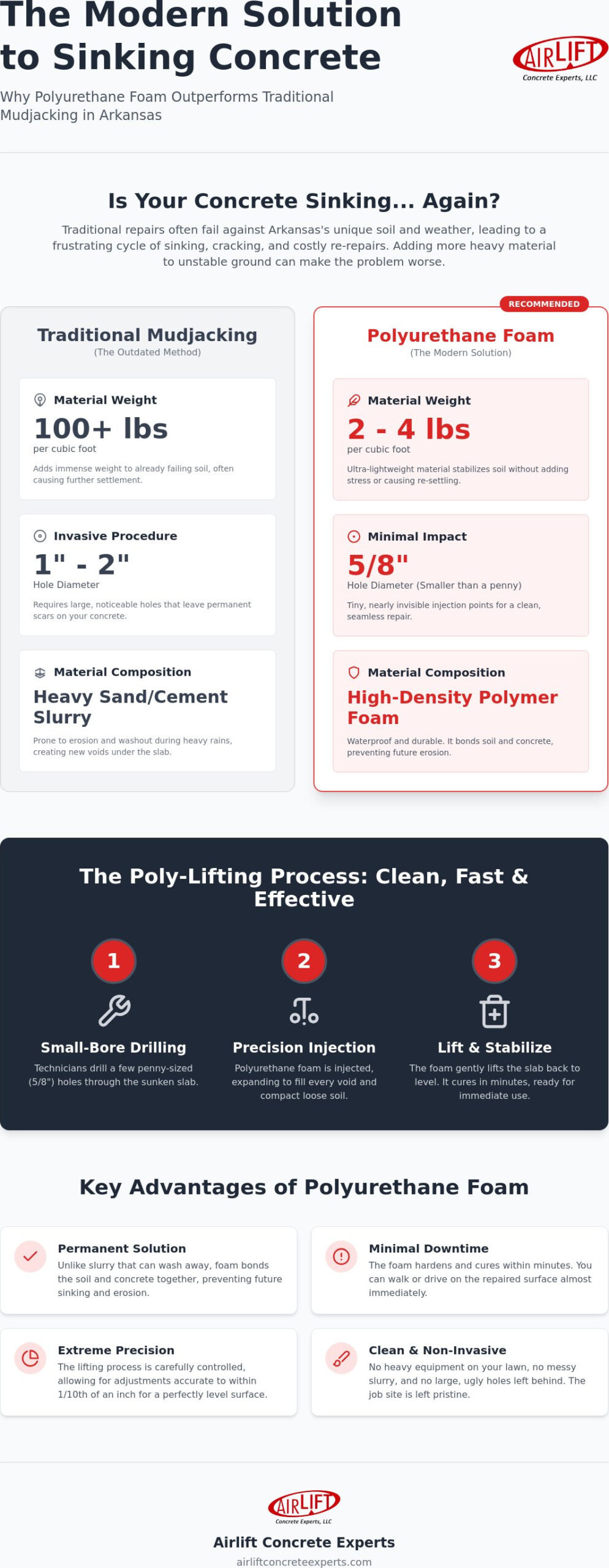
The primary reason mudjacking fails involves basic physics. Traditional slurry, a mixture of sand, water, and cement, is incredibly heavy. It typically weighs over 100 pounds per cubic foot. When you pump this heavy material under a slab that is already sinking due to weak soil, you’re essentially placing a massive weight on a foundation that’s already struggling. In contrast, high-density polyurethane foam weighs only 2 to 4 pounds per cubic foot. By choosing mudjacking, you might be accidentally causing secondary settlement where the new material pushes the slab down even further. It’s a common misconception that more material equals more support. In reality, the extra weight of the slurry often crushes the very soil intended to hold it up, leading to a recurring cycle of failure.
Our local environment is particularly harsh on cement-based repairs. Arkansas red clay is notorious for its heave and shrink cycle. During a humid Central Arkansas summer, the clay dries out and contracts. When the flash floods of spring arrive, that same soil expands rapidly. Mudjacking material is rigid and doesn’t bond well with the soil, making it susceptible to washing out during these moisture shifts. Homeowners in 2026 prioritize low-impact, clean repair methods that can actually handle these conditions.
Choosing a durable alternative means your repair survives the next thunderstorm and keeps your property looking its best. You want a solution that stays put, regardless of how much rain falls in the Ouachita Mountains or how hot the pavement gets in July.
Polyurethane foam injection has revolutionized how we approach property maintenance in Central Arkansas. As one of the most effective mudjacking alternatives, it utilizes a high-density, two-part expanding polymer designed specifically for structural lifting. Unlike the heavy slurries used in the past, this material expands immediately upon injection. This reaction ensures the foam fills 100% of the void space under a slab, creating a stable and fully supported foundation. Scientific research regarding the performance of polyurethane foams confirms that this material maintains its structural integrity even in saturated soil conditions, making it ideal for our local climate.
The process begins with small-bore drilling. Our technicians use 5/8-inch bits to create injection points, which are significantly smaller than the large holes required for mudjacking. Once the holes are prepared, we move to precision injection. Using specialized equipment, we control the lift to within 1/10th of an inch, allowing us to align uneven joints with extreme accuracy. Finally, the foam provides structural sealing. As it hardens, it bonds with the soil and the concrete to create a waterproof barrier that prevents future erosion during heavy storms.
A common myth is that “foam” is too soft to support heavy loads. In reality, high-density polyurethane is engineered to support massive weight, including delivery trucks and industrial machinery. Hydrostatic pressure is the force exerted by standing water against the underside of your concrete; polyurethane resists this force by creating an impermeable seal that water cannot penetrate or wash away. Because this polymer doesn’t biodegrade, the repair often outlasts the concrete slab itself.
Homeowners also appreciate the environmental safety of modern polymers. These formulas are non-toxic and won’t leach into our Arkansas groundwater or harm your landscaping. The efficiency of the process is unmatched. Because the material reaches 90% of its full strength almost instantly, you can drive a vehicle onto a foam-lifted driveway within 15 minutes of the completed repair. If you’re interested in a cleaner, faster fix, a professional polyurethane concrete leveling assessment can determine if your property is a candidate for this advanced technology.
Choosing the right repair method depends on your long-term goals for your Arkansas home. In 2026, property owners generally weigh three main paths: polyurethane injection, stone slurry grout, or full replacement. Each option has a different impact on your bank account and your property’s curb appeal. While some still consider the “do nothing” approach, ignoring sunken concrete in Little Rock often leads to higher costs later. Trip hazards create liability risks, and standing water in low spots accelerates soil erosion, making the eventual repair much more complex and expensive.
Stone slurry grout is sometimes viewed as a middle ground between old-school mudjacking and modern polymers. This method uses pulverized limestone mixed with water to create a flowable fill. While it’s more stable than the dirt-based mixtures used in traditional mudjacking, it still carries significant weight. In Arkansas landscapes, this heavy limestone mixture can struggle during our intense moisture cycles. We focus on polyurethane as the superior technological leap because it offers better precision without the risk of secondary settling caused by heavy cementitious materials.
Full concrete replacement is the most drastic and expensive route you can take. In Central Arkansas, the price of labor and raw materials for pouring new concrete continues to rise. When you replace a slab, you aren’t just paying for the new pour; you’re also paying for the demolition, the heavy equipment to haul it away, and the fees to dump it at local landfills. Choosing polyurethane concrete leveling typically saves homeowners 50 to 70 percent compared to the cost of a full replacement. It’s a more sustainable choice that keeps functional concrete out of the trash while restoring your property’s safety.
When evaluating the total cost of ownership over a ten-year period, the value of modern mudjacking alternatives becomes clear. A new slab might look great initially, but if you don’t address the underlying soil issues, that expensive new concrete will likely sink or crack just like the old one. Polyurethane injection treats the root cause by filling voids and stabilizing the subgrade. This prevents the cycle of recurring settling that plagues other methods. Investing in a durable, lightweight solution today ensures you won’t be paying for the same repair again in three years.
Every concrete slab serves a different purpose, and the repair method you choose should reflect the specific demands of that surface. While some property owners might consider traditional methods, the most effective mudjacking alternatives are those that address the unique load requirements of your home or business. In Arkansas, where shifting soil is a constant reality, a one-size-fits-all approach doesn’t work. Whether you’re dealing with a sinking front porch in Little Rock or a massive warehouse floor in Conway, understanding the structural needs of your property is the first step toward a permanent fix.
Safety is often the primary driver for these repairs. Sunken concrete creates trip hazards that are more than just a nuisance; they are a significant liability. For residential properties, leveling a front porch or sidewalk prevents expensive slip-and-fall accidents. For homeowners with slab-on-grade foundations, interior floor leveling is critical. When the interior slab sinks, it can cause interior walls to crack and doors to stick, compromising the comfort and value of your home. Addressing these issues early prevents minor settling from turning into a major structural headache.
Repairing a pool deck requires a delicate touch that traditional mudjacking simply cannot provide. Pumping heavy slurry near a pool is risky because the weight can put immense pressure on delicate plumbing lines and pool walls. High-density foam offers a lightweight solution that stabilizes the area without the threat of structural damage or liner leaks. If your backyard oasis is showing signs of age, professional pool deck repair can restore the level surface while protecting your investment from the hazards of heavy, outdated materials.
For industrial and commercial properties, downtime equals lost revenue. Businesses cannot afford to wait days for new concrete to cure or for messy mudjacking equipment to clear out. Modern mudjacking alternatives like poly-lifting allow for an immediate return to service, meaning delivery trucks can drive over the repaired area within minutes. This process is particularly effective for high-traffic loading docks and warehouse floors that face deep-seated soil issues. Our experience with commercial concrete lifting shows that stabilizing the subgrade with polyurethane provides the structural integrity needed for heavy machinery and constant logistics traffic.
The right choice for your property depends on the specific environmental challenges of your location. If you’re ready to secure your property’s foundation, you can request a polyurethane concrete leveling assessment to see how these modern methods can work for you.
Selecting a contractor to handle structural repairs is a significant decision for any property owner. In Central Arkansas, the specific challenges of our environment make local experience essential. A technician who understands the expansive nature of Malvern’s red clay or the drainage patterns in Little Rock will provide a more reliable solution than a general contractor who lacks specialized training. When you explore mudjacking alternatives, you’re looking for a partner who treats your home with the same care they’d give their own neighbor. Regional authority isn’t just about a service area; it’s about knowing how our weather affects your foundation over time.
A professional inspection should be much more than a quick price quote. The “Free Assessment” standard in our industry includes a thorough evaluation of soil moisture, void size, and the current load-bearing capacity of the slab. You should feel free to ask your contractor specific questions about the materials they use. In 2026, you want to ensure they are using high-density polyurethane specifically formulated for structural lifting, not just a generic spray foam. Ask about their warranty; a reputable specialist stands by their work because they know the material won’t wash away or degrade.
At Airlift Concrete Experts, we provide a distinct advantage by specializing exclusively in concrete repair and lifting. We don’t do new pours or general construction. This focus allows us to master the technical nuances of polyurethane injection, ensuring we solve the root cause of your sinking concrete rather than just covering it up with a new layer of material. We view ourselves as your partner in property maintenance, dedicated to providing a permanent fix that restores your peace of mind.
As you research mudjacking alternatives, be wary of certain warning signs. If a contractor still recommends traditional mudjacking for a residential driveway in 2026, they may be relying on outdated equipment or lack the technical expertise for modern polymers. Watch out for low-ball quotes that don’t include a written warranty against future settling. Often, these cheaper options skip the necessary soil stabilization steps, leading to a repeat of the problem within a year. Additionally, ensure the company uses specialized, high-pressure injection systems designed for precision lifting rather than improvised tools.
Preparing for your repair is a straightforward process. We typically ask homeowners to clear vehicles and debris from the affected area to allow our specialized equipment easy access. The timeline is remarkably fast; most residential projects are completed in just a few hours. Once the injection is finished and the 5/8-inch holes are sealed, your driveway or patio is ready for immediate use. You don’t have to wait days for the area to cure or worry about a messy cleanup. If you’re ready to eliminate those trip hazards for good, Contact Airlift Concrete Experts for your complimentary assessment.
Maintaining a safe and level property in Central Arkansas shouldn’t be a source of constant stress. By moving away from outdated, heavy slurries and embracing modern mudjacking alternatives, you’re choosing a solution that works in harmony with our local soil conditions. High-density polyurethane injection provides a lightweight, waterproof, and durable foundation for your driveways and pool decks. It’s a clean process that eliminates the mess and recurring failures associated with older methods; this ensures your concrete stays level through every season of Arkansas rain and humidity.
Airlift Concrete Experts has served the Central Arkansas community since 2017. As a locally owned and operated business in Malvern, AR, we understand the specific structural challenges our neighbors face. We utilize specialized high-density polyurethane technology to provide results that last for the long haul. You don’t have to live with trip hazards or unsightly gaps any longer. Our team is ready to help you restore the safety and value of your home with a professional, solution-oriented approach.
Get Your Free Concrete Leveling Estimate Today and discover the difference that expert repair can make for your property.
Polyurethane leveling typically has a higher initial cost than mudjacking, but it provides significantly better long-term value. Traditional mudjacking often requires re-pumping within a few years because the heavy material causes the soil to settle again. By investing in a permanent solution, you avoid the recurring expenses of secondary repairs. It remains much more affordable than a full concrete replacement, which involves expensive demolition and disposal fees.
Polyurethane leveling is designed to last as long as the concrete slab itself. Our high-density foam is waterproof and does not biodegrade, so it won’t wash away during heavy Central Arkansas rainstorms. While Arkansas red clay shifts significantly during moisture cycles, the foam remains stable. It maintains its structural integrity far longer than traditional sand-based slurries that are prone to erosion and settling.
High-density polyurethane is specifically engineered to lift heavy commercial and industrial slabs with ease. It is frequently used for warehouse floors, loading docks, and municipal roads that carry heavy vehicle traffic. The material’s high compressive strength allows it to support thousands of pounds per square foot. This makes it a reliable choice for both residential driveways and large-scale industrial projects across the region.
The polymers used in modern mudjacking alternatives are environmentally inert and non-toxic once they have cured. They don’t leach harmful chemicals into the Arkansas groundwater or negatively impact your surrounding landscaping and gardens. Because the material doesn’t biodegrade, it won’t break down into the soil over time. This makes it a safe choice for repairs near homes, lawns, and local waterways.
You can typically drive a vehicle on your concrete just 15 minutes after the injection process is complete. Polyurethane foam reaches 90% of its full structural strength almost instantly. This is a significant advantage over traditional methods that may require 24 to 48 hours of curing time. Your daily routine in Little Rock or Hot Springs won’t be disrupted by long construction delays or messy cleanup.
If the deep-seated soil far below our injection point continues to settle, the slab may move, but the foam itself stays attached to the concrete. Our assessment process aims to identify these underlying issues before we begin the repair. Most professional repairs include a warranty to address minor shifts. However, the foam is designed to stabilize the immediate subgrade to prevent most future movement from occurring.
The injection holes are roughly the size of a penny and are barely noticeable once they are patched. We use a 5/8-inch drill bit, which is much smaller than the large holes required for mudjacking. After the lift is complete, we fill the holes with a color-matched concrete grout. Most homeowners find that the holes blend in seamlessly with the existing texture and color of their concrete surface.
Polyurethane injection is the safest method for leveling pool decks because the material is incredibly lightweight. It exerts very little pressure on delicate pool walls and underground plumbing compared to heavy cement slurries. The foam expands to fill voids and stabilize the area without the risk of cracking the pool shell or damaging the liner. This precision makes it the preferred choice for protecting your backyard investment.

 Call Now