
What if the slab you’ve just lifted settles again? It’s a fair concern, especially in Arkansas, where shifting soils and water movement can affect the ground beneath concrete. If you’re asking, “is concrete leveling a permanent solution,” the honest answer is that it can be a durable repair, but no method can promise the same result for every slab or site.
How long a repair holds depends on the slab’s condition, the stability of its support, and whether drainage or soil erosion is contributing to the settlement. Polyurethane concrete leveling can raise suitable slabs, but lifting alone may not resolve an ongoing ground or water problem.
This article explains what influences concrete leveling’s durability, which signs may point to a good candidate for lifting, and when damage or site conditions call for closer evaluation. You’ll also learn what to check around a slab before deciding whether leveling is the right repair.
Concrete leveling can provide a durable repair, but it can’t make every slab permanently immobile. The work raises a settled section and restores support beneath it. It does not control every future change in the soil or surrounding site. So, if you’re wondering, “is concrete leveling a permanent solution,” think of permanence as a stable, serviceable result under the conditions the repair addresses, not a promise that the slab will never move again.
The slab’s condition, the quality of its support, water movement, and future soil changes all influence how well a repair holds. The Concrete leveling overview describes the general process and methods used to address settled concrete. Which approach is suitable, and how durable the result may be, depends on the slab and its site.
A lasting repair addresses the slab’s current position and support. For example, a structurally sound walkway that has settled into a low spot may be a candidate for lifting if the cause and conditions are suitable. That is different from guaranteeing the ground will never shift or the concrete will never develop another problem.
Ask what the proposed work is intended to correct and what limitations apply. A sound recommendation should reflect the slab’s condition and the site assessment, rather than promise a universal lifespan or that the concrete will never move.
A slab may settle again if its support is lost or changes after the repair. Water can contribute to erosion or carry soil from beneath concrete. Changing moisture levels and ongoing soil movement can also affect support. These are factors to investigate, not proof that every Arkansas property has a soil problem. Conditions can vary from one property, or even one part of a site, to another.
If a leveled surface appears to sink, tilt, or separate again, don’t assume the cause from the concrete alone. Note where movement is visible and look for changes in drainage, standing water, or nearby ground level. An assessment should consider both the slab and surrounding conditions. Raising concrete without understanding recurring support loss may not address what is driving the change.
Understanding the repair process helps answer “is concrete leveling a permanent solution?” The goal is to raise an eligible slab and improve its support, not simply disguise an uneven edge. With polyurethane concrete leveling, a technician injects material beneath the concrete through small access points. The material fills spaces under the slab and helps lift it toward the intended position.
Before proposing work, a technician should consider how much the slab has settled, its visible condition, access for equipment, and where support may be missing. A visible dip can suggest a void, but the surface alone does not explain why the concrete moved or whether other site conditions remain active. The Federal Highway Administration guidelines discuss detecting voids beneath concrete slabs. The space beneath the concrete is an important part of the repair problem.
The process generally starts with an assessment of the slab and the area around it. If lifting appears suitable, the technician makes small injection access points and introduces polyurethane material beneath the concrete in a controlled manner. As the slab rises, the technician monitors its position and checks the finished surface. The exact procedure depends on the slab, site access, and professional evaluation.
That sequence matters. Assessing the slab first helps determine where lifting may be appropriate and what result is practical to pursue. A cracked or otherwise compromised slab may call for a different recommendation than sound concrete that has settled. Ask the contractor what they observed, how they plan to monitor the lift, and what the proposed work is intended to correct.
Polyurethane lifting can raise and support a suitable sunken slab, such as a sidewalk section that has dropped below the next panel. But adjusting the concrete’s height does not automatically fix a leaking utility, poor drainage, or another source of continuing water movement. Those conditions may need separate investigation, since ongoing changes beneath or beside the slab can affect its support.
Before work is proposed, note whether water collects nearby, flows toward the slab, or appears to be washing soil away. Share those observations along with any recurring cracks or movement. A site assessment can help distinguish the lifting work from concerns that need attention outside the concrete repair. Property owners considering polyurethane concrete leveling can ask Airlift Concrete Experts whether their slab and site conditions appear suitable for lifting.
Choosing between lifting and replacement starts with the concrete’s condition, not just how far it has settled. Concrete leveling describes the general approach of raising an existing slab. Whether it fits depends on whether the concrete can be lifted and supported, and what caused it to move. Neither repair is automatically more durable in every situation.
| Consideration | Leveling may be worth evaluating | Replacement or further evaluation may be worth discussing |
|---|---|---|
| Slab condition | The slab appears intact enough to raise and remain serviceable. | Concrete is extensively crumbling, broken, or deteriorated. |
| Support needs | A section has settled or lost support, and the cause can be understood. | Movement continues or the underlying issue needs more investigation. |
| Work involved | The goal is to adjust and support existing concrete. | The slab’s condition may not support a lifting repair. |
| Best next step | Have a qualified contractor assess the slab, access, and site. | Seek an on-site evaluation before deciding what work is appropriate. |
Lifting may suit structurally sound concrete that has settled out of position. A driveway panel, sidewalk, patio, or pool deck can be considered, but the surface type alone does not determine suitability. A professional evaluates the slab’s condition, the extent and pattern of settlement, likely support needs, and access for the work. The aim is to determine whether the existing concrete can be raised and supported, not to assume every low spot needs the same fix.
Extensive deterioration, broken sections, or recurring movement call for closer on-site evaluation. A crack by itself does not prove that replacement is necessary, and a photograph may not reveal the slab’s full condition or what lies beneath it. Ask what evidence supports the recommendation and whether the movement appears limited to a concrete slab or may relate to a separate foundation or structural concern. That distinction may require assessment by an appropriate qualified professional.
If you’re weighing is concrete leveling a permanent solution against replacement, focus on diagnosis rather than a blanket promise. A suitable lift can be a durable way to keep serviceable concrete in use, while a severely damaged slab may need a different plan. In either case, lasting performance depends on the slab’s condition and site factors, so compare recommendations against the findings of an on-site assessment.
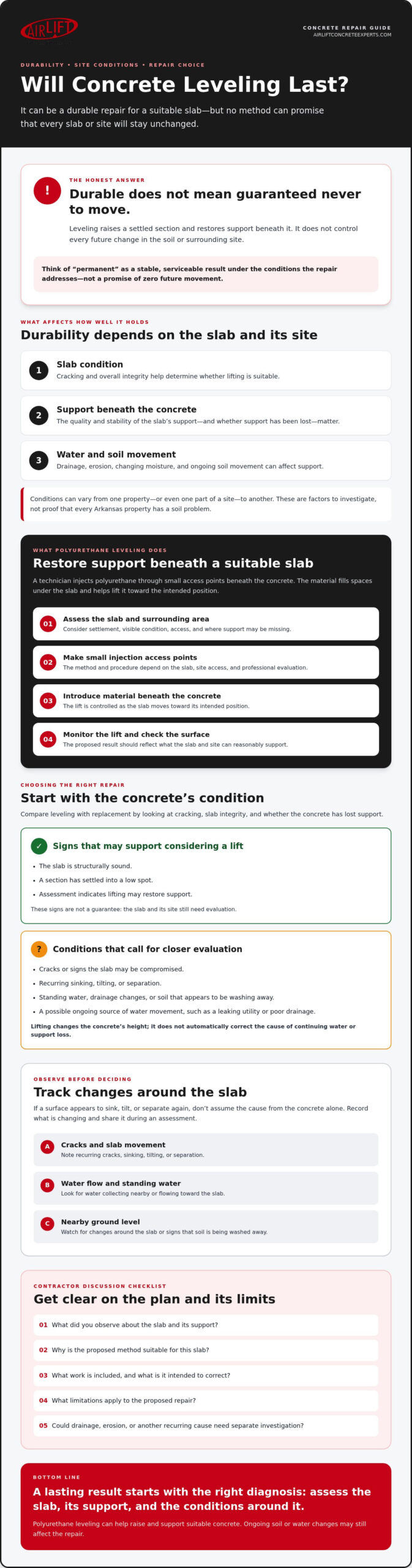
Before deciding whether a lift is likely to hold, gather a clear picture of what’s happening around the slab. Your observations can help a contractor assess movement and support, but they can’t replace an on-site evaluation. Conditions vary across Arkansas, including in Malvern, Hot Springs, Little Rock, Cabot, Conway, Benton, Bryant, North Little Rock, Sherwood, Jacksonville, and Hot Springs Village. Don’t assume one soil or drainage issue explains every settled slab.
These details help frame the question, “is concrete leveling a permanent solution,” for your property. They can point to issues worth discussing, but they don’t establish whether lifting is suitable or whether another condition needs attention first.
Ask how the contractor evaluates the slab’s condition and the support beneath it. Find out whether visible water patterns, possible erosion, or other site conditions may need separate attention. Request a clear explanation of the proposed work, its limitations, and what signs of future movement should prompt follow-up. A useful recommendation should connect the repair to what’s observed, rather than focus only on the slab’s current height.
If you’re unsure how to prepare, this polyurethane concrete leveling homeowner guide can help you understand the repair approach. For a slab that continues to move, or a site where the cause isn’t clear, Airlift Concrete Experts provides polyurethane concrete leveling and raising across Arkansas. Ask Airlift about assessing your concrete leveling needs.
A sound contractor recommendation should explain why the slab settled, whether it’s suitable for lifting, and what the proposed repair can reasonably accomplish. That context matters more than a promise that concrete will never move again. When considering whether is concrete leveling a permanent solution applies to your property, look for clear answers about the diagnosis, repair scope, and site conditions that could affect the result.
Use these questions to compare recommendations and make sure you understand what the work includes:
A direct, specific explanation helps you judge whether the plan addresses the observed problem or only the uneven surface. If an answer is unclear, ask for an explanation before deciding.
Before requesting an assessment, gather photos of the slab and note where it has moved, how the surface is used, and any nearby water or drainage patterns. Share whether you’ve noticed changes over time. These details give a qualified concrete-lifting professional useful context, but an on-site assessment is needed to judge suitability and explain options.
Airlift Concrete Experts provides polyurethane concrete leveling and raising for residential and commercial properties across Arkansas. Its service area includes Malvern, Hot Springs, Little Rock, Cabot, Conway, Benton, Bryant, North Little Rock, Sherwood, Jacksonville, and Hot Springs Village. Polyurethane lifting may be appropriate for an eligible slab, but the right recommendation depends on the concrete and site conditions, not a blanket guarantee of permanence.
If you’re ready to discuss what you’ve observed, discuss your concrete leveling needs with Airlift and ask what an assessment would cover.
So, is concrete leveling a permanent solution? It can be a durable repair when the slab is suitable for lifting and the conditions affecting its support are understood. But no leveling method can prevent every future change in soil or water movement. The right decision depends on the concrete’s condition, what’s happening beneath it, and whether drainage or other site concerns need separate attention.
Before choosing a repair, document visible movement, cracks, and water patterns. Then ask a contractor to explain the assessment, proposed method, scope, and limitations. Leveling may suit sound concrete that has settled, while more extensive damage or an unresolved cause deserves closer evaluation. A clear diagnosis helps you compare options without relying on a blanket promise.
Airlift Concrete Experts is a family-owned Arkansas company founded in 2017, providing polyurethane concrete leveling for residential and commercial properties across the state. If you’re unsure whether lifting fits your slab, discuss your sunken concrete with Airlift. A practical assessment can help you understand the next step and move forward with confidence.
Concrete leveling can provide a durable repair, but it can’t guarantee a slab will never move again. The work raises and supports suitable concrete in its current condition. It doesn’t prevent future changes in soil, moisture, or drainage. Whether leveling is likely to last depends on the slab’s integrity and the conditions beneath and around it. An assessment can help determine whether lifting fits or another issue needs attention.
Service life varies with the leveling method, slab condition, installation, and whether the underlying support remains stable. General industry estimates often place polyurethane foam leveling around 10 to 20 years or more, but that isn’t a guarantee for a particular property. Ongoing erosion, water movement, or soil changes can affect durability. Ask the contractor what factors they considered and what signs of renewed movement to watch for.
Yes, a slab can settle again if it loses support or site conditions continue to change. Water that erodes soil, recurring moisture changes, or ongoing ground movement may contribute, though none should be assumed without an assessment. If the surface dips or tilts again, document where and when you notice it. Have both the concrete and surrounding conditions evaluated to understand what may be causing the movement.
Polyurethane leveling is generally reported to last longer than traditional mudjacking, but actual results depend on the slab and site. Industry estimates commonly place polyurethane leveling around 10 to 20 years or more, compared with roughly 5 to 10 years for mudjacking. These are broad estimates, not promises. Ask a contractor to explain why the proposed method suits your slab and how ongoing support or water concerns may affect durability.
Replacement may warrant consideration if the slab is extensively crumbling, broken into unstable sections, or too deteriorated to raise and support. A sunken but otherwise serviceable slab may be a candidate for leveling. Don’t decide based on a photograph or one crack alone. An on-site evaluation can assess the concrete and settlement pattern. Suspected foundation or structural concerns may require a separate evaluation by an appropriate professional.
No, lifting concrete doesn’t automatically correct drainage. It can raise a suitable slab, but standing water, runoff patterns, leaking utilities, or soil erosion may need separate investigation. Before work is proposed, note where water collects and whether downspouts or runoff direct it toward the concrete. Discuss these observations with the contractor so the proposal makes clear what leveling addresses and which site conditions fall outside the repair scope.
It can be suitable for some settled driveway and sidewalk slabs if the concrete is in adequate condition to be raised and supported. Crumbling, extensive breaks, or ongoing settlement may point to a different repair need. Airlift Concrete Experts provides polyurethane concrete leveling and sidewalk and driveway leveling in Arkansas, including Malvern, Hot Springs, Little Rock, Cabot, Conway, Benton, Bryant, North Little Rock, Sherwood, Jacksonville, and Hot Springs Village. A site assessment helps determine suitability.
Ask how they assess slab condition and support, what method they recommend and why, which areas the proposal includes, and what limitations apply. Discuss drainage, erosion, or other conditions that may need separate attention. Request a clear explanation of the intended result without a promise that the slab will never move. Also ask what follow-up is appropriate if you notice renewed settlement or changes after the repair.

 Call Now