

What if that hairline crack in your kitchen tile isn’t just a cosmetic flaw, but a warning sign from the volatile red clay soil beneath your home? It’s a common sight across Central Arkansas, where shifting ground creates a frequent need for the professional interior floor leveling Arkansas residents rely on to save their foundations. When you notice a dip in the living room or a gap under your baseboards, it’s natural to worry about the cost and chaos of a major repair. We understand that your home is your most significant investment, and seeing it shift can feel like losing your sense of security.
You don’t have to settle for a sloping floor or face the nightmare of a full slab replacement. You’re about to discover how modern polyurethane injection provides a permanent, non-invasive fix that addresses the root cause of the movement without the mess of traditional construction. We’ll walk you through the specialized process that stabilizes your subfloor with surgical precision and minimal disruption to your daily life. This guide will help you protect your property’s resale value and restore the structural stability your family deserves.
Interior floor leveling is the specialized process of restoring sunken concrete slabs to their original, level elevation. In Arkansas, this isn’t just a maintenance chore; it’s a necessary response to our unique geography. Most homeowners in areas like Little Rock or Malvern are familiar with our notorious red clay. This soil is highly expansive, meaning it swells significantly when wet and shrinks during our hot, dry summers. This constant movement of the earth creates instability directly beneath your home’s foundation. While many people assume a sinking floor means the whole house is falling, it often involves interior slab consolidation rather than perimeter foundation settlement. Understanding this distinction is the first step toward finding a lasting solution for interior floor leveling Arkansas residents can trust.
Soil behaves differently depending on where it sits under your home. The dirt near your perimeter walls reacts quickly to rain, but the soil under the center of your slab often dries out at a different rate. This creates an uneven support system. During Arkansas’s heavy rain seasons, hydrostatic pressure can force water into the soil, causing it to expand and push against the concrete. Conversely, during droughts, that same soil pulls away. Soil consolidation is the process where air and water are squeezed out of soil under the weight of the slab. When this happens, the ground loses its ability to support the weight above it, leading to the dips and slopes you feel underfoot. Unlike Concrete leveling on a driveway, interior issues require a more delicate, precise approach to account for these indoor soil conditions.
One of the most common yet overlooked causes of unlevel floors is a sub-slab plumbing leak. Even a pinhole leak in a water line can act like a pressure washer, slowly carving out massive voids in the dirt. Because these leaks are hidden, you might not notice them until the floor begins to sag. Small leaks create big voids. Signs that a plumbing issue is the root cause include localized sinking in a kitchen or bathroom, an unexplained jump in your water bill, or even warm spots on the floor. It’s vital to remember that interior floor leveling Arkansas projects are most successful when the source of the erosion is stopped. Fixing the floor without repairing the underlying leak is only a temporary solution, as the water will eventually wash away any new support.
When you discover a dip in your living room or a slope in the kitchen, you’re faced with two very different paths for repair. The first is a cosmetic “top-down” approach using self-leveling underlayment (SLU). This involve pouring a liquid cementitious compound over the existing floor to create a flat surface. The second is a structural “bottom-up” approach known as polyjacking. This method uses high-density polyurethane injection to lift the concrete slab itself back to its original position. For homeowners seeking interior floor leveling Arkansas experts recommend, the choice usually comes down to whether you want to hide the problem or fix it. While SLU might seem like an easy fix for a flooring installer, it fails to address the soil voids we discussed earlier, often leading to more significant issues down the road.
Adding more material on top of a sinking slab is often counterproductive. Self-leveling compounds are essentially heavy cement. When you pour hundreds of pounds of wet leveler into a low spot, you’re adding significant weight to a subfloor that is already struggling to stay upright. This extra load can actually accelerate the sinking process by further compressing the unstable Arkansas red clay beneath the home. Additionally, these overlays don’t provide any structural reinforcement. Most interior slabs require a specific level of support that thin-set levelers can’t offer. We often see cases where “feathered” edges of cement levelers begin to delaminate or crack under the pressure of daily foot traffic. This leads to the failure of expensive LVP or tile flooring. Beyond the structural risks, pouring wet cement inside a finished home is a messy, multi-day process that requires extensive drying time before you can even think about walking on it.
Polyjacking offers a more sophisticated solution by treating the root cause of the displacement. The high-density foam we use is incredibly lightweight, adding only 3 to 5 pounds per cubic foot. This allows us to lift the slab without putting any additional strain on the underlying soil. The process is remarkably clean and non-invasive. We drill small, 5/8-inch holes, roughly the size of a penny, to inject the material. Once the foam expands, it fills the voids and provides a stable, waterproof base that won’t wash away. One of the biggest benefits for busy families is the speed of the repair. Polyurethane foam cures in a matter of minutes. You can move your furniture back and resume your normal routine almost immediately after we finish. If you’re ready to see how this technology can restore your home’s stability, you can learn more about our specialized interior leveling process and how it compares to traditional methods.
Recognizing the early warning signs of a sinking slab can save you thousands in future repairs. While some homeowners assume that a few cracks in the drywall are just part of a house “settling,” specific indicators point toward the need for professional interior floor leveling Arkansas residents should address before they escalate. One of the most obvious signs is the “baseboard gap.” This occurs when the concrete slab pulls away from the wall trim, leaving a visible space between the bottom of the baseboard and the flooring material. Because the trim is nailed to the wall studs, it stays put while the floor beneath it drops, creating a clear signal that the subfloor is no longer providing adequate support.
You might also notice changes in how your home sounds and feels underfoot. If you walk across a tiled area and hear a hollow “clack” or feel a slight bounce in your luxury vinyl plank (LVP) or laminate flooring, there’s likely a void beneath the slab. Cracked grout lines in your kitchen or bathroom aren’t just an eyesore; they often indicate that the underlying concrete has shifted, putting uneven pressure on the rigid tile above. Similarly, if your interior doors suddenly start rubbing against the floor or refuse to latch, don’t reach for a plane to shave the door down. The issue is frequently a shifting floor that has pulled the door frame out of alignment, a common problem in the shifting clay soils of Central Arkansas.
If you suspect your floor is uneven, look at your furniture and cabinetry. Do your bookshelves lean visibly away from the wall? Do your kitchen cabinet doors swing open on their own? These are common symptoms of a sloping slab. You can perform a simple marble test by placing a marble on a hard surface and watching its path. If it consistently rolls in one direction, you’ve identified the pitch of the sink. In homes with interior brickwork or fireplace hearths, keep an eye out for “stair-step” cracks. These diagonal fractures in the mortar are a hallmark of structural movement in the slab that requires specialized attention.
Ignoring these signs can lead to more than just crooked furniture. When an interior slab sinks, it often puts undue stress on the home’s load-bearing walls, creating structural tension that can compromise the entire building. This movement also creates tripping hazards, which are a significant safety risk and liability for both homeowners and local business owners. By seeking interior floor leveling Arkansas services early, you prevent the need for a total slab replacement. Early intervention with polyurethane injection is much less invasive and far more cost-effective than waiting for the concrete to fail completely, ensuring your home remains a stable, safe environment for your family.
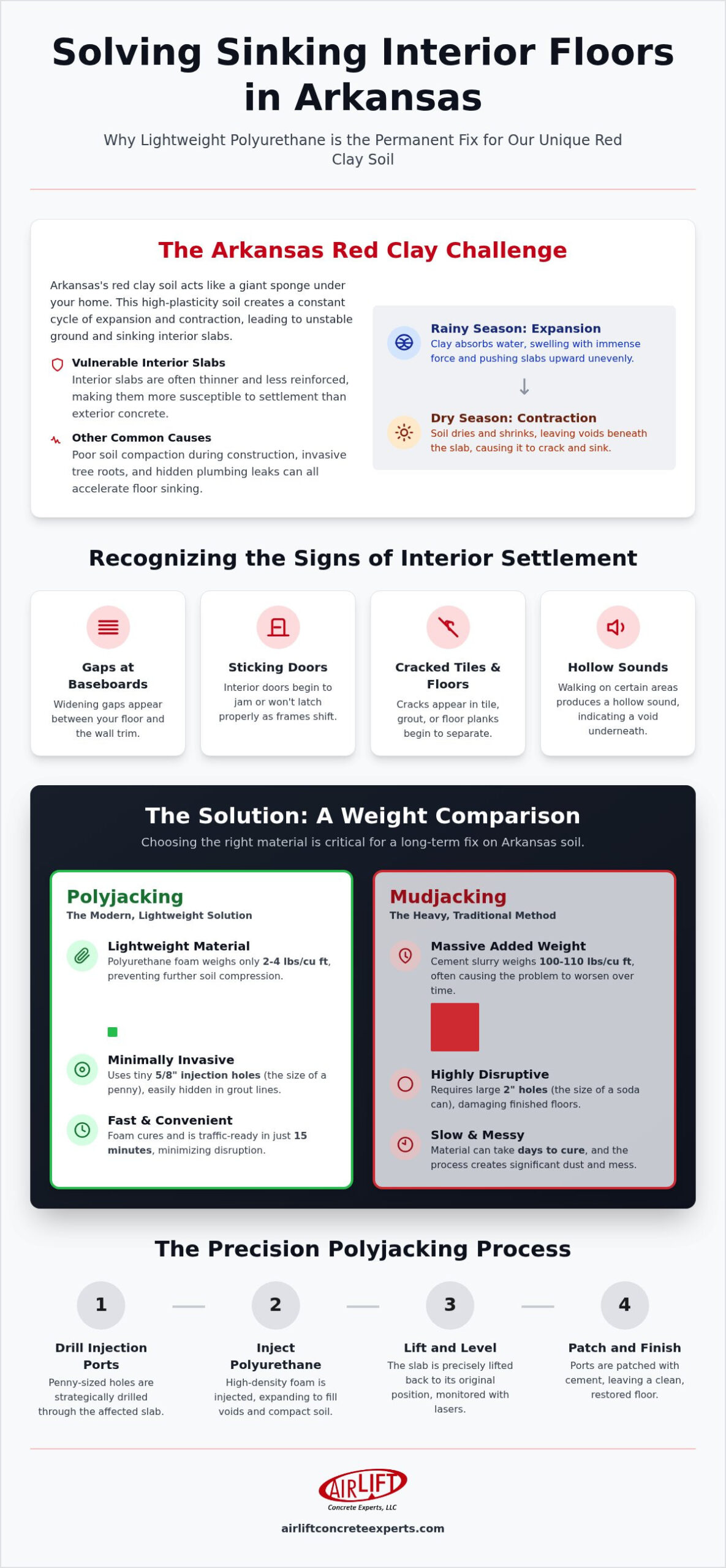
When you choose a modern approach to interior floor leveling Arkansas homeowners often find the process surprisingly simple and efficient. We’ve refined our method to prioritize your comfort while delivering a permanent structural fix that lasts. The project begins with a detailed site assessment where our technicians don’t just look for surface cracks; they use specialized tools to map the entire sunken area. This mapping identifies the specific locations where the subfloor has lost contact with the soil. By understanding the exact geometry of the void, we can plan our injection points for maximum stability and precision.
The physical work starts with drilling small, strategically placed injection ports into the concrete. These holes are only 5/8 inch in diameter, which is roughly the size of a penny. Because they’re so small, we can often place them in grout lines or inconspicuous areas of your flooring to minimize any visual impact. After the ports are ready, we transition to the injection phase. We use a controlled delivery system to pump high-density polyurethane into the voids. Our technicians utilize laser levels to achieve 1/10th-inch accuracy, monitoring the slab’s movement in real-time as it returns to its original elevation. Finally, we remove the equipment, clean the ports, and seal them with a color-matched compound. This leaves your floor looking untouched and structurally sound.
Precision is the hallmark of our work in homes across Central Arkansas. During the injection, the foam’s “void filling” property is critical because it flows into the smallest gaps in the soil, effectively consolidating the loose earth before it begins to lift the concrete. This creates a uniform support system across the entire slab. The lift is powered by a specific chemical reaction where two liquid components mix together, reacting to expand and harden into a structural foam almost instantly. Because we monitor this lift with laser precision, we can ensure perfectly level transitions between rooms, preventing the tripping hazards that often occur with less accurate methods.
One of the biggest advantages of polyjacking is how little it affects your daily life compared to traditional repairs. We understand that your home is a sanctuary, not a construction site. In most cases, you won’t even need to move your heavy furniture out of the room entirely, as we can work around your belongings with ease. There’s no heavy machinery vibrating your walls and no clouds of concrete dust to clean up after we leave. The process is quiet enough that you can remain in your home or office while we work. If you’re tired of dealing with uneven surfaces and want a clean, professional solution, you can request a professional assessment for interior floor leveling Arkansas to see how we can help restore your property’s value.
Investing in the professional interior floor leveling Arkansas homes require is about much more than fixing a trip hazard. It is a strategic move to secure your most valuable asset. Unlike traditional mudjacking, which uses a heavy slurry that can eventually wash away or shrink, high-density polyurethane is an inert, stable material. Once it cures, it remains unaffected by the moisture levels in our regional soil. It won’t degrade, it won’t leach into the ground, and it provides a permanent support structure that keeps your floors level for decades. This durability ensures that you only have to pay for the repair once, rather than dealing with the recurring costs of temporary cosmetic fixes.
Choosing repair over replacement also offers significant environmental benefits. Tearing out an interior concrete slab is a resource-intensive process that generates tons of waste for our local landfills. It also requires the production and transport of new concrete, which has a high carbon footprint. By stabilizing your existing slab with polyurethane injection, you are choosing a sustainable path. This method preserves the original materials of your home while using a specialized process that requires minimal energy and produces almost zero waste. It is the responsible choice for homeowners who want to maintain their property while respecting the local Arkansas environment.
Unlevel floors are one of the biggest red flags during a home inspection. When a potential buyer sees a gap under a baseboard or feels a slope in the hallway, their first thought is often “structural failure,” which can lead to lower offers or even a cancelled sale. Professional leveling restores the market value of your property by providing documented proof of stability. We provide a transferable warranty on our structural repairs, which gives future buyers the confidence they need to move forward. Buyers today are savvy; they prefer the clean, high-tech nature of polyurethane lifting over the messy, invasive look of traditional foundation work. A level floor suggests a well-maintained home, making your property much more competitive in the Little Rock or Malvern real estate markets.
Central Arkansas has a unique geography that national franchises often fail to appreciate. The specific behavior of the clay in neighborhoods across Hot Springs, Conway, and Little Rock requires a neighborly touch and regional expertise. Airlift Concrete Experts is a family-owned and operated business founded in 2017. We aren’t just contractors; we’re your neighbors who understand exactly how our local climate affects your home’s foundation. Our team uses specialized equipment designed for the surgical precision needed in finished interior spaces. We take pride in our honest, straightforward approach to property maintenance. If you’re ready to restore the stability of your home, Schedule your free interior floor assessment with Airlift Concrete Experts today!
You now understand that sinking floors in Arkansas aren’t just an eyesore; they’re a manageable structural challenge rooted in our regional soil. By choosing a permanent, lightweight solution like polyjacking over temporary cosmetic fillers, you’re protecting your home’s resale value and your family’s safety. This modern approach to interior floor leveling Arkansas homeowners trust ensures that repairs are completed with surgical precision and zero mess. You don’t have to live with the anxiety of a shifting foundation or the tripping hazards of uneven tile and hardwood.
Airlift Concrete Experts is a family-owned and operated team dedicated to serving our neighbors in Little Rock, Malvern, and Conway. We use non-invasive polyjacking technology to restore your peace of mind without the stress of a major construction project. Don’t let uneven floors compromise your property’s integrity any longer. Get Your Free Interior Floor Leveling Quote today and enjoy the comfort of a perfectly level, stable home once again.
Most homeowners insurance policies in Arkansas don’t cover standard floor settlement or soil consolidation. These issues are typically classified as gradual movement, which is excluded from basic coverage. However, if your unlevel floor is a direct result of a sudden plumbing leak or a “covered peril,” you might have a valid claim. We recommend reviewing your specific policy or speaking with your agent to confirm if your interior floor leveling Arkansas project qualifies for assistance.
High-density polyurethane foam is a permanent material that won’t biodegrade or wash away. Once the chemical reaction is complete, the foam becomes an inert solid that provides a stable base for the life of the structure. It is resistant to moisture and the shifting clay soils common in Central Arkansas. This durability makes it a much more reliable long-term investment compared to traditional mudjacking or temporary surface levelers.
Yes, we can lift and level floors without removing your existing tile or hardwood. Our technicians drill penny-sized holes directly through grout lines or small openings in the wood to reach the subfloor. Once the injection is complete, we fill and color-match the ports to ensure the repair is nearly invisible. This non-invasive approach is a primary reason why homeowners prefer polyjacking for finished interior spaces.
Interior floor leveling is typically 50% to 70% less expensive than tearing out and repouring a new concrete slab. Beyond the direct cost of materials and labor, you also save money by avoiding the need to replace your entire flooring finish. Slab replacement is a weeks-long project that involves significant demolition and mess. Leveling achieves the same structural result in a single day for a fraction of the total investment.
The drilling process creates very little dust because we use specialized equipment and HEPA-filtered vacuums at the source. Since the holes are only 5/8 of an inch in diameter, the volume of material removed is minimal. We prioritize keeping your home clean and typically leave the workspace in the same condition we found it. You won’t have to deal with the heavy clouds of concrete dust associated with traditional demolition.
Polyurethane foam is completely safe for indoor use and doesn’t negatively impact your home’s air quality. The material is environmentally inert once it cures, which happens within minutes of the injection. It doesn’t off-gas or release harmful chemicals into your living space. This makes it an ideal solution for interior floor leveling Arkansas residents can use in kitchens, bedrooms, and even commercial offices without safety concerns.
Determining the difference between a slab issue and a foundation issue requires a professional structural assessment. Generally, if only the interior floor is sinking while the exterior walls remain straight and crack-free, it’s likely a slab consolidation problem. If you notice cracks in exterior brickwork or windows that won’t open, it may be a deeper foundation pier issue. We provide a detailed evaluation to ensure we address the correct structural component.
Polyjacking is capable of lifting concrete slabs several inches back to their original elevation. While most residential projects involve corrections of one to three inches, the foam’s expansive force is strong enough to handle more significant settlement. The goal is always to achieve a perfectly level transition with 1/10th-inch accuracy. Our technicians monitor the lift in real-time to ensure we don’t over-lift or put unnecessary stress on your home’s walls.

 Call Now