
What if a settled industrial slab could be lifted without replacing the entire surface? Uneven concrete can complicate safe movement, equipment use, and daily operations, so it’s understandable to ask whether lifting suits your facility. With industrial slab jacking Benton property managers have a targeted repair option to consider: high-density polyurethane foam is injected beneath the slab to help raise it. The slab’s condition and the site’s needs determine whether this approach is suitable.
This guide explains how polyurethane slab jacking works and what to consider when planning the work, from documenting affected areas to coordinating access and operations. It also compares lifting with replacement to help you evaluate the options for your concrete. Airlift Concrete Experts provides commercial and industrial concrete lifting in Benton. A practical repair plan starts with understanding the slab, the site, and how the work area supports daily activity.
Uneven concrete can make routine facility use more difficult. A change in floor elevation may affect pedestrian routes, how carts or equipment cross between areas, or how vehicles approach a loading zone. Early documentation gives your team a clearer picture of the problem and helps focus an assessment.
Look for slab edges that sit higher or lower than adjoining concrete, gaps beneath a slab, uneven transitions at doorways or joints, water collecting in a new low spot, and recurring trip hazards. These signs can indicate movement, but they don’t identify its cause or establish whether lifting is the right repair. A crack or worn surface alone also doesn’t prove that a slab has settled.
Industrial slab jacking raises settled concrete by injecting material beneath the slab to help restore its elevation and support. For facility managers researching industrial slab jacking Benton, a useful first step is to connect visible changes with the specific areas and activities they affect.
Settlement may become noticeable around warehouse floors, loading areas, walkways, or equipment pads. Distinguish surface wear or cracking from a change in elevation, such as a lip at a joint or a ramp-like transition that has developed over time. Record the affected locations, how each area is used, and when your team first noticed the change. Photos and brief notes can help make an on-site assessment more focused.
The concrete surface is only part of the picture. Drainage patterns, the support beneath the slab, and the site’s history can all provide useful context. Note where water collects, whether the area has been repaired before, and whether the change appears to be progressing. Avoid assuming the cause from appearance alone. Sharing these observations helps the assessment consider the site as well as the slab.
A site-specific review helps determine whether lifting suits the slab’s condition or whether other factors need attention. For more context on repair approaches, see this concrete lifting guide. For a Benton facility, documenting symptoms and site conditions is a practical starting point for planning around daily operations.
Polyurethane slab jacking raises an existing concrete slab by injecting foam beneath it. It is a repair method for settled concrete, not a process for pouring a new slab. For Benton industrial properties, the aim is to address the slab’s elevation while accounting for its condition, underlying support, and use.
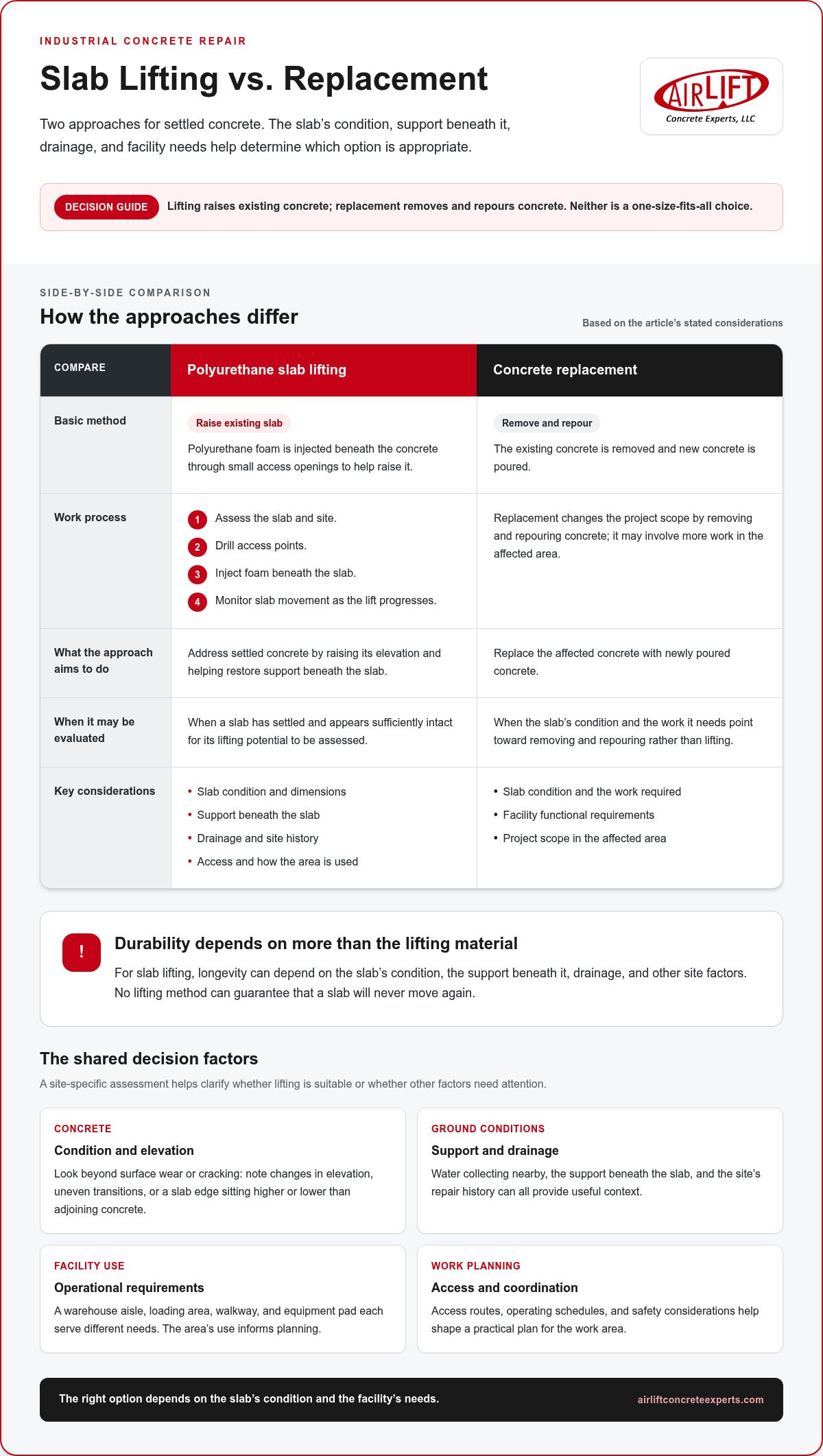
The process follows a few main steps: assess the slab, drill access points, inject polyurethane foam beneath it, and monitor its movement as the lift progresses. The number and placement of injection points, as well as the amount of foam used, depend on the slab and the site assessment. Different work areas may call for different plans.
Technicians make small openings in the concrete to reach the space beneath the slab. They inject polyurethane foam through the access points. As the foam expands, it can fill space and help lift the settled concrete. Technicians monitor the slab’s elevation and movement during the work, adjusting the process in response to what they observe and to site conditions.
An industrial assessment considers more than the visible low spot. It takes into account the slab’s dimensions, elevation, condition, access for the work, and how the surface is used. A warehouse aisle, loading area, and equipment pad serve different operational needs, so the facility’s requirements inform planning. Those requirements alone don’t establish whether lifting is suitable.
Site information also helps the team consider where injection points may be needed and how to approach the work area. A route used by material-handling equipment, for example, may need different coordination from a pedestrian walkway. Sharing access restrictions and operating schedules helps inform a practical plan without assuming a particular timeline or outcome.
For a broader explanation of the material and method, read the polyurethane concrete leveling guide. If a slab at your Benton facility has settled, request a concrete assessment to discuss its condition and potential next steps.
Industrial slab jacking can be a durable repair option, but its longevity depends on more than the lifting material. The slab’s condition, the support beneath it, drainage, and other site factors all matter. An on-site assessment helps determine whether the concrete is a candidate for lifting and whether conditions beneath it may affect the repair plan. No lifting method can guarantee that a slab will never move again.
The choice between lifting and replacement depends on the slab’s condition and the work it needs. Lifting aims to raise existing concrete when its condition and site circumstances make that approach practical. Replacement involves removing and repouring concrete, which changes the project scope and may involve more work in the affected area. The right option depends on the facility’s functional requirements, not a one-size-fits-all rule.
Consider an assessment when a slab has settled but appears sufficiently intact for its lifting potential to be evaluated. If it can be raised, correcting its elevation may address uneven transitions or help the surface function better for routine facility use. That doesn’t mean every slab can be lifted or returned to its exact original position. The slab’s condition and underlying support should guide the recommendation.
Extensive deterioration or structural damage may make lifting less suitable and prompt consideration of alternatives. The review should account for the concrete’s documented condition, the support beneath it, and what the area needs to do. A slab that must meet a particular functional requirement may call for a different approach from one with localized settlement and otherwise serviceable concrete.
For facility managers comparing industrial slab jacking Benton options, focus on four practical questions:
Airlift’s assessment of the site and slab condition helps clarify whether polyurethane concrete lifting is a practical option. The recommendation should reflect the condition of the concrete and how the facility uses the area, rather than promise a particular result.
Good planning starts with a clear record of what your team sees and how the affected area is used. Before an on-site assessment, note where the slab appears uneven, which routes cross it, and whether the change affects pedestrian movement, carts, forklifts, or other equipment. This gives the assessment a practical starting point without asking facility staff to diagnose the cause.
Gather observations that describe both the concrete and its setting. Note drainage patterns, previous repairs, and changes your team has noticed over time. Photos can help show the affected area or how a transition has changed. Also identify access constraints, nearby operations, and safety considerations that could affect how the work area is reached or managed.
After the slab and site are assessed, the project scope and timing can be planned around the conditions found and the facility’s operating needs. Share which routes are essential, where access can be arranged, and what safety measures your team uses to manage nearby activity. This helps shape a site-specific plan without assuming a particular schedule or level of disruption.
For industrial slab jacking Benton facilities, planning should reflect the actual slab and surrounding site conditions, not a general assumption about local soil or moisture. Airlift Concrete Experts provides concrete assessments to help clarify the slab’s condition and potential next steps. To discuss your site, request a concrete assessment.
For an overview of other lifting applications, explore this concrete lifting service guide.
A settled slab can create practical challenges across an industrial property, from uneven transitions to areas that are harder to use as intended. Airlift Concrete Experts provides polyurethane concrete leveling and commercial concrete lifting for industrial properties in Benton and communities across Arkansas. The work focuses on raising existing sunken concrete, with the repair approach shaped by the slab and site conditions.
Airlift is family-owned and operated and was founded in 2017. For facility managers, an assessment is the first step toward understanding the slab’s condition and discussing potential next steps. It helps the team evaluate the specific concrete and site instead of assuming that every uneven surface calls for the same repair.
The assessment considers the concrete, site conditions, and how the affected area supports facility operations. If polyurethane lifting is appropriate, Airlift injects high-density polyurethane foam beneath the slab to help raise it. The scope and approach depend on what the assessment finds. A repair plan can account for the specific area and its use without promising a particular lift, schedule, or outcome.
Before reaching out, summarize where the settlement appears and how it affects pedestrian or equipment movement. Note access routes, operating schedules, and any safety or coordination needs around the work area. These details help start a focused conversation about your facility and make the assessment more useful.
If your Benton property has settled concrete, you don’t need to choose a repair method based on symptoms alone. A site-specific assessment helps clarify the slab’s condition and whether polyurethane concrete lifting may be a practical next step. Airlift serves industrial properties in Benton with an assessment-led approach.
Request a concrete assessment to discuss the affected area and potential next steps for your facility.
Uneven concrete can affect movement, access, and everyday facility use, but visible symptoms alone don’t determine the right repair. A site-specific assessment considers the slab’s condition and underlying support to help clarify whether polyurethane lifting may be suitable or whether other factors need attention. Planning around access routes, operating needs, and safety considerations also grounds the repair discussion in how your facility works.
For industrial slab jacking Benton facility managers can start by documenting affected areas and sharing what has changed over time. Airlift Concrete Experts provides commercial and industrial concrete lifting across Arkansas, including Benton. The family-owned and operated company uses polyurethane concrete leveling to raise settled slabs where appropriate.
To discuss your facility’s settled concrete and potential next steps, request a concrete assessment. A clear assessment can help your team make an informed plan.
Industrial slab jacking is a repair method that raises settled concrete by injecting material beneath the slab. It addresses changes in elevation while retaining existing concrete when the slab’s condition and site factors make lifting practical. For a warehouse floor, loading area, or equipment pad, an assessment helps determine whether the concrete may be suitable and what conditions beneath it should be considered.
Yes. Polyurethane foam can be injected beneath an industrial concrete slab to help raise settled sections. Airlift Concrete Experts uses high-density polyurethane foam for concrete lifting, including commercial and industrial applications. Whether lifting suits a particular slab depends on its condition, underlying support, and site circumstances. An on-site assessment helps clarify the slab’s condition and whether polyurethane concrete leveling is a suitable approach.
Industrial slab jacking generally begins with an assessment of the concrete and work area. Technicians drill access points through the slab, inject polyurethane foam beneath it, and monitor the slab’s movement during the process. The locations of the openings and the amount of material depend on the slab and site assessment. Facility access, surface use, and operating needs can also inform how the work is planned.
Neither option is automatically better. The slab’s condition and the facility’s needs guide the decision. Lifting may be worth evaluating when settled concrete remains sufficiently intact, since the approach aims to raise the existing slab. Extensive deterioration or structural damage may prompt consideration of alternatives. An on-site assessment helps compare the repair scope, disruption, and suitability without assuming every slab can be lifted.
Project timing depends on the slab’s size and condition, the scope of work, site access, and operational coordination. An assessment is needed before discussing a project-specific schedule. Facility teams can prepare by noting affected areas, access routes, operating schedules, and safety considerations. This helps shape a plan for the site rather than relying on a general time estimate.
Work planning can take facility operations into account, but whether an area can remain in use during the project depends on its layout, access needs, and safety considerations. Identify essential routes and activities near the affected slab before the assessment. The repair plan can then address how to coordinate access and work areas. Don’t assume the entire facility can operate without interruption.
Yes. Airlift Concrete Experts provides commercial and industrial concrete lifting in Benton, using polyurethane concrete leveling to raise sunken slabs where appropriate. The family-owned and operated business was founded in 2017 and serves Arkansas communities including Benton, Malvern, Hot Springs, Little Rock, Cabot, Conway, Bryant, North Little Rock, Sherwood, Jacksonville, and Hot Springs Village. An assessment helps clarify potential next steps for your property.

 Call Now