

What if a settled equipment pad could be corrected without tearing it out and putting operations through an extended shutdown? Concrete leveling for industrial equipment pads starts with a more useful question: can the slab and supporting soil be stabilized for the equipment’s load and operating needs? Uneven support may complicate setup, alignment, or safe access, while replacement can bring substantial site disruption and coordination.
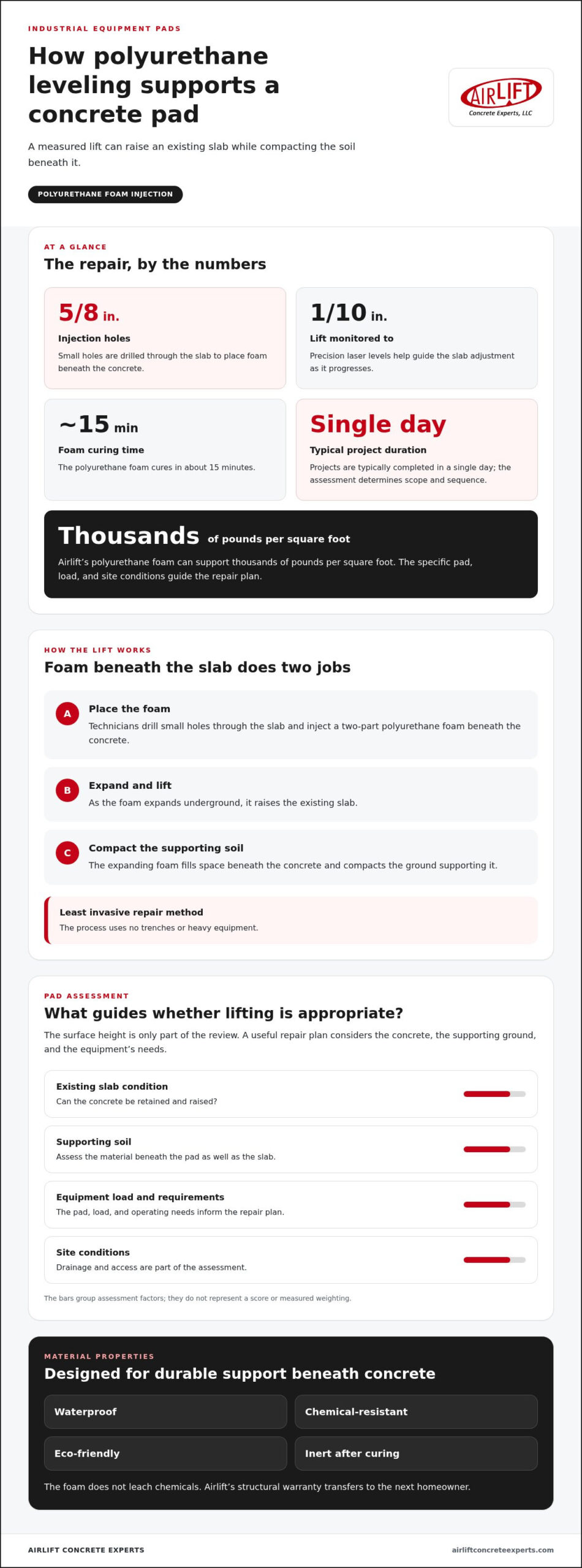
Before choosing a repair, it helps to understand whether the concrete or the ground beneath it is contributing to the problem. This guide explains what affects whether a pad can be lifted, how leveling compares with replacement, and what information to prepare for an assessment. Airlift Concrete Experts uses polyurethane foam injection for commercial concrete lifting. The least invasive repair method uses 5/8-inch injection holes, with no trenches or heavy equipment. Technicians monitor the lift to within 1/10 of an inch; the foam cures in about 15 minutes, and projects are typically completed in a single day. The foam is waterproof, chemical-resistant, eco-friendly, becomes inert after curing, does not leach chemicals, and is safe for families, yards, and agricultural sites. The durable repair includes a structural warranty that transfers to the next homeowner.
A change in an equipment pad’s elevation, a visible gap beneath an edge, water collecting on the surface, or cracks around the slab can all warrant a closer look. These signs don’t establish whether the cause is soil movement, water-related erosion, concrete damage, or another site condition. Treat them as clues to document, not a diagnosis. For facilities in Little Rock, a careful assessment helps determine whether the existing pad may be suitable for lifting or needs a different response.
Look for changes across the whole pad, not just one spot. A slab may slope, separate from an adjoining surface, or show new cracks. Ponding after rain or washdown can point to a change in surface grade, though drainage conditions should also be considered. Record where each symptom appears and whether it seems to be changing. Photos from consistent viewpoints, dates, and notes about water accumulation can make the assessment more useful.
Include the equipment’s footprint and any installation or operating requirements in your notes. A concern involving a small area beneath one machine may call for a different review than settlement affecting much of a shared pad. The assessment should consider the concrete and supporting ground, along with site drainage and the equipment’s specified needs.
A sound, level slab provides a consistent base for equipment installation and routine access. If the pad appears uneven, document any alignment concerns reported by the installation or maintenance team, changes to access around the machine, and restrictions affecting inspection or service. These observations describe the practical issue without assuming the slab has caused a machinery problem or predicting what may happen next.
It’s also helpful to distinguish pad-level concerns from adjustments to the equipment itself. Shims or grout may be used to position an individual machine, but they don’t raise a settled concrete pad or address the ground beneath it. Concrete leveling for industrial equipment pads focuses on the existing slab. Whether lifting is appropriate depends on the slab’s condition, underlying support, and equipment requirements. A general Slabjacking overview explains the broader concept of raising settled concrete.
For a pad that can be retained and lifted, Airlift uses polyurethane foam injection through 5/8-inch holes, with no trenches or heavy equipment. This least invasive repair method provides a durable solution, with lifting monitored to within 1/10 of an inch. The foam cures in about 15 minutes, and projects are typically completed in a single day. It’s waterproof, chemical-resistant, and eco-friendly. After curing, it becomes inert and doesn’t leach chemicals. The foam is safe for families, yards, and agricultural sites, and the work includes a structural warranty that transfers to the next homeowner.
Polyurethane foam injection lifts an existing concrete slab by placing expanding structural foam beneath it. The foam fills space below the concrete and expands, raising the slab while compacting the supporting soil. The process addresses ground support as well as slab elevation. When evaluating concrete leveling for industrial equipment pads, consider both the concrete and the material beneath it, not just the surface height.
Technicians drill small, 5/8-inch holes through the slab, then inject a two-part polyurethane foam beneath the concrete. As it expands underground, it lifts the slab and compacts supporting soil. Precision laser levels monitor the lift to within 1/10 of an inch, helping guide the adjustment as it progresses. This is the least invasive repair method, with no trenches or heavy equipment.
The foam cures in about 15 minutes, and projects are typically completed in a single day. These timelines can help facility teams plan around a repair, though the site assessment determines the project scope and sequence. Unlike an adjustment to an individual machine, foam injection addresses the slab itself and the supporting ground beneath it. For broader context on how equipment foundations are maintained and repaired, see Equipment Foundation Services.
Airlift’s polyurethane foam can support thousands of pounds per square foot. That capacity suits demanding slab-lifting applications, while the specific pad, load, and site conditions guide the repair plan. The foam is waterproof and chemical-resistant, providing durable support beneath concrete.
After curing, the foam becomes inert and does not leach chemicals. It’s eco-friendly and safe for families, yards, and agricultural sites. These material properties matter in facilities where the surrounding environment is part of project planning, but they don’t replace an assessment of the slab and soil. Airlift’s structural warranty transfers to the next homeowner.
For a Little Rock facility, a useful assessment connects observed settlement with the pad’s condition, equipment needs, and access constraints. Airlift’s commercial concrete lifting assessment can help establish whether polyurethane foam injection fits the site and define the work required.
Choosing between lifting an existing pad and replacing it starts with the condition of the concrete and the ground beneath it. Concrete leveling for industrial equipment pads may be appropriate when the slab remains suitable to retain and raise. Replacement may be considered when the concrete itself can no longer serve as the pad, or when the project needs a different slab design. Don’t choose either option based on surface symptoms alone. A site assessment helps establish the scope and whether the pad’s condition and support suit lifting.
| Decision factor | Lifting the existing pad | Replacing the pad |
|---|---|---|
| Existing slab condition | Consider when the concrete can be retained and raised. | Consider when the slab’s condition or project scope calls for new concrete. |
| Soil support | Assessment considers the ground beneath the slab; polyurethane foam expands below it and compacts supporting soil. | Replacement involves removing the existing slab and preparing for a new one, with ground conditions still relevant. |
| Disruption | Injection uses 5/8-inch holes, with no trenches or heavy equipment. Site access and operations still need project-specific planning. | Removal and new concrete placement can involve broader site work and coordination. |
| Project scope | Focuses on raising and supporting the existing concrete. | Can address needs that require a newly constructed slab, beyond lifting the current one. |
Lifting may be worth considering when an assessment finds the slab suitable to retain and raise. Polyurethane foam injection works beneath existing concrete, so the repair uses 5/8-inch holes rather than trenches or heavy equipment. That can reduce site disturbance compared with removing and replacing a slab, but it doesn’t guarantee uninterrupted operations or make every pad a candidate. The assessment must account for access, the concrete, and conditions below it.
Consider the slab’s condition and settlement pattern, drainage and water accumulation, access for the work, and the equipment’s support requirements. The underlying soil matters too: a surface-level review alone can’t establish whether the pad is adequately supported or suitable for lifting. Airlift’s free inspection and project-specific estimate help define the appropriate scope. For broader context on concrete lifting, see this concrete lifting guide.
Airlift monitors foam lifting to within 1/10 of an inch. The foam cures in about 15 minutes, and projects are typically completed in a single day. It’s waterproof, chemical-resistant, and eco-friendly; after curing, it becomes inert and doesn’t leach chemicals. It’s safe for families, yards, and agricultural sites, and the structural warranty transfers to the next homeowner. These details help with planning, while the pad’s actual condition determines whether lifting is the right repair approach.
A little site information can make an assessment more productive. Before scheduling, collect observations about the pad, the equipment it supports, and practical conditions around the work area. You don’t need to diagnose the cause or calculate engineering tolerances. Clear notes and photos help focus the review on the concrete and supporting soil.
Start with the pad’s location and approximate dimensions, then record visible cracks, ponding water, uneven areas, or gaps. Note when you first saw each change and whether it appears to have progressed. Photograph the full pad and closer views of specific symptoms. Dated images from similar angles can help show how conditions change over time.
Next, identify the equipment type and include manufacturer support or level requirements if they’re available. Note access limitations, nearby obstructions, and operational or scheduling constraints for the assessment. This information describes the site without asking facility staff to interpret equipment performance or set repair specifications.
Airlift provides a free inspection and estimate focused on the pad’s concrete and site conditions. The assessment considers whether the slab can be retained and raised, along with the supporting soil, access, and project scope. The repair plan is tailored to the site rather than treated as a universal fix. For a broader overview of concrete lifting and its applications, see this concrete lifting guide.
If polyurethane foam injection suits the pad, the lift is monitored to within 1/10 of an inch. The process uses 5/8-inch holes, with no trenches or heavy equipment, and foam cures in about 15 minutes; projects are typically completed in a single day. The foam is waterproof, chemical-resistant, and eco-friendly. It becomes inert after curing, does not leach chemicals, and is safe for families, yards, and agricultural sites. Airlift’s structural warranty transfers to the next homeowner.
Facilities in Malvern, Little Rock, Hot Springs, and nearby communities can request a free pad inspection and estimate. Bring notes and photos to focus the discussion on the symptoms, equipment, and site conditions that matter to your project.
Airlift Concrete Experts provides commercial concrete lifting and polyurethane slab lifting for industrial pads in Little Rock and across Arkansas. As a family-owned structural repair company, Airlift pairs a project-specific assessment with trained contractors and quality workmanship. Its patented two-part polyurethane foam injection process lifts existing concrete and compacts the supporting soil, with the lift monitored to within 1/10 of an inch.
The repair plan is based on the pad and site conditions, rather than assuming one approach fits every facility. This least invasive repair method uses 5/8-inch holes, with no trenches or heavy equipment. Foam cures in about 15 minutes, and projects are typically completed in a single day. Airlift’s structural warranty transfers to the next homeowner.
The foam can support thousands of pounds per square foot. It’s waterproof, chemical-resistant, and eco-friendly; after curing, it becomes inert and does not leach chemicals. It’s safe for families, yards, and agricultural sites. Airlift’s lifting work can address footings, garages, homes, businesses, and churches. The company has also leveled grain bins and stabilized ground beneath a dam.
Airlift’s free inspection and estimate are the first step for an industrial pad project. The assessment helps determine whether the concrete and underlying conditions suit lifting and what the project requires. A $1,000 deposit is required to guarantee an appointment and is applied 100% toward the total service cost.
Airlift serves these Arkansas communities: Alexander, Arkadelphia, Batesville, Beebe, Bella Vista, Benton, Bentonville, Blytheville, Bryant, Cabot, Camden, Centerton, Conway, El Dorado, Fayetteville, Forrest City, Fort Smith, Helena-West Helena, Hot Springs, Hot Springs Village, Jacksonville, Jonesboro, Little Rock, Magnolia, Malvern, Maumelle, Mayflower, Morrilton, North Little Rock, Paragould, Pine Bluff, Rogers, Russellville, Searcy, Shannon Hills, Sherwood, Siloam Springs, Springdale, Texarkana, Van Buren, Warren, and West Memphis. Grain-bin floor lifting is also available beyond these cities. Contact Airlift for service-area details.
For a project-specific next step, request a free concrete pad assessment.
Use your site notes and equipment requirements to turn a concern about pad movement into a focused repair discussion. The next step is to determine whether the existing slab can be retained and what the site needs to support it. That project-specific decision is central to concrete leveling for industrial equipment pads, especially when facilities need to weigh repair scope alongside operational planning.
Airlift is a family-owned Arkansas company providing commercial concrete lifting. Its foam lifting is monitored to within 1/10 of an inch, cures in about 15 minutes, and projects are typically completed in a single day. The structural warranty transfers to the next homeowner. These details give facility teams practical points to consider as they plan, without assuming every pad or operation has the same requirements.
Bring your observations and questions to Airlift for a professional assessment. Request a free inspection and estimate to discuss your industrial pad and take the next step toward a durable repair plan.
Yes. Airlift’s structural foam can support thousands of pounds per square foot, but that general capacity isn’t a design specification for a particular machine. Before installing heavy production equipment, consider the pad, supporting soil, and equipment requirements together. Whether concrete leveling for industrial equipment pads suits a specific setup depends on those site conditions, which a professional assessment can review.
Airlift uses precision laser levels to monitor foam lifting to within 1/10 of an inch. This describes how closely the lift is monitored, not a universal final tolerance for every pad. The appropriate target depends on the concrete’s condition and project requirements. Share any available equipment guidance during the inspection so the assessment can account for the pad’s intended use.
Airlift’s polyurethane foam cures in about 15 minutes, and projects are typically completed in a single day. The actual work duration depends on project scope and site conditions, so facility managers shouldn’t assume every industrial pad follows the same schedule. Note access windows, operational restrictions, and coordination needs so they can be considered during the assessment.
Airlift’s foam is waterproof, chemical-resistant, and eco-friendly. After curing, it becomes inert and doesn’t leach chemicals; it’s safe for families, yards, and agricultural sites. If the pad is near landscaping, agricultural areas, or other site features that matter to facility operations, include that context in the assessment. This helps Airlift consider the location and surrounding conditions when planning the work.
No. Airlift’s polyurethane foam injection is the least invasive repair method: technicians drill 5/8-inch holes, about the size of a dime, to inject foam beneath the slab. The process uses no trenches or heavy equipment. Rather than excavating the entire pad, the goal is to lift and support the existing concrete. Site access and the pad’s condition still shape the repair plan.
Yes. Airlift provides a structural warranty, and it transfers to the next homeowner. Keep the warranty information with the pad’s maintenance records so future property stakeholders can refer to the documentation.
A $1,000 deposit is required to guarantee an appointment, and the full amount is applied 100% toward the total service cost. Airlift also offers a free inspection and estimate. The estimate outlines the proposed scope and project-specific details for the pad, equipment needs, and site conditions.
Yes. Grain-bin floor lifting is available beyond Arkansas, including parts of the Mid-South and Midwest; contact Airlift for details about a specific location. Airlift serves customers in Malvern, Hot Springs, Little Rock, Cabot, Conway, Benton, Bryant, North Little Rock, Sherwood, Jacksonville, and Hot Springs Village. The extended service-area information applies to grain-bin floor lifting, so share the project location when requesting details.

 Call Now