
Did you know that the warehousing sector currently faces an injury rate of 4.8 cases per 100 workers, which is nearly double the average for private industry? Many facilities across Arkansas face these challenges, where uneven joints and sinking slabs snag forklift tires or create trip hazards for your team. When you’re managing a facility, you know that even a small crack can lead to a major OSHA fine or a costly dip in productivity. For businesses seeking industrial concrete floor repair in Searcy, understanding and addressing the shifting clay soil common in the region is crucial for long-term structural integrity.
It’s frustrating to watch your warehouse floor settle, but at Airlift Concrete Experts, we understand that you shouldn’t have to choose between a safe workspace and a week of lost revenue. We’ll show you how high-density polyurethane foam provides a permanent, industrial-strength fix for sinking concrete with zero operational downtime. This article previews the advantages of modern polyjacking, explains how we stabilize the sub-base for long-term durability, and outlines how you can achieve a level, OSHA-compliant surface without pausing your 24/7 operations. You deserve a stable foundation that protects both your equipment and your people. As trusted specialists in industrial concrete repair, Airlift Concrete Experts provides cutting-edge solutions across Arkansas, helping businesses turn structural anxiety into long-term security.
Industrial slab settlement is rarely just a surface issue; it is almost always a structural failure of the underlying sub-base soil. In Searcy, businesses often notice floors that dip, tilt, or develop deep “spiderweb” cracks. These symptoms occur when the dirt beneath the concrete can no longer support the massive weight of the building and its contents. When you are assessing the need for industrial concrete floor repair Searcy, you have to look beneath the slab. Heavy industrial machinery creates constant, high-frequency vibrations. These micro-pulses act like a soil compactor, forcing loose earth to settle further and creating dangerous empty spaces known as voids.
Hydrostatic pressure also plays a significant role during Arkansas’s intense rainy seasons. As the ground becomes saturated, water exerts significant upward pressure against the bottom of your warehouse slab. When that water eventually recedes, it often carries fine soil particles away with it. This cycle leaves behind a honeycomb of empty pockets. When a heavy reach truck or forklift drives over these hidden voids, the slab flexes and eventually snaps. We see this frequently in Searcy’s industrial corridors where high-traffic operations meet the region’s unique environmental challenges.
White County is defined by its moisture-sensitive soils, particularly the expansive Arkansas red clay. This type of soil is notorious for its dramatic expansion and contraction cycles. It swells significantly when wet and shrinks during our hot, dry summers, leaving the concrete slab suspended over gaps. Because many Searcy industrial zones are situated near the Little Red River basin, groundwater levels fluctuate more than in other parts of the state. This proximity increases the risk of “washout” under large industrial pads. During heavy rain events, the moving groundwater can strip away the structural integrity of the sub-base, leading to sudden and severe slab sinking that threatens your daily operations.
Many facility managers try to address dips with a thin layer of mortar or a new concrete patch. While this might look better for a few weeks, it is a cosmetic band-aid rather than a structural fix. In fact, adding a heavy concrete patch often accelerates the sinking of the original slab because it adds more dead weight to a sub-base that is already failing. True industrial concrete floor repair Searcy requires addressing the root cause: the unstable soil.
Modern concrete leveling techniques focus on stabilizing the earth itself rather than just hiding the cracks. By injecting high-density materials directly into the voids, we can reinforce the sub-base and provide long-term structural support. This approach is far more cost-efficient over time because it prevents the recurring cycle of “patch and fail” that plagues many local warehouses. Addressing the soil ensures your floor remains level and safe for years, not just months.
The science behind industrial concrete floor repair Searcy has evolved significantly from the days of heavy, messy slurries. Modern lifting relies on a sophisticated chemical reaction between two liquid components that mix at the injection nozzle. Once these liquids meet beneath your warehouse slab, they undergo a rapid expansion process, transforming into a rigid, high-density foam within seconds. This expansion is powerful enough to lift thousands of pounds of concrete with surgical precision. Because the material starts as a liquid, it flows into every microscopic crevice and hairline gap, ensuring 100% void fill and creating a uniform support structure that traditional methods simply cannot match.
One of the most critical advantages of this technology is its weight. Traditional mudjacking uses a heavy mixture of sand, cement, and soil that can weigh over 100 pounds per cubic foot. This adds massive “dead weight” to a sub-base that is already struggling to support your floor. High-density polyurethane is remarkably lightweight, usually weighing between two and six pounds per cubic foot. It provides the necessary lift and structural reinforcement without contributing to further soil compaction or future sinking. It’s a permanent fix that respects the delicate balance of the White County soil levels we discussed earlier.
For a Searcy warehouse to remain operational, the repair material must withstand extreme pressure. The industrial-grade foams we use are engineered for high compressive strength, often rated to handle loads far exceeding standard residential requirements. This durability is backed by research on polyurethane foam performance which highlights its ability to maintain structural integrity under the repetitive stress of heavy traffic. Compressive strength in an industrial setting is the capacity of the repair material to resist being crushed under the concentrated, vertical weight of a 10,000-pound forklift as it traverses the slab. By distributing this weight across a larger surface area, the foam prevents “point loading” failures where the concrete might otherwise crack under a single heavy wheel.
Arkansas weather is notoriously unpredictable, but your floor stability shouldn’t be. High-density polyurethane is hydrophobic, meaning it literally repels water. It won’t wash away during a flash flood or degrade when the Little Red River basin’s water table rises. Instead, the foam acts as a moisture barrier, “knitting” loose soil particles together into a stable, waterproof mass. This also helps protect your warehouse inventory from rising dampness that often seeps through untreated cracks. If you’re concerned about the stability of your facility’s foundation, our specialists can evaluate your site for professional foundation repair to ensure your sub-base remains secure. This process ensures that your industrial concrete floor repair Searcy remains a one-time investment rather than a recurring headache.
Choosing the right method for industrial concrete floor repair Searcy depends on how quickly you need your facility back at full capacity. While traditional slab replacement is an option, the environmental and financial costs of demolition are often prohibitive. Tearing out an existing floor creates massive waste and requires weeks of curing time before it can support heavy loads. In contrast, polyjacking offers a surgical approach that preserves your existing concrete while fixing the underlying soil issues we discussed previously. This method is particularly vital for facilities with high-reach racking systems or automated conveyors. These systems require precise tolerances, often within an eighth of an inch, to function safely. Polyjacking allows for incremental, controlled lifting that restores these exact levels without the unpredictability of a new pour.
The environmental impact of your repair choice also matters in 2026. Repairing a slab uses significantly fewer resources than manufacturing and transporting new concrete. By stabilizing the sub-base with high-density foam, you are extending the life of your original infrastructure by decades. This sustainable approach reduces your facility’s carbon footprint while providing a permanent structural solution that stands up to the rigors of daily industrial use.
The differences between modern polyjacking and traditional mudjacking are stark, especially regarding the long-term health of your floor. Mudjacking requires large, two-inch holes to be drilled through your slab, which can look like a series of unsightly soda-can-sized scars. Polyjacking uses tiny, 5/8-inch ports that are barely visible once they are filled and finished. More importantly, mudjacking pumps a heavy sand-and-cement slurry into the ground. As we noted regarding White County’s clay-heavy soil, adding 100 pounds of material per cubic foot often leads to a “second sink” as the soil collapses under the new weight. Polyjacking’s lightweight, two-pound foam provides the necessary lift without stressing the sub-base.
Operational downtime is the hidden killer of warehouse profitability. For a typical 5,000 square foot repair, traditional replacement might shutter a loading bay for ten days or more. By choosing polyjacking near me, Searcy facility managers can schedule repairs in manageable sections. Our teams can work during off-shifts or weekends to ensure your supply chain remains uninterrupted. Because the polyurethane foam cures almost instantly, heavy forklift traffic can typically resume within 15 to 30 minutes of the final injection. This rapid Return to Service (RTS) ensures that your production lines stay moving and your delivery schedules remain on track.
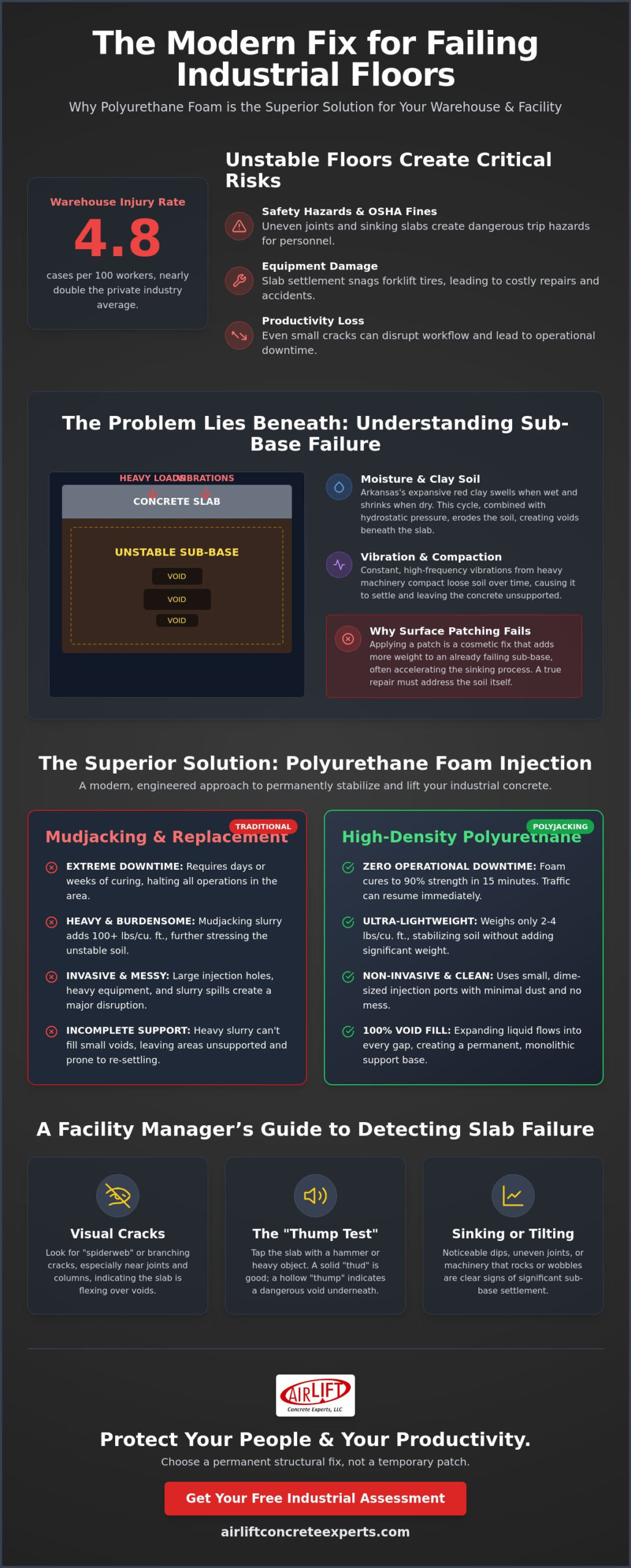
While visible cracks are an obvious concern, they’re often the final stage of a much longer process of sub-base erosion. For facility managers in White County, detecting early signs of settlement is the key to preventing a catastrophic failure. One of the most effective ways to check for hidden issues is the “thump test.” By tapping the floor with a heavy steel rod or even walking across specific areas, you can listen for a hollow, drum-like sound. This “echo” indicates a void where the soil has washed away or compacted, leaving the slab unsupported. If you hear this sound, the concrete is currently acting like a bridge, bearing loads it wasn’t designed to carry without foundation support.
Another subtle sign is the accumulation of fine dust near joints, often called “pumping.” As heavy equipment passes over an unstable joint, the slab deflects, forcing air and pulverized soil up through the crack. Over time, this movement erodes the sub-base further, turning a minor joint issue into a major industrial concrete floor repair Searcy project. Checking for these early indicators allows you to intervene before the structural integrity of the entire bay is compromised. You can often feel the vibration in your feet when a forklift passes over a hollow spot, which is a clear signal that the soil beneath has failed.
In high-cube warehouses, precision is everything. Even a slight 1/8-inch slope at the base of a rack can translate into a significant, dangerous lean at the top of a 30-foot upright. This misalignment puts uneven stress on the racking hardware and increases the risk of a collapse during loading. Beyond the racks, uneven floors are brutal on your material handling equipment. Constant jarring over settled joints shreds forklift tires and causes premature failure in axles and transmission systems. In narrow-aisle environments, these dips are especially hazardous, as they can cause high-reach masts to sway, potentially leading to “tip-over” accidents that endanger your operators and your inventory.
A “minor trip hazard” quickly becomes a major liability when it violates OSHA safety standards. If you notice forklift operators slowing down to navigate specific areas or if you see “daylight” under your racking base plates, it’s time to seek a professional assessment. Local experience in concrete lifting is essential because a specialist who understands Searcy’s environmental triggers can provide a more accurate diagnosis than a general contractor. Proactive maintenance is always more cost-effective than an emergency industrial concrete floor repair Searcy that halts production during peak season. If you suspect your sub-base is failing, we recommend a structural evaluation to secure your facility’s future. Contact our team for a professional site assessment to identify hidden voids before they lead to slab failure.
Airlift Concrete Experts approaches industrial concrete floor repair Searcy with a focus on long-term structural health rather than quick cosmetic fixes. We understand that your warehouse or manufacturing facility is the heartbeat of your business. A settling slab isn’t just an inconvenience; it’s a disruption to your supply chain that can lead to safety hazards and lost revenue. Our team specializes in professional foundation repair techniques that address the root cause of the problem by stabilizing the earth beneath your concrete. We use a proprietary high-density foam injection process specifically engineered to withstand the unique pressures of Searcy’s industrial zones. This isn’t a one-size-fits-all solution. We calibrate our materials and methods to account for the specific load-bearing requirements of your forklifts and racking systems.
Choosing a partner for your facility maintenance means finding someone who understands the local landscape. As a family-owned, Arkansas-based specialist, we don’t just work in Searcy; we live here. We treat every commercial project like we’re working on a neighbor’s property, combining technical expertise with a straightforward, honest approach. Our primary goal is to ensure “business as usual” for your logistics hub or manufacturing plant. We work around your schedule to minimize interruptions, providing a level of reliability that national competitors often struggle to match. This local commitment transforms a stressful structural issue into a sense of security for your business.
Since our founding in 2017, we’ve developed deep roots in Central Arkansas. We’ve spent years studying the shifting clay and moisture patterns that affect White County’s commercial corridors. To handle large-scale industrial projects, we utilize specialized, trailer-mounted equipment designed for high-volume foam delivery. This allows us to stabilize massive sections of warehouse flooring with speed and accuracy that traditional methods can’t replicate. For Searcy facility managers and business owners, we offer a complimentary initial assessment. This low-pressure evaluation provides a clear picture of your slab’s condition without any upfront cost, serving as a bridge between our technical knowledge and your operational needs.
Investing in polyjacking provides an immediate ROI by restoring floor safety, increasing operational speed, and ensuring long-term structural integrity. You won’t have to worry about OSHA fines or damaged equipment once your sub-base is permanently stabilized. The process is clean, fast, and remarkably effective at stopping settlement in its tracks. If you’ve noticed hollow sounds, leaning racks, or uneven joints, don’t wait for a total slab failure. Take the first step toward a safer, more efficient facility by scheduling a structural evaluation today. Contact Airlift Concrete Experts for your industrial concrete floor repair in Searcy today and let us help you build a stable foundation for your business’s future.
Maintaining a safe and efficient warehouse environment starts beneath the surface. We’ve explored how high-density polyurethane foam addresses the root cause of slab settlement by stabilizing the moisture-sensitive soils of White County. This modern approach to industrial concrete floor repair Searcy ensures your facility remains level and OSHA-compliant without the weeks of downtime required by traditional replacement. By choosing a solution that reinforces the sub-base, you’re protecting your forklifts, your racking systems, and most importantly, your team.
Airlift Concrete Experts has been family-owned and operated since 2017. We take pride in serving Searcy, Little Rock, and all of Central Arkansas with high-density industrial-grade polyurethane foam. You don’t have to manage structural anxiety alone; our specialists are here to provide the technical precision your business requires. Take the first step toward a permanent fix and Schedule Your Free Industrial Floor Evaluation in Searcy today. It’s time to transform your property concerns into long-term security with a partner you can trust. We look forward to helping your business stand on solid ground for years to come.
Most industrial repairs are completed in a single day, often within just a few hours. Because high-density polyurethane cures almost instantly, your floor can support full traffic loads within 15 to 30 minutes of the final injection. This timeline is significantly faster than traditional replacement, which requires days or weeks for the concrete to reach structural maturity. It’s a highly efficient way to address safety issues without losing a week of production.
Yes, industrial-grade polyurethane is specifically engineered to support the extreme point loads generated by heavy forklifts and reach trucks. The foam provides high compressive strength and distributes the weight of 10,000-pound equipment across a larger surface area. This prevents the “point loading” failures that often cause thin surface patches or unsupported slabs to crack under pressure. It’s a structural solution designed for the rigors of a 24/7 manufacturing environment.
You typically don’t need to shut down your entire operation because polyjacking allows for sectional repairs. We can work in specific bays or aisles while the rest of your facility continues to function. Since the equipment is trailer-mounted and uses small injection ports, we maintain a small footprint that minimizes the impact on your daily logistics. We can often schedule work around your least busy shifts to ensure minimal disruption to your team.
Industrial concrete leveling is generally much more cost-effective than a full slab replacement. While we don’t provide specific quotes without a site assessment, you save significantly by avoiding the costs of demolition, debris removal, and new material. Additionally, the lack of operational downtime means you avoid the massive indirect costs associated with halting your production lines. It’s an investment that focuses on structural stabilization rather than expensive reconstruction.
The foam does both; it fills the immediate void under the slab and expands into the loose sub-base soil to provide stabilization. This expansion “knits” soil particles together, creating a solid foundation that resists future settlement. By addressing the unstable earth below, industrial concrete floor repair Searcy projects achieve long-term durability rather than just a temporary surface lift. This process turns loose, failing soil into a rigid support structure.
Sinking is usually caused by the moisture-sensitive clay soils common in White County combined with heavy machinery vibrations. Seasonal rains can wash away sub-base support, while constant forklift traffic compresses any remaining loose soil. These environmental factors create voids that eventually cause the concrete to flex and snap under the weight of your inventory. Identifying these triggers early is the best way to plan for a successful industrial concrete floor repair Searcy.
Polyjacking focuses on leveling the slab and stabilizing the sub-base, which stops the movement that causes cracks to widen. While the injection process fills the voids that lead to spalling, very large surface cracks or severely deteriorated joints may require specialized industrial sealants after the lifting is complete. Stabilizing the slab is the essential first step to ensure any surface repairs actually last. Without fixing the foundation, any crack filler will quickly fail again.
We recommend discussing specific service terms during your initial structural assessment to understand the protections available for your facility. Most professional lifting services in Arkansas offer industry-standard warranties on the repair material itself. Because polyurethane is hydrophobic and doesn’t degrade in wet conditions, it provides a highly reliable solution for the specific environmental challenges found in Central Arkansas. It’s a durable fix that local business owners can rely on for years.

 Call Now