

What if lifting a sunken driveway before stopping the water is only a temporary fix? If you’re wondering how to stop soil erosion under driveway concrete, start by tracing where water enters, flows, or escapes. Runoff from a downspout, poor yard grading, or water moving along a slab edge can wash away supporting soil and leave a void beneath the concrete.
It’s understandable to worry when a slab starts to settle, feels hollow, or develops a gap along its edge. The right repair depends on whether erosion is still active or has already left an unsupported section. Addressing the water pathway can help limit further soil loss, while a separate repair may be needed to restore support and reduce a trip hazard.
This guide explains how to spot warning signs, track likely water routes, and compare practical steps for drainage concerns, soil loss, and an existing slab void. You’ll also learn when polyurethane concrete lifting may help with a sunken driveway and how to choose a safe next step for your Arkansas property.
Under-driveway erosion happens when moving water displaces soil or base material from beneath a concrete slab. As water carries fine particles away, the slab loses support. Continued soil loss can leave a hollow space, or void, beneath the concrete. This is one form of soil erosion, but visible symptoms alone can’t show how much material has moved or pinpoint the water source.
Look for changes around the slab as well as on its surface. Fine soil or gravel washing from an edge after rain, a gap beneath the concrete, or water emerging from a joint may point to soil movement. A new crack or a section sitting lower than the concrete beside it can also signal a loss of support, particularly if the condition changes over time.
Check for small cavities at the edge, exposed soil, displaced gravel, and visible separation between the driveway and nearby ground. A slab may settle unevenly or sound hollow when tapped, but no single clue confirms erosion. Cracks can form for several reasons, and a gap at one edge doesn’t show how far a void extends. Keep people and vehicles away from any section that appears unstable or undermined.
Water may flow toward the slab from a roof downspout, run across a poorly graded yard, or escape from a leaking water line. It can reach supporting soil at driveway edges and joints, or pass through cracks. These routes call for different investigations, so note where water appears and when, especially after rain. Don’t assume the nearest crack is the source.
Surface cracking deserves attention, but it isn’t proof that the base has washed out. A small crack confined to the concrete may not indicate a void. Settlement, an edge gap, or soil washing out can suggest that support beneath the slab is changing. Watch whether cracks widen, the slab shifts, or water and sediment appear nearby. These observations can help distinguish a surface defect from a developing support problem.
If you’re researching how to stop soil erosion under driveway concrete, start by observing the area rather than trying to expose the underside. After rain, note the direction runoff takes, where it collects, and whether water or fine sediment emerges from an edge or joint. Look for downspouts discharging close to the slab and ground that slopes toward it. Don’t dig beneath the concrete or enter a cavity to inspect it. An undermined area can be difficult to judge from above.
These signs help you describe what’s happening, but they don’t establish the full extent of soil loss. Keep the area clear if the slab looks unstable, and use your observations to guide an assessment before choosing a repair.
Water can undermine a driveway in stages. Runoff enters at an edge, joint, or crack, or concentrates in soil beneath the slab. As it moves, it may carry fine soil particles away. The remaining space becomes a void, reducing support. Without uniform support, concrete can crack, settle, or move under its own weight and everyday traffic.
The water source matters because different pathways call for different investigations. Roof runoff and surface drainage can often be tracked by watching where water flows during rain. Persistent dampness when the surrounding ground is otherwise dry may be a reason to investigate a possible plumbing leak. Changes to nearby landscaping or drainage can also redirect water toward a driveway; for homeowners coordinating surrounding landscape and hardscape elements, resources from Bayside Pavers provide helpful guidance on integrating ground cover with paved surfaces. Don’t assume that the most visible crack is where water entered.
A downspout that releases water beside a driveway edge can repeatedly saturate the same area. Runoff from a yard can do the same if the surface directs water toward the slab. Observe during rain from a safe location: note where water gathers, crosses the driveway, or disappears along an edge. The goal is to trace the route, not to guess at a particular slope or start digging.
Repeated flow along the same route can have a greater effect than water that disperses across the yard. For example, water flowing toward a low spot beside the driveway may collect there and seep into the supporting soil. If runoff is redirected without considering where it will go next, the problem may shift to another edge or area. For property owners rethinking their yard layouts to better manage runoff, studios like Nu Scape Designs illustrate how tailored, low-maintenance landscaping can protect surrounding hardscapes. Track where water travels before and after it reaches the slab.
Broad, shallow surface wear may affect the concrete’s finish without indicating lost support beneath it. Erosion is more concerning when deterioration appears alongside settlement, an edge washout, or a visible gap. Cracks alone don’t prove soil loss because concrete can crack for several reasons. If the slab moves, a void is visible, or washouts return, arrange an assessment to understand the slab’s condition and likely cause.
Lifting a settled slab can restore its position or address an existing void, but lifting alone doesn’t stop an active water pathway. If runoff continues to carry soil away, the underlying problem may persist and the concrete could settle again. A repair plan should account for both the water source and the resulting slab damage.
That distinction guides how to stop soil erosion under driveway concrete: identify the water route, then determine whether the slab has lost support and needs repair. Airlift Concrete Experts assesses and lifts eligible sunken driveway concrete with polyurethane foam injection. If movement or recurring washouts are present, you can arrange a driveway assessment to help clarify the slab’s condition and next step.
The right repair depends on two questions: Is water still removing soil, and has the concrete already lost support? Treating a settled slab as the only problem can leave the cause untouched. If runoff repeatedly reaches the same edge or a leak is suspected, investigate that pathway as part of deciding how to repair the concrete.
Use this comparison as a starting point, not a diagnosis. The options address different parts of the problem, and some projects need more than one step.
| Option | Condition it addresses | What it doesn’t solve | When assessment is needed |
|---|---|---|---|
| Water source control | Runoff from downspouts, surface flow, or another identifiable water pathway. | It won’t raise a slab that has already settled or restore missing support by itself. | When water repeatedly pools, crosses the same area, or emerges near the driveway. |
| Localized soil or drainage work | Soil loss or a drainage issue confined to a specific area. | It doesn’t automatically correct an uneven slab or determine whether a hidden void remains. | When washout recurs or the extent and cause of soil loss aren’t clear. |
| Concrete lifting | An eligible sunken slab that needs its position and support addressed. | It doesn’t stop active runoff, a plumbing leak, or another ongoing source of water. | When concrete has settled, a void is suspected, or slab movement is apparent. |
| Concrete replacement | Concrete too damaged or unsuitable for lifting, based on its condition. | Replacing the slab alone doesn’t correct the water pathway or prevent further soil loss. | When damage is extensive or an assessment indicates lifting isn’t appropriate. |
Recurring runoff or a suspected leak deserves investigation before cosmetic patching or lifting. From stable ground, note where water flows during rain, where it pools, and whether dampness remains. Identifying a plumbing leak or planning drainage and site work may require a separate assessment. Keep water-source investigation distinct from slab repair so that both the cause and the concrete damage are considered.
Polyurethane foam lifting can raise eligible sunken concrete and address support beneath a settled slab. It’s a concrete repair, not a fix for water that continues to carry soil away. Airlift Concrete Experts uses polyurethane foam injection for driveway leveling in Arkansas. Learn how polyurethane concrete leveling works before comparing it with other repair paths.
To decide how to stop soil erosion under driveway concrete, separate the active cause from the damage it has already left behind. If the slab is level but runoff continues, focus first on tracing the water route. If the water source has been addressed but the slab remains settled, concrete lifting may be relevant. When both conditions exist, plan for both rather than expecting one repair to do both jobs.
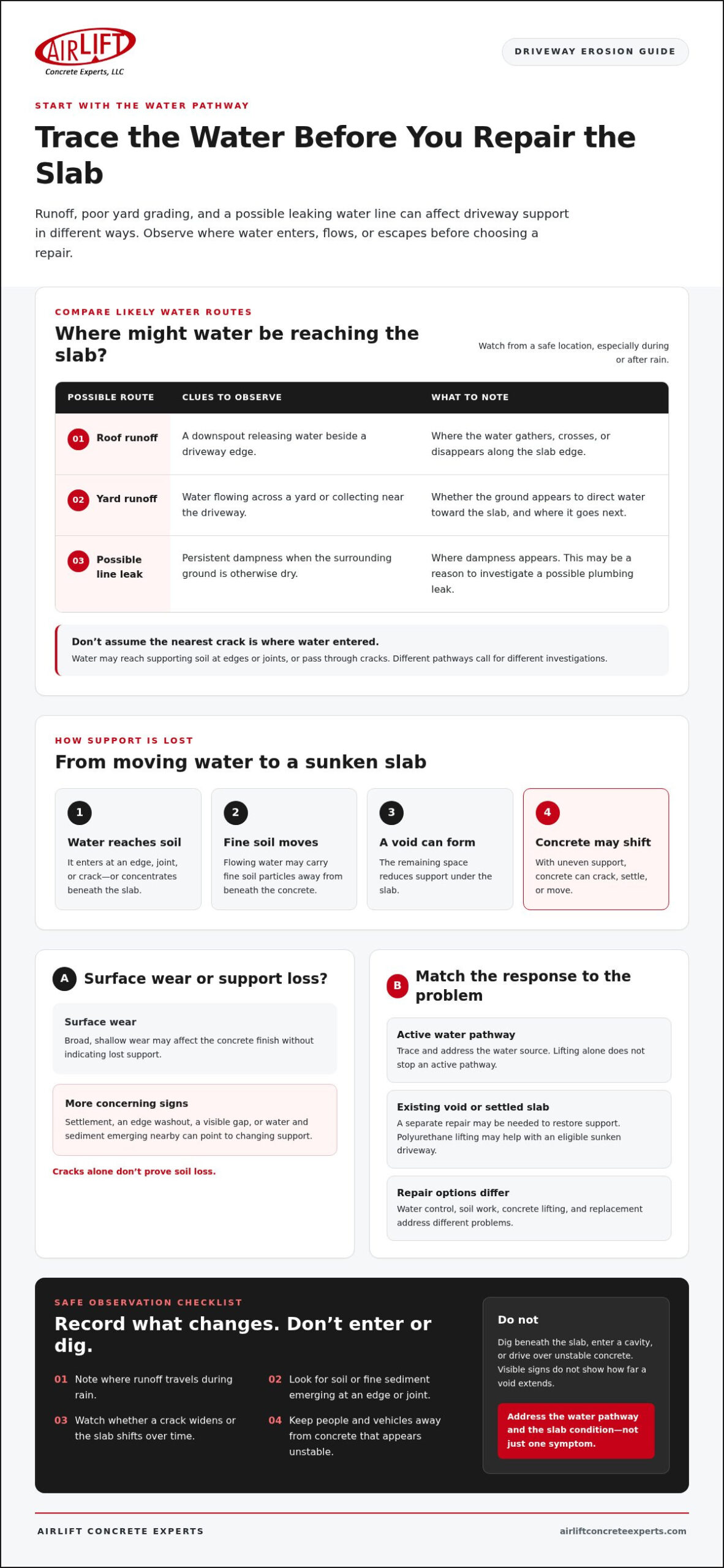
A careful visual check can help you describe the problem without disturbing the soil or putting anyone at risk. Stay on stable ground, keep people and vehicles away from areas that look undermined, and focus on what you can observe rather than trying to uncover the slab’s underside.
For a useful first record, note the location and size of visible gaps or washouts, the direction water travels, whether standing water or dampness remains, and any change in the slab’s height or position.
Look from stable ground at downspout outlets, surface flow, standing water, and visible soil or gravel loss. Keep photographs consistent by capturing the same edge or joint from a similar position after rainfall. Don’t excavate beneath concrete, enter a cavity, or try to block a suspected leak without an appropriate assessment. Those actions can expose you to unstable ground or obscure the source of the problem.
Arrange an assessment promptly if a void appears to be growing, the slab is settling noticeably, washouts keep returning, or an edge looks unstable. Airlift Concrete Experts assesses sunken concrete and can determine whether polyurethane foam lifting fits the slab’s condition. The concrete lifting guide explains how lifting may address a settled slab, while the water pathway also needs consideration.
If you’re deciding how to stop soil erosion under driveway concrete, use your notes to separate two questions: where is the water going, and has the slab lost support? A concrete assessment can clarify the slab’s condition, but it doesn’t replace investigating a suspected leak or ongoing runoff. For an Arkansas driveway with visible settlement or a suspected void, schedule a concrete assessment with Airlift Concrete Experts.
A sunken driveway can leave you unsure whether the slab needs lifting, the water route needs attention, or both. Airlift Concrete Experts assesses driveway concrete in its Arkansas service area and lifts eligible settled slabs using polyurethane foam injection. The assessment considers the concrete’s condition alongside your observations about runoff, suspected leaks, or recurring washouts. Lifting addresses the slab and its support, but it doesn’t stop water that continues to reach the area.
The assessment considers visible settlement, gaps, cracks, and the slab’s overall condition. Your notes and photos can show when the change began, where water travels, and whether movement or washout returns after rain. These details help determine whether concrete lifting fits the project. The right approach depends on the driveway’s condition, not a one-size-fits-all promise.
Before the assessment, gather a few useful details without disturbing the slab: where you’ve noticed settlement, whether water collects or emerges nearby, and how the area changes after rainfall. Keep people and vehicles away from unstable sections, and don’t dig beneath the concrete to look for a void. A clear description of the symptoms gives the assessment a practical starting point.
Polyurethane foam lifting raises eligible sunken concrete by injecting high-density foam beneath the slab. It can address settled driveway concrete and an existing loss of support, but it doesn’t independently correct a leak or ongoing runoff. Understanding the method can help you distinguish slab repair from water-source investigation. Airlift’s Arkansas concrete leveling guide explains more about polyurethane leveling.
For a practical plan, consider both what caused soil movement and the concrete’s current condition. If water still reaches the same area, that pathway needs attention as part of the overall repair plan. If the source has been addressed but the slab remains sunken, lifting may be appropriate based on its condition. Considering both the source and the slab helps avoid treating only the most visible symptom.
Airlift serves homeowners in Malvern, Hot Springs, Little Rock, Cabot, Conway, Benton, Bryant, North Little Rock, Sherwood, Jacksonville, and Hot Springs Village. The family-owned company has served Arkansas since 2017, focusing on concrete leveling and raising. If you’re deciding how to stop soil erosion under driveway concrete and the slab has settled, an assessment can help clarify whether lifting fits the driveway’s condition.
Request a driveway assessment and discuss what you’ve observed. Bring your photos and notes about water movement so the conversation can focus on the slab’s condition and a practical next step.
A driveway concern doesn’t have to leave you guessing. Keep a simple record of what changes, when water appears, and whether the slab shifts. That history can help distinguish a recurring water issue from concrete that has already lost support. If you’re working out how to stop soil erosion under driveway concrete, use what you’ve observed to guide the next decision rather than attempting a risky repair beneath the slab.
The goal is a plan that accounts for both the water pathway and the concrete’s condition. Airlift Concrete Experts can assess sunken driveway concrete and explain whether polyurethane lifting fits the project. An assessment is a practical way to discuss your observations and understand a potential next step.
Request a driveway assessment and take the next step toward a safer, more stable driveway. A clear assessment can make the path forward easier to understand.
Yes, replacement isn’t always necessary. The right approach depends on whether water is still carrying soil away and whether the slab remains suitable for repair. If you’re asking how to stop soil erosion under driveway concrete, first identify the water source, then assess the slab separately. Depending on its condition, correcting the cause and lifting eligible settled concrete may address the problem without removing the entire driveway.
Not by itself if water is still moving through the area. Filling an existing void may restore support beneath a slab, but continued runoff or a leak can keep displacing soil or create another unsupported area. Both the water pathway and slab condition matter. Avoid pouring loose fill into a visible gap, since it may not reach the full void or address what caused it.
It’s not a reliable substitute for professional concrete lifting. Household expanding foam is intended for other applications, and its expansion may be difficult to control beneath a heavy slab. It may not distribute evenly or restore dependable support. Don’t drill into the driveway or inject consumer foam under it. A concrete assessment can determine whether polyurethane foam injection for lifting is appropriate for the slab.
Sealing a crack may limit water entry through that particular opening, but it won’t necessarily stop water reaching the base from an edge, joint, downspout, or another route. A crack can also result from causes unrelated to erosion. Before relying on sealant, check whether runoff continues to collect nearby or soil is washing out. If the slab is settling or moving, sealing alone won’t restore its support.
Yes. If a downspout releases roof runoff beside the driveway, repeated concentrated flow can saturate soil and carry fine material away at an edge or joint. From stable ground, watch where the discharge travels during rain and whether water pools or soil moves nearby. This is a useful observation for Arkansas homeowners in Malvern, Hot Springs, Little Rock, Cabot, Conway, Benton, Bryant, North Little Rock, Sherwood, Jacksonville, and Hot Springs Village.
Coverage depends on your policy, the cause of the damage, and how your insurer defines the event. Gradual soil loss or maintenance-related damage may be treated differently from damage tied to a covered sudden event, so don’t assume either outcome. Review your policy’s exclusions and claim requirements, and document the condition with dated photos. Your insurer can explain how the specific policy applies to driveway erosion and related concrete damage.

 Call Now