
A home’s first impression can stumble before a buyer reaches the front door, especially when the driveway, walkway, or porch is cracked or uneven. If you’re wondering how to increase home value with concrete repair, start with issues that affect safety and everyday use, not simply the most noticeable cosmetic upgrade.
It’s reasonable to ask whether a repair will matter at resale. Concrete work can improve curb appeal, restore function, and help buyers feel more confident about a home’s upkeep, but it can’t guarantee a higher appraisal or a specific return. The right priority depends on the slab’s condition and what the repair needs to accomplish.
This 2026 guide explains how to weigh visible hazards, access concerns, and first impressions when planning repairs before listing. You’ll learn when lifting, resurfacing, or replacement may be worth considering, what polyurethane foam leveling does and doesn’t address, and how an assessment can help you make a practical plan. The goal is a safer, more market-ready home, with repairs chosen for their real value to the property.
If you’re preparing to sell, it’s fair to ask whether repairing a driveway or walkway will make a noticeable difference. Concrete work doesn’t guarantee a higher sale price, and not every flaw needs attention before listing. Still, how to increase home value with concrete repair starts with understanding what a sound, usable surface can contribute: safer access, smoother everyday use, and a more cared-for appearance.
Buyers experience a home in sequence. They pull into the driveway, walk toward the entrance, and notice how the property functions before they’ve seen every room. A settled section of concrete may not define the home’s value, but it can draw attention away from its strengths. Addressing a functional problem can help the exterior feel maintained rather than overlooked.
Concrete repair can include restoring the level of a sunken existing slab. Slabjacking is a concrete repair technology that lifts sunken concrete slabs by injecting material underneath them. For a seller, the key question is whether the repair addresses a problem with the slab itself, not just whether it makes the surface look newer.
Look for visible settlement where one section sits lower than the next, uneven walking surfaces along the approach to the door, and driveway areas that are difficult to use comfortably. These conditions can create a trip concern or make it awkward to walk, park, or move items between a vehicle and the home. During a showing, a buyer may focus on navigating the surface instead of taking in the property.
Concrete that looks neglected can also prompt questions about upkeep. A sloping walkway, for example, may stand out more than a small surface blemish because it affects access. Prioritize the areas people encounter and use, especially around the driveway, front path, and porch. Repairing existing concrete for function and presentation is different from adding a decorative finish to follow a style trend.
No. A repair may improve the property’s condition and presentation, but it can’t guarantee an appraisal increase, a particular offer, or a faster sale. Appraisers consider the home as a whole, while buyers weigh its condition against their needs and the options available in the local market. The effect of any single concrete repair can vary with the property and circumstances.
For sellers in Little Rock, a practical approach is to document the issue, understand what work would address it, and weigh that repair against other listing priorities. Treat concrete work as a way to reduce a visible concern and support a positive showing, not as a promise of added dollars. Well-maintained concrete can help buyers feel more confident about how a home has been cared for. That confidence is worthwhile, even when no exact resale return can be predicted.
A sunken driveway panel or walkway doesn’t always need to be removed and replaced. When a concrete slab is in suitable condition to be raised, polyurethane foam injection can fill space beneath it and bring it back toward a more even position. Understanding the process helps you see how this repair can restore access and appearance while limiting disruption to the property.
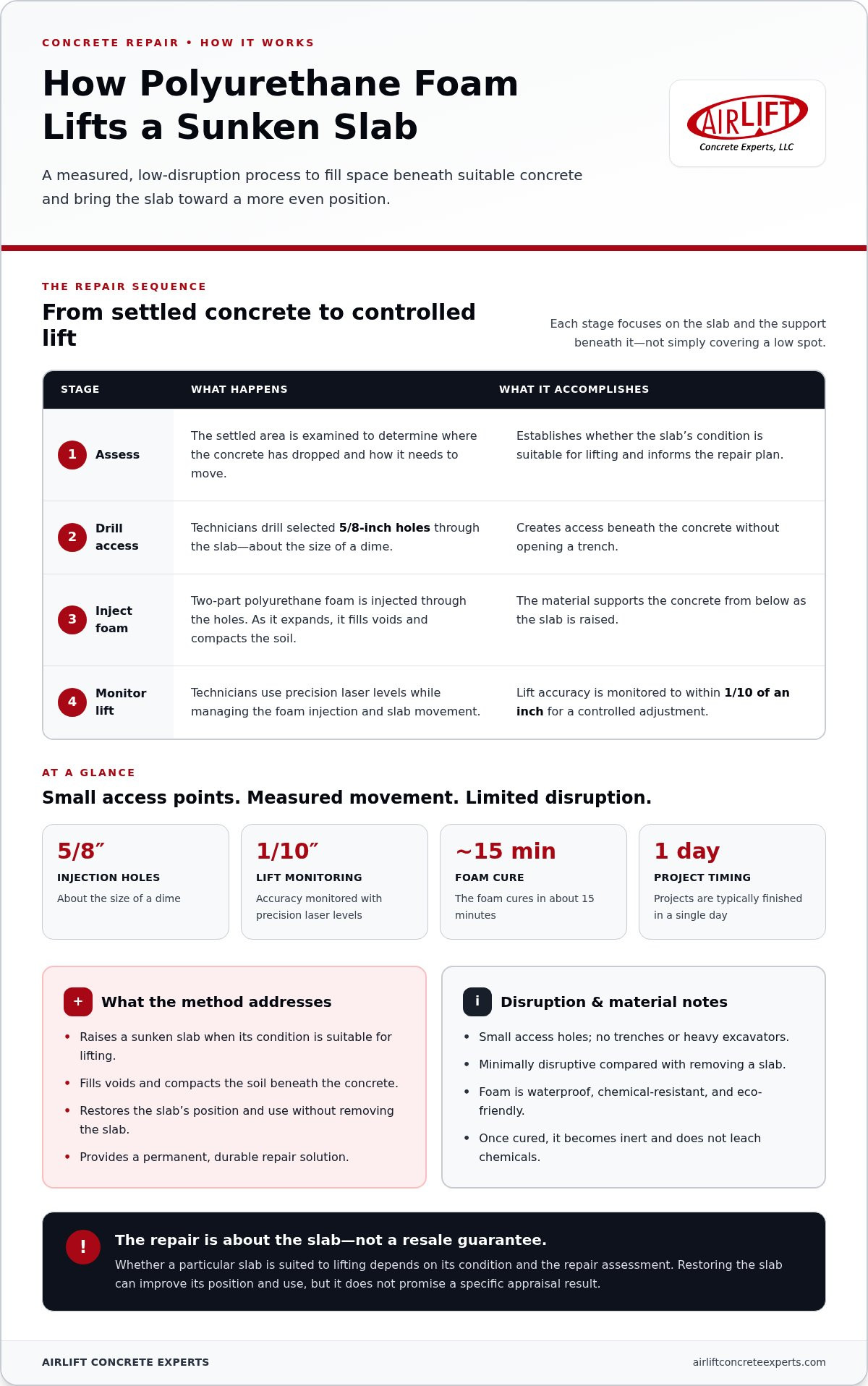
The repair follows a measured sequence. Technicians drill 5/8-inch injection holes, about the size of a dime, and use precision laser levels to monitor the slab as it moves.
This process focuses on the slab and the support beneath it, rather than covering a low spot with a surface treatment. Polyurethane foam lifting is a permanent, durable repair solution. Whether a particular slab is suited to lifting depends on its condition and the repair assessment.
Polyurethane foam injection is the least invasive repair method. It uses small access holes, requires no trenches, and avoids heavy excavators, making the work minimally disruptive compared with removing a slab. The foam cures in about 15 minutes, and projects are typically finished in a single day. That work window can make it easier to plan repairs before listing.
The foam is waterproof, chemical-resistant, and eco-friendly. Once cured, it becomes inert and does not leach chemicals. It’s safe for families, yards, and agricultural sites. These material properties matter to homeowners who want to address settled concrete without extensive excavation.
For sellers considering how to increase home value with concrete repair, the practical benefit is restoring a slab’s position and use, not promising a specific appraisal result. Airlift Concrete Experts provides a structural warranty that transfers to the next homeowner. If a sunken sidewalk, driveway, porch, or pool deck is affecting access, an assessment of settled concrete can help determine whether polyurethane foam injection fits the repair need.
Choosing a concrete repair starts with identifying what’s actually wrong. A sunken slab has a different problem from a surface that looks worn, and treating one as the other can leave the main concern unresolved. For homeowners exploring how to increase home value with concrete repair, the useful question isn’t which option looks newest. It’s which approach addresses the condition buyers will see or experience.
Use this comparison as a starting point. The slab’s condition and the purpose of the work still matter, so an assessment can help clarify which problem needs attention.
| Observed problem | Repair option to consider | What it addresses |
|---|---|---|
| Existing slab has settled or become uneven | Polyurethane foam lifting | Raises a suitable slab and restores its level |
| Surface appearance is worn, but the slab is level | Resurfacing | Refreshes the surface finish, not the slab’s position |
| Concrete is severely deteriorated or unsuitable for lifting | Replacement may be considered | Removes and replaces the damaged section |
| Isolated cosmetic concern without settlement | Surface-focused repair | Addresses the specific visible flaw |
Match the repair to the concrete problem. A better-looking surface won’t correct settlement, and lifting won’t erase every blemish.
A sunken or uneven slab may be a candidate for polyurethane foam lifting if its condition allows it to be raised. The method can be used on existing driveways, sidewalks, porches, garage floors, and pool decks. For example, if one section of a driveway has dropped below the adjoining concrete, lifting focuses on correcting that difference in position. It doesn’t promise to remove every crack or repair severely deteriorated concrete. Suitability depends on the slab’s condition. For homeowners planning broader outdoor upgrades alongside pool deck leveling, guides from specialists like Rod Cameron Pools offer useful inspiration for surrounding landscaping and finishes.
Resurfacing is a finish-focused option when the surface looks worn but the slab’s position isn’t the main concern. It changes the surface appearance, not the level of settled concrete beneath it. If a walkway is uneven, applying a new finish alone wouldn’t correct that height difference.
Replacement may be considered when concrete is too deteriorated for lifting or needs more extensive work. That’s a separate decision from correcting settlement. A surface crack, worn finish, and sunken section can appear together, but they don’t necessarily call for the same treatment. Identify which conditions affect safe access, use, or appearance, then match the repair plan to those needs rather than choosing based on looks alone.
Assess the slab’s level and stability separately from its finish. That distinction helps homeowners in Little Rock focus on functional concerns first and avoid assuming one repair method can solve every visible defect.
Preparing to list can make every visible flaw feel urgent. A simple sequence helps you focus on concrete that affects safe access and daily use before spending time on surface appearance. The aim isn’t to repair every mark or promise a higher sale price. It’s to understand what needs attention and make a clear plan before showings begin.
Start with safety and function, then consider which surfaces buyers encounter first. Walk the route from the driveway to the entrance and note uneven areas underfoot, settled sections, and concrete that makes everyday access awkward. Cleaning or staging can improve presentation, but it won’t restore the level of a sunken slab. Keep those tasks distinct.
This process supports thoughtful planning, not a guaranteed appraisal or sale-price increase. A focused repair may address a visible maintenance concern, while cosmetic cleaning and staging serve different purposes.
Airlift Concrete Experts offers a free inspection and estimate as a low-pressure first step. The assessment considers the affected slab and site conditions, since a recommendation for a settled driveway may differ from one for a walkway or porch. The goal is to understand the condition and identify an appropriate repair plan, not to assume every area needs the same treatment.
A $1,000 deposit is required to guarantee an appointment and is applied 100% toward the total service cost. Keep your notes and photos nearby so you can clearly describe where the problem is and how it affects access. Airlift’s Arkansas guides on concrete leveling and repair costs can also help you prepare questions and compare priorities.
Once you know which areas matter most, planning becomes more manageable. Arrange a free concrete inspection and estimate to discuss settled slabs and next steps before listing.
Once you’ve identified whether a slab has settled or the concern is mainly its surface, the next step is an assessment suited to the concrete’s condition. Airlift Concrete Experts is a family-owned Arkansas company specializing in polyurethane foam injection for sunken slabs. The work can address settled driveways, sidewalks, porches, garage floors, and pool decks when the concrete is suitable for lifting. It’s a practical option to consider as you decide how to increase home value with concrete repair, without treating a repair as a promise of a higher appraisal or sale price.
Airlift uses the least invasive repair method, injecting two-part polyurethane foam through 5/8-inch holes about the size of a dime. The foam expands beneath the slab to fill voids and compact the soil as technicians control the lift. Precision laser levels monitor movement to within 1/10 of an inch. The foam cures in about 15 minutes, and projects are typically finished in a single day.
Polyurethane foam lifting is a permanent, durable solution. The foam is waterproof, chemical-resistant, and eco-friendly. Once cured, it becomes inert and does not leach chemicals, and it’s safe for families, yards, and agricultural sites. A structural warranty is provided and transfers to the next homeowner, an important detail for sellers preparing documentation about completed work.
Airlift serves Alexander, Arkadelphia, Batesville, Beebe, Bella Vista, Benton, Bentonville, Blytheville, Bryant, Cabot, Camden, Centerton, Conway, El Dorado, Fayetteville, Forrest City, Fort Smith, Helena-West Helena, Hot Springs, Hot Springs Village, Jacksonville, Jonesboro, Little Rock, Magnolia, Malvern, Maumelle, Mayflower, Morrilton, North Little Rock, Paragould, Pine Bluff, Rogers, Russellville, Searcy, Shannon Hills, Sherwood, Siloam Springs, Springdale, Texarkana, Van Buren, Warren, and West Memphis.
Start with a free inspection and estimate. An assessment considers the affected slab and site conditions before a repair recommendation is made, so the plan responds to the actual settlement rather than assuming every surface needs the same work. If you’re preparing to sell, sharing your notes about uneven areas and access concerns can help keep the discussion focused on your priorities.
A $1,000 deposit is required to guarantee an appointment and is applied 100% toward the total service cost. Grain-bin floor lifting is also available beyond the Arkansas cities listed above; contact Airlift for details. For a settled driveway, walkway, porch, garage floor, or pool deck, request a free concrete inspection and estimate to discuss a project-specific plan.
Choosing how to increase home value with concrete repair doesn’t mean trying to predict exactly what a buyer or appraiser will value. It means taking a measured look at the property, identifying which concrete issues affect access or everyday use, and deciding what deserves attention before listing. That gives you a practical basis for planning, without treating any repair as a guaranteed return.
If you’re weighing whether a settled slab needs lifting, begin with an assessment of the actual area and its condition. A clear recommendation can help you move forward confidently, whether you’re preparing for showings soon or planning for the months ahead.
Airlift Concrete Experts is a family-owned Arkansas business offering a free inspection and estimate. Request a free concrete inspection and estimate to discuss your property’s concrete and possible next steps. You can make a thoughtful plan one practical decision at a time.
Concrete repair can support a home’s presentation and usability, but it can’t guarantee a higher appraisal or sale price. A level entry path or functional driveway may help buyers focus on the property rather than a maintenance concern. The value of a particular repair depends on the home’s overall condition and the local market. Think of how to increase home value with concrete repair as a prioritization question, not a promise of return.
Start with concrete that affects safe access or everyday use. Walk the route from the driveway to the entrance, then check areas used regularly, such as the garage approach and porch. Note uneven transitions, settled sections, and places where the surface interferes with walking or parking. After functional concerns, consider visible issues buyers are likely to notice during a showing. A short list with locations and photos can help organize next steps.
Not necessarily. Lifting addresses a slab’s position, so a crack may remain visible even if the concrete is raised. The result depends on the crack and the slab’s condition; polyurethane foam injection shouldn’t be presented as a crack-sealing service. If you see a crack alongside settlement, record both concerns for an assessment. That helps distinguish a change in level from surface damage and keeps the repair recommendation focused on the actual condition.
Technicians inject two-part polyurethane foam through small holes drilled into the slab. The foam expands beneath the concrete, filling voids and compacting soil to support a controlled lift. Precision laser levels help monitor the slab’s movement during the work. This process is used for suitable settled slabs, such as a dropped driveway panel or an uneven sidewalk section. The slab’s condition and site circumstances guide whether lifting is appropriate.
The foam cures in about 15 minutes, and projects are typically finished in a single day. Actual project timing depends on the work involved, so sellers should arrange an assessment early enough to plan around listing preparations. The estimate outlines the repair recommendation and project schedule, helping you coordinate other property tasks without assuming every job follows the same timeline.
Yes. Airlift’s polyurethane foam is waterproof and chemical-resistant, and it’s eco-friendly. After curing, the foam becomes inert and does not leach chemicals. It’s safe for families, yards, and agricultural sites. Because the process uses small injection holes rather than trenches, it also avoids extensive excavation around the slab. Discuss the specific area being repaired during the assessment, especially if the concrete is near landscaping or a frequently used outdoor space.
Airlift serves Alexander, Arkadelphia, Batesville, Beebe, Bella Vista, Benton, Bentonville, Blytheville, Bryant, Cabot, Camden, Centerton, Conway, El Dorado, Fayetteville, Forrest City, Fort Smith, Helena-West Helena, Hot Springs, Hot Springs Village, Jacksonville, Jonesboro, Little Rock, Magnolia, Malvern, Maumelle, Mayflower, Morrilton, North Little Rock, Paragould, Pine Bluff, Rogers, Russellville, Searcy, Shannon Hills, Sherwood, Siloam Springs, Springdale, Texarkana, Van Buren, Warren, and West Memphis. Grain-bin floor lifting extends beyond these cities; contact Airlift for details.

 Call Now