

What if “leveled concrete” means an existing slab was raised, not that fresh concrete was poured? That distinction changes the answer to “how long until I can drive on leveled concrete,” and it’s an easy source of conflicting advice. Newly poured concrete generally needs at least seven days before passenger vehicles drive on it. With polyurethane foam leveling, the foam cures in about 15 minutes, but that timing alone isn’t permission to drive. Follow the access instructions for your project.
Airlift Concrete Experts uses polyurethane foam injection, the least invasive repair method, to raise existing concrete through 5/8-inch holes, without trenches or heavy equipment. Precision laser levels monitor the lift to within 1/10 of an inch, and projects are typically finished in one day. The waterproof, chemical-resistant foam is eco-friendly, doesn’t leach chemicals, and becomes inert after curing. It is safe for families, yards, and agricultural sites. The repair includes a structural warranty that transfers to the next homeowner. Read on to learn how new concrete curing differs from foam curing, what those timeframes mean for vehicle access, and what to do before driving over the repaired surface.
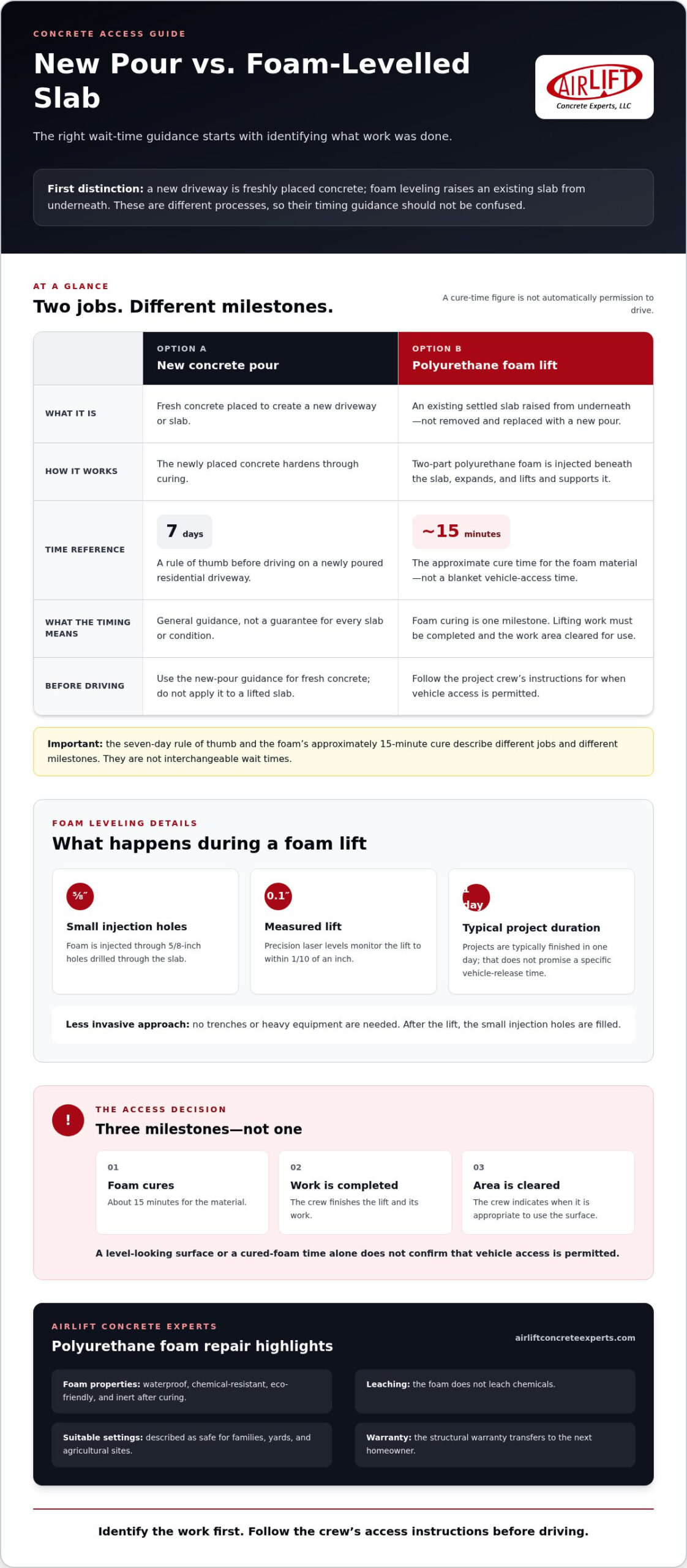
If you’re asking, “how long until I can drive on leveled concrete,” first find out what work was done. The work type determines which timing guidance applies. A newly poured driveway is fresh concrete that needs time to cure. Concrete leveling corrects the position of an existing slab. With polyurethane foam injection, a crew raises settled concrete from underneath rather than replacing it with a new pour. These similar-sounding jobs involve different processes, so their wait times shouldn’t be confused.
Fresh concrete hardens through curing after placement. ConcreteNetwork.com gives seven days as a rule of thumb before driving on a newly poured residential driveway. That’s general guidance, not a guarantee for every slab or condition, and it doesn’t describe foam lifting.
A foam-leveled driveway is an existing slab. Small injection holes allow two-part polyurethane foam to expand beneath it and raise it toward the desired position. This is concrete raising, not new concrete construction. The Concrete Leveling overview describes the general practice of correcting existing concrete surfaces, including injection-based approaches. The key distinction is that the seven-day new-concrete rule of thumb is not Airlift’s polyurethane foam cure time.
Three separate milestones matter: the foam cures, the lifting work is completed, and the work area is cleared for use. Airlift’s polyurethane foam cures in about 15 minutes. That describes the material’s cure, not automatic authorization to drive immediately. The crew’s instructions for your project determine when vehicle access is permitted.
Airlift uses the least invasive repair method, drilling 5/8-inch injection holes without trenches or heavy equipment. Precision laser levels monitor lifts to within 1/10 of an inch, and projects are typically completed in one day. The foam creates a permanent, durable repair. It is waterproof, chemical-resistant, eco-friendly, and inert after curing. It doesn’t leach chemicals and is safe for families, yards, and agricultural sites. The structural warranty transfers to the next homeowner.
Don’t apply a new-pour schedule to a lifted slab or treat a fast foam cure as a standalone go-ahead. Identify the work first, then follow the crew’s direction before driving over the repaired area. That distinction is more useful than relying on one wait time for every kind of concrete work.
Polyurethane foam leveling corrects a settled slab from underneath, without removing and replacing the existing concrete. Airlift Concrete Experts uses a patented two-part injection process. The components are placed beneath the slab, where they react and expand. As the foam fills space below the concrete, it lifts and supports the slab. The crew monitors the lift with precision laser levels to within 1/10 of an inch, guiding the concrete toward the intended position.
The injection points are small, 5/8-inch holes drilled through the slab. The foam expands below the surface, so the repair requires no trenches or heavy equipment. This makes polyurethane foam injection the least invasive repair method. After the lift, the small holes are filled. Airlift uses the process for concrete leveling on sidewalks and driveways, pool decks, and other applicable concrete surfaces.
Once cured, the foam is waterproof, chemical-resistant, eco-friendly, and inert. It doesn’t leach chemicals and is safe for families, yards, and agricultural sites. Polyurethane foam leveling is a permanent, durable solution, and its structural warranty transfers to the next homeowner.
The foam cures in about 15 minutes. That figure describes the material’s cure, not every step required to finish a project or clear the work area. Technicians still need to complete the lift and their work, and the crew must indicate when it’s appropriate to use the surface. Airlift projects are typically finished in one day, but that doesn’t promise that every driveway is released for vehicle traffic at a particular hour.
Foam cure time is about 15 minutes, but that is not a blanket promise that every vehicle can drive over the slab immediately. If you’re wondering how long until I can drive on leveled concrete, distinguish the foam’s curing milestone from the crew’s direction to resume use. A surface may look level while work is still underway, so don’t use its appearance or the cure-time figure alone to decide when to drive.
Before the project, identify where vehicles can remain parked while the driveway or other concrete area is being worked on. At the end, follow the crew’s instructions for releasing the work area before driving across the repaired section. If you’re considering a lift, an Airlift concrete leveling estimate and inspection can help you understand the process for your slab and what to expect on project day.
The right driving guidance depends on whether the driveway was just poured or an existing slab was raised. Those jobs may both be described as concrete work, but they involve different materials and milestones. A seven-day rule of thumb for fresh concrete doesn’t tell you when to drive on a slab lifted with polyurethane foam. Likewise, foam’s cure time shouldn’t be used to decide access to newly placed concrete.
| Work performed | What the timing refers to | What to do before driving |
|---|---|---|
| New concrete poured | ConcreteNetwork.com gives seven days as a rule of thumb for driving on newly placed concrete. | Treat seven days as general guidance, not a guarantee. Follow the instructions for that pour. |
| Existing slab raised with polyurethane foam | The foam cures in about 15 minutes; projects are typically completed in one day. | Wait until the lifting work is complete and the crew releases the area for vehicle use. |
The seven-day guidance applies to concrete that has just been placed. ConcreteNetwork.com discusses how curing conditions affect new concrete and why early vehicle traffic can be a concern. The rule is a useful reference point, not a promise that every driveway will be ready at exactly the same time. Concrete mix and curing conditions can vary, so don’t treat the number as a substitute for instructions about the specific pour.
If the driveway was poured recently, identify when the work took place and follow the guidance provided for that fresh concrete. Don’t borrow the shorter foam cure time. Polyurethane foam lifting is a separate process used to raise an existing slab; it doesn’t make newly poured concrete cure faster.
With polyurethane foam leveling, the original concrete remains in place. Technicians inject foam beneath it to lift the slab rather than pour a replacement driveway. The foam cures in about 15 minutes, and Airlift projects are typically finished in one day. Airlift monitors lifts with precision laser levels to within 1/10 of an inch. Its least invasive method uses 5/8-inch holes, with no trenches or heavy equipment.
Those figures describe the material and the typical project schedule, not a universal vehicle-access time. Curing, completing the lift, finishing the work, and releasing the area for use are distinct steps. The crew’s instructions for the work area determine when you can drive over it.
If you’re still asking, “how long until I can drive on leveled concrete,” use the table to identify which timing guidance fits the job, then follow the instructions for that work. Neither seven days nor about 15 minutes applies automatically to every surface. First confirm whether concrete was poured or an existing slab was foam-leveled, then wait for the applicable project-specific direction before driving.
Before pulling onto a repaired driveway, identify what happened to the concrete and whether the work area has been released for use. A fresh pour and a foam-lifted slab have different timing guidance. These checks help you avoid relying on a number that doesn’t match your project.
For a foam-leveled driveway, Airlift’s least invasive polyurethane injection method uses 5/8-inch holes, with no trenches or heavy equipment. Laser levels monitor the lift to within 1/10 of an inch. Those details describe the repair process, but the practical rule stays straightforward: use the crew’s release instructions to decide when to drive.
If you’re planning a repair in Malvern or Central Arkansas, an Airlift concrete leveling estimate and inspection can help you understand the process and prepare for access around the work area.
Airlift Concrete Experts is a family-owned structural repair company based in Malvern, Arkansas, providing concrete leveling and lifting. If you’re still weighing “how long until I can drive on leveled concrete,” the key takeaway is that Airlift’s polyurethane foam cures in about 15 minutes, but the crew’s instructions determine when the work area is ready for vehicle access. Projects are typically completed in one day, though that isn’t a promise of access at a particular hour.
Airlift uses a patented two-part polyurethane foam injection process to raise existing concrete. The least invasive repair method uses 5/8-inch holes, with no trenches or heavy equipment. Precision laser levels monitor the lift to within 1/10 of an inch. After the foam cures, it’s inert, waterproof, and chemical-resistant. It’s eco-friendly, doesn’t leach chemicals, and is safe for families, yards, and agricultural sites.
Polyurethane foam leveling is a permanent, durable solution for the concrete surfaces the process is designed to address. The condition of the slab and what’s happening beneath it matter when assessing a repair. Airlift’s structural warranty transfers to the next homeowner, which is useful to know if you sell your home in the future.
The cure time and typical project duration answer different questions. About 15 minutes describes the foam’s cure; one day describes the typical project schedule. Neither figure alone tells you when to drive across the repaired area. Follow the crew’s work-area release instructions before using the surface, and keep vehicles off it until the crew says it’s ready.
If you’re unsure whether a settled driveway, sidewalk, pool deck, or other concrete surface could benefit from lifting, a free estimate and inspection can help clarify its condition and the work involved. Airlift serves Malvern and communities across Arkansas, including Alexander, Arkadelphia, Batesville, Beebe, Bella Vista, Benton, Bentonville, Blytheville, Bryant, Cabot, Camden, Centerton, Conway, El Dorado, Fayetteville, Forrest City, Fort Smith, Helena-West Helena, Hot Springs, Hot Springs Village, Jacksonville, Jonesboro, Little Rock, Magnolia, Malvern, Maumelle, Mayflower, Morrilton, North Little Rock, Paragould, Pine Bluff, Rogers, Russellville, Searcy, Shannon Hills, Sherwood, Siloam Springs, Springdale, Texarkana, Van Buren, Warren, and West Memphis. That includes Malvern, Hot Springs, Little Rock, Cabot, Conway, Benton, Bryant, North Little Rock, Sherwood, Jacksonville, and Hot Springs Village. Airlift also provides grain-bin floor lifting and repair beyond these Arkansas cities. Contact Airlift for details about that extended service.
A $1,000 deposit is required to guarantee an appointment and is applied 100% toward the total service cost. This is the appointment deposit, not a separate estimate of the repair price.
For clear guidance on your concrete concern and the appropriate next step, request a free estimate and inspection.
Before you move a vehicle onto concrete that’s just been worked on, make sure you know what happened and that the area has been released for use. If you’re still wondering “how long until I can drive on leveled concrete,” don’t rely on a general timeline alone. Get clear, project-specific direction and plan around it.
If a driveway, sidewalk, or other concrete surface has settled, addressing it can help you move forward with a clear repair plan instead of continuing to work around the uneven area. Airlift Concrete Experts can inspect the concrete and provide a free estimate, giving you a chance to discuss the concern and understand the next steps.
Arrange an inspection for your concrete and get practical guidance for your property. With a clear plan in place, you can prepare for the work and return to using the surface with greater confidence.
No, seven days doesn’t guarantee that every newly poured driveway is ready for vehicle traffic. ConcreteNetwork.com describes seven days as a rule of thumb, not project-specific clearance. That advice applies to a fresh pour, not an existing slab raised with polyurethane foam. If you’re asking how long until I can drive on leveled concrete, first identify the work performed, then follow the instructions for that specific placement or repair.
No, a dry-looking surface doesn’t show that new concrete is ready to carry a vehicle. The surface can appear dry while curing is still underway, so don’t test it by driving over it. ConcreteNetwork.com gives seven days as a general rule of thumb for a newly poured driveway. Use the instructions for your specific placement to determine access, rather than relying on appearance or a general timeframe.
Yes, curing continues beyond the seven-day driving rule of thumb. That figure, cited by ConcreteNetwork.com for newly placed concrete, is a practical vehicle-waiting guideline, not a statement that the concrete has finished curing. These are different milestones: a suggested time before driving and the ongoing curing process. This guidance concerns a fresh pour; it shouldn’t be applied to a slab lifted with polyurethane foam.
Yes, weather and site conditions can affect curing time, as ConcreteNetwork.com notes. Rain alone doesn’t provide a reliable way to calculate an exact additional wait, and there isn’t one extra-day figure that applies to every driveway. For a fresh pour, follow the instructions for that placement and avoid driving until it’s cleared for use. This is separate from the cure time of injected polyurethane foam beneath an existing slab.
Often, polyurethane concrete leveling can raise a settled driveway, but a free inspection is needed to assess the slab’s condition and suitability. Airlift serves homeowners in Malvern, Hot Springs, Little Rock, Cabot, Conway, Benton, Bryant, North Little Rock, Sherwood, Jacksonville, and Hot Springs Village. The inspection helps determine whether lifting fits the concrete concern; it doesn’t mean every cracked, deteriorated, or otherwise damaged slab can be raised.
Airlift’s polyurethane foam is waterproof and chemical-resistant, becomes inert after curing, and doesn’t leach chemicals. It is eco-friendly and safe for families, yards, and agricultural sites. These material properties don’t mean a driveway is ready for traffic. Keep vehicles off the work area until the crew has completed the job and says it’s cleared for use.
Airlift’s structural polyurethane foam can support thousands of pounds per square foot and is the same material used by the Department of Transportation for interstate highway leveling. That capacity describes the foam, not a guaranteed load rating for every repaired slab or vehicle. The condition and support of the specific concrete still matter, so follow the crew’s access directions rather than using material capacity to decide when to drive.

 Call Now