

Did you know that a vertical displacement of just one-quarter of an inch is the non-negotiable threshold for an ADA violation in Cabot? This tiny gap, often caused by the shifting red clay soils of Central Arkansas, is all it takes to transform a standard walkway into a significant legal and financial liability. Understanding the specific HOA sidewalk repair requirements Cabot homeowners must follow is the first step toward protecting your property and your peace of mind. Under Arkansas Code, local authorities can even compel repairs to be made, adding a statutory penalty if the work isn’t completed.
It’s stressful to face potential association fines or the anxiety of a trip-and-fall accident on your property. You deserve a clear path forward that balances safety with cost-effectiveness. This guide will help you navigate Cabot safety standards and clarify exactly who is responsible for the bill. We’ll break down the latest 2026 city codes, explain the difference between city and HOA obligations, and introduce a modern leveling method that restores your sidewalk in minutes without the mess of a full concrete tear-out.
The first question most homeowners ask when they spot a sunken concrete slab is whether the repair falls under their personal budget or the association’s. In Cabot, the answer is rarely a simple one. Responsibility is usually determined by a combination of city ordinances and the specific language found in your homeowner association CC&Rs. While the City of Cabot Public Works Department oversees sidewalks within dedicated public rights-of-way, Arkansas state law often empowers municipalities to compel abutting property owners to handle the physical maintenance and repair of these paths.
Most HOA sidewalk repair requirements Cabot residents encounter are triggered by specific safety or aesthetic failures. Common issues include vertical lips greater than one-quarter of an inch, pooling water that creates slip hazards, or severe cracking that detracts from the neighborhood’s uniform appearance. If you receive a notice, your first step should be to verify the property line. If the damage sits on a walkway leading directly to your front door or runs parallel to your street frontage, the financial obligation likely rests with you.
Property owners in Arkansas have a “duty of care” to keep public-facing walkways safe for pedestrians, including postal carriers and neighbors. Ignoring an HOA mandate doesn’t just lead to fines; it can lead to legal action. Under Arkansas Code § 14-301-106, if a homeowner fails to comply with a repair notice, the city can actually hire a contractor to do the work and then place a lien against the property. This lien often includes the repair cost plus a 6% statutory penalty. Taking a proactive approach to leveling your concrete is always the more cost-effective path than waiting for the association or city to intervene.
Understanding why your sidewalk settled in the first place is essential for a long-term fix. Cabot is built on notorious Arkansas red clay, a soil type known for its high shrink-swell capacity. During our humid summers, the clay dries out and shrinks, creating underground voids. When the heavy spring rains arrive, the soil expands rapidly or washes away into those voids, leaving the concrete slabs unsupported. This cycle is the primary reason for uneven walkways across Central Arkansas. Poorly managed foundation and drainage systems around your home can accelerate this process by allowing water to oversaturate the soil near your sidewalk, making stabilization a critical part of the repair process.
Once you determine responsibility, the next step is identifying exactly what constitutes a violation. For many Cabot neighborhoods, the governing benchmark is the Americans with Disabilities Act (ADA). The Public Right-of-Way Accessibility Guidelines provide a clear framework for what makes a walkway safe. While a hairline crack might be an eyesore, it doesn’t always trigger a repair mandate. However, vertical displacement is a different story. According to ADA standards for 2026, a trip hazard is defined as any vertical change in level exceeding 1/4 inch that remains untreated with a proper bevel or ramp.
HOAs in Cabot prioritize these specific repairs because they directly affect the community’s liability profile. When an association identifies and corrects hazards, it often leads to more favorable insurance premiums and protects the board from negligence claims. For transitions between uneven slabs, the 1:12 slope rule is the gold standard; for every inch of height change, there must be twelve inches of horizontal ramp to ensure accessibility for everyone. Following these HOA sidewalk repair requirements Cabot helps maintain property values and keeps the neighborhood walkable for all residents.
You don’t need specialized engineering equipment to perform a basic audit of your walkway. A simple straightedge and a ruler can help you measure the lip between two concrete panels. If the ruler shows a gap of 1/4 inch or more, you’ve found a hazard that needs attention. Look for invisible signs of trouble too. If a slab sounds hollow when you walk on it, or if you notice soil washing out from the edges, there’s likely a void beneath the concrete. These structural issues are more pressing than surface-level cosmetic cracks because they indicate the slab is no longer supported by the ground.
In Arkansas, the legal concept of constructive notice plays a major role in sidewalk injury cases. This means that if a hazard has existed long enough that a reasonable person should have known about it, the owner can be held liable for accidents, even if they didn’t personally see the crack. Documented trip hazards can also complicate your relationship with your insurance provider. Choosing polyjacking near me is a proactive way to address these risks before they turn into costly legal battles. If you aren’t sure if your sidewalk meets current safety codes, you can always request a complimentary initial assessment to get an expert’s perspective on your concrete’s condition.
When a homeowner or board member evaluates how to meet HOA sidewalk repair requirements Cabot, they usually consider three primary paths: replacement, grinding, or leveling. Each method can technically resolve a trip hazard, but they offer vastly different results in terms of budget, appearance, and longevity. The core objective is to satisfy the 2010 ADA Standards for Accessible Design, which identify any vertical rise greater than one-quarter of an inch as a barrier to accessibility. Selecting the wrong repair method can lead to recurring issues or aesthetic violations that frustrate neighbors and boards alike.
Mechanical grinding involves using a diamond saw or drum to shave down the high side of a concrete lip. While this removes the immediate hazard, it creates significant long-term problems. Grinding leaves behind unsightly white “scars” and exposes the internal aggregate of the concrete, which often violates the “uniform look” mandated by many local associations. This method also thins the structural slab. Shaving an inch off a standard four-inch sidewalk reduces its load-bearing capacity and makes it prone to cracking during the next freeze-thaw cycle. Polyurethane concrete leveling preserves the original surface finish and structural integrity by addressing the problem from underneath rather than attacking the slab from above.
Full concrete replacement is often an unnecessary expense. Leveling is typically 50% cheaper than a complete tear-out and repour, and it avoids the “checkerboard” appearance of bright new concrete sections next to aged walkways. Time is another critical factor. New concrete requires days to cure before it’s safe for foot traffic. Our specialized high-density polyurethane foam reaches its full structural capacity in roughly 15 minutes. This speed is a major benefit for dense HOA neighborhoods where long-term sidewalk closures are a nuisance. Meeting these HOA sidewalk repair requirements Cabot ensures your property stays in compliance without the massive bill of a full repour. By choosing leveling, you also choose a more sustainable option that reduces the environmental footprint associated with new concrete production while providing a permanent fix for the unstable soils common in Central Arkansas.
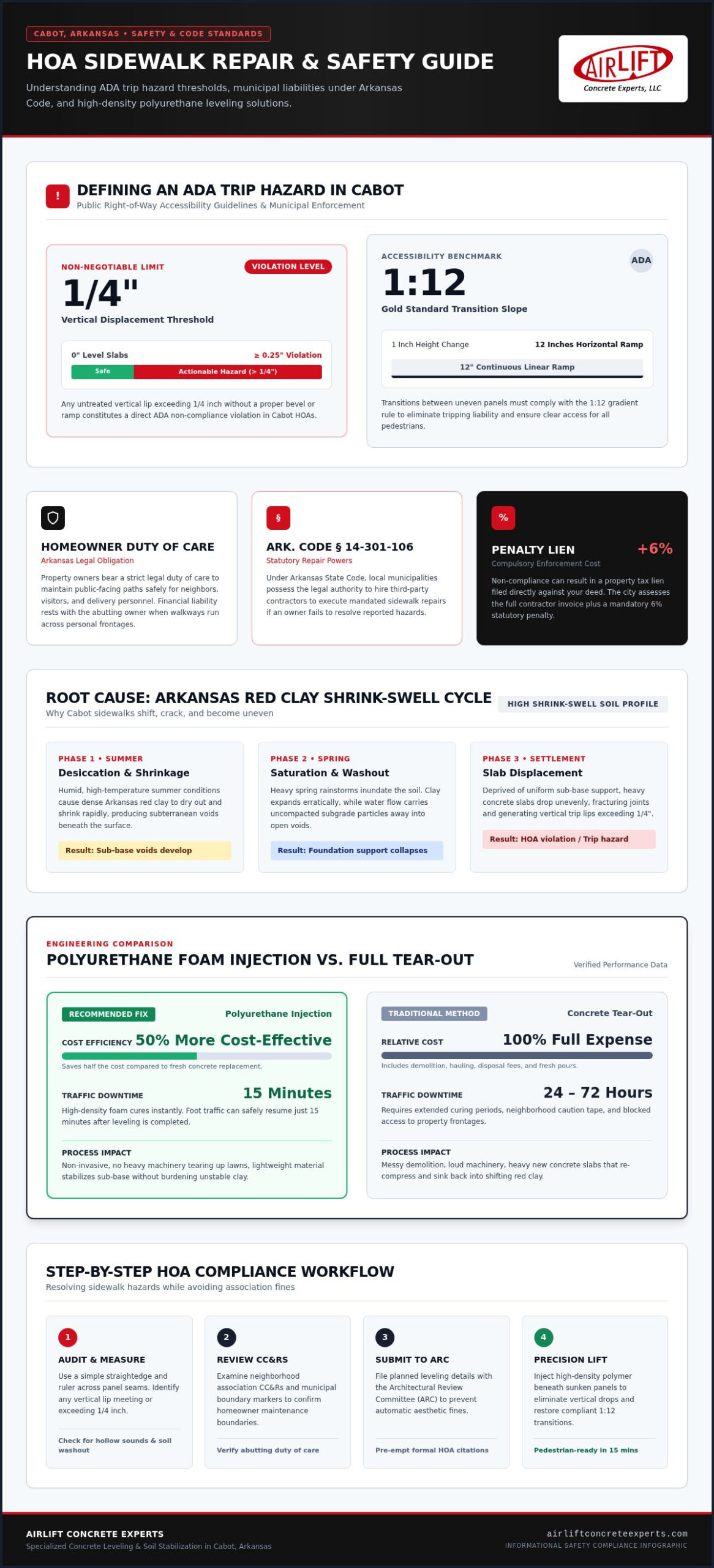
Receiving a formal notice from your association is often the first sign that your walkway has reached a critical settlement point. Don’t panic. Following a steady, organized workflow ensures you meet all HOA sidewalk repair requirements Cabot boards mandate while avoiding unnecessary fines. Start by reviewing the specific details of the notice. These documents usually highlight the exact location of the trip hazard and the timeframe allowed for correction. If the notice isn’t specific, use a straightedge to identify any lips that exceed the 1/4 inch threshold mentioned in previous sections.
Hiring a licensed Arkansas contractor is the next vital step. Local specialists understand the unique challenges of our regional soil and the high standards of Cabot communities. A professional will provide the necessary documentation, including proof of insurance and a detailed scope of work. This transparency is essential when you move into the formal approval phase with your board or management company.
Most associations require you to submit a request to the Architectural Review Committee (ARC) before any work begins. This process prevents unapproved repairs that might hurt neighborhood property values or create inconsistent aesthetics. You’ll typically need to provide a copy of the contractor’s license, insurance certificates, and a simple site plan identifying the sections to be leveled. Material specifications for the high-density polyurethane foam are also helpful to include.
When presenting your plan to the board, it’s helpful to position concrete lifting as the preferred method. Boards often favor this approach because it involves no heavy machinery, produces minimal noise, and maintains the neighborhood’s visual consistency. Unlike grinding, it doesn’t leave unsightly scars, and unlike replacement, it doesn’t create a mismatched “patchwork” look along the streetscape.
Once the repair is complete, verify that the vertical displacement is well below the 1/4 inch ADA limit. A reputable contractor ensures the site is restored to its original state, with no drill dust or debris left behind. After the work is done, submit your final invoice and photos of the leveled slabs to the HOA board for their final sign-off. Keeping records of these warranties and repair dates is a smart move for future property sales, as it proves you’ve proactively maintained the home’s structural safety. If you’ve received a notice and need to start this process, you can request a complimentary initial assessment to ensure your repair meets every local standard.
Navigating the specifics of HOA sidewalk repair requirements Cabot demands a partner who understands both the technical and the communal aspects of property maintenance. At Airlift Concrete Experts, we’ve focused on providing Central Arkansas with specialized polyurethane foam injection since 2017. We aren’t just contractors; we’re neighbors who recognize that a repair needs to be as durable as it is discreet. Our process is designed to address the unique environmental pressures of Lonoke County while respecting the peace and aesthetics of your specific subdivision.
One of the biggest concerns for any association board is the disruption that heavy construction brings to a quiet street. Traditional methods often require large trucks and loud machinery that can damage landscaping or leave ruts in driveways. Our polyjacking equipment is compact and self-contained. We use small injection ports, roughly the size of a penny, to deliver high-density foam directly beneath the settled concrete. This “no-mess” approach is the ideal choice for dense HOA neighborhoods where maintaining curb appeal is a top priority. Because our foam reaches structural capacity in about 15 minutes, your sidewalk is ready for foot traffic almost immediately, eliminating the need for unsightly caution tape or long-term closures.
Our deep background in professional foundation repair informs every lift we perform. We don’t just raise the surface; we stabilize the soil base. Our high-density foam fills the voids created by the shrinking and swelling of Arkansas red clay, creating a waterproof, lightweight foundation that resists future settlement. This technical expertise ensures that your repair isn’t just a temporary fix but a long-term investment in your property’s safety and value.
When you’re ready to move forward, we provide the detailed documentation your board needs for final approval. Our quotes are transparent and clearly outline how our process meets or exceeds the 1/4 inch ADA threshold for safety. We understand the pressure of meeting association deadlines, so we prioritize clear communication from the initial assessment through the final cleanup. Airlift Concrete Experts provides reliable concrete leveling and raising services for residential and commercial properties throughout Cabot and Little Rock. Contact us today to schedule your complimentary initial assessment and take the first step toward a safer, compliant walkway.
Managing sidewalk issues is a critical part of homeownership in Central Arkansas. By identifying trip hazards early and understanding the 1/4 inch ADA threshold, you protect your family and neighbors from accidents. You also shield yourself from potential association fines and legal liabilities. Choosing a modern repair method like polyurethane leveling ensures a durable, aesthetic result that satisfies even the strictest neighborhood standards without the high cost of a full concrete tear-out.
Ensuring your property meets all HOA sidewalk repair requirements Cabot boards expect doesn’t have to be a stressful ordeal. As family-owned Central Arkansas specialists, we provide ADA-compliant results backed by a polyurethane foam warranty. We’re here to help you navigate the repair process with technical expertise and neighborly care. Don’t wait for a formal notice to address sunken concrete on your lot.
Request Your Free Cabot Sidewalk Assessment today to secure your walkway. We’ll provide the documentation you need for ARC approval and deliver a long-term fix that restores your home’s curb appeal. You can move forward with confidence knowing your sidewalk is safe, stable, and ready for years of use.
Most homeowners find that the City of Cabot does not pay for sidewalk repairs on residential lots. Under Arkansas state law, municipalities can require property owners to maintain the walkways that abut their land. While the city manages public rights-of-way, the physical and financial responsibility for repairs usually falls on the individual homeowner or the HOA. It is best to check your specific property lines and neighborhood CC&Rs before starting any work to confirm your obligation.
Ignoring a repair notice can lead to escalating fines from your association and potential legal action. In Cabot, local authorities have the power to step in if a safety hazard remains unaddressed. If the city performs the repair, they can place a priority lien against your property for the total cost plus a 6% statutory penalty. Proactively meeting HOA sidewalk repair requirements Cabot residents face is the most cost-effective way to avoid these severe financial consequences.
We don’t recommend using DIY concrete leveling kits for HOA compliance. These kits often lack the structural high-density polyurethane needed to provide a permanent fix in shifting Arkansas soils. Most Cabot associations require repairs to be performed by a licensed contractor to ensure the results meet ADA safety standards. Professional leveling provides a uniform finish and structural stability that amateur patches cannot match, protecting you from future liability or association re-work orders.
Polyurethane leveling is designed to be a long-term solution that often outlasts traditional mudjacking. The high-density foam we use is hydrophobic, meaning it won’t wash away during heavy Central Arkansas rainstorms. It specifically addresses the underground voids caused by our regional red clay soil. Once the foam cures and stabilizes the base, the slab remains supported. This durability makes it a reliable choice for homeowners looking for a fix that stands the test of time.
Yes, the high-density polyurethane foam we use is environmentally inert and safe for use around your lawn and landscaping. It doesn’t leach harmful chemicals into the soil or groundwater once it has cured. Because the process requires only small injection ports and no heavy machinery, your grass and gardens remain undisturbed. This eco-friendly profile is one reason why so many Cabot neighborhoods prefer this method over the massive disruption of a full concrete demolition.
Most Cabot HOAs approve polyurethane leveling because it preserves the neighborhood’s aesthetic consistency. Unlike replacement, which often results in mismatched concrete colors, leveling keeps your original slabs in place. The process is quiet and fast, which minimizes the impact on your neighbors. We provide the necessary technical specifications and documentation to help you secure approval from your board, ensuring the repair meets all HOA sidewalk repair requirements Cabot boards mandate for safety.
Our specialized equipment can lift sunken concrete slabs several inches to restore their original position. While the primary goal is often correcting a 1/4 inch trip hazard to meet ADA standards, we can address more significant settlement issues. The lifting process is highly controlled, allowing us to achieve precision alignment with adjacent slabs. This accuracy is essential for ensuring proper water drainage and creating a seamless, accessible transition for pedestrians throughout your property.
Sidewalk leveling is significantly more affordable than full concrete replacement, typically offering savings of around 50%. You avoid the high costs of demolition, debris removal, and the price of new materials. Additionally, the speed of the process saves you money on labor and prevents long-term property access issues. By choosing to raise your existing concrete, you invest in a professional, durable solution that fixes the underlying soil problem at a fraction of the cost.

 Call Now