

What if the cracks spreading across your drywall don’t actually signal a $50,000 disaster? For many homeowners in Little Rock and Malvern, watching the notorious Arkansas red clay shift beneath their feet feels like a countdown to financial ruin. It’s natural to feel anxious when doors start sticking or floors begin to slope, especially when you’re worried that a total slab replacement is the only way to restore safety to your property.
We understand that your home is your most significant investment, and protecting its resale value is a top priority. In this 2026 price guide, we’ll break down the specific regional factors that influence foundation leveling cost in Central Arkansas. You’ll discover why high-density polyurethane technology is the “smart money” alternative to invasive demolition. We will also compare modern poly-jacking against older methods like mudjacking, providing the clarity you need to choose a stable, long-term solution that fits your budget and secures your home’s future.
Foundation leveling is the specialized process of lifting and stabilizing a concrete slab that has settled below its original position. For many residents in Central Arkansas, seeing a sloping floor or a gap under a baseboard is the first sign that the ground is shifting. In 2026, the foundation leveling cost in our region is influenced by a unique mix of local factors. While national construction prices fluctuate, Arkansas maintains a competitive edge with construction costs sitting roughly 22% lower than the national average. This regional advantage allows us to deploy advanced technologies like high-density polyurethane at a price point that remains practical for the average homeowner.
When you start receiving quotes, you’ll notice different pricing structures. Traditional underpinning often uses a “cost-per-pier” model, while modern polyurethane injection is typically quoted based on the pounds of material used. Choosing the “cost-per-pound” approach with foam injection is often more transparent because you pay for exactly what your soil requires to achieve stability. Beyond the financial investment, there’s a real emotional toll to consider. Watching a crack widen above your garage door causes daily stress. Addressing these structural symptoms early doesn’t just save your home; it restores your sense of security.
The geology of Little Rock and Malvern is dominated by expansive red clay. This soil is highly reactive to moisture, expanding significantly during our humid springs and shrinking during dry summers. This constant movement is a primary driver of foundation leveling cost because it requires a repair solution that can withstand high hydrostatic pressure. Understanding Foundation engineering principles is helpful here, as it explains why superficial fixes fail in clay. Without a stable base that resists moisture, the cycle of sinking will simply repeat, leading to wasted money on temporary patches.
Homeowners often wonder if they need a third-party structural engineer before starting a repair. In Arkansas, a professional soil report can cost between $1,000 and $3,500, while a structural engineer’s assessment typically ranges from $500 to $800. You’ll generally need a stamped engineer’s report for major structural alterations that require municipal permits. However, for many leveling projects, a specialized visual inspection is the first step. Airlift Concrete Experts provides a complimentary initial structural assessment, helping you determine the severity of the issue without an immediate upfront cost. We use our local experience to identify whether your home needs a simple lift or a more complex engineering solution.
Choosing the right method for your home often comes down to a choice between traditional mudjacking and modern polyurethane concrete leveling. While mudjacking was the industry standard for decades, polyjacking has rapidly become the preferred choice for Arkansas homeowners. This shift is driven by the foam’s ability to provide a permanent fix where older methods often struggle. By 2025, foam jacking’s market share grew to an estimated 40% of the concrete leveling market, a clear indicator that property owners are prioritizing long-term stability over the lowest possible upfront price.
The technical process of polyjacking involves injecting a high-density, two-part polymer through holes as small as a penny. As the liquid components mix, they expand into a rigid foam that fills every void beneath the slab. Mudjacking, by contrast, relies on a heavy slurry of cement, sand, and soil. While mudjacking might initially appear to lower your overall foundation leveling cost, the weight of that slurry can be a major liability. In the fragile ecosystems of Central Arkansas, adding tons of heavy material to already stressed soil often causes the slab to sink again. Polyurethane foam weighs only about 2 to 4 pounds per cubic foot, meaning it restores the level without adding significant load to the ground.
Business owners and busy families also value the incredible speed of polyurethane. While mudjacking slurry can take 24 to 72 hours to cure, polyurethane foam reaches 90% of its full strength in under 15 minutes. This allows for immediate use of the driveway, garage, or interior floor. A free structural assessment can help you determine if your property is a candidate for this rapid, non-invasive solution.
Polyurethane is fundamentally different because it is hydrophobic. It does not absorb water, and it will not wash away during the heavy rainfall we experience in the Little Rock metro area. The Seasonal swelling and shrinkage of clay soil creates a cycle where traditional slurry can erode or shift. Because foam is injected with “surgical” precision through tiny ports, it preserves the structural integrity of your concrete better than the large, unsightly holes required for mudjacking. It acts as a waterproof barrier that stabilizes the subgrade for years to come.
When calculating the true foundation leveling cost, you have to look at the “re-repair” factor. A failed mudjacking job requires you to pay for the removal of the old slurry before a new fix can be applied. Choosing polyurethane is a one-time investment in your property’s resale value. In 2026, we are also seeing a strong trend toward eco-friendly, non-toxic injection materials that don’t leach chemicals into the surrounding Arkansas landscape. For a closer look at how these factors play out in specific local conditions, read our guide on polyurethane concrete leveling in Malvern.
Every home in Central Arkansas settles differently. While the repair method you choose is a major part of the equation, several physical variables on your specific property will ultimately determine your final foundation leveling cost. We approach every quote with transparency, ensuring you understand exactly where your investment is going. The process isn’t just about lifting concrete; it’s about restoring the long-term stability of your structure.
The most significant cost driver is the total volume of material required for the job. This is a calculation of the slab’s square footage multiplied by the “drop” depth. For instance, a garage floor that has settled four inches requires substantially more high-density polymer than a sidewalk with a minor one-inch deviation. We also look closely at the soil condition beneath the surface. Sometimes, a slab appears relatively stable, but a massive void has formed underneath due to erosion or poor compaction. Filling these hidden gaps is essential for maintaining structural integrity and foundation settlement issues before they lead to more serious structural failure.
Geographic location and site accessibility also play their parts in your estimate. Whether you’re located in Malvern, Hot Springs, or Conway, mobilization costs involve the transport of specialized injection equipment and raw materials. If your settled slab is tucked behind a narrow garden gate or located deep within a finished basement, we factor in the additional labor and hose length required to reach the injection points. Fortunately, our equipment is far less invasive than the heavy machinery used for traditional slab replacement, which helps keep these costs in check.
Commercial projects often come with a different set of requirements than a standard home. High-traffic areas like warehouse floors or loading docks require specialized, higher-density foams to support heavy machinery and constant load-bearing. We often perform commercial concrete lifting during off-hours or weekends. This strategy minimizes downtime for local businesses, though it may involve different labor rates than a standard residential driveway repair completed during normal business hours.
Existing landscaping and utility lines can complicate a leveling project. Large tree roots can exert immense pressure on concrete, sometimes requiring careful navigation to ensure a level lift. Poly-jacking offers a distinct advantage here. Its minimal footprint allows us to work around prize-winning rose bushes or tight utility corridors without the “scorched earth” approach of heavy excavation. You can help keep your labor hours low by clearing the work area of patio furniture or debris before our team arrives at your home.
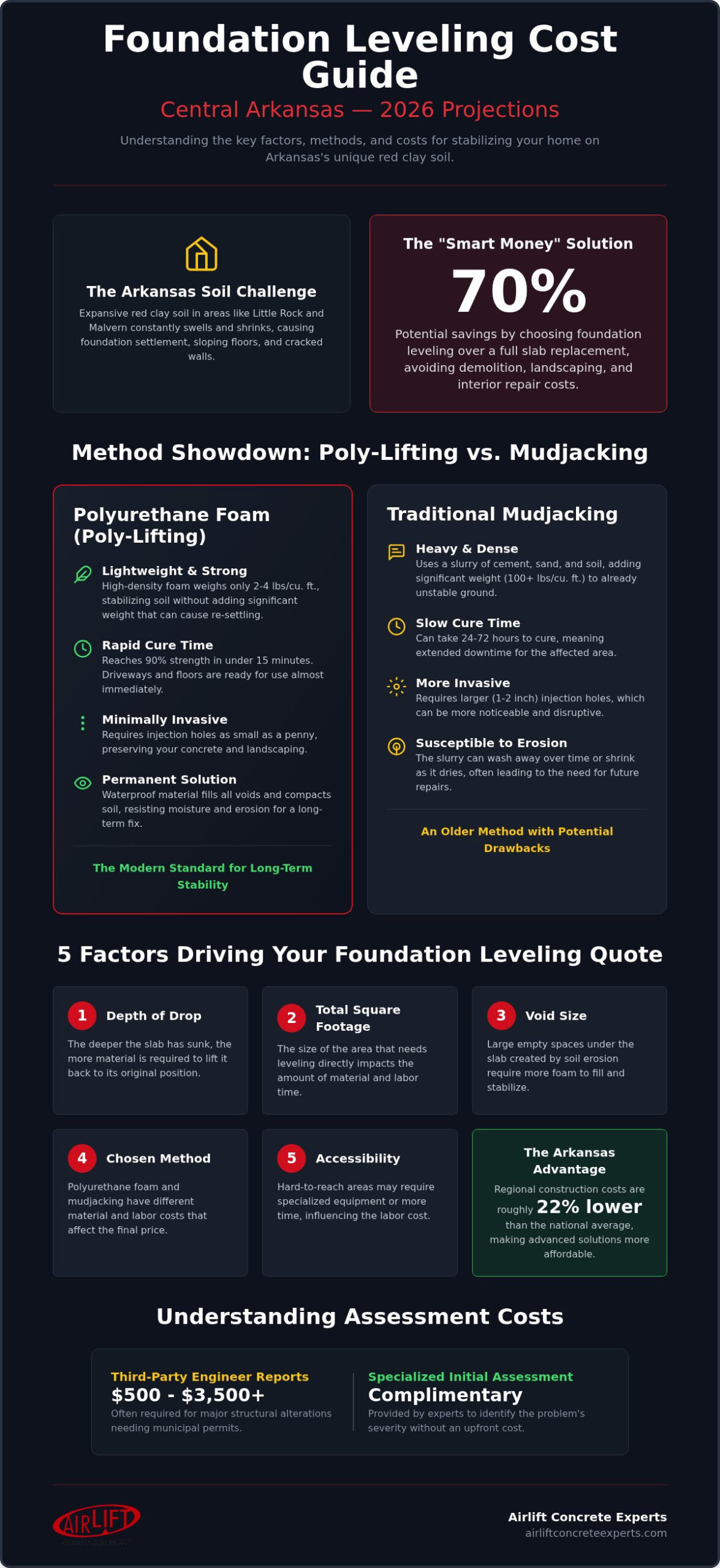
The “wait-and-see” approach is a common strategy for homeowners, but it is rarely the most cost-effective one. In Arkansas, a minor settlement issue today can rapidly evolve into a major structural failure as our seasons cycle through extreme heat and humidity. When you compare the foundation leveling cost to the massive expense of a total slab replacement, the financial advantage of early intervention is clear. While a professional leveling project typically falls within the $3,000 to $10,000 range, a full replacement often starts at $15,000 and can easily climb past $40,000 for larger residential structures.
Total replacement isn’t just about the concrete. It involves heavy demolition, which often destroys surrounding landscaping, irrigation lines, and decorative flower beds. Inside the home, the violent process of jackhammering and pouring new slabs can crack drywall and ruin expensive tile or hardwood flooring. By choosing a non-invasive polyurethane lift now, you avoid these secondary “collateral damage” costs entirely. Settlement issues also compound over time. A one-inch drop this year might seem manageable, but the void beneath the slab will continue to grow. By next year, that drop could reach three inches, significantly increasing the volume of material needed and your eventual foundation leveling cost.
A sunken sidewalk or driveway is more than an eyesore; it’s a significant liability. Trip hazards on your property can lead to expensive lawsuits or insurance claims that far exceed the cost of a repair. From a structural standpoint, a sagging floor can eventually compromise the load-bearing capacity of your walls. If you’re noticing these signs, it’s time to look for foundation repair near me to ensure your family’s safety and the building’s stability. Addressing these hazards early protects both your guests and your bank account.
In the 2026 Arkansas real estate market, savvy buyers and home inspectors are looking for signs of soil movement. A documented repair using modern poly-jacking technology is a major selling point rather than a red flag. We offer a transferable warranty that stays with the home, providing the next owner with the same sense of security you enjoy. This transparency prevents a “failed sale” during the inspection phase, where a buyer might walk away or demand a massive price reduction due to unaddressed foundation issues. Fixing it right the first time ensures you don’t lose equity when it’s time to move. Request your free structural assessment today to protect your home’s equity and your peace of mind.
When you’re dealing with structural instability, you need a partner who understands the specific ground beneath your feet. Airlift Concrete Experts has focused exclusively on Central Arkansas since 2017. We serve homeowners in Little Rock, Conway, Benton, and Malvern with a deep understanding of how our local weather patterns interact with expansive clay. Unlike general contractors who might treat a sunken slab as a side project, we’re a specialist-only shop. This focus ensures that your foundation leveling cost is an investment in precision rather than a generic, one-size-fits-all patch job.
Choosing a specialist over a general contractor makes a significant difference in the longevity of your repair. A general contractor may suggest a total slab replacement simply because they lack the specialized equipment required for polyurethane injection. At Airlift Concrete Experts, we’ve dedicated our business to mastering this technology. This specialization allows us to keep your foundation leveling cost competitive while providing a level of technical accuracy that broad-market competitors can’t match. We know the difference between a minor cosmetic crack and a structural warning sign caused by our state’s specific hydrostatic pressure.
Our quoting process is built on transparency and technical accuracy. We don’t believe in hidden fees or high-pressure sales tactics. Instead, we provide a clear explanation of the repair process, ensuring you understand exactly how our high-density foam will stabilize your property. This local expertise allows us to account for Arkansas-specific variables that national competitors often miss. We’ve built our reputation on being honest, hardworking neighbors who are experts in concrete science.
Our high-density polyurethane foam isn’t a standard off-the-shelf product. We calibrate our materials specifically for the unique density and moisture levels of Arkansas soil. This ensures the foam provides maximum lift and long-term durability against the shifting red clay. We follow the “Airlift Promise,” which means we treat your home like our own. Our crews maintain clean job sites and work to ensure minimal disruption to your daily routine. In 2026, we remain committed to meeting the highest structural standards in the industry, providing repairs that stand the test of time.
Scheduling your assessment is the first step toward a stable home. We offer a no-obligation evaluation in Malvern, Little Rock, and the surrounding metro area. During this 30-minute visit, our specialists perform a thorough visual inspection and take precise measurements to determine the extent of the settlement. We’ll answer your questions about the repair process and provide a detailed plan for restoration. Don’t let structural anxiety linger when a professional solution is just a phone call away. Get a free concrete lifting quote today and secure your home’s future.
Protecting your property’s value starts with understanding the unique challenges of Arkansas soil. We’ve explored how modern polyurethane technology offers a durable, non-invasive alternative to the high expenses and headaches of total slab replacement. By addressing settlement early, you avoid the compounding damage that drives up your eventual foundation leveling cost and safeguard your home’s structural integrity for years to come.
As a family-owned business serving Little Rock, Malvern, and all of Central Arkansas since 2017, we take pride in treating our customers like neighbors. Our specialized polyurethane foam technology is designed specifically to handle the regional environmental factors that other methods often ignore. This modern approach ensures a clean job site and a lift that lasts through our state’s unpredictable weather cycles.
Taking action today prevents minor cracks from becoming major liabilities. Our team is ready to provide the technical expertise and honest guidance you need to make an informed decision about your home. We’re here to ensure your repair is handled correctly the first time.
Request Your Free Foundation Assessment in Arkansas
We look forward to helping you restore the stability and peace of mind you deserve.
On average, homeowners in Arkansas spend between $4,500 and $8,000 on foundation repairs, though minor crack sealing can start as low as $500. Your specific foundation leveling cost depends on the settlement depth and the square footage of the affected area. Local construction costs in our region are about 22% lower than the national average, which helps keep these essential structural repairs more accessible for Central Arkansas residents.
A typical residential project is often completed in just a few hours. Because our high-density polyurethane foam reaches 90% of its full structural strength in under 15 minutes, you can use your driveway or garage almost immediately after we finish. This efficiency is a major advantage over traditional cement-based methods that require days of curing time before they can support the weight of a vehicle.
Yes, our polyurethane injection process is non-invasive and requires absolutely no excavation. We use specialized equipment to pump the foam through small injection ports no larger than a penny. This “no-demolition” approach preserves your landscaping and avoids the mess associated with heavy machinery, saving you the secondary cost of restoring your lawn, irrigation lines, or flower beds.
Slab jacking is a specific type of foundation leveling used to lift sunken concrete surfaces like driveways, patios, or garage floors. While “foundation leveling” is a broad term that can include various structural repairs, slab jacking focuses on filling voids and restoring the elevation of the concrete itself. We use poly-jacking, a modern form of slab jacking, because it’s lighter and more durable in our local soil conditions.
Poly-jacking is considered a long-term solution because the material is hydrophobic and won’t wash away or erode like traditional mudjacking slurry. While the expansive Arkansas red clay will continue its seasonal cycles of swelling and shrinking, the high-density foam remains stable and maintains its structural integrity. This stability helps prevent the soil from shifting again in the same location, protecting your property’s value.
Leveling the foundation often causes interior drywall cracks to close or narrow as the structure returns to its original position. While the structural root cause is corrected, you’ll still need to perform minor cosmetic repairs like taping and painting to fully erase the previous damage. We usually recommend waiting a few weeks after the foundation leveling cost is settled to ensure the house has fully adjusted to its stable elevation.
No, you don’t need to move out or even leave your home while we perform the repair. The process is quiet, clean, and creates no harmful fumes or dust. Since we don’t use heavy jackhammers or massive excavation equipment, your daily routine can continue without interruption. Most homeowners are surprised by how quickly and quietly we can restore their home’s stability.

 Call Now