

What if rainwater keeps pooling beside your Arkansas home after a storm because a concrete slab has settled? Fixing drainage problems with concrete leveling can help when settlement has changed the slab’s slope, but it won’t solve every source of standing water. A downspout issue or broader yard grading may need a different correction. Knowing whether the concrete is affecting water flow is the first step toward choosing the right repair.
Read on to learn what signs to look for, what to note before an inspection, and how polyurethane foam leveling can raise a settled slab without replacing it. An evaluation can consider the slab’s slope alongside visible drainage conditions. If settlement is contributing, Airlift uses polyurethane foam injection through small 5/8-inch holes, with no trenches or heavy equipment. Laser levels monitor the lift to within 1/10 of an inch. The foam cures in about 15 minutes, and projects are typically finished in one day. This permanent, durable approach can help restore water flow while preserving the existing concrete. A free inspection and estimate can help determine whether leveling fits the problem.
A puddle that lingers on your driveway, patio, or garage floor can be frustrating, especially when rain keeps returning it to the same spot. Pooling water has several possible causes. The concrete may have settled and formed a low area, or runoff may be arriving faster than the surrounding surface can carry it away. Downspout discharge and the slope of the yard can also affect where water collects.
Drainage-related slab settlement means a concrete slab has changed elevation or slope enough to disrupt the way water flows across it. Even a small change can create a low spot, redirect runoff, or leave water standing where the surface once drained. A puddle alone doesn’t confirm settlement, so look at the surrounding area too. Does water collect only in one dip in the slab, or does it also pool in nearby soil?
Trace the water’s likely path. A downspout that empties beside a walkway may send roof runoff across it. Water from higher ground may cross a patio or driveway, while broad pooling across the yard can point to a grading or drainage-system concern rather than one sunken slab. Concrete leveling can help when settled slab elevation is contributing to pooling. Fixing drainage problems with concrete leveling is most relevant when the concrete’s changed slope is part of the water-flow issue, not simply because a puddle is present.
Notice whether puddles repeatedly collect in the same low area after rain. Compare adjoining sections of a driveway or sidewalk for a visible height difference, and look for cracks near the low spot. On a patio, check whether water runs toward the house instead of away from it. In a garage, observe whether rainwater reaches the door or gathers on one side. These clues can help you describe the pattern, but none proves settlement on its own.
Standing water can leave a walking surface slippery, so take care around recurring puddles on steps, paths, and driveways. If water repeatedly runs alongside a slab, it may wash away supporting soil or contribute to further movement over time. That possibility doesn’t prove that erosion or damage has occurred. Note how long water remains after rain and whether the slab’s appearance changes. Those observations help distinguish a recurring drainage pattern from confirmed concrete damage.
If a concrete slab has settled and changed the way water moves across it, raising the slab can help restore its slope. Airlift uses a two-part polyurethane foam injection process to lift suitable sunken concrete rather than replace the slab. The goal is to bring the surface closer to its intended elevation so water can flow as designed. Because results depend on the slab and the conditions around it, an evaluation can help determine whether the slab’s position is contributing to the drainage problem.
Polyurethane foam injection raises settled concrete by expanding beneath the slab and compacting the supporting soil. As the foam expands, it fills space beneath the concrete and lifts the slab. Precision laser levels monitor the lift to within 1/10 of an inch. This allows the team to guide the slab toward the target elevation using measured readings rather than visual estimates alone.
The process begins with small injection holes, each 5/8 of an inch wide, about the size of a dime. The two-part foam is injected beneath the sunken slab, where it expands and raises the concrete. The crew monitors the lift as the slab moves, paying attention to its intended height and slope. For driveways, sidewalks, patios, and other suitable slabs, this is the least invasive repair method: it requires no trenches or heavy equipment.
Small access holes allow the existing slab to stay in place during the lift. This can be useful when a surface is suitable for raising but has settled enough to interfere with drainage. Correcting elevation may help water move away from a low area, though it won’t redirect runoff from a downspout or resolve every drainage issue around the property.
The polyurethane foam cures in about 15 minutes, and projects are typically completed in one day. Airlift’s foam lifting is a permanent, durable solution, not a temporary fix. The foam is waterproof and chemical-resistant, and it becomes inert after curing. It is eco-friendly, does not leach chemicals, and is safe for families, yards, and agricultural sites.
These details help explain what the repair involves, but they don’t replace an on-site assessment of the concrete and water pattern. A structural warranty is provided and transfers to the next homeowner. For homeowners in Little Rock considering polyurethane concrete leveling, a free inspection and estimate can help clarify whether raising the slab fits the cause of the pooling.
A puddle doesn’t automatically mean a slab needs lifting. The key question is whether the concrete’s position is shaping the water’s path, or whether water is arriving from somewhere else or can’t drain away. Matching the repair to the cause helps avoid expecting a change in slab elevation to fix a separate runoff or drainage issue.
Settled slab: Water repeatedly gathers in a low spot, and the concrete shows a height difference or altered slope. Leveling may help correct the slab’s elevation.
Runoff source: Roof drainage or the grade of nearby ground directs water onto the concrete. The source or route of the runoff may need separate attention.
Drainage-system issue: A blocked or inadequate drainage pathway may prevent water from moving away. Clearing or correcting that pathway is distinct from raising concrete.
This comparison is a starting point, not a diagnosis. More than one cause can contribute to the same puddle. For example, a downspout may send water across a driveway while a settled section gives it a place to collect. Adjusting the slab may address its low spot, but it won’t change where the downspout releases water.
Leveling is worth considering when a recurring low area aligns with visible settlement or a changed surface slope. A sunken driveway panel, uneven walkway, dipped patio, or low section of a garage floor can alter the way water drains across that slab. Fixing drainage problems with concrete leveling is appropriate when slab settlement contributes to the problem. Raising concrete can correct elevation, but it can’t resolve unrelated grading or runoff conditions by itself.
Look beyond the puddle. A roof downspout may discharge onto a patio, or a higher area of the yard may carry runoff toward a walkway. Leaves, debris, or another obstruction can also limit a drainage pathway. Consider both the water’s source and the slab’s slope rather than assuming one repair suits every situation. This helps distinguish a concrete-leveling need from a drainage concern that requires its own correction.
If settlement is contributing, Airlift’s polyurethane foam injection raises the existing slab as a permanent, durable repair. The least invasive method uses 5/8-inch holes, requires no trenches or heavy equipment, and monitors lifting to within 1/10 of an inch. Foam cures in about 15 minutes, and projects typically finish in one day. The foam is waterproof, chemical-resistant, eco-friendly, inert after curing, does not leach chemicals, and is safe for families, yards, and agricultural sites. A structural warranty transfers to the next homeowner. A free inspection and estimate can help assess whether the slab’s elevation is part of the drainage issue. A $1,000 deposit guarantees an appointment and is applied 100% toward the total service cost. Grain-bin floor lifting is also available beyond the listed Arkansas cities; contact Airlift for details.
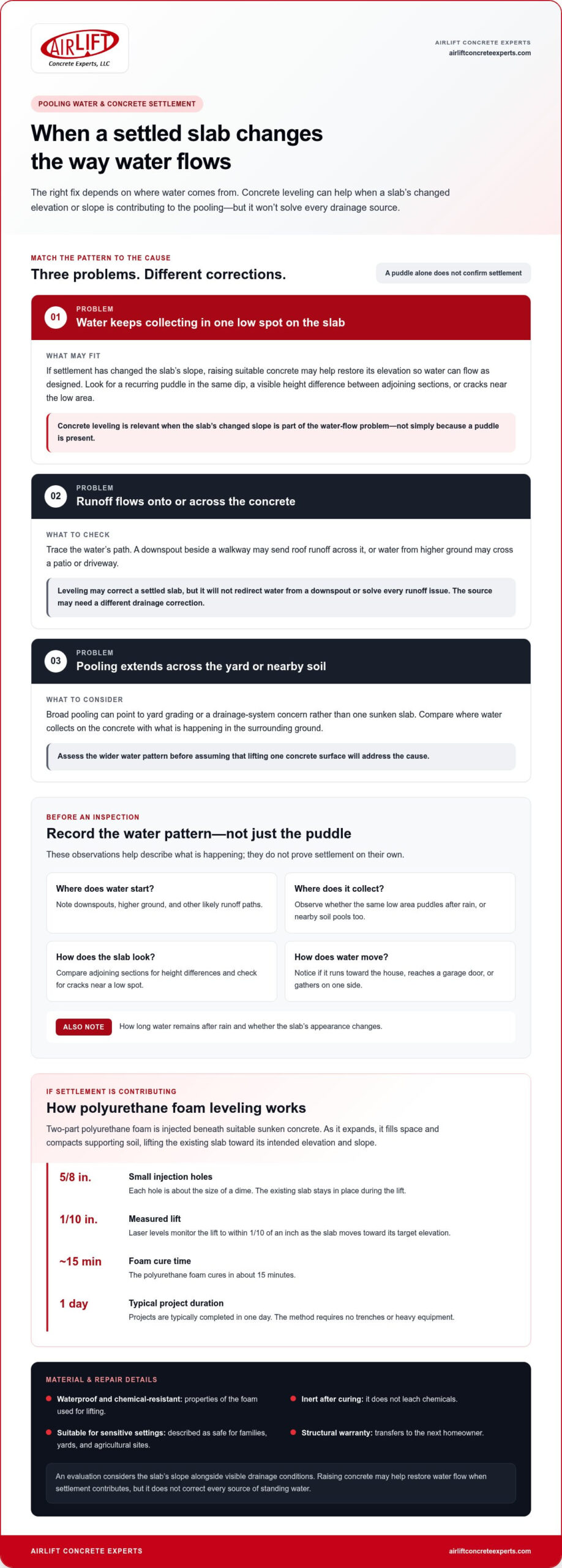
A few clear observations can make an inspection more useful, even if you can’t tell what’s causing the pooling. After rain, follow the water’s path and record what you see rather than trying to diagnose the slab yourself. This gives the evaluation a practical starting point: the affected surface, where water collects, and what surrounds it.
Use this simple sequence after rainfall. Take photos from consistent viewpoints if it’s safe to do so, and note how the area changes as water moves or recedes.
Also note the nearby property slope and any visible drainage paths. These details provide context, not a diagnosis. You can record where water travels and what the slab looks like; determining why it pools requires evaluating the concrete and drainage conditions together.
When describing the concern, be specific: identify the affected surface, explain where water first appears, and say where it collects or flows. Share whether the pattern repeats and point out visible changes you’ve noticed. Photos taken after rainfall can show the location and surrounding conditions, while your notes can distinguish a recurring puddle from a one-time observation.
Airlift’s free inspection and estimate can assess the slab and visible drainage concern. The concrete lifting homeowner’s guide also provides broader context on concrete lifting. If settlement is contributing, Airlift uses polyurethane foam injection through 5/8-inch holes, with no trenches or heavy equipment. Laser levels monitor the lift to within 1/10 of an inch. Foam cures in about 15 minutes, and projects typically finish in one day. It’s a permanent, durable solution, and a structural warranty transfers to the next homeowner.
The foam is waterproof, chemical-resistant, eco-friendly, inert after curing, does not leach chemicals, and is safe for families, yards, and agricultural sites. To discuss a recurring puddle, schedule a free inspection and estimate. A $1,000 deposit guarantees an appointment and is applied 100% toward the total service cost.
For a settled slab that’s contributing to pooling, Airlift Concrete Experts uses polyurethane foam injection to raise existing concrete rather than replace it. Foam lifting is a permanent, durable repair for suitable slabs, and a structural warranty is provided and transfers to the next homeowner. A free inspection and estimate can help assess the concrete and drainage concern before determining whether leveling fits the problem.
Airlift drills 5/8-inch injection holes, then injects two-part polyurethane foam beneath the slab. This is the least invasive repair method: it requires no trenches or heavy equipment. Precision laser levels monitor the lift to within 1/10 of an inch. For a closer overview of the process, explore the polyurethane concrete leveling guide.
When requesting an evaluation, describe which slab is affected and where water repeatedly collects or flows after rain. Mention visible changes in height, cracks, or nearby runoff sources. These details help focus the inspection, while the cause and suitable repair depend on assessing the property. The inspection and estimate are free. A $1,000 deposit guarantees an appointment and is applied 100% toward the total service cost.
Airlift serves the following Arkansas cities:
Polyurethane foam is waterproof, chemical-resistant, and eco-friendly. After curing, it’s inert, does not leach chemicals, and is safe for families, yards, and agricultural sites. Grain-bin floor lifting is available beyond the listed Arkansas cities; contact Airlift for details. To discuss pooling or a settled slab and arrange an evaluation, request a free inspection and estimate.
Standing water doesn’t always point to a settled slab. The right next step is to understand how the concrete and surrounding drainage work together. If you’ve tracked where water collects and noticed a change in the slab, share those observations during an evaluation. That gives the assessment a clear starting point without assuming the cause or repair in advance.
For homeowners in Malvern, Hot Springs, Little Rock, Cabot, Conway, Benton, Bryant, North Little Rock, Sherwood, Jacksonville, and Hot Springs Village, Airlift’s polyurethane foam injection can raise a settled slab with lift precision monitored to within 1/10 of an inch. The structural warranty transfers to the next homeowner. A professional assessment can help determine whether the slab’s elevation is contributing to pooling and what approach makes sense for your property.
Request a free inspection and estimate to discuss the affected concrete and recurring water pattern. A $1,000 deposit guarantees an appointment and is applied 100% toward the total service cost.
It may help if a settled garage slab has changed its surface slope and is directing water toward the door. But fixing drainage problems with concrete leveling won’t correct every source of water. Roof runoff from a downspout or the grade of the surrounding yard may also send water toward the garage. Trace the water from where it starts to where it collects, then have the slab and broader water path assessed together.
Yes, the process uses small injection holes in the slab. Airlift drills holes 5/8 of an inch wide, about the size of a dime, to place polyurethane foam beneath the concrete. It’s the least invasive repair method and requires no trenches or heavy equipment. The holes are part of the injection process; their presence shouldn’t be confused with evidence that the slab has a drainage problem.
Rain can give you a useful chance to observe the water pattern before an evaluation. Note where water first reaches the concrete, where it gathers, and whether it flows toward a doorway, wall, or another part of the property. Photos can capture the puddle’s location, while brief notes can show whether the same area collects water after separate rain events. These observations provide context without diagnosing the cause.
Yes. Airlift’s polyurethane foam is waterproof, chemical-resistant, and eco-friendly. After curing, it’s inert and does not leach chemicals. The foam is safe for families, yards, and agricultural sites. These material properties can help homeowners understand how the repair fits their surroundings, alongside the concrete surface and site conditions.
Cracks don’t automatically rule out leveling, but their presence alone doesn’t identify the cause or determine the right repair. Point out where cracks appear and whether they cross a joint, meet an uneven edge, or sit near the low area. Concrete leveling addresses slab elevation when settlement contributes to the problem. An assessment can consider the cracks along with the slab’s position and the pattern of pooling.
Polyurethane foam cures in about 15 minutes, and projects are typically completed in one day. These are Airlift’s general process expectations, not a guarantee that every project will follow the same schedule. The work involved depends on the property and the slab being evaluated. During an inspection, describe the affected concrete and water pattern so the repair approach can be considered in context.

 Call Now