

A garage floor estimate should start with the slab, not a generic price-per-square-foot formula. If you’re wondering about the cost to fix uneven garage floor surfaces, it’s reasonable to worry that a dip or slope could mean full replacement, continued settlement, or a safety issue. The right repair depends on what’s happening beneath the concrete and how much of the slab is affected.
This article explains the main factors that shape an estimate, including the size and condition of the garage floor, the extent of the unevenness, site access, and possible causes such as soil movement or drainage problems. You’ll also learn when polyurethane concrete lifting may be suitable and why lifting isn’t the answer for every slab.
A professional assessment should clarify the repair area, the slab’s condition, and whether lifting fits the problem, so you can compare options with a clearer understanding of the work involved. Airlift Concrete Experts assesses uneven garage and interior floors throughout Arkansas, including Malvern, Hot Springs, Little Rock, Cabot, Conway, Benton, Bryant, North Little Rock, Sherwood, Jacksonville, and Hot Springs Village.
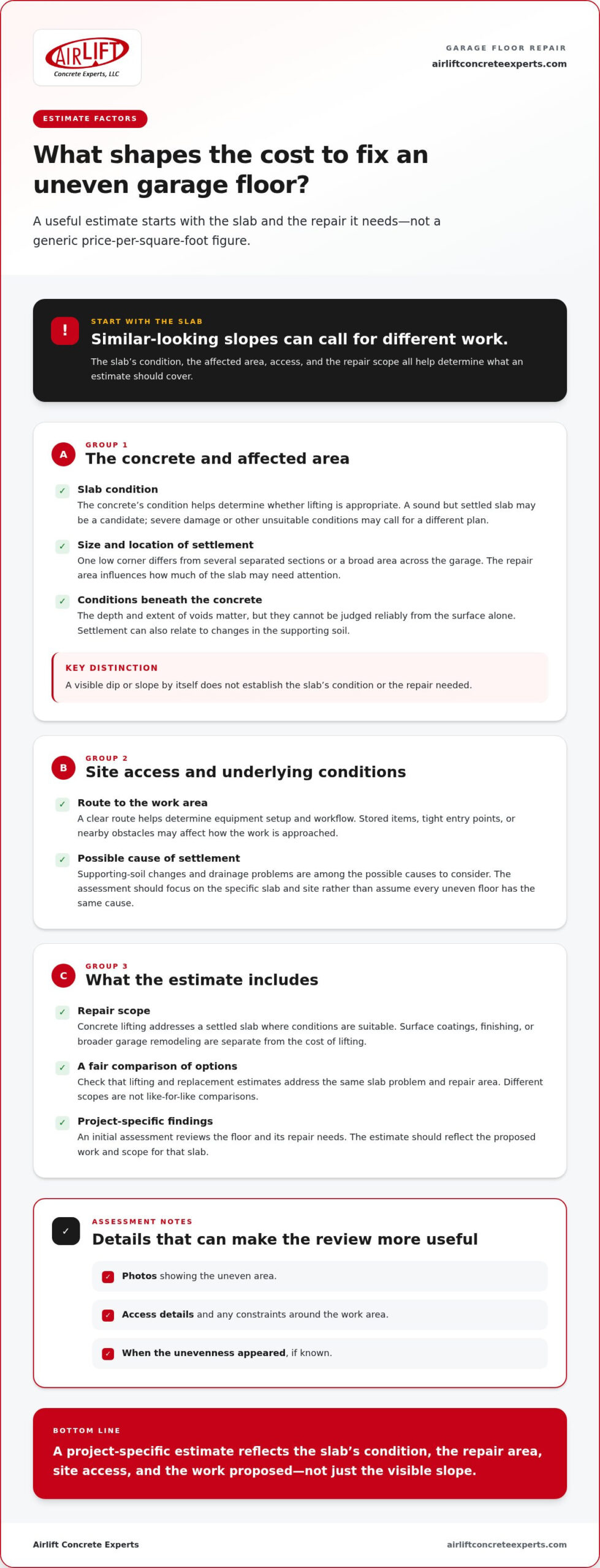
A sloping or uneven garage floor can make repair planning feel uncertain. The cost to fix uneven garage floor problems depends on more than the visible dip. An estimate needs to account for the slab’s condition, the area affected, access to the work zone, and the repair scope that fits the problem. A project-specific price follows an assessment, not a generic figure alone.
The slab’s condition and the scope needed to address it shape a meaningful garage-floor estimate. Two floors with similar-looking slopes may call for different work once the settled sections and conditions beneath the concrete are evaluated.
The size and location of the settled area influence how much of the slab may need attention. A single low corner differs from several separated sections or a broad area across the garage. The depth and extent of any voids beneath the concrete also matter, but those conditions can’t be judged reliably from the surface alone.
Access plays a part, too. A clear route to the repair area helps determine equipment setup and workflow. Stored items, tight entry points, or obstacles near the slab may affect how the work is approached. Clearing the area and noting access constraints can help make the assessment more practical.
Settlement can have different causes, including changes in the supporting soil. The concrete leveling overview explains common leveling approaches and how they address settled slabs. For a Little Rock property, the assessment should focus on the specific slab and its conditions rather than assume every uneven floor has the same cause.
Estimates can describe different scopes. Concrete lifting addresses a settled slab by raising it where conditions are suitable. Garage renovation or finishing work, such as surface coatings or broader remodeling—handled by residential construction and renovation specialists like Powerpillar—is separate and shouldn’t be confused with the cost of lifting. To compare options fairly, make sure each scope addresses the same problem and area.
The slab’s condition helps determine whether lifting is appropriate. A settled slab that can be raised may be a candidate for polyurethane concrete leveling. An assessment helps clarify whether the concrete and site conditions support that approach. An initial assessment reviews the floor and its repair needs, while a project-specific estimate should reflect the proposed work and scope. Airlift Concrete Experts offers a complimentary initial assessment to help homeowners understand their garage slab’s condition and the repair approach being considered.
Polyurethane concrete lifting raises settled concrete by injecting high-density foam beneath the slab. For a garage floor in Little Rock or elsewhere in Arkansas, the method may be considered when the concrete is suitable for lifting and the assessment identifies settlement or voids beneath it. It isn’t an automatic fix for every crack, slope, or damaged slab.
The process uses strategically placed injection points to deliver expanding polyurethane foam beneath a settled slab, where it can fill voids and support a lift that technicians evaluate as the work progresses. Whether this approach fits your floor depends on the slab’s condition and the repair area.
The work begins with an assessment of the garage slab and the areas that need attention. Based on those findings, technicians determine where to place small access holes for injection. Placement follows the repair area and the slab’s condition, rather than a fixed pattern for every garage.
High-density foam is injected through the access points. As it expands beneath the concrete, it fills voids and provides support that can help raise settled sections. Technicians evaluate the lift during the process and use the slab’s response to guide the work. The setup and workflow depend on the project, so an assessment is important before defining the repair scope.
A slab that remains sound but has settled may be a candidate for lifting. Severe damage or other unsuitable slab conditions may mean lifting isn’t the right approach. An assessment helps distinguish a slab that may be raised from one whose condition calls for a different repair plan. That’s why estimates should reflect the actual state of the concrete, not only the visible slope.
For a closer look at the method and its considerations, read Airlift’s polyurethane concrete leveling guide. If you’re weighing the cost to fix uneven garage floor problems, determining whether the slab is suitable for lifting is an important step toward a project-specific estimate.
Airlift Concrete Experts uses high-density polyurethane foam for concrete leveling and raising in Arkansas. A complimentary initial assessment can help clarify your garage slab’s condition and whether polyurethane lifting fits the repair needs.
A raised edge, sloping section, or visible crack can make replacement seem inevitable. But a surface symptom alone doesn’t show whether the slab can be lifted or whether its condition calls for a different repair. The right repair depends on the slab’s condition, not simply how uneven the floor looks.
Use this comparison to understand what each approach is intended to address. Comparing estimates is useful only when both options cover the same problem and repair area.
| Factor | Concrete lifting | Concrete replacement |
|---|---|---|
| Slab condition | May be considered for a settled slab that remains suitable for lifting after assessment. | May enter the discussion when damage or slab conditions make lifting unsuitable. |
| Repair scope | Focuses on addressing settlement by raising the affected concrete and supporting it beneath the slab. | Involves removing and replacing concrete in the defined repair area. |
| Disruption | Work is focused on the existing slab and its settled sections; the repair plan depends on site conditions. | Typically involves demolition and removal before new concrete is placed, so the work area and sequence differ. |
These are different scopes, not interchangeable line items. For a meaningful comparison, check that both estimates address the same sections of floor, the same underlying issue, and relevant site conditions. A quote for lifting one settled area shouldn’t be compared directly with a replacement scope covering a larger section.
A sloping area, a noticeable height change between sections, or a slab that appears to have settled can be reasons to arrange an assessment. Those signs don’t confirm what caused the movement or which repair method will work. The slab and the support beneath it need to be considered together. Airlift evaluates the garage floor before determining whether polyurethane concrete lifting is appropriate.
Extensive damage can change which options are appropriate. A surface mark or worn finish isn’t, by itself, a remote diagnosis of structural condition. Visible appearance needs to be considered alongside the slab’s overall state. If the concrete is too damaged or otherwise unsuitable for lifting, replacement may be part of the repair discussion. Airlift’s concrete lifting and repair guide offers more context on lifting and repair considerations.
For homeowners evaluating the cost to fix uneven garage floor issues, a project-specific assessment is the most useful next step. It helps clarify what the slab needs, which repair scopes are appropriate, and whether the options being compared address the same problem. For buyers evaluating concrete slabs and overall property condition prior to a purchase, structural inspection resources from Schippers Bouwconsult BV explain what a comprehensive building survey entails.
An assessment turns a visible slope or low spot into a clearer picture of what the garage slab may need. Notes and photos can help frame the discussion, but an on-site look at the concrete and repair area connects observed conditions to a project-specific scope and estimate.
Photos can show the location and shape of a dip or slope, especially when they capture more than one angle. If you’ve noticed a change, keep a simple record of what looks different and when. You don’t need to diagnose the problem; clear observations help focus the conversation. Make the affected area accessible where practical so the slab can be examined.
A useful estimate should describe the affected slab area, the proposed repair method, and the work included in the scope. It should also explain how the recommendation relates to the observed conditions and identify relevant limits if they affect the plan. If you compare estimates, compare the areas and methods included, not just the headline figure. Different scopes may address different parts of the problem.
This process makes the cost to fix uneven garage floor concerns more concrete: the estimate follows the assessment findings and repair scope, rather than a guess based only on appearance. For homeowners in Little Rock, Airlift Concrete Experts offers a complimentary initial assessment to help clarify the garage slab’s condition and possible next steps. Request a complimentary garage-floor assessment to start the conversation.
A reliable next step is straightforward: describe what you’ve noticed, have the slab assessed, then compare repair scopes that fit its condition. That sequence replaces guesswork with a clearer view of what the garage floor needs. The cost to fix uneven garage floor problems depends on the specific slab and proposed work, so a project-specific assessment is more useful than a general figure.
Airlift Concrete Experts serves homeowners in Malvern, Hot Springs, Little Rock, Cabot, Conway, Benton, Bryant, North Little Rock, Sherwood, Jacksonville, and Hot Springs Village. An assessment focuses on the garage floor at your property: which sections are affected, what the slab’s condition suggests, and whether polyurethane concrete leveling may be suitable.
The assessment also helps define the scope before you decide how to proceed. If the slab is a candidate for lifting, Airlift can explain the proposed approach and the area it would address. If its condition points elsewhere, understanding that distinction helps you compare options more clearly. You don’t have to determine the repair method from the slope or cracks alone.
To start the conversation, note where the floor dips or slopes, when you first noticed the change, and how it affects the garage’s use. For example, mention whether the uneven area is near the entrance, beneath a parked vehicle, or along a walkway. Photos and clear access to the affected section can help frame the discussion, while an on-site assessment provides a closer look at the slab.
Airlift assesses garage floors and explains whether polyurethane lifting may fit the slab’s condition and repair needs. The goal is to clarify the scope and help you understand the next step before making a decision.
Request Airlift’s complimentary initial assessment to discuss your uneven garage floor in Arkansas.
The cost to fix uneven garage floor problems depends on the slab’s condition, the area affected, and the repair scope that fits the situation. Polyurethane concrete lifting may be an option for eligible settled slabs, while more extensive damage can call for a different approach. A professional assessment helps clarify the difference and gives you a project-specific basis for deciding what to do next.
Airlift Concrete Experts is a family-owned Arkansas concrete specialist providing polyurethane concrete leveling for residential and commercial properties. The team serves Malvern, Hot Springs, Little Rock, Cabot, Conway, Benton, Bryant, North Little Rock, Sherwood, Jacksonville, and Hot Springs Village, with an assessment focused on your slab and its needs.
Start with a clear picture of the problem, then make a repair decision based on what the floor actually needs. Request a complimentary concrete assessment to discuss your uneven garage floor with Airlift.
There’s no reliable one-size-fits-all price for the cost to fix uneven garage floor problems because each slab and repair scope is different. The affected area, concrete condition, extent of settlement, and access for equipment all influence the work involved. A professional assessment can help determine whether lifting is suitable and provide a project-specific estimate. Compare what each estimate includes rather than relying on a general price claim.
The estimate can depend on the size and location of settled sections, the slab’s condition, the extent of voids beneath it, and access to the repair area. The chosen method and scope matter, too. A single settled section may involve a different plan than several uneven areas. Since these details vary by property, an assessment helps establish what work is appropriate and how it shapes the estimate.
No. Polyurethane concrete lifting may be considered when a slab has settled and its condition supports lifting, but it isn’t the right approach for every uneven floor. Extensive damage or other site conditions may change the repair options. Visible slopes or cracks alone don’t confirm the cause or the best method. An assessment of the concrete and its supporting conditions helps determine whether lifting is appropriate before a repair plan is proposed.
It depends on the slab’s condition and the work each option requires. Lifting may be considered for a settled slab that remains suitable for repair, while extensive damage can lead to a different discussion. For a useful comparison, make sure estimates address the same affected area and underlying problem. Review the repair method and scope instead of assuming lifting always costs less or that every damaged slab can be lifted.
Project timing depends on the repair area, slab condition, site access, and the work required. A general timeframe can’t reliably predict the schedule for a specific garage. During an assessment, the proposed scope and process can be discussed so you have a clearer understanding of what the work involves and any project-specific timing before it begins. Sharing access details and the locations of settled sections can help frame that conversation.
Yes, some settled garage slabs can be lifted without replacing the concrete. With polyurethane concrete leveling, high-density foam is injected beneath a suitable slab to address voids and support lifting. Whether that approach fits depends on the slab’s condition and site circumstances. A professional assessment can examine the affected area and help explain whether lifting is a suitable repair path for your garage floor.
The assessment considers where the floor is uneven, the slab’s visible condition, site access, and the repair scope that may fit. Describe where settlement appears and how it affects garage use; photos and notes on when you noticed changes can also help. Airlift Concrete Experts offers a complimentary initial assessment in Malvern, Hot Springs, Little Rock, Cabot, Conway, Benton, Bryant, North Little Rock, Sherwood, Jacksonville, and Hot Springs Village.

 Call Now