
Arkansas red clay is one of the most unforgiving foundation surfaces in the country, capable of shifting an entire house with just one season of heavy rain. It’s incredibly stressful to notice new cracks spreading across your floors or to find that your front door suddenly sticks in its frame. You aren’t alone in worrying if these symptoms point to a total structural failure, but specialized help is closer than you think. Understanding the science behind our local soil is the first step toward reclaiming your peace of mind.
This 2026 guide provides the clarity you need regarding concrete slab foundation repair, focusing on the most effective ways to identify and permanently fix damage. We’ll show you how to evaluate your home’s stability and explain why modern polyurethane foam has become the gold standard for Arkansas homeowners over outdated mudjacking methods. You’ll learn how to stop structural decline in its tracks and implement a cost-effective, long-term solution that keeps your home level for years to come. From no-cost initial assessments to the final lift, we’re here to help you navigate the repair process with confidence.
Seeing a crack in your living room wall can trigger immediate anxiety. For many homeowners in Central Arkansas, the fear of foundation failure is a constant concern. True foundation failure occurs when the ground beneath your home no longer provides uniform support, causing the structure to shift, tilt, or sink. While there are many types of foundations used in residential construction, the slab-on-grade design is particularly common in our region. This design relies heavily on the stability of the top layer of soil, which makes it vulnerable to the environmental challenges unique to Arkansas.
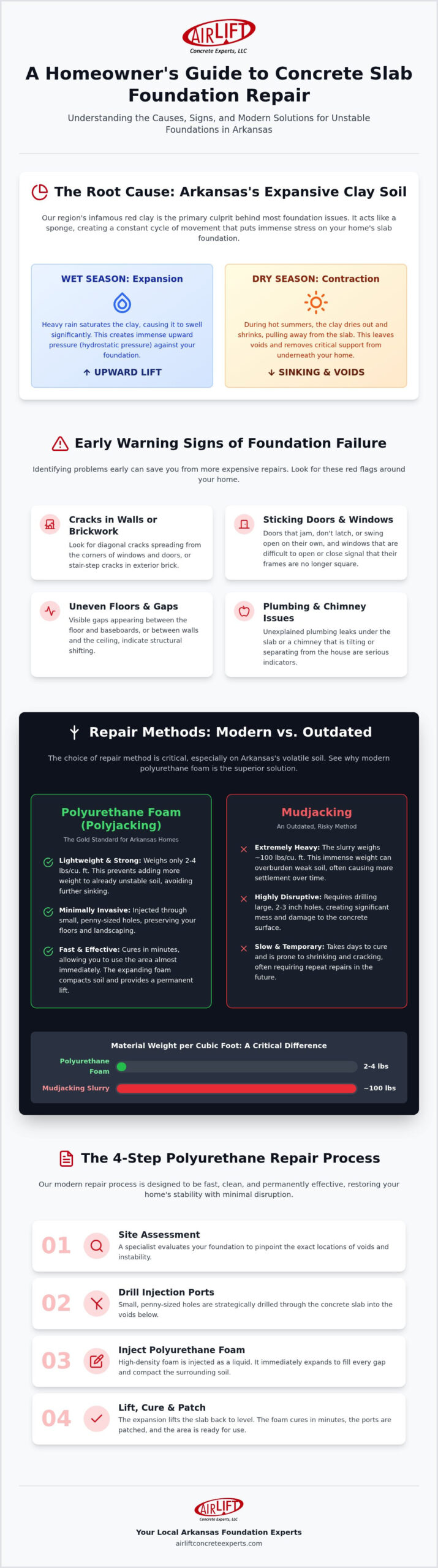
The primary culprit behind most local issues is our state’s infamous red clay. This soil is expansive, meaning it acts like a sponge. It swells significantly when wet and shrinks drastically during our hot, humid summers. This constant cycle of expansion and contraction puts immense stress on your home. Over time, this movement creates voids or uneven pressure points, leading to the need for professional concrete slab foundation repair to restore structural integrity and prevent further damage.
Identifying a problem early can save you from much more expensive fixes down the road. While some minor hairline cracks in a new home might be simple settling, other signs indicate a deeper structural issue. Look for these specific red flags in your home:
If you notice these symptoms in your Little Rock or Conway residence, it’s a sign that the soil is no longer supporting your slab evenly. Distinguishing between cosmetic settling and structural failure is key; if cracks are wider than a quarter-inch or continue to grow, the issue is likely structural.
Arkansas experiences heavy rainfall cycles followed by intense dry spells. During heavy rains, water saturates the clay around your home, creating hydrostatic pressure that pushes against the concrete. Conversely, during a drought, the soil pulls away from the slab, leaving it hanging without support. Poor drainage or leaking gutters often accelerate this process by concentrating water in specific areas, washing away the soil that keeps your home level. Effective concrete slab foundation repair addresses these environmental realities by stabilizing the ground beneath the home, ensuring your property remains safe and level regardless of the weather.
Traditional methods like concrete piering have served the industry for decades, but they are often an aggressive response to issues that require a more surgical touch. Modern concrete slab foundation repair has shifted toward methods that address the root cause of the problem without destroying your landscaping or interior flooring—a priority for structural experts like TRD Remedial who specialize in non-invasive remediation. Polyjacking, which uses high-density polyurethane injection, is now the standard for homeowners in Central Arkansas. This process focuses on the “void” — the empty space created when our local red clay shrinks or washes away. By filling these gaps with a specialized material, we restore the uniform support your home’s structure requires.
Steel piers are vital for deep structural stabilization, but they don’t always address the needs of a sinking garage floor or an uneven interior slab. Polyurethane foam is a game-changer for interior floor leveling because of its incredible strength-to-weight ratio. While traditional mudjacking slurry weighs about 100 pounds per cubic foot, polyurethane weighs only 2 to 4 pounds. This weight difference is critical in Arkansas, where adding heavy material to expansive clay often causes further sinking. The foam stabilizes the soil itself by expanding into every crevice and compacting loose dirt. If you are debating between different repair options, scheduling a no-cost initial assessment with a local specialist can help determine the most durable path forward for your specific property.
The science behind this method involves a precise chemical reaction between two liquid components. When injected through penny-sized holes, these liquids expand into a rigid, closed-cell foam within seconds. This expansion generates enough upward force to lift heavy concrete slabs back to their original position with pinpoint accuracy. Because the foam is closed-cell, it is completely impervious to the intense ground moisture and seasonal flooding common in areas like Conway and Malvern. While the foam protects the slab, external solutions from floodwaterpros.com can help prevent floodwaters from reaching the structure in the first place. It won’t degrade, rot, or wash away over time. Modern geotechnical foams are also designed to be eco-friendly, providing a permanent solution that respects the local environment while ensuring your home remains level for the long haul.
Homeowners often assume that a sinking floor requires a complete demolition and a fresh pour. This is a common misconception that can lead to unnecessary stress and high expenses. Choosing the right path for concrete slab foundation repair involves weighing three distinct options: polyjacking, mudjacking, or total replacement. Each method has a different impact on your property’s long-term stability, especially when dealing with the unique environmental stressors found in the Natural State.
The primary difference between these methods is the weight of the material used. Mudjacking relies on a heavy slurry of sand, soil, and cement that weighs over 100 pounds per cubic foot. In contrast, high-density polyurethane weighs only 2 to 4 pounds per cubic foot. In Arkansas, where our soil is already prone to shifting, adding the immense weight of a mudjacking slurry can actually cause the slab to sink further over time. Polyjacking provides the necessary lift without overburdening the ground beneath your home.
Mudjacking was the industry standard for years, but its limitations are clear in expansive clay environments. The process requires drilling large, unsightly holes into your concrete, often the size of a soda can. These ports are difficult to patch and leave a permanent “polka dot” pattern on your surfaces. Beyond the aesthetics, the failure rate of mudjacking in Central Arkansas is high. The heavy cement mixture doesn’t always bond with the soil; it can shrink and crack during our dry summer months, leading to a recurrence of the original problem. Modern polyurethane methods avoid these pitfalls entirely by using 5/8-inch injection ports that are nearly invisible once sealed.
Total replacement is rarely the most efficient solution. Tearing out an existing slab involves heavy machinery, permits, and weeks of curing time where you cannot use your space. It also frequently leads to collateral damage to your landscaping and surrounding structures. Unless a slab is severely pulverized or “too far gone” structurally, repair is almost always the superior choice.
Choosing polyurethane concrete leveling allows you to keep your original surfaces while restoring their level in a matter of minutes, not days. This approach is a fraction of the cost of replacement and avoids the hidden fees of demolition and debris removal. By opting for a surgical concrete slab foundation repair, you preserve your home’s integrity with minimal disruption to your daily life.
Understanding the logistics of concrete slab foundation repair can help turn a stressful home project into a manageable afternoon. Unlike the disruptive excavation required for older methods, modern polyjacking is a streamlined, surgical process designed to respect your time and property. Whether you live in Benton, Bryant, or the surrounding Little Rock metro, the process begins with a careful evaluation of how your home interacts with the local terrain. We focus on a solution-oriented approach that minimizes noise, dust, and downtime for your family.
Our technicians use specialized sensors to map the voids hiding beneath your slab. This mapping ensures we only drill where it is absolutely necessary. We create a series of 5/8-inch holes, which are about the size of a penny. This precision drilling keeps the impact on your interior flooring or exterior driveway to a minimum. We take great care to protect your surrounding landscaping and interior finishes during this phase. Because we don’t use heavy machinery or large-scale excavation, your yard remains intact and your home stays clean.
Once the ports are in place, we inject the high-density polyurethane. This is where the technical expertise of our team truly shines. Technicians monitor the lift in real-time, often using laser levels to ensure accuracy within 1/10th of an inch. As the foam expands, it fills the empty spaces that allow water to pool and cause further erosion. This process doesn’t just lift the concrete; it compacts the soil and provides a stable, waterproof base that prevents future sinking. We verify the lift and structural stability at every injection point to ensure the results are permanent and safe.
After the slab reaches the desired level, the injection ports are removed. We seal the holes with a matching cementitious grout, leaving a finish that is near-invisible to the naked eye. Your home is stable, the mess is non-existent, and the area is ready for use immediately. If you’re ready to see how this process can restore your property, you can request a no-cost initial assessment from our local team to get started.
Accountability is the hallmark of a neighborly business. When you work with a family-owned company, the technicians aren’t just completing a job; they are helping a neighbor protect their largest investment. You should look for a team that offers transparency regarding their methods and provides clear documentation of their process. A professional assessment should feel educational rather than high-pressure, transforming your anxiety into a sense of security through technical clarity and straightforward communication.
Since 2017, we have dedicated ourselves to serving the Malvern, Little Rock, and Hot Springs communities. Our family-owned operation focuses exclusively on repair and lifting, rather than new construction, allowing us to master the specific nuances of concrete slab foundation repair. We prioritize polyurethane foam injection because it solves the unique challenges posed by Arkansas soil better than any other method. By choosing a lightweight, waterproof, and durable material, we provide a permanent fix that doesn’t add unnecessary burden to the ground. Our commitment to expert concrete lifting ensures that every project meets the high standards our neighbors expect and deserve.
If you’ve noticed sticking doors or cracks in your drywall, the first step is a thorough inspection. To prepare, clear any furniture or debris away from the affected areas so the technician can see the full extent of the movement. You should also have a list of questions ready for your specialist, such as:
Taking action early prevents minor settling from turning into a major structural failure. Our team is ready to provide the professional guidance you need to keep your home stable and level for years to come. Schedule your professional foundation assessment today to receive a clear, solution-oriented plan for your property.
Protecting your home from shifting Arkansas soil doesn’t have to be a source of constant stress. By recognizing early warning signs like sticking doors and drywall cracks, you’ve already taken the first step toward a more stable property. We’ve explored how modern polyurethane technology offers a lightweight, permanent alternative to heavy, outdated mudjacking methods. This surgical approach to concrete slab foundation repair addresses the voids beneath your home without the mess or delay of traditional excavation.
Airlift Concrete Experts has been a family-owned and operated partner for Central Arkansas homeowners since 2017. We understand the specific challenges of our region’s red clay and provide the advanced solutions your property deserves. You don’t have to navigate these structural concerns alone; our team is here to provide the technical expertise and neighborly support you need to protect your investment.
Ready to reclaim your peace of mind? Request Your Free Foundation Assessment from Airlift Concrete Experts today. Your home’s stability is our priority, and we look forward to helping you restore the safety and comfort of your living space.
The cost for concrete slab foundation repair depends on the size of the void and the amount of material required to stabilize the structure. Factors like local soil density in Benton or the depth of the settlement in Little Rock play a significant role in determining the project scope. Since every home’s situation is unique, we recommend a professional evaluation to identify the specific needs of your property. This ensures you receive a solution tailored to your home’s environmental conditions.
Yes, high-density polyurethane foam is a permanent solution for stabilizing sunken concrete slabs. Unlike mudjacking slurry, which can shrink or wash away over time, this closed-cell material is waterproof and impervious to the intense ground moisture found in areas like Malvern. It creates a stable, long-lasting base that won’t degrade or rot. This durability is essential for homes built on the expansive red clay soils common throughout Central Arkansas and the surrounding regions.
Most polyurethane slab lifting projects are completed in a single day, often taking only a few hours. The specialized foam reaches 90% of its full strength within 15 minutes of injection, allowing you to use your space almost immediately. This is significantly faster than traditional concrete replacement, which requires days of curing time. Technicians can restore the level of your driveway or interior floor in Sherwood or Jacksonville with minimal disruption to your daily schedule.
Polyjacking is a minimally invasive process that will not damage your yard or landscaping. We don’t use heavy excavation equipment or large trucks that tear up turf in places like Bryant or Conway. The entire repair is performed through small, penny-sized holes drilled directly into the concrete. Once the work is finished and the ports are sealed, the repair is nearly invisible. This leaves your outdoor living spaces and garden beds completely intact after we finish.
You can absolutely stay in your home during the entire concrete slab foundation repair process. The injection equipment is relatively quiet and the polyurethane material is non-toxic and odorless. There is no need for messy demolition or the vibration associated with heavy machinery. Homeowners in North Little Rock find this method much more convenient than traditional repairs, as it allows them to maintain their daily routines without any significant interruptions or relocation costs.
Foundation failure in Arkansas is primarily caused by expansive red clay soil that swells when wet and shrinks during dry spells. This constant movement creates voids beneath the slab, leading to settlement and cracking. Poor drainage or heavy rainfall cycles in Hot Springs Village can also wash away the supporting soil. In some parts of the state, seismic activity and hydrostatic pressure further contribute to the instability of residential and commercial concrete surfaces.
Most standard homeowners’ insurance policies do not cover foundation repair unless the damage was caused by a sudden, covered event like a plumbing leak. General soil movement, settling, and erosion are typically excluded from basic coverage. We recommend reviewing your specific policy or speaking with your agent in Cabot to see if you have riders for earth movement. Understanding your coverage early can help you plan for the necessary maintenance of your home’s structural integrity.
Slab jacking, specifically polyjacking, focuses on filling the voids directly beneath the concrete to lift and support the slab. Foundation piering involves driving steel or concrete piles deep into the earth until they reach load-bearing strata or bedrock. While piering is used for deep structural support, polyjacking is the preferred modern method for leveling interior floors, driveways, and pool decks. It provides a lightweight yet durable solution for surface-level settlement issues throughout the Little Rock area.

 Call Now