
A level-looking sidewalk doesn’t automatically mean an accessible route meets ADA requirements. Concrete leveling for ADA compliance may correct a sunken slab or abrupt change in height, but the full route, including its slopes and clear width, matters too. A repair may address one barrier without resolving other issues along the route.
If an uneven walkway is raising concerns for customers, tenants, or visitors, assess the conditions before choosing a fix. Some existing slabs may be candidates for lifting, while others may need a different repair or replacement. The right approach depends on the slab, the correction needed, and the requirements that apply to your property.
This guide explains which concrete conditions warrant an accessibility review, how to compare leveling with other repair options, and what to ask when evaluating a contractor. Airlift Concrete Experts provides polyurethane concrete leveling and commercial concrete lifting across Arkansas, including Malvern, Hot Springs, Little Rock, Cabot, Conway, Benton, Bryant, North Little Rock, Sherwood, Jacksonville, and Hot Springs Village. Learn how to assess a walkway and choose a next step without assuming that leveling alone guarantees compliance.
A raised sidewalk edge, a settled panel, or water collecting near an entrance can make a route harder to use. These conditions deserve a closer look, especially at commercial properties in Little Rock, where visitors may use the same path from a parking area or public sidewalk to an entrance. An accessibility review involves more than spotting a trip hazard or checking one concrete panel.
The Americans with Disabilities Act (ADA) is a federal civil rights law addressing access for people with disabilities. The practical guidance below can help property owners recognize conditions to investigate. It isn’t a property-specific compliance determination, and concrete leveling alone can’t establish that an entire route meets applicable requirements.
Look for vertical offsets where neighboring slabs meet, panels that rock underfoot, wide or broken joints, and surface deterioration such as spalling or crumbling edges. These conditions can affect movement across a walkway. Pooling water is another reason to investigate. It may point to drainage or settlement concerns, but appearance alone can’t confirm the cause.
Include sidewalks, entrances, curb ramps, and ramp landings in a visual review. Record where a problem appears and whether it lies on a route people use to reach a building or another site feature. Photos and notes can help a qualified professional assess the condition and determine whether the slab may be repairable.
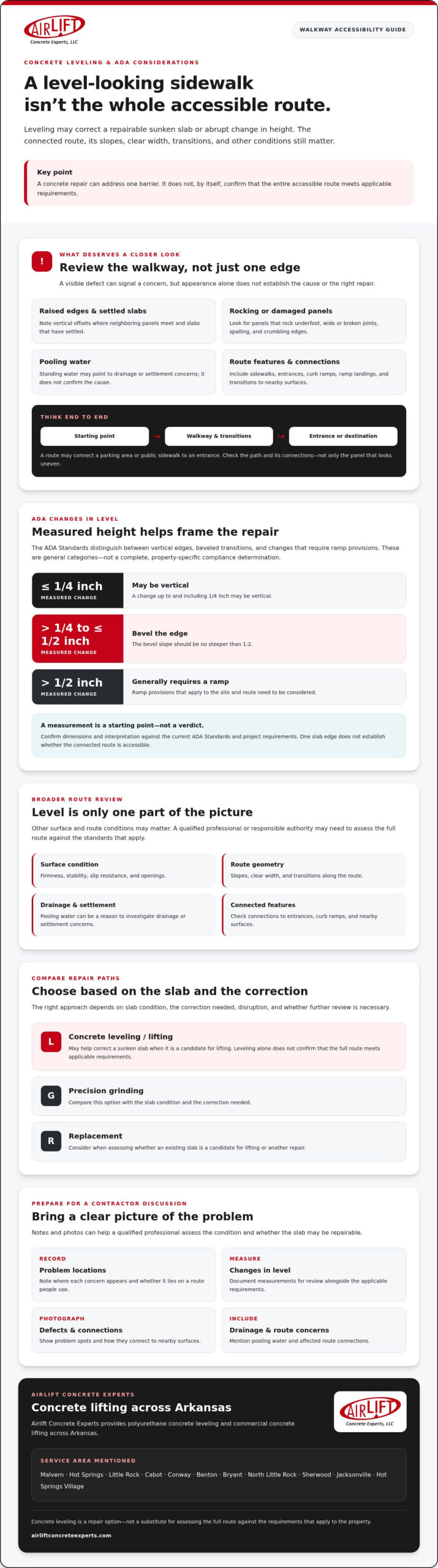
An accessible route is a connected path, not just an individual sidewalk panel. Leveling one spot may leave a difficult transition before or after it, or fail to address another issue along the route. Consider the path from end to end, including how it connects to entrances and curb ramps.
Surface firmness, stability, slip resistance, openings, slopes, and transitions can all matter in an accessibility review. A slab that appears level may still have a surface or connection that needs attention. A visible defect, on its own, doesn’t identify the right repair.
Qualified professionals or the responsible authority may need to assess the full route against the standards that apply to the property. Treat concrete leveling for ADA compliance as a repair option for potentially liftable slabs, not as a substitute for that broader review.
A quarter-inch measurement is a useful starting point, not a complete verdict on an accessible route. The U.S. Access Board’s Guide to the ADA Standards explains how the Standards treat changes in level. The appropriate response depends on the measured height change and the requirements that apply to the site and route.
For changes in level along walking surfaces, the ADA Standards distinguish between vertical edges, beveled transitions, and changes that require ramp provisions. In general, a change up to and including 1/4 inch may be vertical. A larger change needs different treatment.
| Measured change in level | General treatment |
|---|---|
| Up to and including 1/4 inch | May be vertical. |
| Over 1/4 inch and up to and including 1/2 inch | Bevel the edge, with a slope no steeper than 1:2. |
| Over 1/2 inch | Generally requires a ramp that meets applicable ramp provisions. |
These categories summarize general guidance, not every condition or exception. Confirm dimensions and interpretation against the current ADA Standards and project requirements before selecting a repair. Measuring one slab edge won’t establish whether the connected route, including its other transitions and features, is accessible.
Height is only one part of the review. Walking surfaces also need appropriate firmness, stability, and slip resistance. Check for openings or damaged joints, changes in slope, and transitions between sidewalk panels, curb ramps, landings, and entrances. A repair that corrects one edge may not address a separate concern elsewhere on the route.
As a first step, note where the change occurs and measure the height difference consistently. Then have a qualified professional assess the repair scope and whether the condition calls for concrete lifting or another approach. Requirements can vary with the route, facility, and project, so confirm applicable federal, state, local, and project-specific rules with a qualified professional or responsible authority.
Concrete leveling for ADA compliance may be worth evaluating when a settled slab appears potentially repairable, but lifting it doesn’t certify the route or guarantee compliance. If you’ve documented a specific sunken sidewalk panel in Little Rock, you can discuss a concrete lifting assessment with Airlift Concrete Experts and ask whether the slab may be suitable for that repair.
The right repair depends on what’s wrong with the slab and what correction the route needs. A settled panel that remains sound may call for a different approach than a broken slab or a raised edge. Compare options based on the slab’s condition and the intended result, then assess the finished route rather than assuming any single method ensures accessibility.
| Option | Slab condition | Type of correction | Disruption and further assessment |
|---|---|---|---|
| Polyurethane lifting | An existing slab has settled and may still be suitable to lift. | Foam is injected beneath the concrete to raise the slab toward the desired position. | Site access and work conditions affect disruption. A contractor should assess slab condition, underlying voids, drainage, and the correction needed. |
| Precision grinding | A localized high edge may be suitable for material removal. | Reduces a raised area by grinding the concrete surface. | Suitability depends on the location and amount of concrete that can be removed. Assess the resulting surface and nearby transitions. |
| Slab replacement | Damage or site conditions may make lifting unsuitable. | Removes and replaces the affected slab. | Work can affect access to the area. Review connections to adjacent surfaces and the route after the work is complete. |
Polyurethane concrete leveling may be an option when an existing sidewalk or walkway slab has settled but remains structurally suitable for lifting. The contractor needs to inspect the concrete and conditions beneath it, including voids, access for the work, drainage concerns, and the requested correction. A visible dip alone can’t confirm that lifting is appropriate. For more background on the method, see Polyurethane Concrete Leveling in Malvern & Central Arkansas: The 2026 Homeowner’s Guide.
Grinding may be worth evaluating for a localized high edge when removing some surface material can address the specific condition. It may not suit every slab or resolve a broader settlement issue. Replacement may be considered if the concrete is too damaged to lift or site conditions make lifting unsuitable. Neither option is automatically faster, less disruptive, or more accessible. Compare the proposed correction, work area, and route impacts.
For property owners considering concrete leveling for ADA compliance, ask the contractor to explain why the proposed method fits the slab and what needs review afterward. Evaluate the completed repair as part of the connected route. No repair method alone guarantees compliance.
A clear proposal should explain the concrete work without suggesting that a lifting contractor can certify the whole property as accessible. When comparing contractors for commercial concrete leveling, focus on how they evaluate the slabs, define the repair scope, and explain what still needs review after the work.
Before approving work, ask the contractor to identify the affected slabs and describe the proposed method and scope. A useful proposal also addresses site access, preparation, work sequencing, and how people will use or avoid the area during the repair. Ask what records they’ll provide afterward, such as photos or notes about the completed concrete work. Those records can document the repair, but they aren’t an accessibility certification.
Look for relevant commercial concrete lifting experience and ask for references appropriate to a project like yours. Discuss connected conditions, not just the visibly uneven panel. Drainage, adjoining slabs, curb ramps, landings, and transitions may affect the work or need separate review. For an overview of the service in the region, see Expert Concrete Lifting in Malvern & Little Rock: The 2026 Homeowner’s Guide.
Use this numbered checklist to compare proposals:
Airlift Concrete Experts provides commercial concrete lifting in Arkansas, including communities such as Little Rock, Malvern, Conway, and Benton. Confirm current coverage for your property and ask whether the specific slabs are suitable for lifting. For a site-specific discussion of commercial concrete lifting, request an assessment from Airlift Concrete Experts. Concrete leveling for ADA compliance can address a repairable slab concern, but the finished route still needs appropriate evaluation.
A settled sidewalk slab may warrant a professional concrete lifting assessment when it creates a noticeable height change, affects access to an entrance, or appears to have shifted in a way that disrupts the walkway. An assessment can help determine whether the existing concrete may be suitable for lifting and what repair scope to consider. Appearance alone can’t confirm the cause of settlement or whether lifting is appropriate.
Airlift Concrete Experts provides polyurethane concrete leveling and commercial concrete lifting for existing concrete in Arkansas. The company focuses on lifting and repair, not new concrete construction. This work may address a slab concern, but it doesn’t certify an accessible route or guarantee ADA compliance. If a project raises broader accessibility questions, share those concerns with the appropriate qualified professional or responsible authority.
A site-specific review can focus on the affected slabs, visible settlement, access to the work area, and whether the concrete appears suitable for lifting. Help make the conversation useful by showing the contractor where the walkway connects to entrances, curb ramps, or other route features. If you have measurements, photos, drainage observations, or findings from an accessibility evaluation, share them so the repair discussion reflects the site’s needs.
A concrete leveling assessment addresses potential concrete repair. It isn’t a substitute for a full accessibility inspection, a determination that the entire route meets applicable standards, or legal advice. Confirm the scope of any broader review separately.
Before contacting a contractor, gather the property location, photos of the affected walkway, and a brief description of the access concern. Note whether water collects near the slab and whether the area connects to an entrance or ramp. These details can focus the initial conversation and clarify what should be reviewed on site.
Airlift Concrete Experts serves Arkansas communities including Malvern, Hot Springs, Little Rock, Cabot, Conway, Benton, Bryant, North Little Rock, Sherwood, Jacksonville, and Hot Springs Village. Confirm current coverage for your property and whether the slab may be a candidate for polyurethane lifting. If you’re considering concrete leveling for ADA compliance, start with a focused review of the slab and leave whole-route accessibility questions to the appropriate evaluator.
Request a concrete leveling assessment to discuss the walkway concern and possible repair scope.
A raised edge or settled sidewalk panel deserves attention, but one repair can’t determine whether an entire accessible route meets the requirements that apply to your property. Measure and document the concern, consider how it connects to the rest of the route, and compare repair options based on the slab’s condition. Concrete leveling for ADA compliance may be worth evaluating when an existing slab has settled and remains suitable for lifting, but the finished route needs its own appropriate review.
Airlift Concrete Experts is a family-owned Arkansas business founded in 2017. The team specializes in polyurethane concrete leveling and commercial concrete lifting, focusing on repairing and raising existing concrete, not certifying accessibility or building new slabs. Share your site details and walkway concerns to discuss whether a concrete lifting assessment may be a useful next step.
Request a concrete leveling assessment to discuss repair options for your property.
No. Concrete leveling may correct a settled slab or uneven transition, but it doesn’t establish that the full accessible route meets applicable requirements. Other factors, including slopes, surface condition, openings, and connections to entrances or curb ramps, may need review. Treat concrete leveling for ADA compliance as a potential repair approach, not a compliance certification. Have the repaired area and connected route evaluated as appropriate for your property.
Under the general change-in-level provisions, a vertical change up to and including 1/4 inch may be permitted. A change over 1/4 inch and up to 1/2 inch generally needs a bevel no steeper than 1:2, while a change over 1/2 inch generally requires a ramp meeting applicable provisions. These are general thresholds, not a complete compliance test. Confirm current Standards and project-specific requirements with a qualified professional.
It may correct an uneven sidewalk slab if the existing concrete is suitable for lifting and the proposed adjustment fits the site conditions. Polyurethane foam is injected beneath the slab to raise it, but a contractor needs to assess the concrete, access, drainage, and requested correction first. Airlift Concrete Experts serves Arkansas communities including Malvern, Hot Springs, Little Rock, Cabot, Conway, Benton, Bryant, North Little Rock, Sherwood, Jacksonville, and Hot Springs Village. Confirm coverage for your property.
Measure the vertical difference between adjoining surfaces at the point where the edge is highest, using a straightedge and a ruler or measuring tool. Record the location and measurement, and take a photo that shows the surrounding walkway and route connections. Check more than one point if the edge varies. A single measurement can help identify a concern, but it doesn’t assess slopes, surface conditions, or the full accessible route.
Neither option is automatically better. Leveling may be worth evaluating when a settled slab remains suitable for lifting. Replacement may be considered if the concrete is badly damaged or site conditions make lifting unsuitable. For a localized high edge, grinding may also be considered after site review. Compare the slab’s condition, the correction needed, access during work, and route impacts. Ask the contractor to explain why the recommended option fits your specific site.
Responsibility can depend on the property, the parties involved, and applicable requirements. Property owners and managers should review their roles and obligations with the responsible authority or qualified legal and accessibility professionals. A concrete lifting contractor can assess repair suitability and explain the proposed concrete work, but shouldn’t be treated as the authority on legal responsibility or whole-property compliance. Keep records of observed walkway concerns, repair proposals, and any accessibility evaluations.
It may be possible to lift an existing concrete slab in a curb ramp or landing area, but suitability depends on the slab and the correction required. Changing a slab’s elevation can affect connected transitions and slopes, so the entire feature and adjoining route need appropriate review. Ask the contractor to assess the proposed concrete work, and consult a qualified accessibility professional or responsible authority about applicable requirements. Lifting alone doesn’t certify the ramp or landing.

 Call Now