
Did you know that a single OSHA citation for a trip hazard now starts at approximately $16,550 per violation? For facility managers and property owners, securing expert commercial concrete lifting Little Rock services isn’t just about curb appeal; it’s a critical step in protecting your bottom line from massive fines and liability. You’ve likely spent weeks worrying about how to level your warehouse floors or loading docks without losing days of productivity to a loud, messy jackhammer crew.
We understand that in the fast-paced Central Arkansas business environment, you don’t have time for downtime. This guide will show you how to restore your property using non-invasive polyurethane leveling that cures in minutes, allowing your forklifts and customers to return to the surface almost immediately. We’ll explore the latest 2026 safety regulations, the technical precision of high-density foam, and why lifting is the most cost-effective alternative to a full concrete replacement for your Benton or Little Rock business.
Arkansas business owners often face unique structural challenges because of the ground beneath their feet. In Little Rock and Benton, the soil isn’t a static foundation; it’s a dynamic environment that reacts to every seasonal shift. When large commercial slabs begin to tilt or crack, it’s usually a symptom of deep-seated soil issues rather than a failure of the concrete itself. Understanding these local geological factors is the first step toward a permanent solution. Heavy rainfall followed by intense heat creates a cycle that most traditional building materials simply weren’t designed to handle indefinitely.
Pulaski and Saline counties are famous for their dense red clay. While this soil looks solid, it’s highly expansive. During the wet spring months, the clay absorbs water and swells, exerting massive hydrostatic pressure against your foundation. When the inevitable Arkansas summer drought hits, that same clay loses moisture and shrinks significantly. This cycle leaves behind large voids or empty pockets where the soil used to support the slab. Heavy rain runoff, common in the hilly areas of Little Rock, also causes washout, where water moves beneath the concrete and physically carries the soil away. Slab settlement in Little Rock refers to the downward movement of a concrete section caused by the loss of soil support or the shifting of unstable clay layers beneath the commercial structure.
Industrial parks and warehouses face additional stressors that residential properties don’t. Often, during the rapid construction of large commercial zones, soil isn’t compacted to the necessary density. Over time, the weight of the building and heavy stored inventory forces the soil to settle further. Heavy machinery adds a dynamic load that accelerates this process. When a forklift crosses a joint in the floor, it creates a rocking slab effect. This repetitive motion pumps air and moisture through the joints, eroding the sub-grade soil even faster. This is why polyurethane concrete lifting has become the preferred choice for local facility managers; it fills those specific voids and stabilizes the base without adding the weight of traditional mudjacking slurry.
Loading docks and warehouse entries are particularly vulnerable to these forces. These areas handle the highest traffic and are often exposed to the elements, leading to rapid sub-surface erosion near the edges of the slab. If you notice your warehouse floor sinking or shifting, it’s likely a combination of these heavy loads and the unstable Arkansas soil. Investing in commercial concrete lifting Little Rock services early can prevent a minor dip from becoming a major OSHA safety violation or a liability for your business.
High-density polyurethane has emerged as the gold standard for structural repairs in 2026. While older methods relied on heavy cement slurries, modern commercial concrete lifting Little Rock projects utilize lightweight, closed-cell polymers. This material isn’t just a filler; it’s an engineered solution designed to withstand the rigors of industrial environments. It’s fast. It’s clean. Most importantly, it provides a permanent fix for the unstable ground conditions found throughout Central Arkansas. The process is remarkably non-invasive, requiring only penny-sized holes to be drilled directly through the existing slab, which preserves the aesthetic and structural integrity of your facility floor.
The success of this method lies in its controlled, multi-stage application. Our technicians follow a methodical approach to ensure the results are both precise and durable:
In a commercial setting, the repair material must be as tough as the concrete it supports. Polyurethane foam is completely impervious to Arkansas groundwater and common soil pests, meaning it won’t wash away or degrade over time like traditional mudjacking materials. Because the foam is incredibly lightweight, it doesn’t add significant “overburden” to already stressed soils. High-density foam prevents future settlement by aggressively compacting the base soil as it expands, creating a dense and stable foundation that resists further shifting. This creates a lasting bond that can support the weight of heavy industrial structures and high-volume machinery without cracking or dipping.
Maintaining compliance with OSHA requirements for safe walking surfaces is a top priority for facility managers. Since 2026 regulations define a trip hazard as any height difference greater than ⅛ inch, the precision of our commercial concrete lifting Little Rock services is a vital asset for risk management. If you’ve noticed uneven slabs in your loading docks or customer entries, a professional site evaluation can help you identify the best path forward to ensure a safe, level environment for your team and your clients.
When a facility manager notices a sunken slab, the immediate instinct is often to call for a full replacement. In many cases, this is an over-engineered and unnecessarily expensive response to a soil problem. Tearing out old concrete involves heavy demolition, disposal fees at local landfills, and the high cost of new materials. Choosing commercial concrete lifting Little Rock instead allows you to preserve your existing infrastructure while addressing the underlying soil voids. This approach typically costs a fraction of a total replacement, making it the most fiscally responsible choice for businesses in Benton and surrounding areas. It also maintains aesthetic consistency in retail or public-facing spaces, as you won’t have the “patchwork” look of a bright new concrete slab sitting next to aged sections.
The most significant hidden cost of concrete replacement isn’t the material; it’s the downtime. New concrete can take up to 28 days to reach its full structural strength, which is a lifetime for a 24/7 operation. In contrast, high-density polyurethane foam cures almost instantly. Most surfaces are ready for full foot and forklift traffic within 15 to 30 minutes of the final injection. We recently helped a Little Rock warehouse floor regain its level profile overnight, allowing the morning shift to start on time without a single hour of lost production. This speed is a game-changer for loading docks, entryways, and busy production lines where every minute of closure impacts your quarterly goals; to further optimize safety in these areas, alotofstriping.com offers professional warehouse striping to clearly define traffic patterns on your newly leveled floors.
Ignoring a settling slab is a recipe for escalating maintenance costs. Uneven floors are notorious for causing accelerated wear on forklift tires and damaging sensitive steering components in warehouse machinery. By stabilizing the soil now, you prevent catastrophic slab cracking that could eventually require the very replacement you’re trying to avoid. Proactive maintenance ensures your facility remains safe and efficient for years. For those also managing residential assets or smaller office footprints, you can learn more about how these principles apply to different structures in our guide on Expert Concrete Lifting in Malvern & Little Rock. Investing in precision leveling protects your equipment, your staff, and your long-term capital budget. It’s a strategic move that favors stability and efficiency over the disruption of traditional construction.
Preserving your existing concrete is also the environmentally conscious choice for Central Arkansas businesses. By lifting rather than replacing, you keep tons of heavy debris out of our local waste streams. It’s a clean, efficient process that leaves your property better than we found it, without the dust and debris associated with jackhammers and dump trucks.
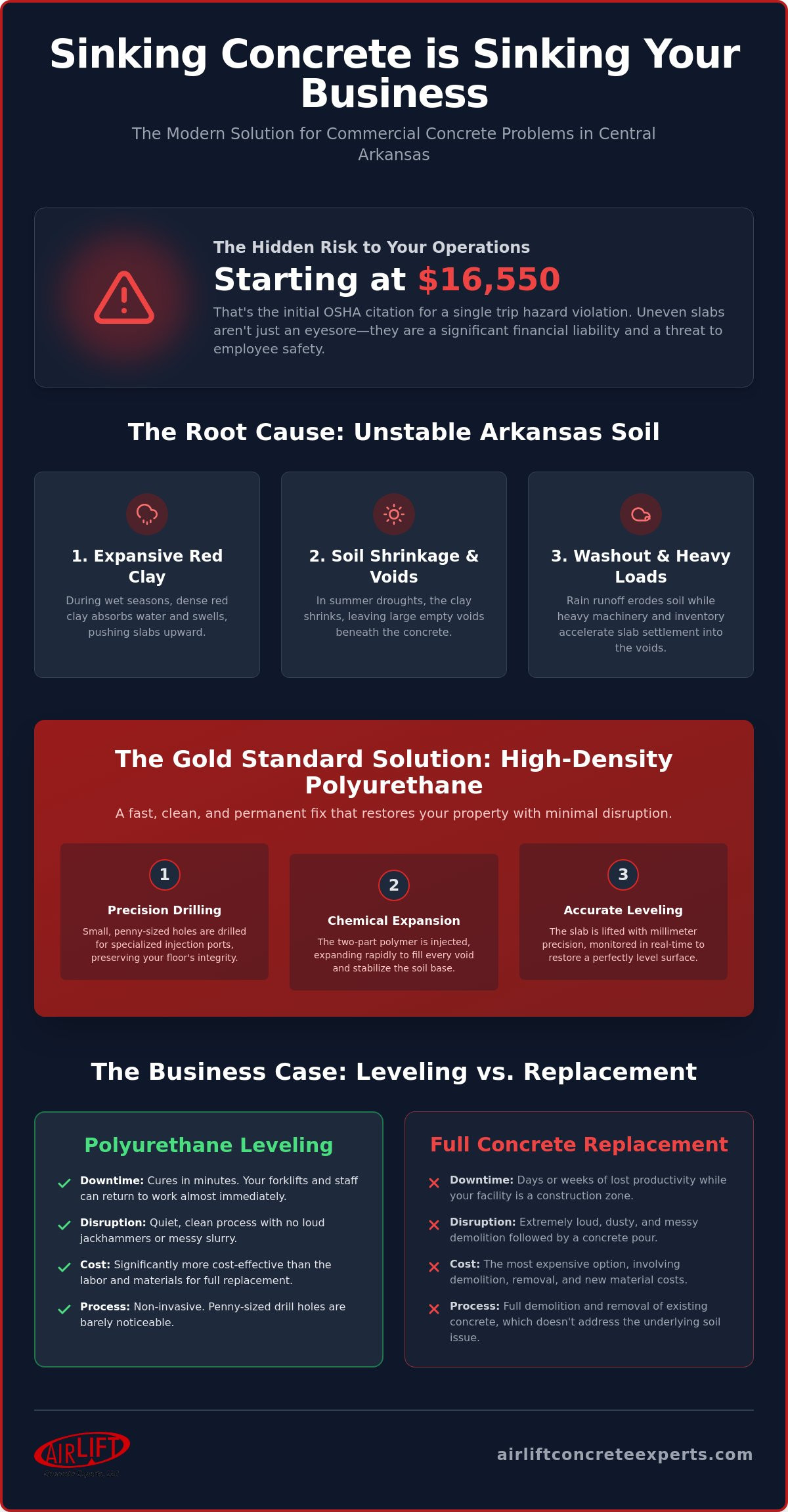
Safety in a commercial environment is a matter of precision. According to current 2026 OSHA standards for walking and working surfaces, any height difference greater than 1/8 inch is classified as a trip hazard. For facility managers in Pulaski and Saline counties, these aren’t just suggestions; they’re strict mandates with significant financial consequences. A standard citation for a trip hazard violation now starts at approximately $16,550. If the violation is deemed willful or a repeat offense, that figure can climb as high as $165,514 per instance. Utilizing professional commercial concrete lifting Little Rock ensures your property remains compliant and your employees stay safe from preventable workplace injuries.
Liability extends beyond federal fines. In public-facing areas of Benton and Little Rock, uneven concrete creates a massive insurance risk. If a customer trips on a sunken sidewalk or an unlevel threshold, your business could face litigation that far exceeds the cost of a simple repair. Maintaining ADA compliance is equally vital. Accessible routes must remain level and stable to accommodate wheelchairs and mobility aids. Ignoring these structural shifts doesn’t just invite legal trouble; it signals a lack of care for your community and your staff. Keeping your surfaces level is a proactive way to protect your brand’s reputation and your bottom line.
Loading docks and threshold entries are typically the first areas to show signs of failure. The constant vibration from heavy trailers and the repetitive impact of pallet jacks accelerate soil compaction. You should also check the slabs beneath heavy equipment pads or industrial server room floors. Voids in these areas can lead to machinery misalignment or structural cracking. Look for visual cues like separating expansion joints or cracks in the brickwork above garage doors. These symptoms often indicate that the sub-grade soil has shifted and the slab is no longer properly supported.
Don’t wait for an OSHA inspector to find a problem. Scheduling annual slab inspections allows you to catch micro-settlement before it becomes a dangerous hazard. We often find that small voids can be filled quickly, preventing the need for more extensive repairs later. Proper drainage is also essential. Ensure that gutters and downspouts direct water away from your commercial slabs to prevent the soil washout we discussed earlier. If you’re seeing signs of broader structural movement beyond your floor slabs, it’s wise to consult a specialist in Foundation Repair Near Me to evaluate the stability of your entire facility.
Our team understands the specific building codes in Benton and Little Rock, including the 2012 Arkansas Fire Prevention Code requirements. We provide the technical expertise needed to bring your facility back into compliance with minimal disruption. If you’re concerned about a potential trip hazard on your property, you can schedule a professional site assessment to get a clear, honest evaluation of your concrete’s condition and a plan for permanent stabilization.
Since 2017, Airlift Concrete Experts has served as a reliable partner for businesses across Central Arkansas. We’ve built our reputation on a foundation of technical precision and honest, neighborly communication. When you choose us for commercial concrete lifting Little Rock, you aren’t just hiring a contractor; you’re partnering with a local team that understands the specific structural demands of our region. Our high-density polyurethane method has become the definitive choice for Arkansas industry because it addresses the root cause of slab instability without the mess or delays of traditional construction. We focus on providing a stable, long-term solution that lets you get back to work with total peace of mind.
Being a family-owned and operated business means we treat every commercial project like we’re working for a neighbor. We’ve spent years studying the unique behavior of Pulaski and Saline County soils. We know exactly how the local red clay reacts to our humid springs and dry summers. This deep regional experience allows us to anticipate challenges that national competitors might overlook. Local warehouse operators and property managers often tell us that our straightforward, solution-oriented approach gives them the security they need to focus on their own operations. We don’t use flashy marketing gimmicks. We use proven technology and hard work to stabilize your facility. Our team is committed to the community because we live here too, and we take pride in keeping our local economy moving on solid ground.
Every successful repair begins with a thorough understanding of the problem. Our site evaluations are professional, non-invasive, and designed to provide you with a clear roadmap for restoration. During this assessment, we examine the specific traffic patterns of your loading docks, the weight requirements of your machinery, and the extent of the voids beneath your slabs. We then develop a customized plan tailored to your facility’s unique needs. If you’re searching for Polyjacking Near Me, you’ll find that our team offers the most advanced equipment and methods available in the Little Rock metro area. This initial step is vital for ensuring that the injection process target the exact areas of soil failure.
We believe in transparency throughout the entire process. You’ll receive a detailed explanation of the injection method and a predictable timeline for completion. Our goal is to transform your anxiety about structural safety into a sense of confidence in your property’s long-term stability. We’re here to help you maintain a safe, level environment for your team while protecting your capital investment from the risks of commercial concrete lifting Little Rock issues. Contact us today to schedule your complimentary initial assessment and see why so many Central Arkansas businesses trust Airlift to keep their operations level and safe.
Maintaining a safe and efficient commercial property requires more than just reactive fixes. We’ve seen how Arkansas’s volatile red clay can undermine even the most robust slabs; however, you don’t have to settle for the high costs and long delays of traditional concrete replacement. By choosing high-density polyurethane injection, you ensure your facility remains compliant with strict 2026 OSHA standards while eliminating the trip hazards that threaten your team and your bottom line. This modern approach provides a durable, eco-friendly solution that supports heavy machinery and high-volume traffic without disrupting your daily operations. For property owners managing recreational venues or resorts, once your grounds are stabilized, you can explore Commercial Inflatable Water Park Sales and Custom Design to further enhance your facility’s appeal.
Airlift Concrete Experts has been family-owned and operated in Arkansas since 2017. We specialize in high-density commercial concrete lifting Little Rock projects, bringing technical expertise and neighborly service to every job site. We understand the pressure of managing a busy facility, and we’re here to provide the stable foundation you need to grow. Take the first step toward a safer property today and Request Your Free Commercial Slab Assessment in Little Rock. We look forward to helping you protect your capital investment with a level of precision you can trust and the peace of mind you deserve.
Most commercial projects are completed within a single working day. While the exact timeline depends on the size of the area, the injection process itself is efficient. Since the material reaches nearly its full structural strength in under 30 minutes, your facility can return to normal operations almost immediately after we pack up our equipment. This is a massive advantage for businesses that can’t afford the multi-day delays of traditional repairs.
Yes, high-density polyurethane is specifically engineered to handle the intense pressure of industrial environments. It’s the same material used to stabilize bridge approaches and highway slabs. It easily supports the weight of fully loaded forklifts, heavy manufacturing machinery, and high-density storage racking. The foam doesn’t just lift the slab; it creates a stable, rigid base that resists compression under heavy daily use.
Leveling is a much more cost-effective alternative to a full tear-out and pour. You avoid the high costs of demolition, debris disposal, and the rising price of new concrete materials. Beyond the direct invoice, the real savings come from avoiding business interruption. You won’t lose weeks of revenue waiting for new concrete to cure, which makes leveling the smarter financial choice for most Benton property owners.
The process is incredibly clean and non-invasive. We only drill small, 5/8-inch holes, which are about the size of a penny, to inject the foam. Our primary equipment remains in a truck outside your building, with only a single hose running to the repair area. This eliminates the dust, loud jackhammering, and heavy debris that usually make interior repairs a logistical nightmare for active businesses.
Look for doors that suddenly stick, gaps appearing between the floor and the walls, or visible tilting in your loading dock areas. In Central Arkansas, you’ll often see “stair-step” cracks in exterior brickwork or water pooling in areas that used to drain properly. These symptoms suggest the soil has shifted beneath your foundation, creating voids that require professional stabilization to prevent further structural damage.
Polyurethane is considered a permanent solution for structural stabilization. It’s a closed-cell polymer that doesn’t biodegrade, shrink, or wash away when exposed to groundwater. Once the foam expands and hardens, it remains in place indefinitely. As long as you maintain proper drainage around your facility to prevent new soil erosion, the stabilized surface will continue to support your commercial traffic for the life of the concrete.
The high-density foam used for commercial concrete lifting Little Rock is an environmentally responsible choice. It’s a stable material that doesn’t leach harmful chemicals into the surrounding Pulaski County soil. Additionally, by choosing to lift your existing slabs rather than replacing them, you’re keeping tons of heavy concrete waste out of local landfills and reducing the carbon footprint associated with new concrete production.
Full shutdowns are almost never required. We pride ourselves on being a flexible partner for local industry, and we can often work in sections to keep your floor space accessible. We can also schedule our crew during your off-hours or weekend shifts to ensure your productivity remains at 100%. Your team can typically walk or drive on the repaired surface as soon as we finish the injection.

 Call Now