

Winter doesn’t automatically put concrete leveling on hold. If you’re asking, “can you level a concrete slab in the winter,” the answer depends on conditions at the site, not just the calendar. Frozen soil can shift as it thaws, so lifting a slab before the ground settles may leave it uneven again.
It’s understandable to wonder whether cold weather could affect a repair, especially when a raised edge or sunken walkway creates a trip concern. Air temperature alone doesn’t tell the whole story. The ground, slab location, forecast, and leveling method all matter.
This guide explains what to consider before scheduling winter concrete leveling, including why an exterior slab can face different challenges than an interior floor. You’ll learn what to ask a contractor about site conditions and polyurethane leveling, and how an assessment can help you decide whether to proceed or wait. For property owners in Malvern, Hot Springs, Little Rock, and other Central Arkansas communities, the first step is to evaluate the slab and the ground beneath it.
Yes, winter concrete leveling may be possible, but site conditions determine whether work is suitable. The question “can you level a concrete slab in the winter” can’t be answered reliably by the season or air temperature alone. A contractor needs to assess the slab and the ground and conditions around it.
Key principle: assess the slab, the ground beneath it, and the weather together before deciding whether to lift it.
Concrete leveling raises an existing slab that has settled, bringing it closer to an even position. It’s a repair, not the same as pouring new concrete. With polyurethane concrete leveling, a professional injects foam beneath a sunken slab to help raise and support it. The method isn’t right for every winter situation, so suitability depends on the site and the contractor’s process.
An assessment can consider the slab’s condition, the soil beneath it, equipment access, and current site conditions. Airlift Concrete Experts provides concrete leveling and raising for residential and commercial properties in Arkansas.
Air temperature is only one factor. The slab’s temperature and the condition of the subgrade, the soil beneath the concrete, also matter. A sunny afternoon may warm the surface while the soil below remains cold or frozen. Recent rain or melting snow can leave the ground wet even after the air turns colder.
One winter-related process is frost heaving, when freezing moisture in susceptible soil can cause upward movement. If changing ground conditions have affected a slab’s position, lifting it without understanding those conditions may not address the underlying issue. A professional should evaluate whether the slab and soil can be assessed reliably at that time.
Equipment and material requirements vary by leveling method and job conditions. Ask whether the specific materials and equipment can be used at your site, and what conditions might prompt a reschedule. Airlift’s polyurethane leveling is an option for raising existing slabs, but winter availability and suitability need to be confirmed for each project. An assessment can help you decide whether to proceed, plan work for later, or wait for more suitable conditions.
Winter conditions involve more than the temperature on a forecast. Air temperature, the concrete slab’s temperature, and the subgrade beneath it are related, but each tells a contractor something different. A sunny afternoon may warm the concrete surface while the soil below remains cold or frozen. Recent rain or melting snow can also leave the ground wet after the air turns colder.
Frozen or waterlogged ground can make it harder to judge what is supporting a slab and how its position may change. That’s why a site-specific evaluation matters more than a single temperature reading.
Frozen ground can make it harder to evaluate the soil and the slab’s current position. If freezing has changed the ground’s shape or firmness, the slab’s level today may not reflect how it will sit after a thaw. That doesn’t mean every frozen site rules out foam injection or guarantees a repair will fail. The effect depends on the slab, the ground, and the repair plan.
Ask the contractor what they observe beneath or around the slab, how those conditions affect the proposed work, and whether waiting could allow a more dependable assessment. A clear explanation should connect the site findings to the recommendation.
Soil conditions can change as moisture freezes, thaws, and moves through the ground. A freeze-thaw cycle may contribute to shifting, but its effect depends on factors such as soil, drainage, and local weather. Not every cold snap creates the same risk, and visible unevenness alone doesn’t confirm that freezing caused the problem.
Before an assessment, note what you can see and when it happens:
These observations can help a professional investigate possible contributing conditions without treating them as a confirmed cause. If a sunken driveway, sidewalk, or other slab in Arkansas concerns you, ask Airlift Concrete Experts about concrete leveling and how current ground and weather conditions may affect an assessment.
Winter doesn’t automatically rule out an assessment or repair. The practical question is whether the slab, ground, access, and proposed materials can be evaluated and handled under current conditions. Use the comparison below to guide a discussion with a concrete leveling professional, not as a do-it-yourself decision or a promise that work can proceed.
| Conditions to discuss for possible work | Reasons to reassess or wait |
|---|---|
| The slab is accessible, and the contractor can inspect its edges, surface, and surroundings. | Ice, standing water, or snow prevents a clear inspection or makes access unsafe. |
| You can describe whether the slab seems stable or has changed, and share photos of uneven edges or gaps. | The slab’s movement is unclear, or its position may be affected by changing ground conditions. |
| Drainage paths and recent water issues are visible and can be discussed during the assessment. | Water is pooling near the slab, or the ground appears frozen, saturated, or otherwise difficult to evaluate. |
| The contractor confirms that the proposed materials and equipment suit the site conditions. | The contractor can’t verify that material or equipment requirements can be met at the site. |
A clear path to the slab and visible areas to inspect can help a contractor evaluate the site, even in cold weather. Before scheduling, gather photos of the slab and its edges, note its location, and mention any recent pooling water or changes you’ve observed. The contractor still needs to confirm whether the ground, materials, and equipment are suitable for the job.
Ice, standing water, frozen ground, or unsafe access are reasons to pause and ask for a professional recommendation. If the contractor can’t confirm suitable conditions or confidently assess the slab’s position, postponing may be prudent. Ask what needs to change before the site can be evaluated again instead of relying on a date or forecast alone.
If you’re wondering, “can you level a concrete slab in the winter,” treat the calendar as context, not a decision rule. A site assessment can clarify whether the slab is a candidate for work now or whether waiting would allow a more reliable evaluation.
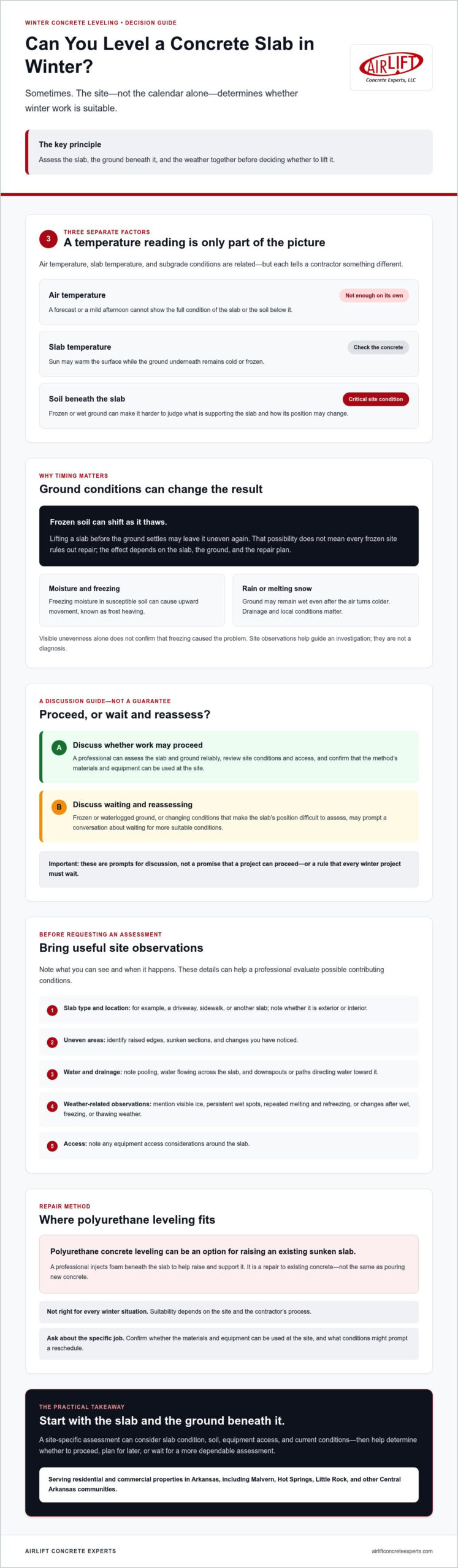
A little preparation can make a winter assessment more useful. Follow this checklist and share what you observe rather than trying to diagnose the cause yourself.
If you want to understand the repair process before speaking with a contractor, read about polyurethane concrete leveling and how it can raise existing sunken slabs. The method’s suitability still depends on the slab and site conditions.
Likewise, if winter weather or severe freeze-thaw cycles have contributed to broader exterior issues across your property, Fox Claims Consultants provides professional property inspection and storm damage assessment services to help document and evaluate the damage.
Ask what conditions they’ll check to decide whether work can proceed on the scheduled day. Find out how they evaluate the soil, drainage, slab condition, and access, and whether cold or moisture affects the materials and equipment they plan to use. Ask what findings would lead them to recommend waiting or considering a different repair approach. A clear answer should relate to your site, not just the season.
Make the area reasonably accessible only if you can do so safely. Take photos showing the whole slab and close views of uneven joints, trip edges, water accumulation, and nearby drainage features. Note when the issue appeared and whether you’ve seen changes after rain, freezing weather, or a thaw. These details help the professional focus the assessment.
Still asking, “can you level a concrete slab in the winter”? A site assessment is the practical next step to determine whether your slab and current conditions are suitable. Request an assessment for concrete leveling from Airlift Concrete Experts to discuss the slab, its location, and the conditions you’ve observed.
For property owners in Malvern, Hot Springs, Little Rock, and nearby Central Arkansas communities, winter slab concerns call for a local, site-specific evaluation. Airlift Concrete Experts provides residential and commercial concrete leveling and raising across Arkansas. The company focuses on lifting and repairing existing concrete, not pouring new slabs.
Polyurethane concrete leveling may be an option for a settled slab, but that doesn’t mean a winter repair can proceed in every case. Current ground and weather conditions, the slab’s condition, and access to the work area all factor into the decision. If you’re asking, “can you level a concrete slab in the winter,” an assessment can help determine whether to proceed, monitor the issue, or revisit it when conditions change.
A professional can assess a sunken driveway, uneven sidewalk, pool deck, interior floor, or commercial concrete area to determine whether lifting may be appropriate. Airlift’s services include polyurethane concrete leveling, concrete raising, interior floor leveling, pool deck repair, and commercial concrete lifting. For an overview of how lifting compares with other repair options, look for a guide to concrete lifting; the right approach depends on the slab and its condition.
When interior slab settling or uneven subfloors are discovered during larger structural updates or additions, firms like Vancouver General Contractors illustrate how professional builders coordinate foundation leveling with comprehensive home remodeling.
Start by describing what you’ve noticed: where the slab is, how its edges or joints look, whether it seems to have changed, and whether water collects nearby. The assessment can also consider access and seasonal conditions that may affect the proposed method. Confirm winter work availability directly with the contractor, since it depends on the site and the material and equipment requirements.
Ask whether the best next step is to proceed, monitor the slab, or reschedule for more suitable conditions. A clear recommendation should explain how the observed site conditions inform that choice, rather than treating the season alone as the deciding factor.
If you have an uneven slab in Airlift’s Arkansas service area, contact Airlift Concrete Experts to discuss its condition and whether an assessment makes sense. Winter work isn’t automatically possible or automatically off the table; the site itself should guide the conversation.
So, can you level a concrete slab in the winter? Sometimes, but the season alone can’t answer that. Air temperature, the slab, ground conditions, moisture, and safe access all help determine whether work is suitable. A professional assessment can clarify whether to proceed or wait based on what’s happening at your property.
Airlift Concrete Experts provides polyurethane concrete leveling and raising for residential and commercial properties across Arkansas. The family-owned company was founded in 2017 and serves communities including Malvern and the Central Arkansas area. Winter availability depends on site conditions, so ask the team how they affect your slab and the proposed repair.
If an uneven driveway, sidewalk, pool deck, or other slab concerns you, start by discussing what you’ve observed. Request a concrete slab assessment and ask whether an evaluation makes sense for your property. Clear information about the slab and its surroundings can help you make an informed decision about what to do next.
Sometimes. The answer to “can you level a concrete slab in the winter” depends on the slab, the ground beneath it, site access, and whether the contractor can use the proposed materials and equipment under current conditions. Cold air alone doesn’t determine suitability. A professional assessment can help establish whether the slab can be evaluated reliably now or whether waiting is more appropriate.
It may be possible under some cold-weather conditions, but freezing air alone doesn’t establish whether a specific job can proceed. The ground, slab, moisture, equipment, and material requirements all need consideration. Ask the contractor how they assess those factors and whether the method is suitable for your site. Airlift Concrete Experts provides polyurethane concrete leveling, but confirm current winter availability directly with the company.
Frozen soil can make it harder to judge what is supporting the slab and whether its current position will remain stable after a thaw. If the ground has shifted during freezing, lifting the concrete before conditions settle could lead to an inaccurate assessment. Frozen soil doesn’t automatically mean every repair is impossible, but it’s a condition to discuss with a contractor before deciding whether to proceed or wait.
Possibly, if a professional finds the slab and site conditions suitable. A contractor may need to consider the ground, drainage, visible ice or water, access, and the proposed materials and equipment. Share photos of uneven edges or joints, along with any recent changes you’ve noticed. Airlift Concrete Experts provides sidewalk and driveway leveling in Arkansas, but winter suitability needs to be confirmed for the specific site.
Not automatically. A site assessment can help determine whether current conditions allow a reliable evaluation or whether postponing makes more sense. Ice, standing water, frozen ground, or unsafe access may be reasons to reassess timing, but the calendar alone can’t settle the question. Ask the contractor what they observed, what conditions need to change, and whether to proceed, monitor the slab, or schedule a later assessment.
Freeze-thaw cycles can change soil conditions as moisture freezes and later thaws. Depending on the soil and drainage, this movement may contribute to shifting beneath or around a slab. Effects vary by site, so a change in slab height doesn’t prove freezing caused it. Note any pooling water and whether the slab’s position seems different after wet, freezing, or thawing weather, then share those observations with a professional.
Ask what site conditions determine whether work can proceed on the scheduled day, and how the contractor will evaluate the slab, soil, drainage, and access. Confirm how cold and moisture affect the proposed materials and equipment, and what would prompt a recommendation to wait. Airlift Concrete Experts serves Malvern, Hot Springs, Little Rock, Cabot, Conway, Benton, Bryant, North Little Rock, Sherwood, Jacksonville, and Hot Springs Village.

 Call Now