
The newest repair method isn’t automatically the right one for every slab. Still, the benefits of polyjacking over mudjacking can matter when smaller injection points, lighter lifting material, and less downtime suit the site. If a driveway, sidewalk, or pool deck has settled, it’s reasonable to look for a repair that works without creating more disruption than necessary.
Polyjacking uses expanding polyurethane foam, while mudjacking pumps a cement-based slurry beneath the concrete. Polyurethane can offer practical advantages, including smaller access holes and a potentially faster return to use. The result still depends on the slab, the material beneath it, and the contractor’s technique. Neither method is designed to repair a broken slab or address structural foundation settlement.
This comparison explains how the methods differ, when polyjacking may be a good fit, and what limitations to consider. You’ll also find questions to ask about site conditions, access-hole placement, curing, and the cause of settlement before approving work. For Arkansas property owners, a local concrete-lifting professional can assess the existing surface and help determine whether lifting is appropriate.
Uneven concrete can make a sidewalk harder to navigate, leave water pooling near a driveway, or create a trip concern at a pool deck or entry. The visible dip alone doesn’t determine which repair approach is suitable. The benefits of polyjacking over mudjacking come down to how each material is placed beneath the slab and whether those differences suit the concrete and site conditions.
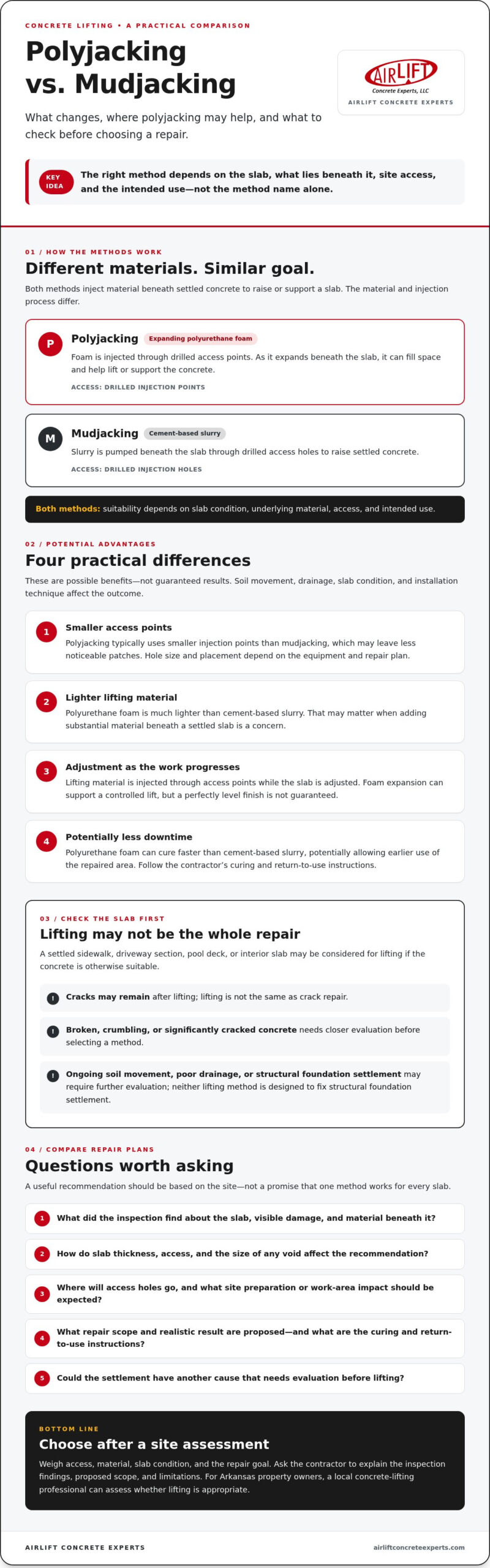
Polyjacking injects expanding polyurethane foam beneath a concrete slab to raise or support it. A contractor injects the foam through drilled access points. As it expands, it can fill space beneath the slab and help lift it. Mudjacking pumps a cement-based slurry beneath a slab through drilled access holes to raise settled concrete. The materials and installation methods differ, so foam and slurry shouldn’t be treated as interchangeable. For a neutral overview of these approaches, see Concrete leveling.
| Factor | Polyjacking | Mudjacking |
|---|---|---|
| Material | Expanding polyurethane foam | Cement-based slurry |
| Injection approach | Foam is injected beneath the slab and expands | Slurry is pumped beneath the slab |
| Access points | Drilled points for foam injection | Drilled holes for slurry injection |
| Key decision factors | Slab condition, underlying material, access, and intended use | The same site-specific factors, assessed for the proposed method |
The table describes general differences, not a guaranteed result. The appropriate method depends on the slab’s condition, what lies beneath it, and a professional’s assessment of the repair.
Both methods may be considered for settled, otherwise suitable concrete, such as a sunken sidewalk panel, driveway section, pool deck, or interior slab. The goal is to lift or support settled concrete, not to repair every kind of damage. A crack may remain after lifting. A slab that’s broken, crumbling, or shifting for more than one possible reason needs closer evaluation before a method is selected.
For property owners in Little Rock, a site assessment can help clarify whether the slab itself can be lifted and what may be contributing to the settlement. Ask the professional to explain what they observed beneath and around the concrete, not just which material they plan to inject. If movement points to a larger structural issue, concrete lifting may not be the right repair.
The benefits of polyjacking over mudjacking are most relevant when the repair needs to limit access points, reduce added weight beneath the slab, or minimize interruption to the area. These are potential advantages, not guaranteed results. Soil movement, drainage, slab condition, and installation technique all affect how a repair performs.
Polyjacking typically uses smaller injection points than mudjacking, which may leave less noticeable patches in the concrete. The exact hole size and placement depend on the contractor’s equipment and repair plan, so ask what to expect for your slab. Smaller holes don’t mean there will be no worksite impact. Crews still need access to the area, and landscaping, nearby structures, and site preparation can affect the work.
Polyurethane foam is much lighter than the cement-based slurry used in mudjacking. That difference may be useful where adding substantial material beneath a settled slab is a concern. The foam still needs to suit the application, and adding material alone won’t correct ongoing soil movement or poor drainage. Ask the contractor how they evaluated the underlying conditions and selected the repair approach.
Contractors inject lifting material through access points and adjust the slab as the repair progresses. Polyurethane foam’s expansion can support a controlled lift, but it doesn’t guarantee a perfectly level finish. Existing slopes, joints, cracks, and the slab’s condition influence the achievable result. A clear repair plan should explain which sections will be raised and what outcome is realistic.
Polyurethane foam can cure faster than cement-based slurry, potentially allowing earlier use of the repaired area. The actual wait depends on the material, site conditions, and contractor’s instructions. Before work begins, ask when people, vehicles, or equipment can return to the surface. Follow guidance for your specific project rather than relying on a general estimate.
Polyjacking may offer smaller access points, lighter lifting material, and a quicker return to use, but performance and timing depend on the slab, site conditions, and contractor’s process. For a Little Rock sidewalk, driveway, pool deck, or interior floor, compare the proposed method with the cause of settlement and the condition of the concrete. A local polyurethane concrete leveling assessment can help clarify whether lifting is appropriate and what work the site requires.
Polyjacking may suit a slab when its condition, available access, and repair goals align with polyurethane foam injection. But method selection shouldn’t rest on a single advantage. A thin or badly damaged panel, an extensive void, limited equipment access, or the surface’s intended use can all affect what a contractor recommends.
A useful assessment looks beyond the low spot. The contractor should review the slab’s thickness and condition, the pattern of settlement, visible cracks, possible voids, drainage, soil support, and space to position equipment. Ask whether the concrete is sound enough to lift and what evidence supports the proposed cause. Pooling water or a sloping driveway is an observed symptom; it doesn’t, by itself, prove why the slab moved.
For a Little Rock sidewalk, driveway, pool deck, or interior slab, consider asking:
These questions help distinguish inspection findings from assumptions and make recommendations easier to compare.
Mudjacking can remain an option if its cement-based material and installation process fit the slab, access, and site conditions. Polyjacking isn’t automatically the better choice for every project. A contractor should explain why the recommended method suits the repair, including any relevant limits of the slab or work area.
Significant cracking, crumbling, or continued movement calls for further evaluation before lifting is approved. Either lifting method addresses settled concrete, not the underlying cause of recurring soil or water movement. If a slab is too damaged or otherwise unsuitable to lift, a different repair plan may be appropriate. Replacement shouldn’t be assumed without a qualified assessment.
The practical benefits of polyjacking over mudjacking matter most when they match the site’s needs and the concrete can be lifted. For more background on the method, read this polyurethane concrete leveling guide.
A quote is useful only if it explains what the contractor observed and how the proposed repair responds to it. The potential benefits of polyjacking over mudjacking matter, but a lower price or a preferred material alone can’t show whether the work fits your slab. Compare inspection findings and repair scope side by side, then ask for anything unclear in writing.
Use this checklist to review each recommendation for a settled driveway, sidewalk, pool deck, or interior slab in Little Rock or nearby:
These details help you compare recommendations beyond the headline total. If a quote doesn’t explain the inspection or scope, you may not know whether the contractor has accounted for the actual site conditions. For broader background on repair options, see the concrete lifting homeowner guide.
Soil moisture, drainage, and changing support beneath a slab can be relevant to settlement, but the cause should be assessed at the property rather than guessed from its location. Ask how the contractor evaluated water flow, soil support, and any voids beneath the concrete. A local assessment can connect those observations to a practical repair plan without assuming a specific soil type.
For properties in Malvern, Little Rock, and surrounding Central Arkansas communities, request recommendations that address the slab and its site, not just the chosen material. Airlift Concrete Experts provides polyurethane concrete leveling and raising in Arkansas. Request an assessment of your settled concrete to discuss whether lifting may suit the surface.
Choosing between polyjacking and mudjacking starts with the concrete and the conditions around it, not a general claim that one method is always better. Compare the slab’s condition, access constraints, underlying support, and what you need the repaired surface to do. Then ask the contractor to explain why the recommended method fits those findings.
A contractor should examine where and how the slab has settled, its visible condition, access for equipment, and the surrounding surface. Share any patterns you’ve noticed, such as water collecting beside a driveway or recurring movement near a sidewalk. Those details can guide the inspection, but the recommendation should be based on what the contractor observes at your property, not a generic claim about foam or slurry.
Ask the professional to explain what they found, what the proposed lifting work can address, and what it won’t correct. Polyjacking may offer practical advantages in suitable conditions, but it isn’t a universal solution or a permanent guarantee. The polyjacking service guide offers more information about the process and can help you prepare questions.
An assessment may be useful if an existing sidewalk, driveway, pool deck, or interior concrete floor has become uneven or settled. A specialist can evaluate whether the slab may be a candidate for lifting and explain possible next steps. Mention cracks, crumbling, drainage concerns, or repeated movement so the contractor can consider them during the site review.
Airlift Concrete Experts provides polyurethane concrete leveling and raising for residential and commercial properties throughout Arkansas. The company serves communities including Malvern, Hot Springs, Little Rock, Cabot, Conway, Benton, Bryant, North Little Rock, Sherwood, Jacksonville, and Hot Springs Village. Confirm availability for your property.
Once you’ve reviewed the slab, site constraints, repair goals, and contractor’s reasoning, you’ll be in a better position to weigh the benefits of polyjacking over mudjacking for your situation. If you’re considering lifting in Arkansas, contact Airlift to discuss your concrete and possible next steps. A conversation can help clarify what to assess, without assuming that every slab should be lifted.
The benefits of polyjacking over mudjacking can include smaller access points, lighter lifting material, and less waiting before the surface can be used. Whether those advantages matter for your project depends on the slab, site conditions, and repair goals. A careful assessment and a clear explanation of the proposed work can help you compare options without relying on broad promises.
Airlift Concrete Experts is a family-owned and operated Arkansas business founded in 2017. The team specializes in polyurethane concrete leveling and raising for residential and commercial properties. An assessment can help determine whether lifting is appropriate for your sidewalk, driveway, pool deck, interior floor, or other existing concrete.
Contact Airlift Concrete Experts to discuss your settled concrete and possible next steps. A site-specific recommendation can help clarify what your surface may need.
The main benefits of polyjacking over mudjacking may include smaller access holes, lighter lifting material, and a potentially quicker return to use. Polyurethane foam is injected beneath the slab, where it expands to support or raise it. These advantages can reduce some aspects of site disruption, but they don’t guarantee a particular result. Slab condition, soil support, drainage, and the contractor’s technique all matter.
No. Polyjacking isn’t the best choice for every slab, and mudjacking may suit some projects depending on the material, site access, and repair needs. A contractor should inspect the concrete, settlement pattern, underlying support, and intended use before recommending a method. Slabs that are badly cracked, crumbling, or still moving may need further evaluation. Compare the inspection findings and repair plan rather than relying on a general claim.
Polyjacking works by injecting polyurethane foam through drilled access points beneath a settled concrete slab. The foam expands into the space below, helping support or raise the concrete. The contractor controls the injection as the slab is adjusted, but the achievable result depends on the slab and site conditions. Ask what the process involves for your surface, including preparation, access-point locations, and instructions for using the area afterward.
Typically, yes. Polyjacking generally uses smaller injection holes than mudjacking, which can mean less noticeable patching after the work. Exact hole size and placement depend on the contractor’s equipment and repair plan, so ask what to expect for your slab. Smaller access points don’t make a project mess-free. The work area, equipment access, landscaping, and crew practices can all affect disruption.
There isn’t one lifespan that applies to every polyjacking or mudjacking repair. How long a lift performs depends on the slab’s condition, soil support, drainage, continued ground movement, and the quality of the installation. Ask contractors what factors could affect the repair at your property and whether their recommendations address the cause of settlement. Treat broad lifespan claims cautiously, since neither method comes with a universal performance guarantee.
Polyjacking can lift or support suitable settled concrete, but it doesn’t repair every crack or make a severely damaged slab structurally sound. Crumbling concrete, major breaks, or repeated movement may require further evaluation before lifting is considered. Ask the contractor whether the slab is sound enough to raise and which issues the proposed work will address. A site assessment can help determine whether lifting is appropriate or another repair plan is needed.
It may be suitable for settled Arkansas driveways and sidewalks if the slab is in appropriate condition and the site supports the repair method. A professional should assess the concrete, access, drainage, and underlying support rather than assume a method based only on location. Airlift Concrete Experts provides polyurethane concrete leveling and sidewalk and driveway leveling in Arkansas. A site-specific assessment can clarify whether lifting fits your property.
Choose a contractor who inspects the slab, explains the evidence behind their recommendation, and provides a clear written scope, material, access plan, preparation details, and return-to-use instructions. Ask how they considered drainage and any recurring settlement, and confirm service availability for your address. Airlift Concrete Experts serves Arkansas communities including Malvern, Hot Springs, Little Rock, Cabot, Conway, Benton, Bryant, North Little Rock, Sherwood, Jacksonville, and Hot Springs Village. Coverage can vary by location.

 Call Now