
Replacing every uneven sidewalk slab may seem like the safest way to address trip hazards, but some settled sections may be candidates for lifting instead. Concrete leveling for municipal sidewalks can raise suitable slabs while preserving usable concrete. The right choice depends on each section’s condition and the access the route needs to provide.
Uneven sidewalks can affect public access, so repair budgets and disruption make it important to set a practical scope. Polyurethane lifting isn’t the answer for every slab. A sound plan starts with assessing the hazards, the concrete, and the conditions beneath it.
This guide explains how Arkansas communities can evaluate sidewalk problems, compare polyurethane lifting with cutting and replacement, and plan work around site conditions. Airlift Concrete Experts provides commercial concrete lifting and sidewalk leveling across Arkansas, including Malvern, Hot Springs, Little Rock, and Conway. Use the steps below to decide where lifting may fit and where another repair approach may be more appropriate.
For public works teams, uneven sidewalks pose a practical challenge: identify the concern, decide how urgently to address it, and select a repair suited to the site. A raised joint, settled panel, crack, or abrupt surface change can affect pedestrian movement. Appearance alone, however, doesn’t show why the slab shifted or which repair will work. Concrete leveling raises a settled slab by placing stabilizing material beneath it. It may suit some slabs, but it isn’t a solution for every sidewalk condition.
Two kinds of assessment are useful. The responsible public authority reviews accessibility and applicable local criteria. A concrete repair assessment examines the slab and its support to help determine whether lifting or another repair approach is suitable. These reviews inform one another, but a contractor’s assessment doesn’t replace the authority’s accessibility review. For background on methods used to raise concrete, see this overview of concrete leveling.
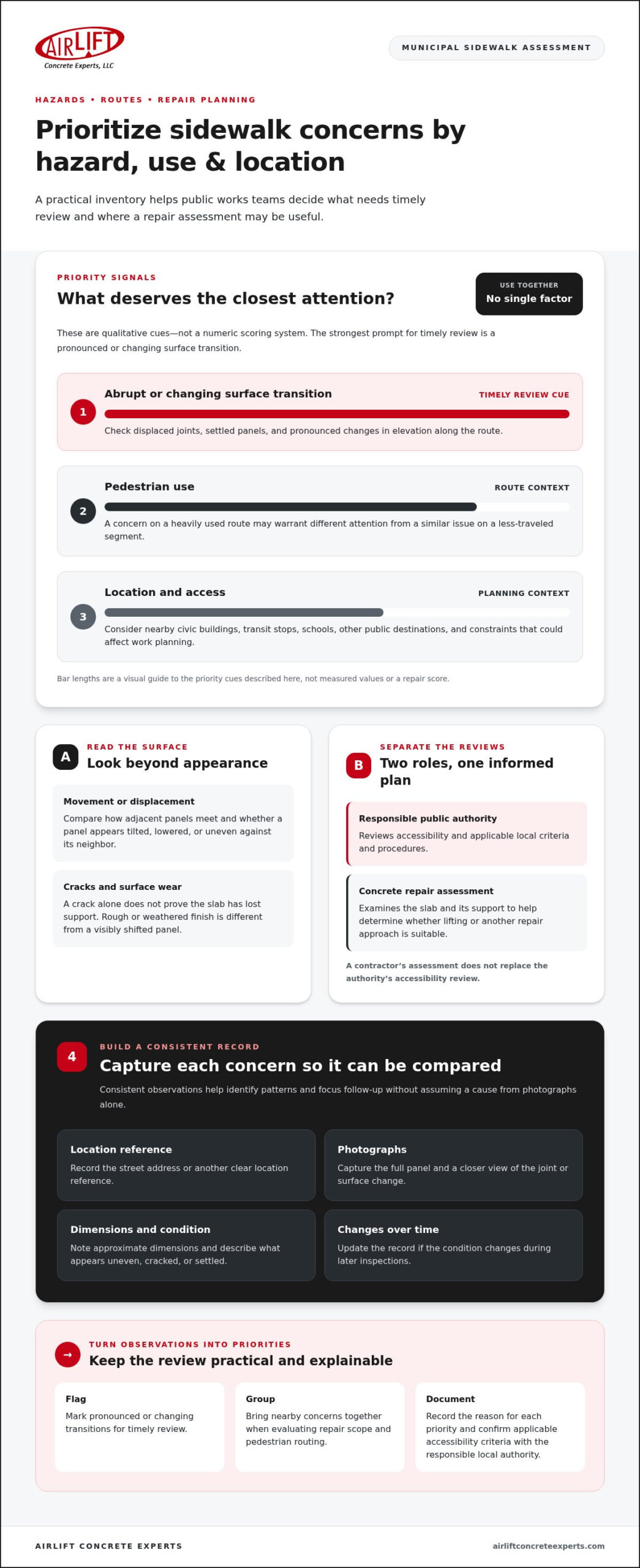
Check how adjacent panels meet and how the surface changes along the pedestrian route. A displaced joint or settled panel can create an abrupt transition underfoot. Cracks may accompany movement, but a crack alone doesn’t prove that the slab has lost support. Surface wear, such as a rough or weathered finish, is also different from a panel that appears tilted, lowered, or uneven against its neighbor.
Record observations consistently so the team can compare locations and plan follow-up:
Consistent records help identify patterns and focus repair assessments without assuming a cause from photographs alone.
Organize recorded issues by pedestrian use, apparent hazard, and location. A concern on a heavily used route may warrant different attention from a similar observation on a less-traveled segment. Include routes near civic buildings, transit stops, schools, and other public destinations when relevant. Note nearby access constraints that could affect work planning.
Keep the criteria practical and consistent:
Before setting project priorities, confirm applicable accessibility criteria and procedures with the responsible local authority. A documented inventory gives that review a useful starting point and helps direct repair attention where it can best support accessible public routes.
Polyurethane concrete leveling uses injected high-density foam to raise a sunken concrete slab. For a municipal sidewalk, the goal is to lift a suitable panel by filling space beneath it and improving its support, not to disguise surface damage. The method can address some settled slabs, but it doesn’t rebuild concrete that is broken apart or missing.
Slab lifting raises settled concrete from below; surface cutting grinds down a raised edge, while replacement removes and repours a panel. Each approach addresses a different condition. The Federal Highway Administration’s overview of concrete pavement rehabilitation and preservation treatments provides broader context for evaluating repair strategies. For concrete leveling for municipal sidewalks, a site assessment helps determine whether lifting fits the slab and its surroundings.
The process starts with examining the panel, its edges, and the surrounding concrete. Technicians drill small access holes through the slab and inject polyurethane foam beneath it. As foam enters the space below, they control the injection and monitor the slab’s response, adjusting the work based on observed movement. Access-hole placement and repair scope depend on site conditions.
This sequence is a guide, not a fixed template. A narrow panel beside a curb, a slab near a utility feature, or multiple adjoining sections may call for different access points and scope. The layout should reflect conditions at the site.
Slab integrity matters: the concrete needs enough sound material to be raised without simply breaking apart. The amount and direction of displacement also matter, as does whether neighboring panels have moved or are affected by the same condition. A panel that appears low may have a void beneath it, but surface appearance alone doesn’t establish the size or extent of that space.
Conditions beneath the sidewalk help inform the assessment because the injection plan depends on what lies below the slab. The repair evaluation should consider visible cracks, edges, adjacent concrete, and relevant site constraints together. Don’t assume one panel’s condition represents the entire route. A site-specific review helps determine where lifting may be appropriate and where the slab’s condition calls for another approach.
For Arkansas communities considering a lift in Little Rock or elsewhere in the region, Airlift Concrete Experts provides polyurethane sidewalk leveling for suitable settled slabs, along with commercial concrete lifting.
A sidewalk repair plan doesn’t have to use one method everywhere. In Little Rock, a settled but sound panel may call for a different response than a broken slab or raised edge. Match the repair to the condition and objective at each location, then review the finished route against applicable accessibility requirements.
| Method | Suitable condition | Primary objective | Key limitation |
|---|---|---|---|
| Polyurethane lifting | A settled slab with enough integrity to raise | Lift the panel by injecting foam beneath it | Doesn’t rebuild missing or extensively broken concrete |
| Surface cutting | Certain raised edges or abrupt transitions | Reshape a portion of the concrete surface | Doesn’t lift a settled panel or restore support beneath it |
| Panel replacement | Concrete that is severely broken, missing, or unsuitable for lifting | Remove the damaged panel and install a replacement | Requires removing the existing panel and completing replacement work |
This comparison is a starting point, not a site diagnosis. Concrete leveling for municipal sidewalks is most relevant when a panel has settled but remains intact enough to raise. Cutting changes the surface profile, while replacement addresses concrete that can’t serve its purpose in its current condition.
Consider polyurethane lifting when a sound panel has settled and the objective is to raise it rather than remove or grind down its surface. The assessment should account for the slab’s condition, displacement, adjacent panels, and support beneath it. Suitability depends on the specific sidewalk, so lifting isn’t a universal fix. For a closer look at the injection process, see this polyurethane concrete leveling guide.
Cutting can address certain raised edges by modifying the concrete surface, but it won’t raise a low panel or correct every settlement issue. Replacement may be appropriate when a panel is extensively damaged, partly missing, or otherwise unsuitable for lifting. The right choice depends on what needs correction, the condition of the concrete, and the surrounding site.
Don’t treat the name of a repair method as proof of accessibility compliance. The finished sidewalk and the applicable requirements matter. The responsible authority should review accessibility criteria and project outcomes, while the repair assessment informs which method may fit each panel. A condition-based approach helps teams avoid assuming one technique will address every hazard along a route.
A practical sidewalk project starts with a clear record of what needs attention, where it is, and what the repair should accomplish. For concrete leveling for municipal sidewalks, an organized scope helps public works teams discuss suitable methods, coordinate public access, and review the finished work against applicable local accessibility requirements.
Use a consistent sequence to move from initial observations to a project that can be reviewed and maintained:
Useful records connect a repair concern to a specific place and public need. Include the address, panel location, photographs from more than one view, and notes describing the observed displacement. Add relevant pedestrian access needs and work-area constraints, such as nearby entrances or limited space for routing people around the area. Grouping sites by geography shows how locations relate; grouping them by urgency supports focused priority discussions.
For broader context on concrete raising and repair, the concrete lifting guide explains how lifting fits within concrete repair planning.
Plan pedestrian detours around the needs of each location rather than assuming one routing plan will work everywhere. Consider which entrances, destinations, or sidewalk connections people need to reach, then coordinate public communication and access arrangements with the teams responsible for those locations. Before work begins, document the agreed scope and observable completion criteria, and align acceptance criteria with applicable local accessibility requirements. The responsible authority should confirm those requirements.
After the work, update the location record with what was repaired and note any remaining concerns for follow-up. A clear record supports consistent review and helps staff distinguish completed work from items that still need attention. Airlift Concrete Experts provides sidewalk leveling and commercial concrete lifting for Arkansas projects.
Municipal teams in Little Rock and across Central Arkansas need sidewalk repairs suited to the concrete’s condition and the needs of each public route. Airlift Concrete Experts is a family-owned Arkansas concrete repair company founded in 2017. The company provides polyurethane concrete leveling, sidewalk leveling, and commercial concrete lifting for suitable settled slabs.
Polyurethane leveling uses injected foam beneath a settled panel to raise it. It may suit concrete that remains intact enough to lift, but it isn’t the right answer for every sidewalk. A lifting method alone also doesn’t establish that a route meets applicable accessibility requirements. The repair approach depends on the slab and surrounding site conditions.
Airlift serves communities throughout Arkansas, including Little Rock, Malvern, Hot Springs, Cabot, Conway, Benton, Bryant, North Little Rock, Sherwood, Jacksonville, and Hot Springs Village. Its sidewalk and commercial concrete-lifting services support projects ranging from an individual section to a broader list of locations.
An assessment considers the slab’s condition, how it is displaced, and the repair objective at that location. It also accounts for nearby panels and surrounding conditions that may affect whether lifting is suitable. A panel that appears settled cannot be fully evaluated by appearance alone. Recommendations should reflect the observed concrete and site conditions rather than assume every sidewalk concern calls for the same repair.
Municipal staff can gather the location of each concern, photographs, notes about the observed surface change, and relevant pedestrian access requirements. This information helps frame the repair discussion around the site and public route. The responsible authority remains central to determining applicable accessibility criteria and project acceptance requirements.
Arkansas communities can share project locations, observed concerns, and access needs that could affect the work area or pedestrian route. This information gives the repair discussion a useful starting point. Any repair scope or recommendation depends on the actual sidewalk and surrounding conditions.
Municipal teams can discuss which locations may suit polyurethane lifting and how the proposed scope relates to project objectives. This discussion doesn’t replace the municipality’s accessibility review or decisions about public access. It helps clarify the concrete repair question so the team can consider an appropriate next step for each site.
To discuss sidewalk leveling for your project, contact Airlift Concrete Experts with the locations and conditions your team wants addressed.
A well-organized sidewalk repair program can address today’s concerns and support future maintenance planning. Clear records of assessed locations and repair decisions give your team a useful reference and make it easier to revisit areas as conditions change. This process makes concrete leveling for municipal sidewalks a considered part of managing public access, rather than a series of disconnected fixes.
Bring priority locations, observed conditions, and access needs into a focused project discussion. Airlift Concrete Experts provides polyurethane leveling for suitable settled concrete, including municipal sidewalks. The appropriate repair scope depends on the sidewalk and surrounding conditions.
Contact Airlift Concrete Experts about municipal sidewalk leveling to discuss the locations that need attention.
It may address a trip hazard caused by a settled slab when the concrete remains suitable to raise. Concrete leveling for municipal sidewalks won’t correct every hazard: a damaged edge, missing concrete, or a raised panel may need another approach. For example, if the adjacent panel is higher rather than the affected slab being settled, lifting may not match the repair objective. A site assessment helps distinguish these conditions.
No repair method by itself guarantees that a sidewalk is ADA compliant. Leveling changes a slab’s position, but the responsible public authority must evaluate the completed route against the accessibility requirements that apply to the project. A review may need to consider more than the repaired joint, including the surrounding path and how people move through it. Treat lifting as a concrete repair option, not as a compliance determination.
Start by matching the repair to the condition and goal at each location. A sound panel that has settled may be a candidate for lifting; a raised edge may be considered for surface cutting; severely broken or missing concrete may call for replacement. If a sidewalk segment has several affected panels, assess them individually rather than assuming one repair method fits the entire block.
Possibly. A crack alone doesn’t determine whether a slab can be lifted; the concrete’s overall integrity and the extent of movement matter. A panel with a crack but enough sound concrete may warrant assessment, while a slab broken into unstable pieces may not be a suitable candidate. Record where cracks run and whether they appear to cross panel edges, then include those observations in the repair review.
Technicians drill access holes through a settled slab and inject high-density polyurethane foam beneath it. As the foam enters the space below, they monitor the concrete’s movement and control the injection based on its response. The work plan, including access-point placement, depends on the panel and site conditions. The method raises suitable existing concrete; it doesn’t replace missing sections or rebuild a badly broken panel.
Share project locations, panel references, photographs, observed concerns, and known pedestrian-access needs. Add notes about nearby entrances, destinations, or constraints that could affect the work area. If the request covers several sites, identify which locations the municipality considers most urgent and why. This context helps focus the assessment and supports a clearer discussion of potential repair scope without treating initial observations as a final diagnosis.
Yes. Airlift Concrete Experts provides sidewalk leveling and commercial concrete lifting in Arkansas, including work for suitable settled sidewalk slabs. Its regional communities include Malvern, Hot Springs, Little Rock, Cabot, Conway, Benton, Bryant, North Little Rock, Sherwood, Jacksonville, and Hot Springs Village. Municipal teams can share locations and observed conditions to start a discussion about site-specific repair needs.

 Call Now