

A settled slab doesn’t always need to be replaced. For homeowners comparing concrete leveling before and after in Conway, polyurethane foam injection can lift and stabilize sunken concrete, helping restore a more even surface. Polyjacking can last 20 years or longer, though the result depends on the repair and the conditions beneath the slab.
It’s natural to want more than a technical explanation when a patio, driveway, or walkway has shifted. You want to see what changes after a repair and understand whether the approach fits your home. This guide explains how foam injection works and what to look for in before-and-after examples and Conway homeowner reviews.
Learn how leveling can address common residential slab problems, from uneven entryways to settled outdoor concrete, and what to look for in before-and-after photos. These practical checks help you judge visible results and understand what a slab evaluation should cover.
Polyurethane foam injection lifts a sunken slab by filling space beneath it. A technician drills small access holes, places injection ports, then pumps expanding polyurethane into weak or empty areas. As the foam expands, it supports the concrete and raises it toward the target elevation. The crew monitors the slab during injection, then removes the ports and patches the holes. This concrete injection leveling method can address sinking without removing the entire slab.
Mudjacking uses a different fill material. A cement, sand, and water slurry is pumped beneath concrete to lift and stabilize it. Polyjacking uses expanding foam instead. Mudjacking typically lasts five to 10 years, while polyjacking can last 20 years or longer. These are typical lifespans, not guarantees for an individual slab. Soil movement, water erosion, slab condition, and whether the cause of sinking is addressed all affect performance.
Terms for injection foam can vary, so focus on the repair method rather than a label. Ask how the crew identifies voids beneath the slab, controls the lift, and checks the finished position. The material expands after injection, which means careful placement and monitoring matter. Severe cracking or deteriorated concrete can limit what lifting alone can accomplish, even when the slab has settled.
Illustrative Conway patio example: Situation: a concrete patio beside a home has settled, leaving an uneven surface and directing water toward the house. Action: injection ports deliver polyurethane beneath the low area, and the crew raises the slab in measured stages. Result: lifting can improve the patio’s position and address the uneven surface. The repair plan should also consider water flow, not only slab height.
Risks, limitations, and warranty coverage: Poorly placed foam or inadequate monitoring can result in an uneven lift. Lifting will not rebuild severely broken concrete or, by itself, stop ongoing soil erosion. Airlift Concrete Experts provides a structural warranty that transfers to the next homeowner. Review the written terms to understand coverage and exclusions.
Cracks and joints need separate attention after a lift. Inspect them to determine whether they need sealing or repair. Sealing can help limit water entry beneath concrete, where erosion may contribute to further movement. The National Institute of Standards and Technology reported that occupants complained of odor on some floors about a year after installation of a self-leveling compound. That report concerns a different material and application, so it is not evidence about polyurethane injection.
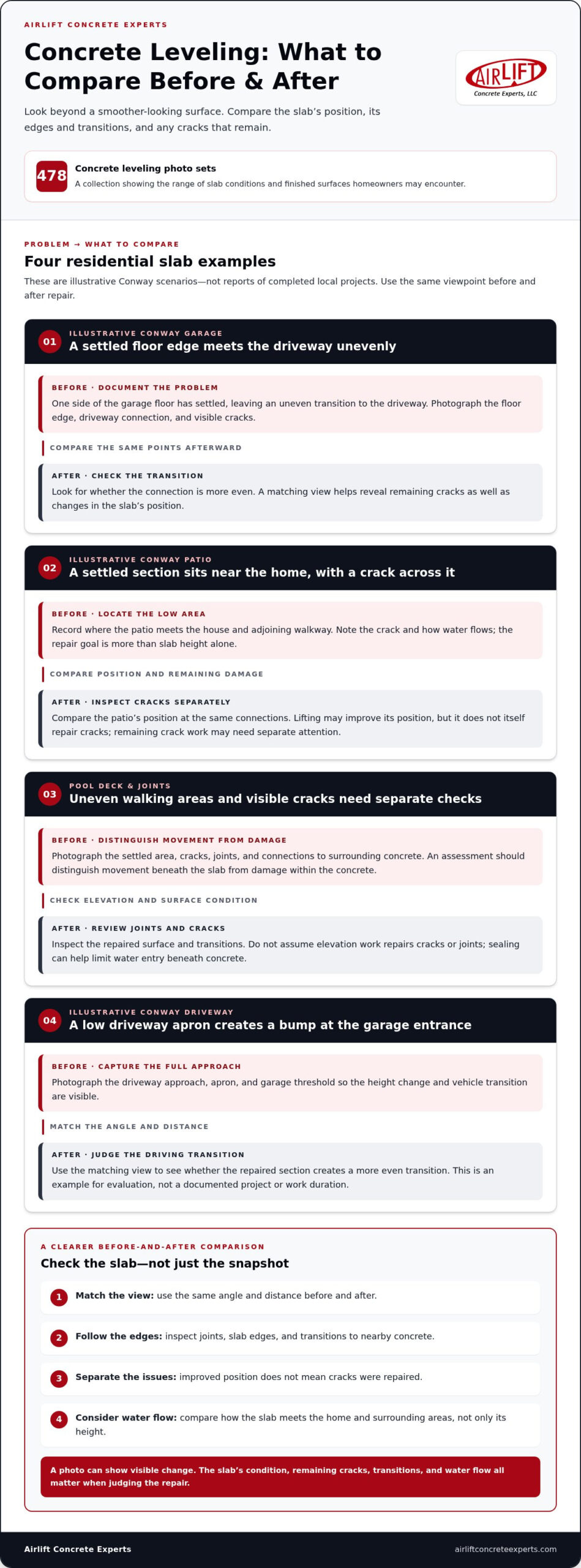
Before-and-after photos help show whether a repair corrected a slab’s position, not just its surface appearance. Compare matching viewpoints and inspect edges, joints, and transitions in both images. Note cracks that remain visible, since lifting concrete does not itself repair cracks. A collection of 478 concrete leveling photo sets shows the range of slab conditions and finished surfaces homeowners may encounter. For a Conway property, photos of your own slab can make the repair goal easier to assess.
Illustrative Conway garage: Situation: one side of a garage floor has settled, leaving an uneven transition to the driveway. Action: document the floor edge, driveway connection, and visible cracks before work. Result: compare the same points afterward to see whether the transition is more even. This is an example for evaluating a local slab, not a report of a completed Conway project.
Illustrative Conway patio: Situation: a patio has settled near the home, and a crack crosses one section. Action: identify the low area and check how the patio meets the house and adjoining walkway. After lifting, inspect cracks separately because they may need repair. Result: a before-and-after comparison can show whether the patio’s position improved and make any remaining crack work visible.
Pool deck and joints: A settled pool deck can create uneven walking areas and expose cracks. An assessment should distinguish movement beneath the slab from damage within the concrete. After lifting, inspect the joints and cracks rather than assuming elevation work repairs them. Sealing can help limit water entry beneath concrete, where erosion may contribute to further movement. Photos should show the repaired surface and its transitions to surrounding areas.
Illustrative Conway driveway: Situation: a driveway apron sits lower than the garage entrance, creating a bump for vehicles. Action: photograph the approach, apron, and garage threshold before repair. Result: matching views afterward help show whether the repaired section created a more even driving transition. This example illustrates a practical comparison, not a documented local project or work duration.
For Conway homeowners, focus on evidence that applies to the actual property: the slab’s position, its connection to nearby concrete, visible cracks, and water flow. Keep before-and-after pictures from the same angle and distance, then compare each feature rather than relying on a single close-up. For a local perspective on residential concrete repair, consider the repair approach that fits your slab and its condition.
Residential slabs serve different purposes, so the repair target depends on where settlement occurs. At a front door, a height change can create a tripping hazard. On a driveway, an uneven transition can affect vehicle access. Before judging whether leveling addresses the problem, identify the slab, the adjoining surface, and the direction of movement.
Front entry situation: A walkway slab has dropped beside the front door, leaving an uneven step. Action: Map the height difference and check how the entry slab meets the porch, threshold, and adjoining walkway. Result: Leveling can address the uneven concrete at a home’s front door. Compare the entry transition before and after, not just the middle of the slab.
Garage and service-door situation: A garage slab has settled near its service door, leaving a lip at the entrance. Action: Check the threshold, nearby cracks, and adjacent concrete, then determine whether lifting can bring the low section closer to its original position. Result: A more even transition can make the entrance easier to cross. Record cracks separately, since changing the slab’s position does not repair cracked concrete.
A driveway apron needs a different check. If it has sunk, the resulting bump can make it harder to drive into a garage smoothly. Inspect the apron’s connections to the driveway and garage floor. Lifting can improve the transition vehicles cross. Compare the approach and garage entrance as well as the repaired section, so you can judge it in context.
Warehouse slab situation: A warehouse floor in Conway, Arkansas, has a settled section along an interior route. Action: Mark the affected area, note cracks and joints, and consider how the slab connects to surrounding floor sections. Result: This assessment identifies the repair area and clarifies whether slab stabilization addresses the surface problem. Warehouse traffic and use differ from residential entryways, so this example is not a report of a specific Conway project.
Slab stabilization supports settled concrete and restores its position. It does not automatically resolve active soil movement, drainage issues, or damage to a building’s foundation. During an assessment, note where water flows, whether cracks cross slab joints, and whether walls or door frames also show movement. These clues help distinguish a concrete repair need from a broader foundation concern.
For a useful before-and-after review, compare the same edges, thresholds, and joints in both views. Check whether transitions at the front door, garage entrance, or driveway apron are more even. These landmarks help Conway homeowners judge whether leveling improved how the slab functions, rather than relying on a close-up of one smooth-looking patch.
In Conway, permit requirements depend on the scope of work. Raising an existing slab differs from changing drainage, access, or a structure. Include the full project scope when determining which local requirements apply. Sunken concrete can result from soil settling or water moving soil away from beneath a slab. A visible dip shows where support changed, but not always why.
Start an assessment at the uneven surface, then follow the evidence around it. Note which edge has dropped, whether cracks cross the slab, and where water travels after rain. Check nearby downspouts, soil grades, and joints for signs of water movement. These observations help distinguish a localized slab problem from continuing erosion or movement affecting a larger area.
Illustrative Conway patio example: Situation: one patio corner has sunk, leaving a lip along the walkway. Action: mark the low corner, compare adjoining slab edges, and observe runoff around the patio. Result: these checks help clarify whether lifting the affected section addresses the uneven surface or whether water flow also needs attention. This illustrates an assessment process, not a documented Conway repair.
Look for a repair plan that explains the lifting target and the limits of slab work. Concrete lifting changes the position of an existing slab; it does not correct every problem around a house. A settled patio may also need attention to drainage, while floor movement paired with crawl space concerns may call for a broader structural assessment. Crawl space repair and surface lifting address different conditions.
Illustrative Conway driveway example: Situation: a driveway apron sits lower than the garage entrance, creating a bump for vehicles. Action: compare the apron with the adjoining driveway and garage floor, then identify the section requiring support. Result: defining the repair area makes it easier to judge the lifted surface afterward. Photos should show the same transition before and after, not just a close-up of the repaired concrete.
Conway is roughly 8 miles from Mayflower, but proximity alone does not explain why a slab sinks. Water erosion, shifting support, and the slab’s condition are more useful clues. A local assessment should connect those clues to the specific surface, whether it’s a patio, entryway, or driveway. The takeaway: evaluate both the slab’s position and the conditions beneath and around it before choosing a repair approach.
For concrete leveling in Conway, local requirements depend on whether the work is limited to raising an existing slab or also changes drainage, access, or a structure. Provide the complete project scope when determining which requirements apply.
For a settled slab in Conway, compare what each option changes. Leveling keeps the existing concrete and raises it toward a more even position. Replacement removes the damaged slab and installs new concrete. This distinction matters: leveling addresses the slab’s position and support, while replacement can address concrete too deteriorated to remain in place. Compare the slab’s condition, the cause of movement, and the result the property needs.
Leveling example: Situation: a patio has sunk but remains largely intact. Action: a technician evaluates the slab and the void beneath it, then lifts the concrete where support is needed. Result: the existing patio can return closer to its intended position without full slab removal. Airlift Concrete Experts provides a free estimate and inspection. A project estimate reflects the slab’s dimensions, condition, access, and repair scope.
Replacement example: Situation: a slab is extensively broken or has damage that lifting cannot correct. Action: remove the affected concrete, prepare the base, and install a replacement slab. Result: the new surface replaces material that could not be restored by repositioning. This route changes more than elevation, so compare demolition, base preparation, new concrete, and finishing work against the specific repair goal.
Conway homeowners can compare results by documenting the same points before and after work. Photograph slab edges, joints, nearby thresholds, and cracks from consistent angles. Then check whether the repair improved the transition and restored the surface’s function. A level appearance alone does not show whether the original cause, such as water movement beneath the slab, was addressed. Include drainage and surrounding soil conditions in the comparison.
Concrete leveling is not a structural repair for every kind of damage. A stable, mostly intact slab with a changed position may suit lifting; concrete that has broken apart or lost usable surface may call for replacement. These are condition-based criteria, not a blanket rule. An assessment should connect visible damage to the proposed work, explain what the repair changes, and identify related issues outside its scope.
For a Conway driveway, consider how the apron meets the garage and whether vehicles still cross a bump. For a patio, check the edge near the house and the direction water flows. These practical outcomes help compare options beyond the initial appearance. If the slab remains suitable for lifting, request a concrete leveling quote to discuss the repair scope and cost factors for your concrete.
Airlift Concrete Experts provides polyurethane concrete leveling for sunken residential slabs in Conway. When a patio, walkway, or driveway has settled but remains suitable for lifting, the service raises and supports the existing concrete. Concrete raising and interior floor leveling address other slab concerns, while commercial concrete lifting serves commercial properties. The right approach depends on the slab’s condition, position, and the support it needs.
Share what has changed, such as an uneven transition, a low slab edge, or a settled interior floor. These details help focus the discussion on the concrete and the repair goal. For help with a sunken slab, contact Airlift Concrete Experts.
When comparing concrete leveling before and after in Conway, start by recording what matters at your property. Note where the slab feels uneven, which edges meet doors or walkways, and whether water collects nearby. Clear photos from consistent angles help focus the discussion on the repair goal.
Bring those observations into a conversation about the slab’s condition and the outcome you want. The decision should fit the concrete in front of you, not a generic before-and-after picture. If movement extends beyond the slab, mention that context so the repair discussion can account for the wider concern.
When you’re ready to discuss a concrete leveling project in Conway, contact Airlift Concrete Experts about your slab. A thoughtful next step can make the repair choices easier to understand and help you move forward with confidence.
Compare photos of the same slab taken from matching viewpoints, focusing on edges, joints, and connections to nearby surfaces. A straightedge across a transition can help show whether the height difference changed. Look beyond the repaired area for cracks or drainage paths, so the images show more than whether the concrete appears level. Conway homeowners can also photograph their slab before repair for a useful comparison afterward.
Airlift Concrete Experts serves Arkansas communities including Alexander, Arkadelphia, Batesville, Beebe, Bella Vista, Benton, Bentonville, Blytheville, Bryant, Cabot, Camden, Centerton, Conway, El Dorado, Fayetteville, Forrest City, Fort Smith, Helena-West Helena, Hot Springs, Hot Springs Village, Jacksonville, Jonesboro, Little Rock, Magnolia, Malvern, Maumelle, Mayflower, Morrilton, North Little Rock, Paragould, Pine Bluff, Rogers, Russellville, Searcy, Shannon Hills, Sherwood, Siloam Springs, Springdale, Texarkana, Van Buren, Warren, and West Memphis. Grain-bin floor lifting is also available beyond Arkansas; contact Airlift Concrete Experts for details.
There is no single per-square-foot rate for every Conway slab. Pricing depends on the slab’s dimensions, condition, access, and required work. Airlift Concrete Experts provides a free estimate and inspection, giving you a project-specific basis for comparing the work.
Airlift Concrete Experts injects two-part, closed-cell structural polyurethane through 5/8-inch holes. The expanding foam lifts the slab and compacts soil, while laser levels monitor the lift to within 1/10 of an inch. It’s the least invasive repair method, requiring no trenches or heavy equipment. The foam is waterproof, chemical-resistant, eco-friendly, becomes inert, and doesn’t leach chemicals. It’s safe for families, yards, and agricultural sites, and supports thousands of pounds per square foot.
Polyurethane foam cures in about 15 minutes, and projects are typically finished in a single day. Curing and project completion are separate milestones, so use the surface according to the job-specific access instructions. For example, a homeowner may need to keep vehicles off a driveway until the crew confirms the work area is ready. This helps protect the repaired slab and lets the crew complete final checks.
Polyjacking can last 20 years or longer, and Airlift Concrete Experts describes its polyurethane foam leveling as a permanent, durable solution. Soil movement, water erosion, slab condition, and whether the underlying cause is addressed affect how a repair performs. Airlift Concrete Experts also provides a structural warranty that transfers to the next homeowner. Review the written warranty terms to understand what coverage applies to the specific repair.

 Call Now