

A porch that looks ready for demolition may only need its slab lifted. If an uneven entryway has you wondering whether concrete porch leveling can fix the problem, the answer depends on the slab’s condition and how it meets the home, steps, and walkways, not just how far it has settled.
Cracks, gaps, and a sloping surface can be concerning, but surface damage and settlement are different problems. Settlement happens when the soil or other support beneath a slab shifts or compresses. Patching a crack may improve the surface, but it won’t correct a change in the slab’s height. An assessment can help identify the issue before you choose a repair.
This guide covers signs and causes of porch settlement, how polyurethane concrete leveling compares with patching or replacement, and what to expect during an assessment and repair. Airlift Concrete Experts provides polyurethane leveling for sunken porch slabs when their condition makes lifting suitable. The company serves Arkansas communities including Malvern, Hot Springs, Little Rock, Cabot, Conway, Benton, Bryant, North Little Rock, Sherwood, Jacksonville, and Hot Springs Village.
An uneven porch can make entering and leaving home less comfortable. A height change at the door, a sloping section, or a raised edge where the porch meets a walkway can catch a foot or make it harder to move items across the entry. These signs are worth documenting, but they don’t reveal the cause by themselves.
Surface damage affects the concrete’s finish; slab movement changes the concrete’s position or angle. Both can occur at once. A crack or chipped edge alone doesn’t show whether the porch has settled.
Check the full walking surface rather than focusing on one crack. Look for sections that slope differently or sit at a different height where the porch meets a step. Compare the porch with the home, steps, and adjoining walkways. A widening gap or separated joint may indicate movement, although it can have other causes.
Photograph the same areas from consistent angles, including a nearby reference such as a step or doorway. Keep a brief log of what you observe and when: where the slope is noticeable, which joints have gaps, and whether the condition appears to change. This record can help an assessor understand the pattern, though photographs alone can’t diagnose the cause.
A concrete slab depends on the material beneath it for support. If that material shifts, compresses, washes away, or was inadequate to begin with, part of the slab may lose support and move downward. Understanding Concrete Leveling provides an overview of lifting methods and their limitations.
Surface wear is different. Scuffs, shallow chips, and small areas of flaking can affect the finish without changing the slab’s position. A tilted surface, a height change at a joint, or a gap beside an adjacent structure may indicate movement, but appearance alone can’t confirm what is happening beneath the concrete or whether the slab can be lifted.
For Arkansas properties, soil and drainage conditions may be relevant, but they vary from site to site. Don’t assume a particular cause based on the location alone. Note where runoff collects or flows near the porch and share those observations during an assessment.
Concrete porch leveling corrects the position of a settled slab when its condition allows it to be lifted. Rather than adding material on top to disguise a low spot, polyurethane leveling works beneath the concrete to raise the slab. The goal is to address its position, not to repair every crack or restore every part of the porch.
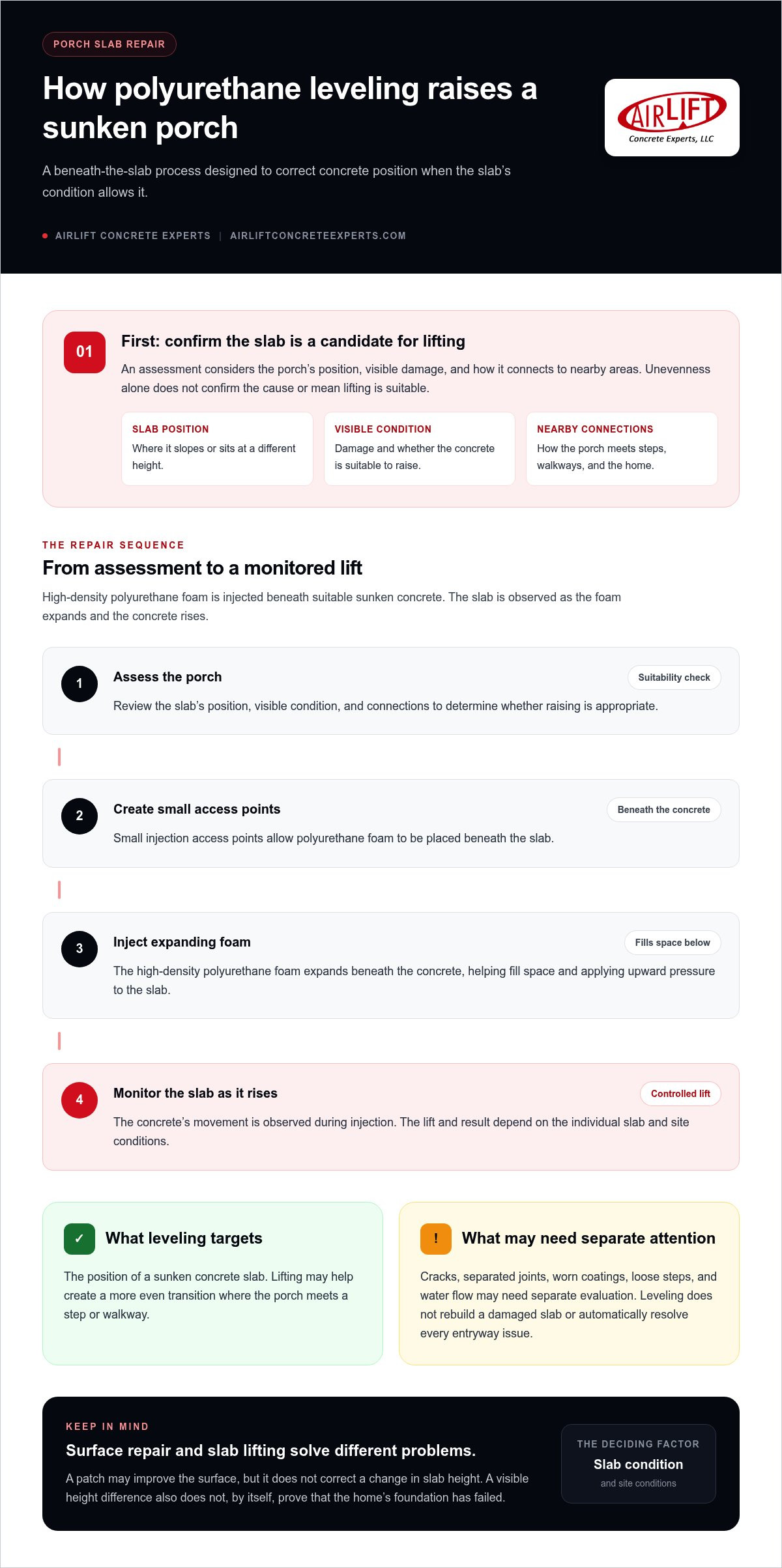
Airlift Concrete Experts uses high-density polyurethane foam injected beneath sunken concrete, including porch slabs suitable for lifting. The foam expands beneath the slab and helps fill space below it, supporting a controlled lift. After assessing the slab, the concrete leveling process uses small injection access points to place foam beneath the concrete, with the slab observed as it rises.
The process begins with an assessment of the porch and its condition. The slab’s position, visible damage, and connection to nearby areas help determine whether lifting is appropriate. This step matters because uneven porches can have different underlying issues, and the concrete needs to be suitable for raising.
For the lifting work, small access points allow polyurethane foam to be injected beneath the concrete. As the foam expands, it applies upward pressure to the slab. The concrete’s movement is monitored during injection. Unlike a surface coating or patch, the method is intended to change the slab’s position from below. The lift and result depend on the individual slab and site conditions, so they can’t be determined from a photograph or assumed in advance.
This approach differs from filling a depression on the walking surface. It works beneath the slab to correct its position and may help create a more even transition where the porch meets a step or walkway. The slab’s condition guides the decision, since lifting is not appropriate for every porch.
Polyurethane lifting targets the position of sunken concrete. It doesn’t rebuild a damaged slab or automatically resolve every issue around the entry. Cracks, separated joints, worn coatings, loose steps, and water flow may need separate evaluation. A porch can have more than one problem, so raising the slab shouldn’t be treated as a cure-all.
An uneven porch alone doesn’t prove that the home’s foundation has failed. The porch slab and the home’s foundation are different parts of the structure. The cause of a visible height difference needs to be assessed rather than assumed. Lifting can correct a slab’s position, but it may not change how water moves across the surrounding area.
Airlift Concrete Experts provides polyurethane concrete leveling for sunken slabs, including suitable porches. An assessment helps determine whether the slab can be raised and whether other concerns need separate attention. If your porch has settled, you can explore Airlift’s concrete leveling service to learn about the repair approach.
An uneven porch doesn’t automatically need to be demolished and rebuilt. The right repair depends on what has changed: the slab’s position, its surface, or its overall condition. Concrete porch leveling may suit a slab that has settled but remains suitable for lifting. Patching and replacement serve different purposes, so compare each option with the problem you want to address.
| Repair option | Main purpose | What it doesn’t automatically address |
|---|---|---|
| Concrete lifting | Raise a settled slab by correcting its position from beneath the concrete. | Every crack, damaged area, joint, or drainage concern. |
| Surface patching | Repair selected surface defects, such as localized chips or shallow damage. | A slab that sits too low or has a height difference across its surface. |
| Slab replacement | Remove and replace concrete when the existing slab is unsuitable for lifting or repair. | Underlying site conditions unless they’re also addressed. |
A settled porch slab may be a candidate for lifting if it remains in suitable condition. That decision depends on an assessment, not on one crack or a visible dip. The slab’s condition, pattern of movement, and connection to the steps, walkway, and home all help guide the recommendation. Airlift’s concrete lifting guide provides broader context on raising settled slabs.
An uneven porch doesn’t mean replacement is the only possible solution. At the same time, lifting isn’t right for every slab or crack pattern. An assessment can help determine whether the existing concrete can be raised or whether its condition points to another repair.
Patching repairs the surface. Filling a chipped area may improve that spot, but it won’t raise the slab or correct a height difference between the porch and a step. Adding material to a low area can change the walking surface without changing the position of the concrete beneath it. Match the repair to the problem you need to address.
Replacement is a separate option when lifting isn’t suitable. It involves removing the existing slab and installing new concrete, rather than correcting the position of the existing slab. An assessment can help distinguish surface damage from settlement and identify which repair fits the porch’s condition. This avoids assuming every uneven entry needs a full rebuild, while recognizing when lifting isn’t the right answer.
A little preparation can make an assessment more useful. You don’t need to determine why the porch is uneven or measure the slab yourself. Instead, note where you see or feel a change and how it relates to the entry. These observations give Airlift Concrete Experts useful context to consider alongside the concrete and surrounding features.
Walk the usual route to the door and note where the surface feels different underfoot. Record which areas look low, whether the unevenness affects the main entry path, and what you see where the porch meets steps or adjoining slabs. Photos taken from the same viewpoints can help show the location and pattern of visible changes.
A short written log is useful, too. Keep it factual and describe what you observe rather than guessing at the cause. Include details such as:
These notes don’t replace an assessment, but they help you explain the concern clearly. If the condition appears to change, add the observation to your log and take another photo from a similar angle. Avoid filling gaps or altering the surface beforehand, so the assessor can see the condition you’re concerned about.
An assessment considers the slab’s condition and settlement, access to the affected area, and nearby features such as steps, walkways, and the home. The goal is to understand how the concrete sits in relation to its surroundings and whether its condition makes lifting appropriate. A crack or dip is one observation, not a diagnosis by itself.
Airlift evaluates the concrete and project conditions before recommending a repair approach. The assessment helps distinguish a slab-position concern from surface damage or other issues that may need separate attention. The polyurethane leveling guide explains the broader method used to raise settled concrete.
For an assessment, share your notes and point out the exact route or location where the porch feels uneven. To discuss a settled porch, request an assessment from Airlift Concrete Experts.
A sunken porch can make a familiar entry feel awkward, but the right repair starts with understanding the slab rather than assuming it needs replacement. Airlift Concrete Experts is a family-owned Arkansas specialist founded in 2017. The company provides polyurethane concrete leveling and raising for sunken slabs, including porches whose condition makes lifting appropriate.
Airlift’s process starts with the project. The team evaluates the porch’s condition and the surrounding area before recommending a repair approach. That assessment helps determine whether the slab is suitable for lifting and brings nearby concrete features into view. The recommendation is based on the porch, rather than a one-size-fits-all method.
For suitable sunken slabs, Airlift injects high-density polyurethane foam beneath the concrete to raise it. The foam expands below the slab, helping lift it toward a more even position. The method addresses the slab’s position; it doesn’t automatically repair every crack, surface defect, or drainage concern. Those conditions may need separate attention, depending on the project.
Understanding the scope before work begins helps set realistic expectations. The repair approach and expected result depend on the porch’s condition and the project details. Airlift serves Malvern, Hot Springs, Little Rock, Cabot, Conway, Benton, Bryant, North Little Rock, Sherwood, Jacksonville, and Hot Springs Village.
When you reach out, sharing a few clear details can make the conversation more useful. Note the property’s location, where the porch feels uneven, and any visible cracks, gaps, or height changes. Describe how the porch meets nearby steps, the walkway, or the home. Include any access limitations that could affect the assessment.
Photos and brief observations can help explain what you’re seeing, but you don’t need to diagnose the cause yourself. Airlift can assess the concrete and project conditions, then explain whether polyurethane lifting is suitable for the porch. This gives you a practical next step without assuming every uneven slab needs the same repair.
If your porch has settled in Malvern, Hot Springs, Little Rock, Cabot, Conway, Benton, Bryant, North Little Rock, Sherwood, Jacksonville, or Hot Springs Village, request a concrete assessment to discuss the visible symptoms and next steps.
An uneven porch doesn’t have to leave you guessing about what comes next. Think about how you use the entryway: whether you need a steady route to the door, a clean transition to the steps, or a smooth connection to nearby walkways. These priorities help focus an assessment on the details that matter in everyday use.
Concrete porch leveling may be an option if the slab’s condition allows it, but the first step is understanding the porch as it is now. Share what you’ve noticed and where the unevenness affects your routine. A project-specific evaluation can clarify whether lifting suits the slab or whether another issue needs attention, helping you decide without assuming demolition is the only answer.
To discuss your porch and the repair options, request a concrete assessment from Airlift Concrete Experts. A clear understanding of the problem can make the next step toward a more comfortable entry easier to plan.
Yes. Some settled porch slabs can be lifted without removing the concrete, but suitability depends on the slab’s condition and the cause of the movement. Concrete porch leveling raises existing concrete, while replacement removes the slab and installs new concrete. An assessment considers cracking, stability, and how the porch meets the steps and home before recommending lifting. Extensive deterioration may call for a different repair.
No repair can be described as permanent for every porch. How leveling performs depends on the slab, its underlying support, drainage, and the conditions of the project. Lifting corrects the slab’s position, but it doesn’t necessarily stop ongoing water movement or repair worn concrete. Point out recurring puddles, runoff routes, or changes you’ve noticed so those site conditions can inform the assessment.
Possibly, but assess the porch and step together before deciding on a repair. A step may be a separate slab, attached to the porch, or settled differently, and those differences affect the plan. Raising the porch alone, for example, could leave an abrupt transition at the step. An assessment considers how each surface is constructed, its condition, and how their heights relate.
Raising a slab may change its slope, but it isn’t a guaranteed fix for pooling. Water flow also depends on the porch layout and surrounding drainage, so adjusting the concrete may not resolve every source of standing water. Point out where water collects and describe where runoff travels during an assessment. This helps Airlift consider the porch alongside adjacent surfaces when evaluating a repair approach.
Leveling changes a slab’s position; it doesn’t automatically close or remove cracks. Some cracks may remain visible after lifting, while others may need separate attention depending on their characteristics and the slab’s condition. A crack can occur alongside movement, but surface wear can also cause visible damage. An assessment helps distinguish these concerns and determine whether lifting suits the concrete and whether other repairs may be needed.
Appearance alone can’t determine whether leveling or replacement is right. An assessment considers the concrete’s condition, settlement, cracks, and connections to the home and steps. A slab that is too damaged or unstable may need another approach. Airlift evaluates porch slabs as part of its Arkansas concrete leveling work in Malvern, Hot Springs, Little Rock, Cabot, Conway, Benton, Bryant, North Little Rock, Sherwood, Jacksonville, and Hot Springs Village.

 Call Now