

What if the sunken strip of concrete at your garage doesn’t need to be replaced? A noticeable drop where the driveway meets the garage can make driving and walking awkward, and it may leave water pooling near the entrance. If you’re researching sunken garage apron repair Bryant homeowners can consider, the right solution depends on how the slab has settled and what condition it’s in.
It’s understandable to wonder whether concrete lifting can restore a smoother transition or whether the apron is too damaged to raise. Polyurethane concrete lifting can be an option for eligible settled slabs. An assessment helps determine whether it suits your apron and what may be contributing to the movement.
This guide explains the visible signs and possible causes of apron settlement, how polyurethane lifting works, and what to expect during a repair assessment. Airlift Concrete Experts provides concrete leveling and raising in Bryant. An assessment can help you understand the slab’s condition and practical next steps.
The garage apron is the paved section that connects the driveway to the garage threshold. It forms the transition vehicles cross when entering or leaving the garage and is also part of the route people use on foot. If that transition develops a noticeable dip, crack, or gap, start by identifying the surface material and what has changed. For sunken garage apron repair Bryant homeowners need to distinguish a concrete apron from other paving materials before considering a repair.
This section focuses on concrete aprons. An asphalt apron may show similar dips or cracking, but it is a different material and needs repair guidance suited to asphalt. A concrete slab may be a candidate for lifting, depending on its condition. Visible symptoms are useful clues, not a diagnosis: they show that something has changed, but don’t establish why or which repair will suit the slab.
Check the apron’s edges and where it meets the garage threshold and driveway. A height difference may appear as a low edge, a sudden lip, or an uneven slope between the surfaces. You might also see cracks across the slab, a gap at an adjoining edge, or an edge that shifts or rocks underfoot. These observations help describe the problem, but they don’t confirm what is happening below the concrete.
Notice how the surface behaves during ordinary use. A raised or lowered edge can make walking less comfortable and cause a vehicle to cross an abrupt transition. After rain or washing the driveway, water may collect in a dip or near the garage. Pooling points to a drainage concern worth noting, but it doesn’t prove that water caused the settlement. The location and pattern of these signs can make an assessment more useful.
A concrete slab relies on support beneath it. If that support changes or is lost, part of the apron may settle, leaving a height difference or uneven surface. Ground conditions can also change over time. Water moving beneath or around the slab may contribute to changes in support, while water collecting on top may simply result from the apron’s altered slope. An inspection is needed to determine which factors may apply.
Cracking alone doesn’t show whether the slab has settled. A crack can be a surface issue, while a change in elevation can indicate that the concrete has moved. An on-site assessment helps distinguish visible surface damage from slab settlement and evaluate whether lifting may suit the existing concrete. Airlift Concrete Experts serves Bryant and assesses settled concrete as part of its leveling and raising services. Before the visit, note where you see dips, cracks, gaps, or standing water, and whether the transition has changed over time. Those details provide a practical starting point for understanding the apron’s condition.
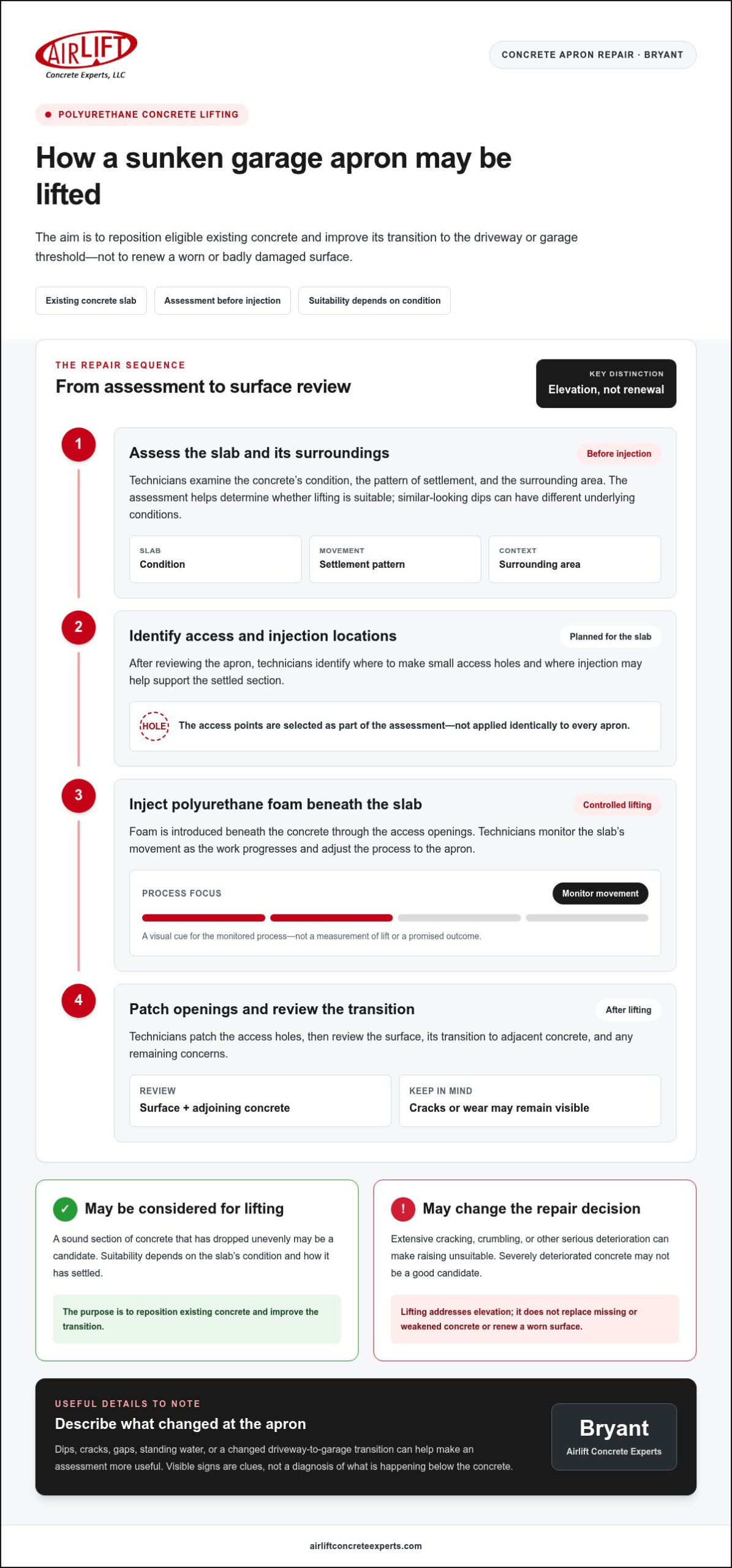
Polyurethane concrete lifting raises a settled concrete slab by injecting foam beneath it. For a garage apron, the goal is to reposition eligible existing concrete and improve its transition to the driveway or garage threshold. Lifting doesn’t renew a worn or badly damaged surface, and it isn’t a blanket fix for every cracked apron.
The process starts with an assessment, not injection. Technicians examine the slab’s condition, the pattern of settlement, and the surrounding area to determine whether lifting is suitable. This evaluation matters because similar-looking dips can have different underlying conditions, and severely deteriorated concrete may not be a good candidate for raising.
After reviewing the apron, technicians identify where to make small access holes and where injection may help support the settled section. They introduce polyurethane foam beneath the slab through those openings in a controlled way, monitoring the concrete’s movement as the work progresses. This step-by-step approach lets the technician adjust the process to the slab rather than treating every apron the same way.
Once lifting is complete, the access holes are patched. The technician then reviews the surface and its transition to adjacent concrete, along with any remaining concerns. Cracks or surface wear may still be visible because raising concrete addresses its position, not the appearance or condition of every part of the slab.
Suitability depends on the slab’s condition and how it has settled. A sound section of concrete that has dropped unevenly may be considered for lifting, while extensive cracking, crumbling, or other serious deterioration can change the repair decision. The pattern of movement also matters: an assessment helps establish whether the slab can be raised appropriately and what limitations to expect.
Think of lifting as a way to address elevation, not a way to make old concrete new. If the apron is substantially damaged, repositioning it won’t replace missing or weakened concrete. An assessment connects what you see at the surface with the slab’s condition and the practical options for addressing it, rather than assuming that every dip calls for the same repair.
For homeowners considering sunken garage apron repair Bryant, polyurethane leveling is an option when the existing concrete is suitable for raising. Airlift Concrete Experts provides polyurethane concrete leveling in Bryant. An assessment can help clarify the slab’s condition and whether lifting fits. Learn more about polyurethane concrete leveling and how it may address settled concrete.
Choosing between lifting and replacement starts with the repair goal, not just the visible crack or dip. Polyurethane concrete lifting raises and repositions eligible existing concrete when settlement has created an uneven transition. Replacement addresses the concrete itself when the apron is too deteriorated to serve reliably. Neither option is automatically the better choice; the slab’s integrity and site conditions guide the decision.
The work involved also differs. Lifting works with the existing slab and uses small access points for injection, while replacement involves removing and renewing the damaged concrete. The details and effects depend on the project. An assessment helps clarify what the apron needs rather than treating every low spot as the same problem.
Lifting may suit a concrete apron whose main concern is its settled position, such as a dropped edge or uneven connection to the driveway. Raising the slab aims to correct elevation. It doesn’t resurface worn concrete, fill every crack, or guarantee that cracks will disappear. A slab can be closer to level and still show age or surface damage.
That distinction matters if the apron looks rough but remains near its original elevation, or if it has both settlement and visible deterioration. An assessment considers these issues separately: where the concrete sits, how intact it is, and what the repair is meant to address.
Severe breakage, missing sections, or widespread deterioration may mean the existing slab can’t be suitably repositioned. These are assessment considerations, not automatic rules. The concrete’s overall integrity and conditions at the site help determine whether lifting could address the settlement or whether a different repair plan is more appropriate.
For a practical comparison, consider:
Replacement isn’t a failure, and lifting isn’t a shortcut for every apron. The right choice matches the repair to the problem. If a slab is mostly intact but has settled, repositioning may be worth evaluating. If the concrete has extensive damage, raising it alone may not address the condition that matters most.
For sunken garage apron repair Bryant homeowners can have the slab assessed to understand its condition and whether polyurethane concrete leveling fits the settlement. Airlift Concrete Experts provides concrete lifting for eligible settled slabs, helping connect the visible problem to a practical repair decision.
A little preparation can make an assessment more useful. You don’t need to identify the cause of a dip or decide on a repair beforehand. Instead, gather clear observations about what you see and how the apron behaves. For homeowners considering sunken garage apron repair Bryant, these details help connect visible symptoms with the slab’s condition during an on-site review.
Walk around the concrete apron and record where the surface appears low, where cracks or gaps show, and where water collects after rain or washing. Note when you first noticed each change, even if your estimate is approximate. If the signs have changed over time, describe what looks different now.
Photos can help you keep track of the pattern. Take clear views from both the garage threshold and the driveway approach, then include closer images of cracks, gaps, or pooling. Show how the apron meets the adjoining surfaces, not only the damaged spot. A simple checklist can keep the information organized:
These notes don’t need to be technical. For example, record whether water collects near one side of the garage after rain or whether a vehicle now crosses a sharper lip when entering. Such observations give the technician a clearer picture of how the apron functions in daily use.
During an on-site assessment, the technician reviews the concrete’s condition, the pattern of settlement, and the surrounding area. They also consider whether the slab has suitable access points for injection if polyurethane lifting appears appropriate. Your photos and timeline can guide that review, but the slab itself needs to be evaluated before a repair approach is selected.
The findings help distinguish a surface concern from movement in the slab and show whether lifting may suit the apron. They also help set practical expectations: the goal is to match the repair to the concrete’s condition, not assume every crack or dip calls for the same work.
Airlift Concrete Experts serves Bryant and assesses settled concrete as part of its leveling and raising services. If you’ve documented what you’re seeing, contact Airlift about a garage apron assessment and discuss the slab’s condition and a suitable next step.
A noticeable drop at the garage entrance can leave you unsure what to do next. Start by identifying whether the concrete apron has settled, assessing the slab’s condition, and choosing a repair that fits what’s there. Polyurethane lifting may suit an eligible slab, while extensive damage can call for a different repair plan. The right answer depends on the concrete’s condition, not on assuming every apron needs the same fix.
Airlift Concrete Experts serves Bryant and specializes in polyurethane concrete leveling and raising. For an eligible settled apron, this method focuses on repositioning existing concrete. An assessment connects the visible symptoms with the slab’s condition and helps clarify whether lifting is a practical option. It also gives you a chance to discuss what the method addresses, what it doesn’t, and what to expect from the repair approach.
The process begins with a review of the concrete and its settlement pattern. The technician considers the apron’s integrity and surrounding conditions before selecting an approach. If lifting is suitable, polyurethane foam is injected beneath the slab through small access points, with the slab’s movement monitored during the work. The approach is tailored to the existing concrete, rather than treating surface cracks as proof that lifting is always the answer.
Clear expectations matter. Lifting aims to adjust the slab’s elevation, but it doesn’t renew the concrete surface or promise that every crack will disappear. To understand how concrete lifting fits into a repair decision, explore Airlift Concrete Experts’s concrete lifting guide. It provides further context on the method while keeping the central question in view: is the existing apron a suitable candidate?
You don’t need to arrive with a diagnosis. Sharing what you’ve observed, such as where the apron sits low or how the transition affects daily use, gives the assessment a useful starting point. Airlift Concrete Experts’s assessment helps Bryant homeowners understand the slab’s condition and discuss a fitting next step.
If polyurethane leveling may suit the apron, the assessment can help explain how that option relates to the site and existing concrete. If the slab’s condition points elsewhere, the findings help clarify why lifting may not be the right match. For more on the technique, Airlift Concrete Experts’s polyurethane concrete leveling guide explains the approach in greater detail.
For sunken garage apron repair Bryant homeowners can take a practical next step: contact Airlift Concrete Experts about a garage apron assessment. It’s a direct way to talk about the apron with a local concrete-lifting specialist and understand the options for your property before choosing a repair.
A change at the garage entrance doesn’t have to leave you guessing. Get a clear view of the concrete’s condition before deciding what repair makes sense. For sunken garage apron repair Bryant homeowners can start by sharing what they’ve noticed and arranging an assessment focused on their property, not a one-size-fits-all answer.
Airlift Concrete Experts is a family-owned and operated Arkansas business founded in 2017. Its team specializes in polyurethane concrete leveling and serves Bryant and communities across Arkansas. An assessment offers a straightforward way to discuss your apron and understand whether lifting may fit its condition, before deciding on a repair.
Contact Airlift Concrete Experts about a concrete apron assessment and take a practical first step toward understanding your options. A clear assessment can help turn an uneven entrance into a manageable property-maintenance decision.
Yes, an apron may be lifted if its concrete is sound enough and its settlement pattern suits the repair. For sunken garage apron repair Bryant homeowners can have the slab assessed to understand whether polyurethane lifting is appropriate. Before deciding, consider what you want the repair to address, such as an abrupt edge at the garage entrance. Lifting changes the slab’s position, but it won’t restore worn concrete or guarantee that cracks disappear.
A garage apron can settle when the ground supporting it shifts or compresses, and water movement may contribute to those changes. A low spot or crack alone can’t confirm the cause. Note whether water runs toward the apron from a downspout or another nearby area, but treat that as an observation rather than a diagnosis. Conditions vary from property to property, so an on-site review is needed to assess the specific slab.
Technicians inject polyurethane foam beneath eligible concrete through small access points, monitoring the slab as they work. After the adjustment, they patch the openings and review the surface. The process is controlled in relation to the slab’s movement, not based on a universal lift amount. The apron’s condition and site conditions affect what adjustment is suitable, so exact results can’t be assumed in advance.
An uneven apron can be a trip concern or make vehicle entry uncomfortable, particularly where a sharp edge crosses a commonly used path. The practical risk depends on the height difference, location, and how people use the entrance. Until you understand the condition, make the uneven area easy to see and use another route if crossing it feels difficult. An assessment can help clarify the surface condition and possible repair options.
There isn’t one reliable duration for every apron. The time depends on factors such as slab size, access, settlement pattern, and conditions at the property. During an assessment, discuss how those details may affect the work sequence for your specific apron. A general time estimate may not reflect the preparation, injection, and surface review required for your project.
No, lifting focuses on the position of eligible concrete, not on removing surface cracks. A crack may remain visible after the slab is raised, and extensive deterioration can affect whether lifting is suitable. Note whether cracks appear to be changing and where they sit in relation to the uneven area. Sharing those observations helps the technician consider both the apron’s elevation and its overall condition instead of treating the crack as the whole problem.
Before an assessment, note what you’ve observed and when you first noticed it. You can also mention any earlier repairs or changes to how you use the entrance. Airlift Concrete Experts serves Bryant and nearby Arkansas communities, including Benton, Malvern, Hot Springs, Little Rock, Cabot, Conway, North Little Rock, Sherwood, Jacksonville, and Hot Springs Village. These details help start a practical conversation about the apron.

 Call Now