

What if a moving commercial floor doesn’t need to be torn out and replaced? A dip, crack, or uneven joint can signal that a slab has lost support beneath it, but visible symptoms alone don’t determine the right repair. Void filling services for commercial floors can be a targeted option when the slab’s condition, site access, and operational needs suit the work.
When concrete shifts, businesses may worry about worker safety, equipment, and interruptions to daily operations. Airlift Concrete Experts provides commercial concrete lifting across Arkansas, using polyurethane foam injection to lift and support sunken slabs.
This guide explains how commercial floor void filling works, which signs warrant an assessment, and what information helps shape a repair plan. It also compares targeted lifting with slab replacement and outlines what to consider when coordinating work around your facility’s needs.
A commercial floor can feel uneven, hollow, or less supportive when a concrete slab shifts or loses contact with the material beneath it. The change may affect a small area or extend beyond the spot where it is easiest to notice. Treat a symptom as a reason to investigate, not proof that a void is present or that a particular repair is needed.
Commercial floor void filling places material beneath a concrete slab to fill gaps and help restore support. With polyurethane concrete leveling, foam is injected through small access points beneath the slab to lift and support sunken concrete. The method is suited to slabs whose condition allows targeted lifting. The broader principles of Concrete leveling include filling space beneath slabs to address settlement and restore their position.
Watch for changes in the floor’s surface and how it behaves during normal use. Possible indicators include:
These signs can have more than one cause. A crack alone does not confirm a void, and a hollow sound is not a complete diagnosis. Record where symptoms appear, when you first noticed them, and whether they are changing. Photos and notes about nearby joints, equipment, or frequently used routes can help an on-site assessment distinguish the visible affected area from a potentially wider support issue.
Commercial floors support everyday movement: employees and customers walking, carts moving between work areas, and equipment or stored goods placing demands on the slab. A change in level or support can interfere with those routines and affect how smoothly people move through the space. Evaluating the area helps facility managers understand what needs attention and plan next steps based on the actual condition.
For businesses considering void filling services for commercial floors, the key question is whether the slab’s condition and the cause of its movement suit targeted lifting and support. An assessment of the concrete and affected area helps determine whether void filling is appropriate. It also gives you a clearer basis for prioritizing the issue and planning around facility operations.
A useful assessment considers both the concrete and the facility’s day-to-day needs. A dip may be easy to spot, but the visible area does not necessarily show how far a loss of support extends beneath the slab. Documenting symptoms and site conditions gives the evaluation a clear starting point and helps connect the repair approach to how the space is used.
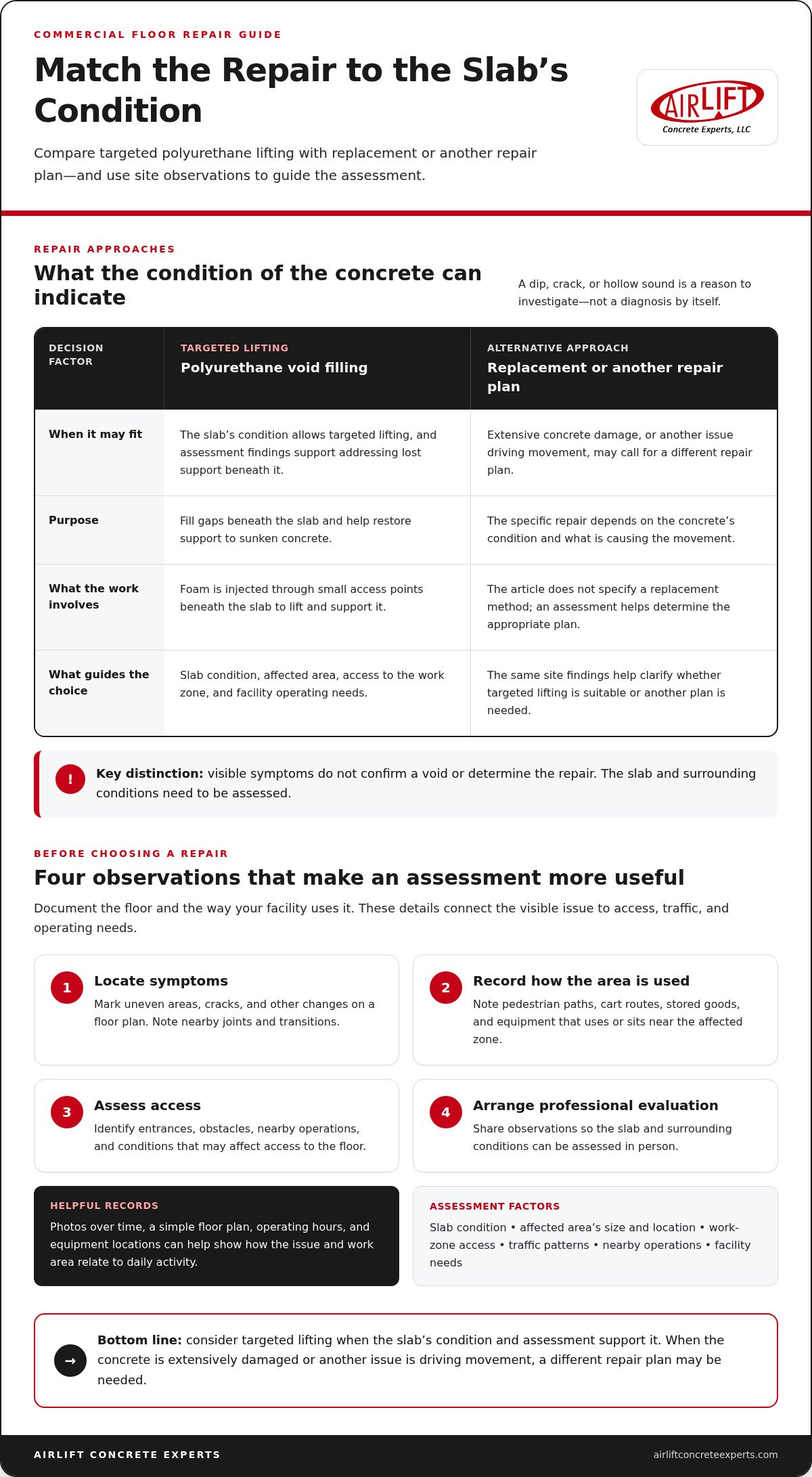
Use this framework to organize what you have observed:
Photos can show how a symptom changes over time, while a simple floor plan helps distinguish the visible surface issue from a potentially wider support concern. Include operating hours and equipment locations, too. These details show where repair work may intersect with normal facility activity.
The assessment considers the slab’s condition, the size and location of the affected area, access to the work zone, and the facility’s operating needs. Traffic patterns matter: a change in a frequently used route may require different coordination from a similar symptom in a seldom-used area. Nearby operations and equipment also shape how the work area is approached and planned.
These findings help determine whether lifting and support are appropriate for the slab, rather than basing a recommendation on one crack, dip, or hollow sound. The American Concrete Institute offers background on industry standards for concrete repair, including repair approaches that professionals consider in context. For more on the lifting process, see this commercial concrete lifting guide.
For Central Arkansas businesses weighing void filling services for commercial floors, a well-documented site assessment makes the next steps easier to understand. Airlift Concrete Experts evaluates commercial concrete and provides polyurethane lifting across the region. Learn more about commercial concrete lifting in Arkansas.
Choosing between targeted lifting and replacement starts with the condition of the concrete, not just the floor’s appearance. Polyurethane void filling can address lost support beneath a slab that remains suitable for lifting. If the concrete is extensively damaged or another issue is driving the movement, a different repair plan may be needed. Neither approach fits every floor.
| Consideration | Targeted polyurethane lifting and support | Slab replacement |
|---|---|---|
| What it addresses | Gaps beneath a slab and settlement that can be addressed by lifting and supporting the existing concrete. | A slab that needs to be removed and replaced because its condition or repair needs call for a broader intervention. |
| What assessment examines | Whether the slab can be lifted, where support is needed, and whether the work area is accessible. | The extent of concrete damage and whether keeping the existing slab is a suitable option. |
| Planning focus | Access points, affected area, nearby activity, and how to coordinate work around facility operations. | Removal and replacement requirements, work-area access, and how the project may affect facility use. |
Airlift Concrete Experts injects high-density polyurethane foam beneath sunken slabs to lift and support them. When an assessment shows that the existing concrete can be addressed, this targeted approach may help avoid replacing the entire affected slab. The repair depends on the slab’s condition and the cause and extent of movement. Filling a void is not a universal fix. Learn more in this polyurethane concrete leveling guide.
Extensive cracking, broken or deteriorated concrete, or movement linked to other underlying conditions can change what repair is appropriate. These signs alone do not confirm a structural or foundation problem and should not be used to diagnose one. An assessment examines the slab and site findings to determine whether lifting and support make sense or whether the floor needs a different solution.
For businesses comparing void filling services for commercial floors with replacement, the useful question is not simply which method seems less involved. Consider which approach matches the slab’s condition, movement, access, and operational needs. A clear assessment helps set the direction before repair planning begins.
Planning void filling in an active facility means coordinating work on the slab with people, equipment, and daily tasks. Before work begins, facility teams and the repair crew need a shared understanding of the work area, movement around it, and nearby activities that need consideration. The plan depends on the site and repair scope, so set expectations for timing and reopening only after those details have been assessed.
Start with a facility-ready checklist. Map the area under consideration and mark routes and activities that could be affected. Share the information with staff who oversee the space so they understand access restrictions and operational priorities.
Keep preparation practical rather than assuming every facility needs the same setup. A site assessment clarifies access needs and which areas require coordination during the work.
Discuss the proposed work area, access, nearby operations, and the facility’s operating priorities. The plan should explain how the crew will approach the repair, which spaces are involved, and how updates or changes will be communicated. Polyurethane injection lifts and supports sunken slabs, while the exact work plan depends on the site and assessment findings.
Scheduling should reflect the business’s actual activity. A route used for deliveries, for example, may need different coordination from an area with limited movement. Set scheduling expectations through project planning, based on the facility and repair scope, rather than relying on a generic timeline. For a closer look at the method, read the polyjacking service guide.
A clear plan gives staff a practical reference for work zones, access, and next steps. If you’re preparing for void filling services for commercial floors in Little Rock or nearby Central Arkansas communities, contact Airlift Concrete Experts to discuss your commercial floor assessment.
Airlift Concrete Experts is a family-owned Arkansas company providing commercial concrete lifting for commercial and industrial surfaces. The team injects high-density polyurethane foam beneath sunken slabs to lift and support the existing concrete. For businesses considering void filling services for commercial floors, the first step is assessing the slab and site to determine whether targeted lifting fits the floor’s condition and facility needs.
The assessment considers the concrete’s condition, the affected area, and the work site’s requirements. Those findings guide a project-specific discussion about whether polyurethane lifting and support are appropriate and how the work area relates to facility operations. Airlift’s commercial concrete lifting and interior floor leveling services help connect the floor concern to practical repair planning, rather than assuming one method suits every slab.
After the assessment, the discussion can focus on the affected area, site access, and operational priorities. Share where the floor feels uneven or has changed, how the space is used, and what nearby activity needs consideration. This context helps clarify a suitable next step based on the slab and site.
Airlift serves businesses in Little Rock, Conway, Benton, Bryant, Malvern, and nearby Central Arkansas communities. The team provides concrete lifting in the region, including for commercial floor concerns. If your facility is weighing targeted lifting against a broader repair, a site-specific assessment grounds that decision in the slab’s condition.
Describe the areas you’ve noticed, how the floor is used, and any access or scheduling needs that could shape the work. You don’t need to arrive with a diagnosis. The assessment reviews the concrete and site requirements, then helps identify a practical plan for the project.
Discuss your commercial floor project with Airlift Concrete Experts and take the next step toward understanding your repair options.
An uneven or settling floor deserves a closer look, but one symptom alone cannot confirm what is happening beneath the slab. Documenting affected areas, how the space is used, and access needs helps make an assessment more useful. The slab’s condition and site findings then guide whether targeted lifting or another repair approach is appropriate.
Airlift Concrete Experts is a family-owned Arkansas business founded in 2017. The team provides commercial concrete lifting and interior floor leveling, using high-density polyurethane foam injection to lift and support sunken slabs when conditions are suitable. This targeted approach can be an alternative to replacing an affected slab, with the repair decision based on the assessment.
If you’re weighing void filling services for commercial floors, share what you’ve observed and what your facility needs to keep operating smoothly. Discuss your commercial floor project with Airlift Concrete Experts to plan a practical next step toward a more functional space.
Void filling places material beneath a concrete slab to fill gaps and help support the floor. In polyurethane concrete leveling, foam is injected beneath sunken concrete to lift and support the slab when its condition suits the approach. The aim is to address lost support beneath existing concrete, not to assume every crack or uneven patch has the same cause. An on-site assessment helps determine whether this repair fits.
You can’t confirm a void from one symptom alone, but uneven or settled areas, cracks, and hollow-sounding spots may warrant an assessment. Note whether changes are spreading or affecting how people, carts, or equipment move across the floor. Mark locations on a simple floor plan and take photos over time. This record helps a professional assess the visible area and consider whether the support issue may extend farther.
Yes. High-density polyurethane foam can be injected beneath commercial concrete to fill gaps and lift and support sunken slabs when an assessment shows the approach suits the slab. Airlift Concrete Experts provides commercial concrete lifting and polyurethane concrete leveling across Arkansas. The appropriate repair depends on concrete condition, movement, access, and site needs. Foam injection is not a diagnosis or a universal solution for every floor concern.
It can be a targeted alternative when the existing slab is suitable for lifting and support. Replacement may be appropriate when the concrete’s condition or assessment findings point to a broader repair need. Compare the options based on slab condition, movement, access, and the affected area, not on one visible crack or dip alone. A professional evaluation helps clarify whether void filling or another approach fits.
Airlift Concrete Experts assesses visible symptoms alongside slab condition, affected areas, access, and how the space is used. Sharing photos, a floor plan, changes over time, and details about traffic or equipment helps explain the concern. Airlift serves Arkansas communities including Malvern, Hot Springs, Little Rock, Cabot, Conway, Benton, Bryant, North Little Rock, Sherwood, Jacksonville, and Hot Springs Village.
Coordination around the work area may be needed, and the extent depends on site conditions and repair scope. Before planning, identify affected zones, pedestrian routes, equipment movement, and nearby activities. Discuss access, operating priorities, and communication with the project team so the plan reflects how your facility functions. Work and reopening expectations should be based on the project-specific assessment and plan.
If the slab continues to lose support or move, uneven areas, cracks, or difficult transitions may persist or change, affecting routine use of the space. The extent and progression vary, so a symptom alone does not establish what will happen next. Documenting changes and arranging an assessment helps clarify the condition and repair priorities. That information supports practical decisions for employees, customers, equipment, and daily operations.

 Call Now