
Can a raised pool-deck edge be leveled, or does the whole slab need replacing? If you’ve noticed a sunken section or an uneven joint, it’s reasonable to be concerned about trip hazards and wonder what caused the change. For homeowners considering leveling concrete around pool Conway AR properties, the practical first step is to understand why the slab moved and whether it is suitable for lifting.
Settlement may relate to changing soil support, drainage, or another site condition, and the concrete’s overall condition matters too. This guide covers signs to watch for, factors a professional will assess, and what polyurethane concrete leveling may involve when a poolside slab is a suitable candidate. You’ll also learn how to compare leveling with replacement and what questions to ask before approving work. Airlift Concrete Experts provides polyurethane concrete leveling and pool deck repair in Conway, offering a local option for homeowners evaluating their existing concrete.
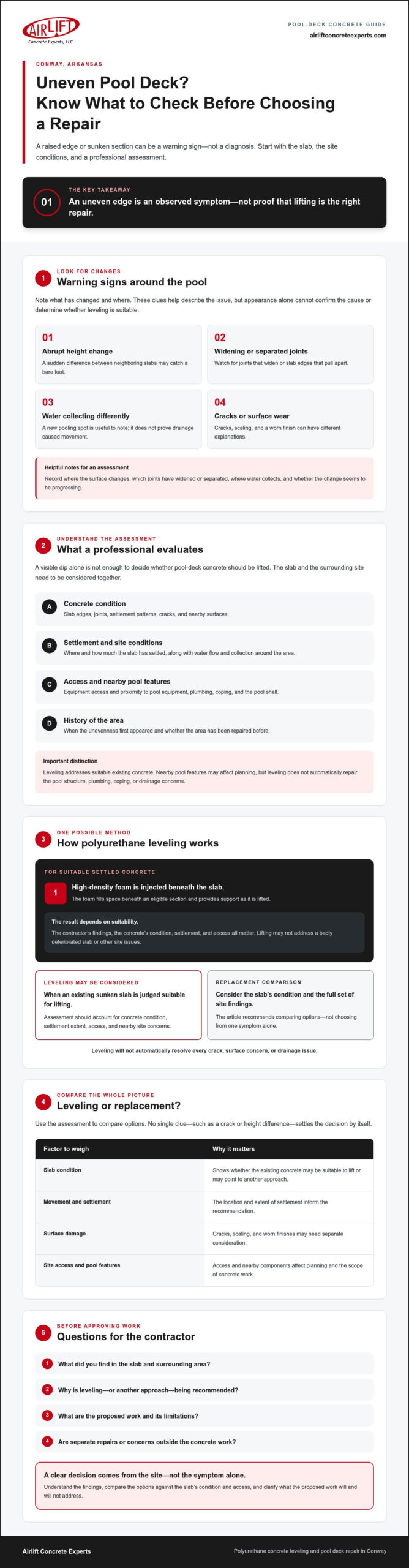
A sloped, sunken, or uneven pool surround can raise safety concerns. A sudden height change between slabs may catch a bare foot, while a tilted walking surface can make moving around the pool less comfortable. These signs deserve attention, but they don’t automatically mean the concrete should be lifted. Start by identifying what has changed and arranging an assessment of the existing slab.
Look for abrupt height differences, widening joints between sections, edges pulling apart, and water collecting in places where it didn’t before. A slab that sits lower than its neighbor may have settled, while surface scaling, a worn finish, and cracks can have different explanations. Appearance alone can’t confirm the cause or show whether leveling is suitable. Note the locations of the changes and whether they seem to be progressing.
Those observations can help a contractor understand the issue. A raised edge at one joint, for example, looks different from widespread surface wear. If you’re researching leveling concrete around pool Conway AR, focus on the existing poolside slabs. Concrete leveling describes methods for raising settled concrete; this concrete leveling overview explains the general process. Pool-structure repairs and new concrete construction are separate from lifting an eligible existing slab.
Water flow and the support beneath a slab are relevant factors for a contractor to assess. Water collecting near an uneven area is useful to note, but it doesn’t prove that drainage caused the movement. A visible crack or height difference also can’t establish what is happening beneath the concrete on its own. The slab and surrounding site conditions need to be considered together.
An uneven edge is an observed symptom, not a confirmed diagnosis or proof that lifting is the right repair.
Before an assessment, note where the surface changes, which joints have widened or separated, and where water tends to collect. This gives you a clear starting point without guessing at the cause. A professional can evaluate whether polyurethane concrete leveling may suit the settled section or whether the slab’s condition points to another approach.
A sound recommendation for leveling concrete around pool Conway AR starts with inspecting the slab and its surroundings. A contractor considers the concrete’s condition, where and how much it has settled, equipment access, and the work area’s proximity to pool features. A visible dip alone isn’t enough to determine whether lifting is appropriate.
The contractor may inspect slab edges, joints, settlement patterns, cracks, and nearby surfaces to see how the affected section relates to the rest of the deck. They may also ask where water flows or collects, whether the area has been repaired before, and when you first noticed the unevenness. Share what you’ve observed, then use the inspection findings to understand the recommendation.
Pool equipment, plumbing, coping, and the pool shell matter as nearby features that can affect access and planning. Their presence doesn’t mean concrete leveling will repair them. Ask the contractor to explain any concerns involving these components and clarify what is, and isn’t, included in the proposed concrete work.
Polyurethane concrete leveling involves injecting high-density foam beneath suitable sunken concrete to raise it. The foam fills space beneath an eligible slab and provides support as the section is lifted. Polyurethane concrete leveling is a method of raising suitable settled concrete by injecting foam beneath the slab.
Whether it fits depends on the concrete’s condition, the extent of settlement, access, and the contractor’s findings. If the slab is badly deteriorated or other site issues need attention, lifting may not address the full problem. Not every uneven pool deck is a candidate for the same repair.
A useful assessment should explain the observed conditions, why lifting is or isn’t being considered, and any limitations or separate concerns. The Association of State Dam Safety Officials’ overview of Concrete repair techniques offers broader context on evaluating repair approaches, though a pool deck still needs a site-specific review.
Airlift Concrete Experts provides polyurethane concrete leveling and pool deck repair in Conway. Review its pool deck repair services and ask what an assessment involves before deciding on a next step.
Choosing between leveling and replacement starts with the condition of the existing slab, not a one-size-fits-all rule. An intact section that has settled may be worth assessing for lifting. Extensive cracking, crumbling, or other substantial damage may make lifting unsuitable, but only an on-site evaluation can clarify the options. The amount of movement and access to the affected area matter too.
Leveling can address eligible settled concrete. It doesn’t automatically repair every crack, correct a drainage problem, or resolve concerns with the pool shell, coping, plumbing, or equipment. Keep those issues distinct when discussing the work so the proposed scope addresses the right part of the pool area. For more background on the method, see this guide to polyurethane concrete leveling in Malvern and Central Arkansas.
A settled slab that remains largely intact may prompt a professional assessment for lifting, but appearance alone can’t confirm suitability. Severe deterioration, widespread surface damage, or movement linked to an unresolved underlying issue calls for a broader evaluation. If the concern involves pool components rather than the concrete deck, ask which specialist should assess that feature.
Ask the contractor what they observed, what work they propose, and which site conditions could limit the repair. Clarify whether drainage concerns or adjacent pool features need separate attention, and confirm exactly which areas are included in the scope. These questions help you compare recommendations for leveling concrete around pool Conway AR without relying on price alone.
| Question to ask | What the answer helps clarify |
|---|---|
| What do you believe caused the slab to move? | The observed evidence behind the recommendation, and what remains uncertain. |
| Is the slab suitable for lifting, and why? | Whether its condition, movement, and access support considering leveling. |
| What work is included, and what isn’t? | Whether cracks, drainage concerns, or nearby pool features require separate attention. |
| What limitations should I understand? | Factors that may affect the proposed scope or the outcome expected from the work. |
A clear explanation should show why leveling, further evaluation, or replacement is being considered. You don’t need to decide based on one crack or dip alone. Use the assessment and written scope to compare the options for your pool deck.
Once a contractor determines that a poolside slab may be suitable for lifting, ask what will happen before work begins. The process generally includes assessment, repair planning, access preparation, foam injection, and a final review. The exact method and access needs depend on the slab and site conditions, so confirm the plan for your pool deck rather than assuming every project follows the same steps.
For suitable settled concrete, technicians make access points in the slab and inject high-density polyurethane foam beneath it. The material expands under the concrete, helping fill space and raise the section in a controlled manner. The assessment guides the injection locations and helps determine whether this approach fits the deck. The goal is a practical adjustment, not a promise that every slab will return to a perfect or original position.
After planning, the crew prepares access to the work area, then carries out the injection while monitoring the slab. A final review checks the repaired section against the agreed scope. Ask what to expect around pool furniture, pool use, access routes, and any preparation specific to your site. Confirm what the crew needs before moving equipment or clearing areas.
Make the conversation more useful by noting where the surface feels uneven, which sections or joints appear affected, and where water collects after ordinary pool use or rainfall. Photos may help you describe changes you’ve noticed over time. Before moving furniture or clearing a route, ask the contractor what access is needed for the assessment and any proposed work.
These steps help set expectations for leveling concrete around pool Conway AR without presuming the repair method or outcome. For a broader look at the approach, read this overview of professional concrete lifting in Malvern and Little Rock.
If you’re ready to discuss an existing pool deck, ask Airlift Concrete Experts about pool deck repair and what an assessment may involve.
A useful contractor recommendation should fit the condition of your pool deck, not promise that every slab can be lifted. For leveling concrete around pool Conway AR, look for experience with polyurethane concrete leveling and pool deck repair, plus a clear explanation of what the inspection found. Understand why the contractor recommends a particular approach before approving work.
Ask how the slab’s condition, amount of movement, access, and nearby pool features affect the proposed work. A useful explanation should describe the findings, outline the repair scope, and identify limitations. Confirm which areas are included, and ask whether cracks, drainage concerns, or issues with coping, plumbing, equipment, or the pool shell need separate attention.
Before making contact, gather clear photos and note where uneven sections appear, when you first noticed them, and whether they seem to be changing. Mention any water collecting nearby or previous work on the area. These details can start a focused conversation, but an on-site assessment is needed to determine whether lifting is appropriate.
Airlift Concrete Experts provides polyurethane concrete leveling and pool deck repair in Arkansas, including Conway. Ask whether the company is currently serving your location and what an assessment involves. Airlift focuses on lifting and repairing existing concrete, not new concrete construction or DIY kits.
If you’d like to discuss your pool deck and possible next steps, request an assessment from Airlift Concrete Experts. Ask about the assessment terms before deciding how to proceed.
Uneven poolside concrete can raise safety concerns, but a dip or crack alone won’t tell you what caused the change or which repair makes sense. Note where the slab has shifted, look for signs such as widening joints or unusual water collection, and ask a contractor to assess the concrete, access, and nearby pool features. Polyurethane leveling may be an option for suitable settled slabs, while damaged concrete or separate drainage concerns may need additional evaluation.
For homeowners considering leveling concrete around pool Conway AR, a site-specific explanation can replace guesswork with a practical plan. Airlift Concrete Experts is a family-owned and operated Arkansas business founded in 2017, providing polyurethane concrete leveling and pool deck repair. Ask the company about current Conway availability and assessment terms.
Request an assessment from Airlift Concrete Experts to discuss your pool deck and ask what the findings may mean for your options. A clear conversation is a sensible first step toward a more even space around the pool.
Yes, some settled sections can be lifted without replacing the entire deck if the existing slab is suitable. A contractor should inspect its condition, movement, access, and nearby pool features before recommending polyurethane leveling. This repair focuses on eligible existing concrete; it won’t automatically address severe cracking, crumbling, or separate drainage issues. A site-specific assessment helps determine whether lifting a section is practical or whether other work needs consideration.
Polyurethane foam leveling may suit a pool deck when a slab has settled but remains appropriate for lifting. A professional evaluates the concrete’s condition, the extent of movement, access, and nearby features before making a recommendation. The method involves injecting foam beneath suitable concrete to raise it. It isn’t right for every deck, so ask about any limitations or separate concerns rather than assuming a particular result.
Concrete may sink or shift when support beneath a slab changes or becomes inadequate, though the cause varies by property. Water flow, the condition of the ground below, and past work near the deck may be relevant factors for a contractor to examine. A widening joint or low section is a clue, not a diagnosis. An on-site evaluation is needed to connect visible movement with its likely cause.
Polyurethane concrete leveling raises suitable settled concrete by injecting high-density foam beneath the slab. A contractor first assesses the deck and determines whether the concrete and site conditions suit the method. Technicians then make access points and inject foam at selected locations while monitoring the lift. The goal is to adjust the eligible section, not guarantee that every slab returns to its exact original position or resolve unrelated pool-area issues.
Not necessarily. Leveling may adjust a suitable settled slab, but it doesn’t automatically correct every drainage concern or change how water moves across the entire pool area. Tell the contractor where water collects and whether the pattern has changed. Ask whether the proposed lifting addresses the affected concrete and whether drainage needs separate attention. The assessment should distinguish the slab’s movement from any broader water-flow issue.
Look for experience with polyurethane concrete leveling and pool deck repair, then ask for a site-specific explanation of the findings, proposed scope, limitations, and any separate work. Airlift Concrete Experts provides concrete leveling and repair services in Arkansas communities including Conway, Malvern, Hot Springs, Little Rock, Cabot, Benton, Bryant, North Little Rock, Sherwood, Jacksonville, and Hot Springs Village. Confirm current availability and assessment terms directly with the provider.
Choose between leveling and replacement based on the slab’s condition, extent of movement, surface damage, and access, not appearance alone. An intact but settled section may be assessed for lifting, while severe deterioration or extensive damage may require a different repair plan. Ask a contractor to explain why the proposed option fits your deck and which cracks, drainage concerns, or nearby pool features fall outside the work.
Note where the water gathers and whether it appears after ordinary pool use, rainfall, or both. Share those observations and photos with a concrete-leveling contractor, but don’t assume the uneven slab is the only cause. Ask the professional to assess both the settled section and water flow around it, and clarify whether the proposed concrete work addresses the drainage concern or whether that issue needs separate evaluation.

 Call Now