
That slight vertical lip between your driveway slabs isn’t just an eyesore; it’s a structural warning sign that the ground beneath your feet is shifting. Many homeowners in our community assume that a sunken joint is a surface problem that requires total replacement, but the reality is often hidden deeper in the soil. When you need to repair uneven concrete joints in Little Rock, you’re usually fighting against the natural movement of our regional red clay.
It’s unsettling to watch your family trip over a jagged walkway or see water pool near your foundation after a heavy Arkansas rain. You want a safe, level property, but the thought of heavy machinery tearing up your yard is often just as stressful as the damage itself. This guide explains how you can restore your property’s safety and value using advanced polyurethane solutions. We’ll walk through the science of soil stabilization and show you how to achieve a permanent, level surface without the mess of traditional concrete trucks or weeks of downtime. Discover how modern technology makes it possible to stabilize your home’s exterior while protecting your investment for the long term.
Concrete joints serve a vital purpose in any driveway, sidewalk, or patio. They’re intentional seams created by builders to guide where concrete will naturally crack as it cures and temperature changes occur. Without these control joints, your surfaces would eventually look like a spiderweb of random fractures. However, these same seams can become a significant liability when “differential settlement” occurs. This happens when the soil beneath one slab loses its ability to support weight, causing it to sink while the adjacent slab remains at its original height.
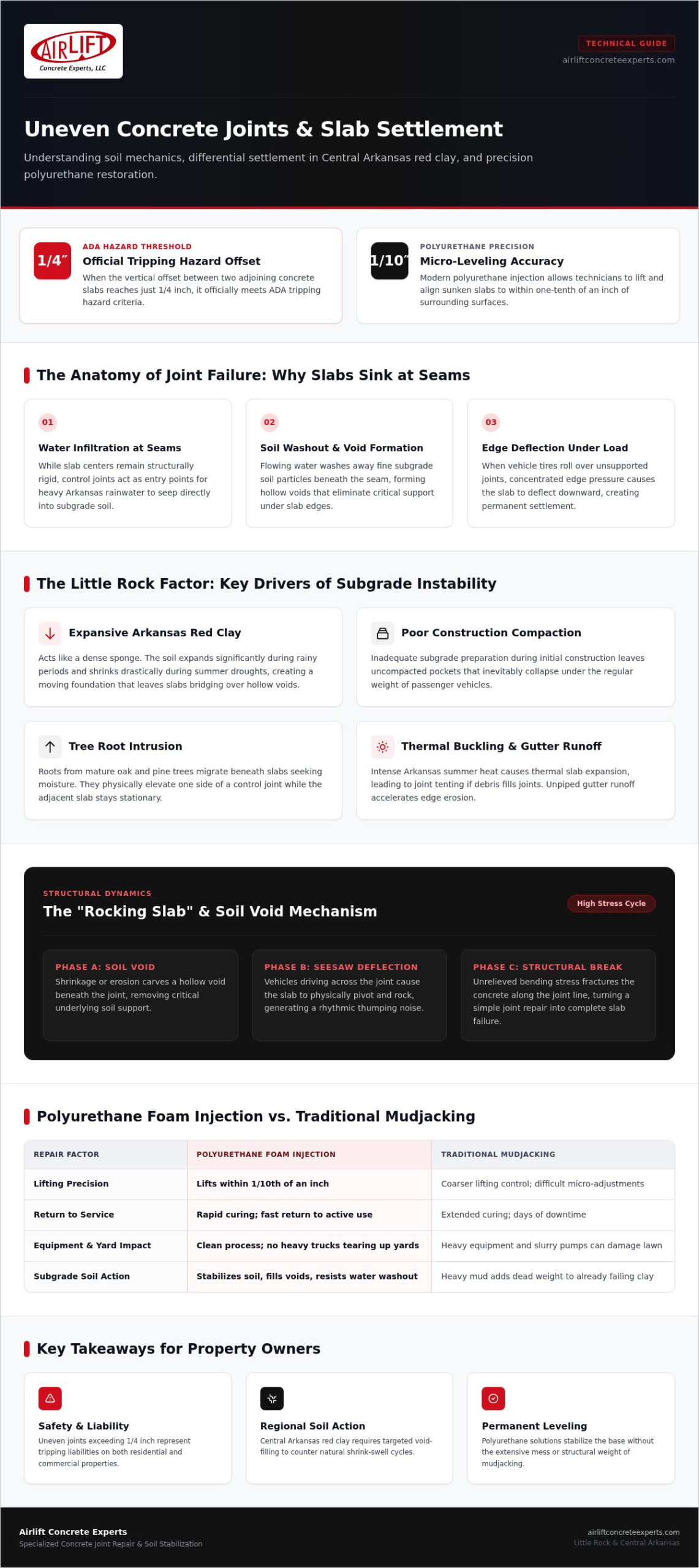
In our local climate, this movement is particularly aggressive. As we look at 2026 weather patterns in Central Arkansas, the shift between intense rainy seasons and prolonged dry spells accelerates the movement of our external surfaces. When the vertical offset between two slabs reaches just 1/4 inch, it officially meets the Americans with Disabilities Act (ADA) definition of a tripping hazard. For a homeowner, this isn’t just a maintenance task; it’s a priority to protect guests and family. If you need to repair uneven concrete joints in Little Rock, understanding these underlying mechanics is the first step toward a permanent fix.
While a concrete slab is incredibly strong in its center, its edges are vulnerable. Joints act as an open door for rainwater to seep directly into the subgrade. Over time, this constant moisture flow washes away the fine particles of soil that provide structural support. This process, often referred to as concrete degradation and joint failure, creates empty pockets or “voids” beneath the surface.
Heavy vehicle loads make the problem worse. When a car or truck rolls over a joint, the weight isn’t distributed across a whole slab. Instead, the pressure is concentrated right at the edge. If there’s a void underneath, that edge will deflect downward, eventually leading to a permanent sink. Addressing these issues early is the most effective way to repair uneven concrete joints in Little Rock before the damage spreads to the rest of the slab.
The primary culprit behind most local concrete issues is Arkansas red clay. This soil is highly “expansive,” meaning it acts like a sponge. It swells significantly when wet and shrinks drastically during our humid summer droughts. This constant shrink-swell cycle creates a moving foundation that traditional concrete joints aren’t designed to handle.
Central Arkansas humidity also plays a role. It keeps the soil moisture levels in a state of constant flux, preventing the ground from ever truly stabilizing. When the clay shrinks away from the bottom of your driveway, it leaves the slab “bridging” over a hollow space. Eventually, the weight of the concrete itself or the traffic above it causes the joint to fail and drop, creating the uneven surfaces that plague so many local properties.
While many factors contribute to slab movement, the most frequent cause we see in Central Arkansas is poor soil compaction from the original construction phase. If the ground wasn’t properly prepared before the concrete was poured, the soil eventually settles under the weight of your vehicles. This creates an uneven foundation that manifests first at the joints. In our older neighborhoods, tree roots also play a major role. Large oaks and pines common to our area send roots deep under driveways in search of moisture. These roots can physically lift one side of a joint while the other remains stationary, creating a dangerous ledge that only gets worse as the tree grows.
Water management is another critical local factor. When gutters aren’t piped away from the driveway, heavy runoff saturates the soil at the slab’s edge. This saturation leads to erosion and structural instability, which is a primary reason why homeowners eventually need to repair uneven concrete joints in Little Rock. Additionally, we must consider the intense Arkansas summer heat. Thermal expansion causes concrete slabs to grow. If the joints are clogged with dirt or the slabs are already misaligned, they may “tent” or buckle under the pressure. Addressing these issues with a professional assessment can prevent a complete driveway failure.
A soil void is essentially a hollow pocket where the supporting ground has washed away or shrunk. When a vehicle drives over a joint with a void underneath, the slab can “rock” like a seesaw. This movement creates a rhythmic thumping sound and puts immense stress on the concrete. Soil voids form in Arkansas red clay as the material significantly contracts during dry periods, leaving behind structural gaps that cannot support the weight of the slab. This lack of support is what ultimately leads to the vertical drops you see in your walkway or driveway.
Ignoring a small vertical offset is a risky gamble. What begins as a minor 1/2-inch lip can quickly progress into a 2-inch drop as the underlying void grows. This unevenness doesn’t just look bad; it leads to full slab cracking because the concrete is no longer supported by the earth. For property owners, the liability is real. According to trip and fall injury statistics from the CDC, falls are a leading cause of unintentional injury. Whether it’s a neighbor on your sidewalk or a customer at your business, a jagged joint is a legal and safety hazard that requires a professional plan to repair uneven concrete joints in Little Rock before someone gets hurt.
When you look for a way to repair uneven concrete joints in Little Rock, you’ll likely encounter three main options: grinding, mudjacking, or polyurethane injection. While older methods were once the industry standard, modern structural engineering has shifted toward polyurethane foam for its superior precision and long-term stability. This advanced material allows technicians to lift sunken slabs to within 1/10th of an inch of their original position, ensuring a perfectly flush transition between joints.
One of the most critical advantages of polyurethane is its weight. Traditional mudjacking uses a heavy slurry of sand and cement that can weigh over 100 pounds per cubic foot. In the unstable red clay common throughout Central Arkansas, adding that much weight can actually accelerate soil settlement. Polyurethane foam weighs only about 3 to 5 pounds per cubic foot. It expands to fill the voids we discussed earlier without adding unnecessary mass to the subgrade. Additionally, the material is non-toxic and impervious to water, meaning it won’t wash away during the next heavy Arkansas storm.
Some contractors suggest grinding down the high side of a joint to remove the trip hazard. While this technically levels the surface, it’s a destructive process that removes the concrete’s protective “wear layer.” This exposes the rough aggregate underneath, leaving a scarred, unsightly patch on your driveway. More importantly, grinding does nothing to address the underlying soil void. Since the root cause of the sinking remains, the slab will likely continue to drop, forcing you to deal with the same problem again in a few months. Lifting the slab back to its original height is the only way to restore the aesthetic and structural integrity of the joint.
The physical footprint of the repair is another major difference. Mudjacking requires drilling holes the size of a soda can into your concrete to pump the thick slurry. Polyjacking uses tiny, penny-sized holes that are easily patched and virtually invisible once the job is finished. The speed of the repair is also unmatched. While mudjacking requires you to keep vehicles off the surface for several days while the slurry cures, polyurethane-treated joints are ready for full service in about 15 to 30 minutes. This efficiency is why so many local residents choose this modern method to repair uneven concrete joints in Little Rock when they want a clean, permanent result.
Beyond the physical damage to your property, uneven slabs carry significant financial and legal risks. For Little Rock businesses, compliance with the Americans with Disabilities Act (ADA) is a critical operational requirement. As established earlier, any vertical offset greater than 1/4 inch is considered a trip hazard. Ignoring these offsets doesn’t just create an obstacle for customers; it opens your business to potential lawsuits and accessibility violations. Residential homeowners face similar pressures. Whether it’s a delivery driver or a neighbor, you’re responsible for the safety of anyone walking on your property.
The financial argument for proactive maintenance is clear. Choosing concrete lifting is significantly more cost-effective than waiting for a slab to fail completely. Full concrete replacement involves demolition, disposal fees, and the cost of new materials. By addressing the root cause now, you preserve the existing concrete and avoid the massive expense of a total tear-out. Additionally, first impressions matter. A jagged, uneven driveway or walkway immediately detracts from your home’s curb appeal and can lower your property value when it’s time to sell. To protect your investment, you should request a professional inspection to determine the best path forward.
High-traffic areas like retail entryways, parking lots, and municipal sidewalks require constant monitoring. In these environments, even a minor joint failure can lead to a major liability. Traditional concrete replacement often forces businesses to close their doors or divert traffic for days while the new pour cures. This downtime represents a secondary cost that many owners fail to calculate. Our team provides commercial concrete lifting that restores safety with zero downtime. Because polyurethane reaches 90 percent of its full strength within minutes, your customers can walk or drive on the repaired joints immediately after we finish.
At home, the priority is often the safety of children and elderly family members who are more susceptible to falls. A sunken joint in the driveway can also cause long-term damage to your vehicles, specifically affecting tires and suspension systems over hundreds of small impacts. When you repair uneven concrete joints in Little Rock, you aren’t just leveling the surface. You’re stabilizing the soil beneath your home to prevent future movement. This long-term stability ensures your walkways remain safe and your property maintains its structural integrity against the unpredictable shifts of Arkansas red clay.
Airlift Concrete Experts operates as specialized technical injection consultants rather than general contractors. We understand the specific mechanical needs required to repair uneven concrete joints in Little Rock, and we’ve spent years refining a process that prioritizes your property’s long-term health. Since 2017, our family-owned team has worked with a “no-mess” guarantee. This commitment ensures that your repair doesn’t involve heavy concrete trucks, destroyed landscaping, or lingering construction dust. We treat every project with the care we would give a neighbor’s home.
Arkansas geography presents challenges that national companies often overlook. The way soil shifts in Chenal Valley is fundamentally different from the conditions in Hillcrest or the downtown riverfront. Our regional expertise allows us to calibrate our polyurethane injection to match the specific resistance and density of the local subgrade. This level of technical precision is what transforms a simple surface adjustment into a permanently stabilized slab that can withstand the test of time.
A professional assessment is the only reliable way to understand the movement happening beneath your concrete. During our visit, we look beyond the surface lip to identify underlying soil issues before they escalate into expensive structural disasters. We’ll provide a clear, low-pressure explanation of the repair process and show you exactly how our polyurethane technology will restore your property’s safety. Get your free concrete leveling quote today! and take the first step toward a level, worry-free home.
Addressing sunken slabs involves more than simple aesthetics; it’s about securing your home’s foundation against the unique challenges of Arkansas red clay. You’ve learned how soil voids lead to differential settlement and why traditional grinding or mudjacking often fails to provide a lasting fix. By choosing high-density polyurethane injection, you ensure a precise, clean, and durable repair that stabilizes the ground beneath your feet for the long term. This modern approach eliminates the need for heavy equipment while providing a level surface that stands up to regional weather patterns.
Airlift Concrete Experts brings over 7 years of Arkansas-specific structural experience to every project. As a family-owned business, we combine neighborhood values with patented high-density foam technology to deliver results that broad national competitors often miss. When you’re ready to repair uneven concrete joints in Little Rock, our team is here to help you eliminate trip hazards and protect your property’s value. Take the first step toward a level surface today. Request Your Free Concrete Joint Inspection in Little Rock. You deserve the peace of mind that comes with a stable, safe, and professional result.
Costs for professional repair depend on the size of the voids and the degree of lifting required to level the slabs. Generally, this specialized service is significantly more affordable than a full tear-out and replacement. You save on demolition, debris removal, and new material costs. Because the process is highly efficient, you also avoid the indirect expenses associated with long construction delays or property downtime.
We do not recommend or offer DIY repair kits for structural joint issues. Professional polyurethane requires specialized equipment to maintain the precise temperature and pressure needed for proper expansion. Consumer-grade kits often lack the density required to support vehicle loads and don’t offer the control necessary to level a slab accurately. Attempting a DIY fix often results in uneven surfaces that are much harder to correct professionally later.
Polyurethane repair is designed as a permanent solution for sunken slabs. The high-density foam we use is a stable, non-biodegradable material that doesn’t break down over time. By filling the underlying voids and stabilizing the subgrade, it addresses the root cause of the settlement. While we can’t stop the earth from shifting, the foam provides a waterproof, durable base that remains intact for the life of the concrete itself.
Leveling is almost always the superior choice if your concrete is still structurally sound. It’s faster, cleaner, and preserves the existing slab while fixing the soil issues beneath it. Replacing a slab is a massive undertaking that often disturbs the soil even further, leading to future settlement. When you repair uneven concrete joints in Little Rock with polyjacking, you’re choosing a surgical fix that maintains your property’s original aesthetic and structural integrity.
No, the polyurethane foam will not wash away during our intense rainy seasons. Once the foam cures, which happens in just a few minutes, it becomes a solid, waterproof mass. It’s completely impervious to moisture and actually acts as a protective barrier that prevents future erosion of the supporting soil. This makes it an ideal solution for the humid and wet environmental conditions common throughout Central Arkansas.
You can drive on your driveway almost immediately after the repair is complete. Unlike traditional concrete pours that require days to cure, or mudjacking which needs 24 to 48 hours, polyurethane reaches nearly full strength in about 15 to 30 minutes. By the time our team has finished sealing the small injection ports and packing up our equipment, your driveway is ready for normal vehicle traffic and full service.
Yes, our process is specifically designed to handle the diverse soil profiles found in our region. We have extensive experience working with the expansive red clay that is so common in Central Arkansas. Our technical injection consulting allows us to adjust the process based on whether the soil is sandy, silty, or heavy clay. This ensures a stable, reliable lift regardless of the specific geographic conditions at your property.
The main differences are the weight of the material and the size of the footprint. Mudjacking uses a heavy sand and cement slurry that can cause further sinking in soft soil. Polyjacking uses a lightweight foam that adds minimal weight to the subgrade. Additionally, polyjacking requires only penny-sized holes, while mudjacking needs holes the size of a soda can. Polyurethane also cures in minutes, whereas mudjacking takes much longer to set.

 Call Now